Paper II — Q7
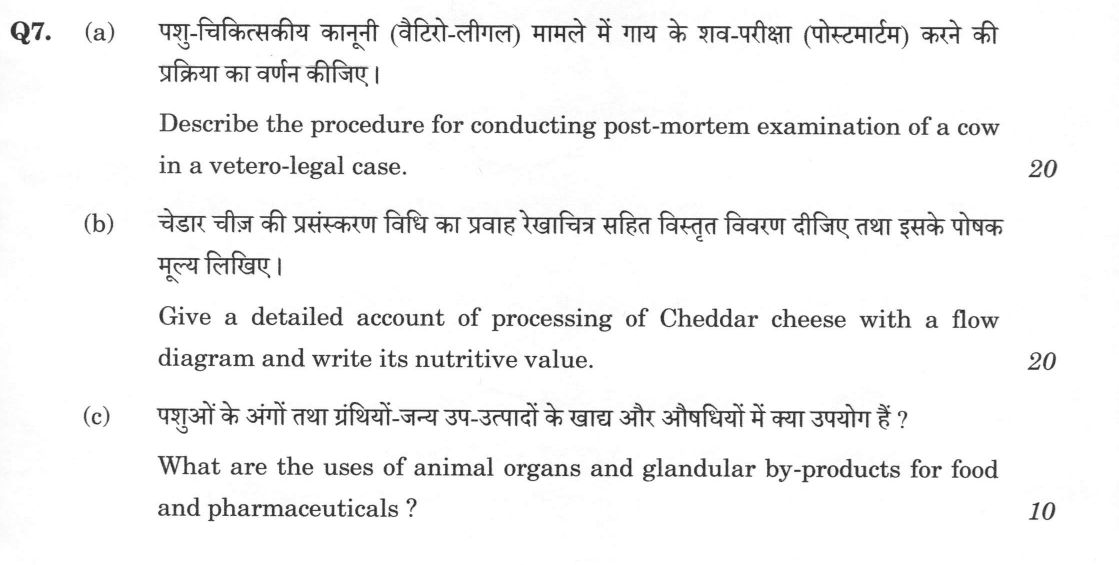
(a) Describe the procedure for conducting post-mortem examination of a cow in a vetero-legal case. (20 marks) (b) Give a…
Describe the procedure for conducting post-mortem examination of a cow in a vetero-legal case. 20 marks
Give a detailed account of processing of Cheddar cheese with a flow diagram and write its nutritive value. 20 marks
What are the uses of animal organs and glandular by-products for food and pharmaceuticals ? 10 marks
हिंदी में प्रश्न पढ़ें
पशु-चिकित्सकीय कानूनी (वैटिरो-लीगल) मामले में गाय के शव-परीक्षा (पोस्टमार्टम) करने की प्रक्रिया का वर्णन कीजिए। (20 अंक)
चेडार चीज़ की प्रसंस्करण विधि का प्रवाह रेखाचित्र सहित विस्तृत विवरण दीजिए तथा इसके पोषक मूल्य लिखिए। (20 अंक)
पशुओं के अंगों तथा ग्रंथियों-जन्य उप-उत्पादों के खाद्य और औषधियों में क्या उपयोग हैं ? (10 अंक)
Model answer
Drafted with AI by UPSC Answer Check against this question's marking rubric, to the expected length. UPSC does not publish answers for Mains — this is one way to score well, not an official key. How we build rubrics and answers.
(a) Procedure of post-mortem examination of a cow in a vetero-legal case (20 marks)
A vetero-legal post-mortem is done to establish the cause and manner of death for the courts, in cases such as poisoning, cruelty (Prevention of Cruelty to Animals Act, 1960), killing or maiming of an animal (BNS section 325, old IPC 428 and 429), unlawful slaughter, electrocution, and disputed insurance claims.
Preliminaries:
- Act only on a written requisition from the police, court or other competent authority, and record the date, time, place and those present, including two witnesses.
- Identify the animal by species, breed, sex, age, colour, marks and ear tag, and note the history, the time of death and the circumstances.
- Suspect anthrax in sudden death with oozing dark, unclotted blood: do not open the carcass, and take a peripheral blood smear from an ear vein instead.
- Do the examination in daylight as early as possible, before decomposition, wearing gloves and protective clothing, with photographs at each stage.
External examination: rigor mortis and decomposition, bloat, wounds (site, size, type), ligature or rope marks, discharges from orifices, colour of the mucous membranes, and hooves, skin, udder and ectoparasites.
Internal examination:
- Lay the cow on its left side, so that the rumen lies below, and cut the skin from chin to pubis.
- Reflect the skin and examine the subcutaneous tissue for haemorrhage and oedema, then remove the upper limbs.
- Open the abdomen and examine the organs in position (fluid, torsion, peritonitis), then open the chest and examine the pleura, pericardium, heart and lungs.
- Remove and examine each organ in turn: the rumen and reticulum (odour of poison, foreign bodies), abomasum, intestines, liver, spleen, kidneys, bladder and uterus (pregnancy), then the brain.
Sample collection: take rumen contents, liver, kidney, blood, urine and brain (about 500 g each of the solid samples) in clean separate containers with saturated salt solution as preservative, never formalin, for toxicology, and 10% formalin for histopathology. Label, seal and hand over with a chain-of-custody record to the forensic laboratory.
Report: give a signed written report of the findings, with an opinion on the cause, mode and probable time of death, to the requisitioning authority; keep a copy, be ready to give evidence in court, and dispose of the carcass by deep burial with lime or incineration.
(b) Processing of Cheddar cheese with flow diagram, and its nutritive value (20 marks)
Cheddar is a hard, ripened cheese made from cow or buffalo milk, and its name comes from the "cheddaring" stage.
Process, as shown in the flow diagram. Milk is standardised to 3.5 to 4% fat with a casein to fat ratio of about 0.7, pasteurised at 72 °C for 15 seconds and cooled to 30 to 31 °C in the cheese vat. A starter of 1 to 2% Lactococcus lactis subsp. cremoris and lactis is added with annatto colour and, if needed, calcium chloride (0.02%), and the milk is ripened for 30 to 45 minutes. Rennet (chymosin) is added, and the milk sets in 30 to 40 minutes. The coagulum is cut into 6 to 8 mm cubes, the curd is stirred and cooked slowly to 38 to 39 °C over 30 to 40 minutes to shrink it and expel whey, and the whey is drained at about pH 6.2. In cheddaring the curd mat is cut into slabs which are turned and piled for 1 to 1.5 hours until the pH is 5.2 to 5.3, giving a fibrous texture. The curd is milled to finger-size pieces, salted at 2 to 2.5%, filled into hoops and pressed for about 16 hours. The cheese is dried and waxed or vacuum-packed, and ripened at 6 to 10 °C for 3 to 12 months or longer, when proteolysis and lipolysis develop flavour and texture. The yield is about 10 kg per 100 kg of milk.

Nutritive value. As per the FSSAI and Codex standard, Cheddar has at most 39% moisture and at least 48% fat in its dry matter. Per 100 g it gives about 400 kcal, about 25 g of high-quality protein rich in essential amino acids, about 33 g of fat, and only traces of lactose, since it is lost in the whey and fermented. It is an excellent source of calcium (about 700 mg) and phosphorus, and of vitamin A, vitamin B12 and riboflavin. Salt, saturated fat and energy are high, so intake should be moderate.
(c) Uses of animal organs and glandular by-products for food and pharmaceuticals (10 marks)
Food:
- Liver, heart, kidney, tongue and tripe are eaten as offal, being rich in iron, vitamin A, B12 and folate.
- Blood is used in blood products; bones give soups and stock; fat gives lard and tallow; gelatin and collagen casings come from skin, bones and intestine.
Pharmaceuticals:
- Pancreas: insulin (now largely recombinant), pancreatin, trypsin and chymotrypsin.
- Intestinal mucosa and lung: heparin.
- Stomach: pepsin; calf abomasum gives rennet.
- Pituitary: ACTH, oxytocin and vasopressin; thyroid: thyroxine extract; adrenal: adrenaline and corticoids; ovary and testis: sex hormones and hyaluronidase.
- Liver and bile: liver extracts and bile acids.
- Cartilage: chondroitin sulphate; intestine: catgut sutures; porcine heart valves for implants.
How this answer will be evaluated
Evaluation rubric
Each sub-part is marked on its own, against the marks and word limit printed on the paper.
- (a) Describe the procedure of post-mortem examination of a cow in a vetero-legal case (20 marks; no word limit printed). 20 marks
Must cover
- Legal preliminaries: written requisition from police or court, identification of the animal, history, witnesses, photographs, timing
- Anthrax precaution: no opening of a suspect carcass, peripheral blood smear instead
- External then systematic internal examination: left lateral position, incision, abdominal and thoracic organs in situ, each organ, brain
- Sample collection and preservation (saturated salt solution for toxicology, formalin for histopathology), sealing and chain of custody, then report with opinion and disposal of carcass
Loses marks
- Using formalin as the preservative for poison analysis.
- Opening a suspected anthrax carcass.
- Proceeding without a written requisition.
Earns more
- Statutory context named (PCA Act 1960, BNS 325).
- Findings recorded objectively and opinion limited to the evidence.
Extra mark
- Estimation of time of death from rigor and decomposition
- (b) Give a detailed account of processing of Cheddar cheese with a flow diagram and write its nutritive value (20 marks; no word limit printed). 20 marks
Must cover
- Milk standardisation and pasteurisation (72 °C, 15 s), cooling to 30-31 °C, starter 1-2% with annatto and CaCl₂
- Renneting (30-40 min), cutting, cooking to 38-39 °C, whey drainage
- Cheddaring to pH 5.2-5.3, milling, salting 2-2.5%, hooping and pressing, waxing or packing, ripening 6-10 °C for 3-12 months
- Flow diagram with parameters; nutritive value (about 25 g protein, 33 g fat, 700 mg calcium per 100 g, vitamins A and B12) and compositional standard
Loses marks
- Omitting cheddaring, the defining step.
- No flow diagram.
- Giving fat-free composition figures.
Earns more
- Explanation of what cheddaring achieves.
- Yield of about 10 kg per 100 kg milk.
Extra mark
- Ripening changes (proteolysis, lipolysis)
- (c) What are the uses of animal organs and glandular by-products for food and pharmaceuticals? (10 marks; no word limit printed) 10 marks
Must cover
- Food uses of offal (liver, heart, kidney, tripe) with nutrient value
- Blood, bone, fat, gelatin and collagen casings
- Pharmaceutical products with source organs: insulin and pancreatin (pancreas), heparin (intestine, lung), pepsin, rennet (stomach), pituitary and thyroid hormones
- Other medical uses: chondroitin sulphate, catgut, bile acids, porcine heart valves
Loses marks
- Wrong organ-product pairing, e.g. heparin from pancreas.
- Listing only food uses.
Earns more
- Correct pairing of product and organ.
- Two heads (food and pharmaceutical) kept separate.
Extra mark
- Note that insulin is now largely recombinant
What "Describe" is asking you to do
Give a full, ordered account of the thing named — its parts, stages or mechanism — in the sequence in which it actually exists or occurs. Most describe questions come from the science optionals, where the marks sit in correct technical detail and, where the stem says so, a labelled diagram.
Structure that answers it
One-line identification of the subject → the parts or stages in their real order, each with its defining detail → labelled diagram where the subject is structural → closing line on function or significance
Where marks are lost
Loose general prose where the examiner is ticking named parts, correct terminology and their sequence; and in the General Studies papers, turning to evaluation before the description is finished.
Practice this exact question
Write your answer and it is marked point by point against the model answer above — what you covered, what you missed, what you got wrong.
Evaluate my answer →More from Animal Husbandry & Veterinary Science 2026 Paper II
- Q4 (a) Give a detailed account of the impact of water, air and soil pollution on animal heal…
- Q5 Write short notes on/answer the following in about 150 words each : (a) Role of animals a…
- Q6 (a) Describe the processing of yoghurt and cultured buttermilk along with flow diagrams.…
- Q7 (a) Describe the procedure for conducting post-mortem examination of a cow in a vetero-le…
- Q8 (a) Differentiate between a service abattoir and a commercial abattoir. Write down the ge…