Paper II — Q6
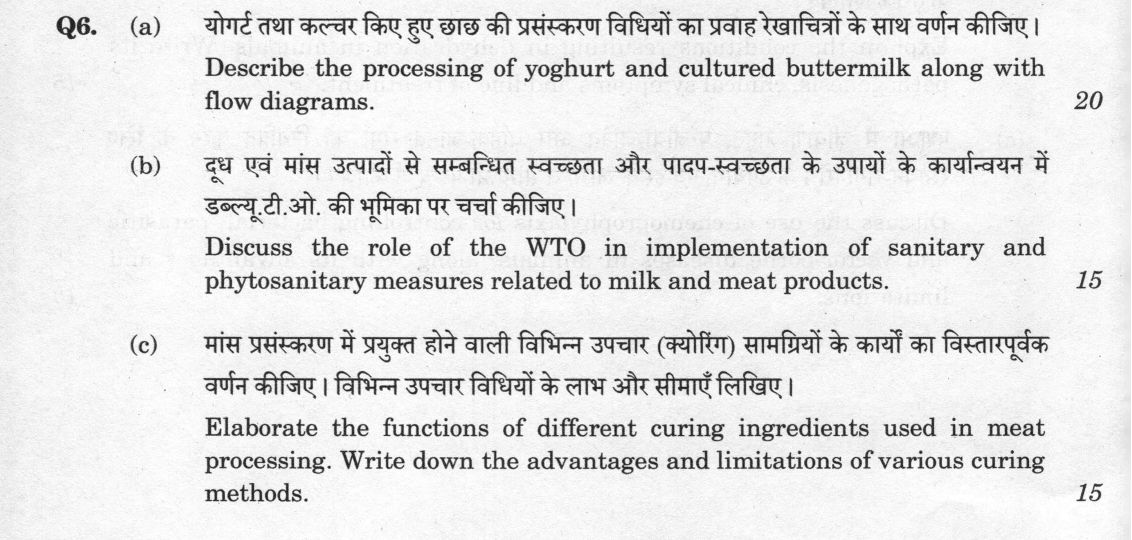
(a) Describe the processing of yoghurt and cultured buttermilk along with flow diagrams. (20 marks) (b) Discuss the role of the…
Describe the processing of yoghurt and cultured buttermilk along with flow diagrams. 20 marks
Discuss the role of the WTO in implementation of sanitary and phytosanitary measures related to milk and meat products. 15 marks
Elaborate the functions of different curing ingredients used in meat processing. Write down the advantages and limitations of various curing methods. 15 marks
हिंदी में प्रश्न पढ़ें
योगर्ट तथा कल्चर किए हुए छाछ की प्रसंस्करण विधियों का प्रवाह रेखाचित्रों के साथ वर्णन कीजिए। (20 अंक)
दूध एवं मांस उत्पादों से सम्बन्धित स्वच्छता और पादप-स्वच्छता के उपायों के कार्यान्वयन में डब्ल्यू टी.ओ. की भूमिका पर चर्चा कीजिए। (15 अंक)
मांस प्रसंस्करण में प्रयुक्त होने वाली विभिन्न उपचार (क्योरिंग) सामग्रियों के कार्यों का विस्तारपूर्वक वर्णन कीजिए। विभिन्न उपचार विधियों के लाभ और सीमाएँ लिखिए। (15 अंक)
Model answer
Drafted with AI by UPSC Answer Check against this question's marking rubric, to the expected length. UPSC does not publish answers for Mains — this is one way to score well, not an official key. How we build rubrics and answers.
(a) Processing of yoghurt and cultured buttermilk, with flow diagrams (20 marks)
Both are made by lactic fermentation of heat-treated milk with a defined starter, but they differ in milk composition, culture and temperature.
Yoghurt. Milk is standardised to 3 to 3.5% fat and 14 to 15% solids-not-fat, with added skim milk powder if needed, to give a firm body. It is homogenised at about 60 °C and 150 to 200 bar to prevent creaming, then heated at 85 to 90 °C for 15 to 30 minutes, which kills competing organisms and denatures whey proteins so that the gel is firm. It is cooled to 42 to 45 °C and inoculated with 2 to 3% of a 1:1 mixed culture of Streptococcus thermophilus and Lactobacillus delbrueckii subsp. bulgaricus, which grow together (protocooperation). Incubation for 3 to 4 hours gives a pH of 4.5 to 4.6 and about 0.9% lactic acid, with acetaldehyde as the typical flavour. In set yoghurt this is done in the retail pack; in stirred yoghurt it is done in a tank, and the coagulum is broken, cooled to 4 to 5 °C, mixed with fruit or flavour and packed. Storage is at 4 °C.
Cultured buttermilk. Skim or low-fat milk (0.5 to 1% fat) is heated at 85 to 90 °C for 30 minutes, cooled to 20 to 22 °C and inoculated with about 1% of a mesophilic culture of Lactococcus lactis subsp. lactis and cremoris, with L. lactis subsp. lactis biovar diacetylactis and Leuconostoc species that ferment citrate to diacetyl for the buttery flavour. It is held for 12 to 16 hours to about pH 4.5 (0.8 to 0.9% acidity). The curd is broken by gentle stirring, cooled to about 5 °C, salted at 0.1 to 0.2% and flavoured if desired, then packed and stored at 4 to 5 °C.

(b) Role of the WTO in implementing sanitary and phytosanitary measures for milk and meat products (15 marks)
The WTO Agreement on the Application of Sanitary and Phytosanitary (SPS) Measures, in force since 1995, lets members protect human, animal and plant life and health, but stops such measures from becoming disguised trade barriers. Its role for milk and meat trade is as follows:
- Scientific basis: measures must rest on scientific evidence and a risk assessment, be applied only to the extent necessary, and not discriminate between members in similar conditions.
- Harmonisation: members are encouraged to base measures on the standards of the three bodies named in the Agreement, Codex Alimentarius (food safety, including residue limits and hygiene codes for milk and meat), the World Organisation for Animal Health (animal diseases such as foot-and-mouth disease, BSE and avian influenza) and the International Plant Protection Convention (plant pests, relevant to imported feed grains and fodder).
- Equivalence and regionalisation: an importer should accept different measures that give the same protection, and recognise disease-free areas or zones.
- Transparency: notification of new measures and national enquiry points.
- SPS Committee: a forum in which members raise specific trade concerns, such as import bans over residues or disease status, with the dispute settlement system as the last resort.
- Technical assistance to developing countries, including through the Standards and Trade Development Facility.
For India, this means aligning milk and meat exports with Codex and WOAH standards, residue monitoring, disease-free zones, HACCP and certification by the Export Inspection Council and FSSAI.
(c) Curing ingredients in meat processing, with advantages and limitations of curing methods (15 marks)
Functions of curing ingredients:
- Common salt (about 2 to 3%): preserves by lowering water activity, adds flavour, and solubilises myofibrillar proteins so that water and fat are bound.
- Nitrite (and nitrate, which bacteria reduce to nitrite): forms nitric oxide, which combines with myoglobin to give the stable pink nitrosohaemochrome, contributes cured flavour, inhibits Clostridium botulinum and delays rancidity. Its level is legally limited because of nitrosamine formation.
- Sugar: offsets the harshness of salt, adds flavour and feeds lactic bacteria in fermented products.
- Ascorbate or erythorbate (cure accelerators): speed up the reduction of nitrite to nitric oxide and reduce nitrosamine formation.
- Phosphates (about 0.3 to 0.5%): raise pH and water-holding capacity and improve yield.
- Spices and smoke: flavour, and antioxidant and antimicrobial action.
Curing methods:
- Dry curing (rubbing the mixture on the surface). Advantages: simple, long shelf life, intense flavour. Limitations: slow and uneven, high salt, 20 to 30% weight loss.
- Wet (brine) curing by immersion. Advantages: uniform, less shrinkage. Limitations: slow for thick cuts, bulky, needs refrigeration, and the brine can spoil.
- Injection (pumping) with brine, often with tumbling. Advantages: fast (hours), uniform, high yield. Limitations: equipment cost, contamination along needle tracks, less traditional flavour.
- Direct addition of the cure to comminuted meat: quick and uniform, but needs accurate dosing.
How this answer will be evaluated
Evaluation rubric
Each sub-part is marked on its own, against the marks and word limit printed on the paper.
- (a) Describe the processing of yoghurt and cultured buttermilk with flow diagrams (20 marks; no word limit printed). 20 marks
Must cover
- Yoghurt: standardise (3-3.5% fat, 14-15% SNF), homogenise, heat 85-90 °C, cool to 42-45 °C, inoculate 2-3% S. thermophilus + L. bulgaricus, incubate 3-4 h to pH 4.5-4.6, cool, pack
- Cultured buttermilk: skim milk, heat, cool to 20-22 °C, inoculate about 1% mesophilic lactococci with diacetylactis and Leuconostoc, 12-16 h, break curd, cool, pack
- Flow diagrams drawn for both products with the temperature and time at each step
- Rationale: heat denatures whey protein for firm gel, diacetyl gives buttery flavour, set versus stirred yoghurt
Loses marks
- Using thermophilic culture at 42 °C for buttermilk or mesophilic culture for yoghurt.
- Giving no diagram or a diagram with no parameters.
Earns more
- Set and stirred yoghurt distinguished.
- Organism roles (protocooperation, acetaldehyde, diacetyl) explained.
Extra mark
- Typical final acidity and pH figures for both products
- (b) Discuss the role of the WTO in implementing sanitary and phytosanitary measures for milk and meat products (15 marks; no word limit printed). 15 marks
Must cover
- SPS Agreement (1995): right to protect life and health, but no disguised trade barrier
- Science-based measures, risk assessment, non-discrimination
- Harmonisation with Codex, WOAH and IPPC; equivalence and regionalisation
- Transparency, SPS Committee for trade concerns, dispute settlement, technical assistance; relevance to Indian milk and meat exports
Loses marks
- Confusing SPS with TBT or with the tariff provisions of GATT.
- Omitting the three standard-setting bodies.
Earns more
- Milk or meat examples such as residues, FMD, BSE, avian influenza.
- Link to India's export certification and residue monitoring.
Extra mark
- STDF or a named trade dispute such as hormone-treated beef
- (c) Elaborate the functions of curing ingredients in meat processing and write the advantages and limitations of curing methods (15 marks; no word limit printed). 15 marks
Must cover
- Salt: preservation, flavour, protein solubilisation and water binding
- Nitrite/nitrate: cured colour via nitric oxide and myoglobin, flavour, anti-botulinum action, antioxidant; legal limit because of nitrosamines
- Sugar, ascorbate or erythorbate, phosphates, spices and smoke with their functions
- Methods (dry, wet, injection, direct addition to comminuted meat) each with an advantage and a limitation
Loses marks
- Stating that nitrite is added only for colour.
- Giving methods without any limitations.
Earns more
- Typical levels of salt and phosphate.
- Reasoning for the cure accelerators.
Extra mark
- Vacuum tumbling to speed distribution
What "Describe" is asking you to do
Give a full, ordered account of the thing named — its parts, stages or mechanism — in the sequence in which it actually exists or occurs. Most describe questions come from the science optionals, where the marks sit in correct technical detail and, where the stem says so, a labelled diagram.
Structure that answers it
One-line identification of the subject → the parts or stages in their real order, each with its defining detail → labelled diagram where the subject is structural → closing line on function or significance
Where marks are lost
Loose general prose where the examiner is ticking named parts, correct terminology and their sequence; and in the General Studies papers, turning to evaluation before the description is finished.
Practice this exact question
Write your answer and it is marked point by point against the model answer above — what you covered, what you missed, what you got wrong.
Evaluate my answer →More from Animal Husbandry & Veterinary Science 2026 Paper II
- Q3 (a) Enlist the major sources of Vitamin A and its deficiency symptoms in newborn calves,…
- Q4 (a) Give a detailed account of the impact of water, air and soil pollution on animal heal…
- Q5 Write short notes on/answer the following in about 150 words each : (a) Role of animals a…
- Q6 (a) Describe the processing of yoghurt and cultured buttermilk along with flow diagrams.…
- Q7 (a) Describe the procedure for conducting post-mortem examination of a cow in a vetero-le…
- Q8 (a) Differentiate between a service abattoir and a commercial abattoir. Write down the ge…