Paper I — Q1
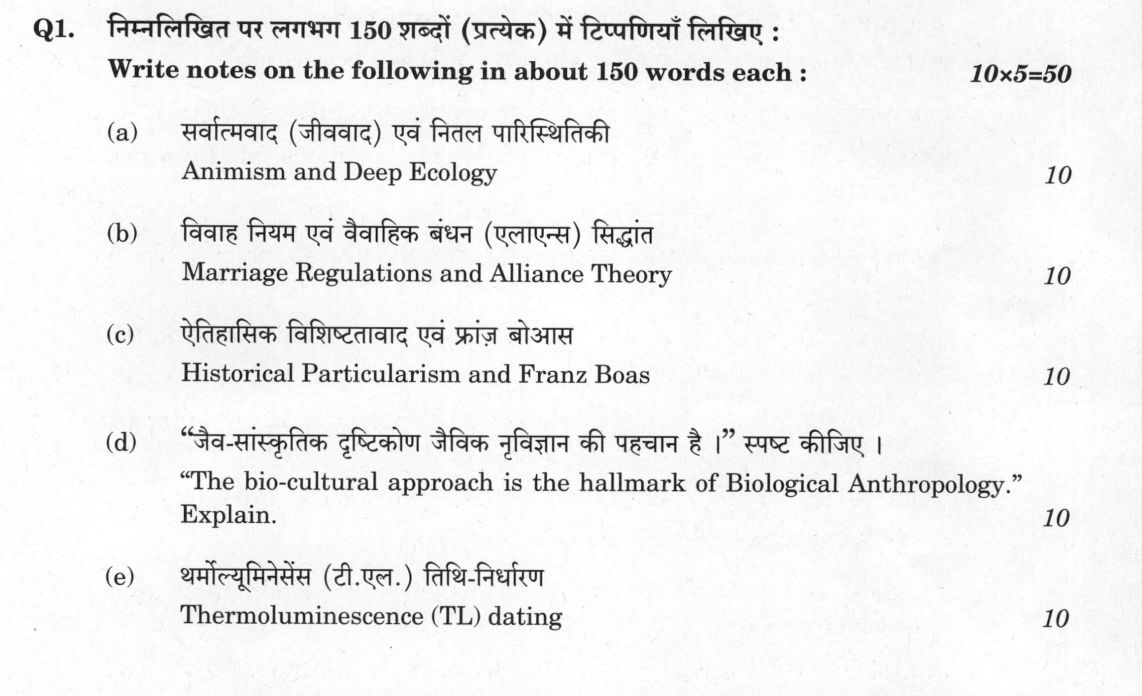
Write notes on the following in about 150 words each: (a) Animism and Deep Ecology (10 marks) (b) Marriage Regulations and…
Write notes on the following in about 150 words each: Animism and Deep Ecology 10 marks
Marriage Regulations and Alliance Theory 10 marks
Historical Particularism and Franz Boas 10 marks
"The bio-cultural approach is the hallmark of Biological Anthropology." Explain. 10 marks
Thermoluminescence (TL) dating 10 marks
हिंदी में प्रश्न पढ़ें
निम्नलिखित पर लगभग 150 शब्दों (प्रत्येक) में टिप्पणियाँ लिखिए : सर्वात्मवाद (जीववाद) एवं नितल पारिस्थितिकी (10 अंक)
विवाह नियम एवं वैवाहिक बंधन (एलायंस) सिद्धांत (10 अंक)
ऐतिहासिक विशिष्टतावाद एवं फ्रांज बोअस (10 अंक)
"जैव-सांस्कृतिक दृष्टिकोण जैविक नृविज्ञान की पहचान है।" स्पष्ट कीजिए। (10 अंक)
थर्मोल्युमिनेसेंस (टी.एल.) तिथि-निर्धारण (10 अंक)
Model answer
Written by UPSC Answer Check against this question's marking rubric, to the 150-word length. UPSC does not publish answers for Mains — this is one way to score well, not an official key.
(a) Animism and Deep Ecology Edward Tylor defined animism as the "oldest form of religion," positing that early humans projected souls onto natural phenomena, creating a spiritual unity between humans and nature. In contrast, Arne Naess’s Deep Ecology (1973) is a modern philosophical movement advocating biocentric equality, where all living beings possess intrinsic value independent of their utility to humans. Naess emphasizes "self-realization," arguing that the ego must expand to include the broader ecological community. While Tylor’s view is anthropocentric in its origin (human projection), Deep Ecology is ontological (nature’s inherent worth). However, both converge in rejecting the Western dualism that separates humans from the environment. In India, this convergence is visible in tribal practices; for instance, Gond and Bhil communities maintain sacred groves (Dev Van) not merely for resource management but as sites of spiritual reverence, reflecting an animistic worldview that aligns with Deep Ecology’s call for ecological humility. This indigenous knowledge system offers a critical alternative to industrial modernity’s extractive logic, suggesting that sustainable environmental ethics must be rooted in recognizing the agency of non-human entities.
(b) Marriage Regulations and Alliance Theory Lévi-Strauss’s Alliance Theory, presented in The Elementary Structures of Kinship (1949), revolutionized kinship studies by shifting focus from descent (vertical lineage) to alliance (horizontal exchange). He argued that marriage is fundamentally a system of exchange of women between groups, creating social solidarity and political bonds. This contrasts with earlier descent-based theories that viewed marriage as a means of reproducing lineages. Lévi-Strauss distinguished between "elementary structures" (restricted exchange, e.g., direct exchange between two groups) and "generalized exchange" (circular exchange among multiple groups), the latter being more complex and stable. In the Indian context, this theory helps explain the North-South divide: North Indian societies often practice cross-cousin marriage, which reinforces alliances with specific kin groups, while South Indian Dravidian systems historically favored cross-cousin marriage to maintain stable, long-term alliances between lineages. By viewing marriage as a social contract rather than a biological or familial event, Alliance Theory highlights how kinship structures regulate social order and resource distribution, providing a framework for understanding how marriage rules function as mechanisms of social integration and conflict resolution in complex societies.
(c) Historical Particularism and Franz Boas Franz Boas, the father of American anthropology, developed Historical Particularism to reject the 19th-century unilineal evolutionism that ranked cultures on a single scale from "savagery" to "civilization." Boas argued that each culture is a unique product of its specific history and environment, necessitating the study of individual cultures in their own context. His "four-field" approach integrated physical anthropology, linguistics, archaeology, and cultural anthropology, emphasizing rigorous fieldwork and cultural relativism—the idea that cultures must be understood on their own terms, not judged by external standards. Boas’s students, such as Alfred Kroeber and Ruth Benedict, further developed this approach, focusing on cultural patterns and personality. This methodology profoundly influenced Indian anthropology, particularly the village studies tradition initiated by M.N. Srinivas and others, which sought to understand Indian social structures through detailed, context-specific ethnographies rather than grand evolutionary theories. By prioritizing empirical data and historical specificity, Boas laid the groundwork for modern anthropological practice, ensuring that research remained grounded in local realities and resistant to ethnocentric biases, thereby transforming anthropology into a rigorous social science.
(d) The Bio-cultural Approach The bio-cultural approach is the hallmark of Biological Anthropology because it rejects the false dichotomy between nature and nurture, asserting that human biology and culture are mutually constitutive. This perspective integrates biological variables (genetics, physiology) with cultural factors (diet, technology, social organization) to explain human variation and adaptation. For example, human adaptation to high altitudes in the Andes and Himalayas involves both genetic changes (e.g., EPAS1 gene variants in Tibetans) and cultural practices (diet, clothing, social organization) that mitigate hypoxia. Similarly, lactase persistence—the ability to digest lactose into adulthood—is caused by regulatory genetic variants affecting the expression of the LCT gene, which evolved in populations with cultural practices of dairy farming. This approach also illuminates disease ecology, where cultural behaviors (hygiene, diet) interact with biological susceptibility to determine health outcomes. By moving beyond biological determinism, the bio-cultural framework demonstrates that human evolution is not a linear biological process but a dynamic interplay of genetic, environmental, and cultural forces. This integrative view is essential for understanding contemporary issues like global health disparities and the impact of lifestyle changes on human biology, highlighting the complexity of human existence.
(e) Thermoluminescence (TL) Dating Thermoluminescence (TL) dating is a geochronological technique used to date inorganic materials, particularly pottery and burnt flint, by measuring the light emitted when they are heated. The principle relies on the fact that natural radiation (from uranium, thorium, and potassium in the environment) traps electrons in the crystal lattice of minerals like quartz or feldspar over time. When the material is heated in the lab, these trapped electrons are released, emitting light (luminescence) proportional to the accumulated radiation dose. The age is calculated using the formula: Age = Paleodose (Gy) / Annual Dose Rate (Gy/year). This method is advantageous over radiocarbon dating because it can date inorganic materials and has a much wider range, typically from ~100 to 500,000 years. In archaeology, TL dating has been crucial for dating ceramic sequences in the Indus Valley Civilization, where organic materials for radiocarbon dating are often scarce or contaminated. It provides independent chronological anchors for cultural phases, helping to refine the timeline of urbanization and trade networks in the subcontinent. By offering a reliable method for dating non-organic artifacts, TL dating complements other techniques, enhancing the accuracy of archaeological chronologies in regions with limited organic preservation.
What "Write short notes" is asking you to do
Five or six self-contained answers, marked separately, typically 10 marks and about 150 words each. Each note must carry its own definition, its two or three defining features and a line on why it matters; a common introduction or conclusion across the notes earns nothing.
Structure that answers it
Per note: one-line definition or identification → two or three features, mechanisms or named examples → one line of significance or Indian application
Where marks are lost
Writing the first two notes at essay length and rationing the rest. Each note is marked on its own, so marks surrendered on a compressed or unattempted note cannot be won back by the long ones.
How this answer will be evaluated
Approach
Framework: UPSC Anthropology Paper 1 (General Anthropology). (a) write short notes: define > 3-4 key features > one example > one-line significance | (b) write short notes: define > 3-4 key features > one example > one-line significance | (c) write short notes: define > 3-4 key features > one example > one-line significance | (d) explain: definition/context > points in order > small example > short close | (e) write short notes: define > 3-4 key features > one example > one-line significance Full marks: Precise definitions, named theorists, clear distinctions, and relevant examples for each part.
Key points expected
- Define Animism (Tylor) as belief in non-human agency
- Define Deep Ecology (Naess) as biocentric equality
- Distinguish Animism (cultural) from Deep Ecology (philosophical)
- Mention the link between human and non-human nature
- Define Marriage Regulations (rules of exogamy/endogamy)
- Define Alliance Theory (marriage as social exchange)
- Attribute Alliance Theory to Lévi-Strauss
- Explain marriage as a bond between groups, not just individuals
Evaluation rubric
Each sub-part is marked on its own, against the marks and word limit printed on the paper.
- (a) Define Animism and Deep Ecology, highlighting their core tenets and relationship. 10 marks · 150 words
write short notes— define → 3-4 key features → one example → one-line significance
Must cover
- Define Animism (Tylor) as belief in non-human agency
- Define Deep Ecology (Naess) as biocentric equality
- Distinguish Animism (cultural) from Deep Ecology (philosophical)
- Mention the link between human and non-human nature
Loses marks
- Confusing Animism with Animatism
- Treating Deep Ecology as a political party only
- Ignoring the philosophical roots of Deep Ecology
Earns more
- Reference to Arne Naess or Arne Næss
- Reference to Edward Tylor
- Mention of 'ecological self' or 'biocentric' values
- Contrast with anthropocentrism
Extra mark
- Reference to specific indigenous animist practices
- Mention of 'ecosophy'
- (b) Explain Marriage Regulations (exogamy/endogamy) and Alliance Theory (Lévi-Strauss). 10 marks · 150 words
write short notes— define → 3-4 key features → one example → one-line significance
Must cover
- Define Marriage Regulations (rules of exogamy/endogamy)
- Define Alliance Theory (marriage as social exchange)
- Attribute Alliance Theory to Lévi-Strauss
- Explain marriage as a bond between groups, not just individuals
Loses marks
- Focusing only on individual choice in marriage
- Ignoring the group-level function of marriage
- Confusing Alliance Theory with Kinship Theory generally
Earns more
- Mention of 'elementary' vs 'complex' marriage
- Reference to cross-cousin marriage
- Mention of 'exchange of women'
- Reference to 'bride price' or 'dowry' as exchange
Extra mark
- Reference to specific tribal marriage rules (e.g., Nayar)
- Mention of 'matrilineal' or 'patrilineal' implications
- (c) Explain Historical Particularism and its association with Franz Boas. 10 marks · 150 words
write short notes— define → 3-4 key features → one example → one-line significance
Must cover
- Define Historical Particularism (culture as unique historical product)
- Attribute the theory to Franz Boas
- Explain rejection of unilinear evolutionism
- Emphasize 'diffusion' and 'historical method'
Loses marks
- Confusing Historical Particularism with Cultural Relativism
- Ignoring the historical dimension of the theory
- Attributing the theory to someone other than Boas
Earns more
- Mention of 'cultural relativism'
- Reference to Boas's work on Kwakiutl or Inuit
- Mention of 'area studies' or 'cultural areas'
- Contrast with 'evolutionism' or 'diffusionism'
Extra mark
- Reference to Boas's students (e.g., Kroeber, Lowie)
- Mention of 'particularistic' vs 'universalistic' approach
- (d) Explain why the bio-cultural approach is the hallmark of Biological Anthropology. 10 marks · 150 words
explain— definition/context → points in order → small example → short close
Must cover
- Define 'bio-cultural approach' (integration of biology and culture)
- Explain how biological traits are shaped by culture
- Explain how culture is shaped by biological constraints
- Give examples of bio-cultural interaction (e.g., lactose tolerance, sickle cell)
Loses marks
- Treating biology and culture as separate
- Ignoring the interactive nature of the approach
- Focusing only on biological determinism
Earns more
- Mention of 'biocultural' or 'biocultural' perspective
- Reference to 'evolutionary anthropology' or 'human variation'
- Mention of 'adaptation' or 'acclimatization'
- Reference to 'genetics' or 'physiology'
Extra mark
- Reference to specific studies (e.g., 'lactose tolerance in pastoralists')
- Mention of 'biocultural' research methods
- (e) Explain Thermoluminescence (TL) dating, its principle and application. 10 marks · 150 words
write short notes— define → 3-4 key features → one example → one-line significance
Must cover
- Define Thermoluminescence (TL) dating
- Explain the principle (light emission upon heating)
- Mention the materials used (ceramics, quartz, feldspar)
- Explain the application in archaeology (dating fired objects)
Loses marks
- Confusing TL with Carbon-14 dating
- Ignoring the heating requirement for TL
- Failing to explain the principle of light emission
Earns more
- Mention of 'electron traps' or 'energy levels'
- Reference to 'radiation dose' or 'accumulated dose'
- Mention of 'optically stimulated luminescence' (OSL) as related
- Reference to 'dating' of 'pottery' or 'hearth stones'
Extra mark
- Mention of 'TL' vs 'OSL' differences
- Reference to specific archaeological sites dated by TL
Practice this exact question
Write your answer and it is marked point by point against the model answer above — what you covered, what you missed, what you got wrong.
Evaluate my answer →More from Anthropology 2021 Paper I
- Q1 Write notes on the following in about 150 words each: (a) Animism and Deep Ecology (10 ma…
- Q2 (a) What are the physical and cultural characteristics of Homo erectus? Discuss its phylo…
- Q3 (a) How do political organisations of simple societies establish power, authority and leg…
- Q4 (a) Elaborate the scope of anthropology and elucidate its uniqueness in the field of othe…