Paper I — Q4
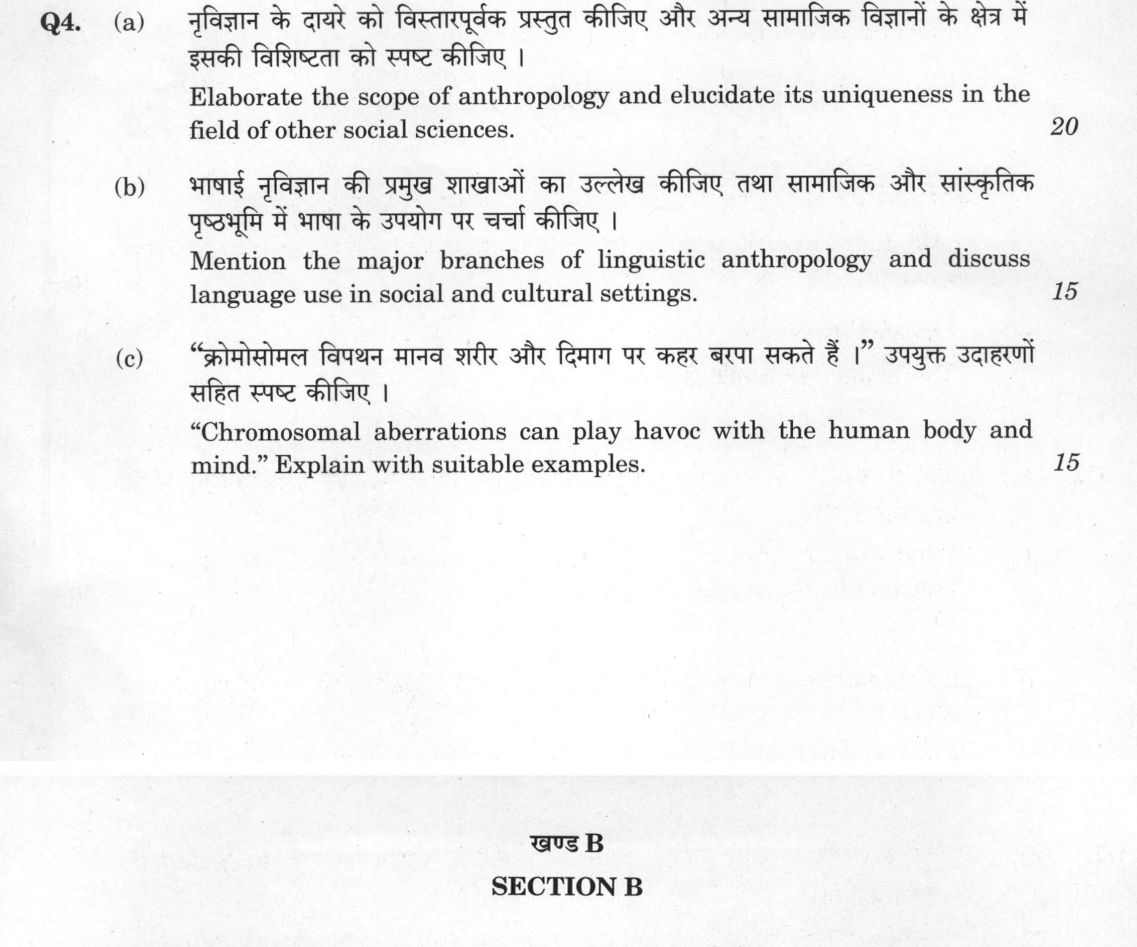
(a) Elaborate the scope of anthropology and elucidate its uniqueness in the field of other social sciences. (20 marks) (b)…
Elaborate the scope of anthropology and elucidate its uniqueness in the field of other social sciences. 20 marks
Mention the major branches of linguistic anthropology and discuss language use in social and cultural settings. 15 marks
"Chromosomal aberrations can play havoc with the human body and mind." Explain with suitable examples. 15 marks
हिंदी में प्रश्न पढ़ें
नृविज्ञान के दायरे को विस्तारपूर्वक प्रस्तुत कीजिए और अन्य सामाजिक विज्ञानों के क्षेत्र में इसकी विशिष्टता को स्पष्ट कीजिए । (20 अंक)
भाषाई नृविज्ञान की प्रमुख शाखाओं का उल्लेख कीजिए तथा सामाजिक और सांस्कृतिक पृष्ठभूमि में भाषा के उपयोग पर चर्चा कीजिए । (15 अंक)
"क्रोमोसोमल विपथन मानव शरीर और दिमाग पर कहर बरपा सकते हैं ।" उपयुक्त उदाहरणों सहित स्पष्ट कीजिए । (15 अंक)
Model answer
Written by UPSC Answer Check against this question's marking rubric, to the expected length. UPSC does not publish answers for Mains — this is one way to score well, not an official key.
Scope and Uniqueness of Anthropology
Anthropology is the holistic study of humanity, integrating biological, cultural, and linguistic dimensions across time and space. Its scope is defined by a comparative approach that examines human variation globally, distinguishing it from disciplines focused on specific regions or eras. The discipline is traditionally divided into four fields: physical (biological) anthropology, archaeology, cultural anthropology, and linguistic anthropology. This structure allows for a diachronic perspective, tracing human evolution and cultural change through prehistory, alongside a synchronic analysis of contemporary societies.
The uniqueness of anthropology lies in its position as a bridge between the natural and social sciences. Unlike sociology, which often employs macro-level structural analysis, anthropology utilizes micro-ethnography and participant observation to understand lived experiences from the insider’s perspective. It differs from history, which relies primarily on written documents, by incorporating oral traditions and material culture to reconstruct pasts. Furthermore, while psychology focuses on individual cognition, anthropology contextualizes behavior within cultural frameworks. In economics, anthropologists often adopt a substantivist view, emphasizing local production and consumption patterns, contrasting with the formalist models of mainstream economics. This interdisciplinary nature allows anthropology to address complex human issues by synthesizing biological data with cultural interpretation.
Branches of Linguistic Anthropology and Language Use
Linguistic anthropology investigates the relationship between language and culture. Its major branches include descriptive linguistics, which documents language structure; historical linguistics, which traces language evolution; ethnolinguistics, which explores how language reflects cultural categories; and sociolinguistics, which analyzes language use in social contexts. While applied linguistics is a related field, the core anthropological focus remains on the cultural embeddedness of speech.
Language is not merely a tool for communication but a form of social action. In social settings, speech communities develop norms that govern interaction. For instance, code-switching occurs when speakers alternate between languages to signal identity or social status. The Sapir-Whorf hypothesis, or linguistic relativity, suggests that language structures influence how speakers perceive reality. In cultural settings, language reinforces social hierarchies and kinship. In India, the Dravidian kinship terminology system classifies relatives based on generation and gender, reflecting specific social obligations and marriage rules. Ritual language, such as Sanskrit in Hindu ceremonies, serves to invoke sacred authority. Additionally, diglossia, where two varieties of a language are used for different functions, is evident in many Indian states, where formal education uses one variety while daily life uses another. The ethnography of communication further highlights how context, such as gendered speech patterns, shapes meaning and social cohesion.
Chromosomal Aberrations
Chromosomal aberrations are structural or numerical changes in chromosomes that can lead to significant physical and cognitive consequences. These are broadly classified into numerical and structural types.
Numerical aberrations involve changes in chromosome number. Aneuploidy, the gain or loss of a single chromosome, is common. For example, Down syndrome (Trisomy 21) results in mild-to-moderate intellectual disability, distinct facial features, and increased risk of heart defects. Turner syndrome (45,X) affects females, leading to short stature and ovarian dysfunction, while Klinefelter syndrome (47,XXY) affects males, causing infertility and reduced testosterone. Polyploidy, where an entire set of chromosomes is added, is generally lethal in humans but can occur in specific cell lines or gametes, leading to miscarriage or severe developmental failure.
Structural aberrations involve changes in chromosome structure. Deletions, where a segment is lost, can cause severe phenotypic effects, such as Cri-du-chat syndrome (5p deletion), characterized by a high-pitched cry and intellectual disability. Duplications, where a segment is repeated, can disrupt gene dosage, leading to developmental delays. Translocations, where segments are exchanged between non-homologous chromosomes, can be balanced (no genetic material lost) or unbalanced. Balanced translocations may be phenotypically normal in the carrier but can cause reproductive failure or miscarriage due to meiotic pairing problems. Inversions, where a segment is reversed, are often phenotypically normal if balanced, but can disrupt gene function if the break point occurs within a gene.
These aberrations highlight the critical link between genetics and phenotype. Understanding them is essential for genetic counseling, prenatal diagnosis, and public health strategies to manage congenital disorders.
Conclusion
Anthropology’s holistic framework allows for a comprehensive understanding of human diversity. By integrating biological insights from chromosomal studies with cultural analyses of language and society, the discipline provides a unique lens to interpret human experience. This convergence of biological and cultural dimensions underscores anthropology’s relevance in addressing contemporary challenges, from genetic health to social integration.
What "Elaborate" is asking you to do
Give the full detailed account the question has compressed into a line — every dimension of it, with specifics. Elaborate rewards completeness and detail rather than clarification or argument: the examiner is checking whether you can fill out a topic without being told what its parts are.
Structure that answers it
State the proposition → first dimension in detail → second dimension in detail → the part the statement leaves implicit → the consolidated picture
Where marks are lost
Repeating the statement at greater length instead of adding substance. Elaborate also punishes narrowness: omitting a whole dimension costs more here than anywhere else in this family.
How this answer will be evaluated
Approach
(a) explain: definition/context > points in order > small example > short close | (b) discuss: intro > 3-4 dimensions > example > balanced close | (c) explain: definition/context > points in order > small example > short close Full marks: Comprehensive, accurate, with specific examples and clear distinctions.
Key points expected
- Define scope: biological, social, cultural, linguistic.
- Holistic approach as unique feature.
- Compare with sociology, psychology, history.
- Mention comparative and cross-cultural method.
- List major branches (e.g., Ethnolinguistics, Sociolinguistics).
- Explain language as a social institution.
- Discuss language and culture relationship (Sapir-Whorf).
- Mention language use in social stratification.
Evaluation rubric
Each sub-part is marked on its own, against the marks and word limit printed on the paper.
- (a) Define scope and distinguish anthropology from other social sciences. 20 marks
explain— definition/context → points in order → small example → short close
Must cover
- Define scope: biological, social, cultural, linguistic.
- Holistic approach as unique feature.
- Compare with sociology, psychology, history.
- Mention comparative and cross-cultural method.
Loses marks
- Treating anthropology as a sub-branch of sociology.
- Ignoring the biological/physical aspect of scope.
Earns more
- Reference to Boas or Malinowski.
- Mention of 'four-field' approach.
- Distinction between micro and macro anthropology.
Extra mark
- Reference to Indian anthropologists (e.g., S.C. Dube).
- (b) List branches of linguistic anthropology and discuss language in social/cultural settings. 15 marks
discuss— intro → 3-4 dimensions → example → balanced close
Must cover
- List major branches (e.g., Ethnolinguistics, Sociolinguistics).
- Explain language as a social institution.
- Discuss language and culture relationship (Sapir-Whorf).
- Mention language use in social stratification.
Loses marks
- Confusing linguistic anthropology with general linguistics.
- Ignoring the social/cultural context of language use.
Earns more
- Reference to Sapir-Whorf hypothesis.
- Example of dialects or pidgin languages.
- Mention of language and identity.
Extra mark
- Reference to specific Indian tribal languages.
- (c) Explain chromosomal aberrations with examples affecting body and mind. 15 marks
explain— definition/context → points in order → small example → short close
Must cover
- Define chromosomal aberrations (structural/numerical).
- Give example of numerical aberration (e.g., Down syndrome).
- Give example of structural aberration (e.g., Cri-du-chat).
- Explain impact on physical and mental development.
Loses marks
- Confusing chromosomal with gene mutations.
- Failing to provide specific examples.
Earns more
- Mention of Klinefelter or Turner syndrome.
- Explanation of mechanism (nondisjunction).
- Reference to genetic counseling.
Extra mark
- Mention of specific gene involved (e.g., SRY).
Practice this exact question
Write your answer and it is marked point by point against the model answer above — what you covered, what you missed, what you got wrong.
Evaluate my answer →More from Anthropology 2021 Paper I
- Q1 Write notes on the following in about 150 words each: (a) Animism and Deep Ecology (10 ma…
- Q2 (a) What are the physical and cultural characteristics of Homo erectus? Discuss its phylo…
- Q3 (a) How do political organisations of simple societies establish power, authority and leg…
- Q4 (a) Elaborate the scope of anthropology and elucidate its uniqueness in the field of othe…
- Q5 Write notes on the following in about 150 words each: (a) Human adolescent growth spurt (…
- Q6 (a) What is acclimatization? Discuss adaptive responses to high altitude and cold climate…
- Q7 (a) Critically evaluate different types of social stratifications with suitable examples.…