Paper I — Q5
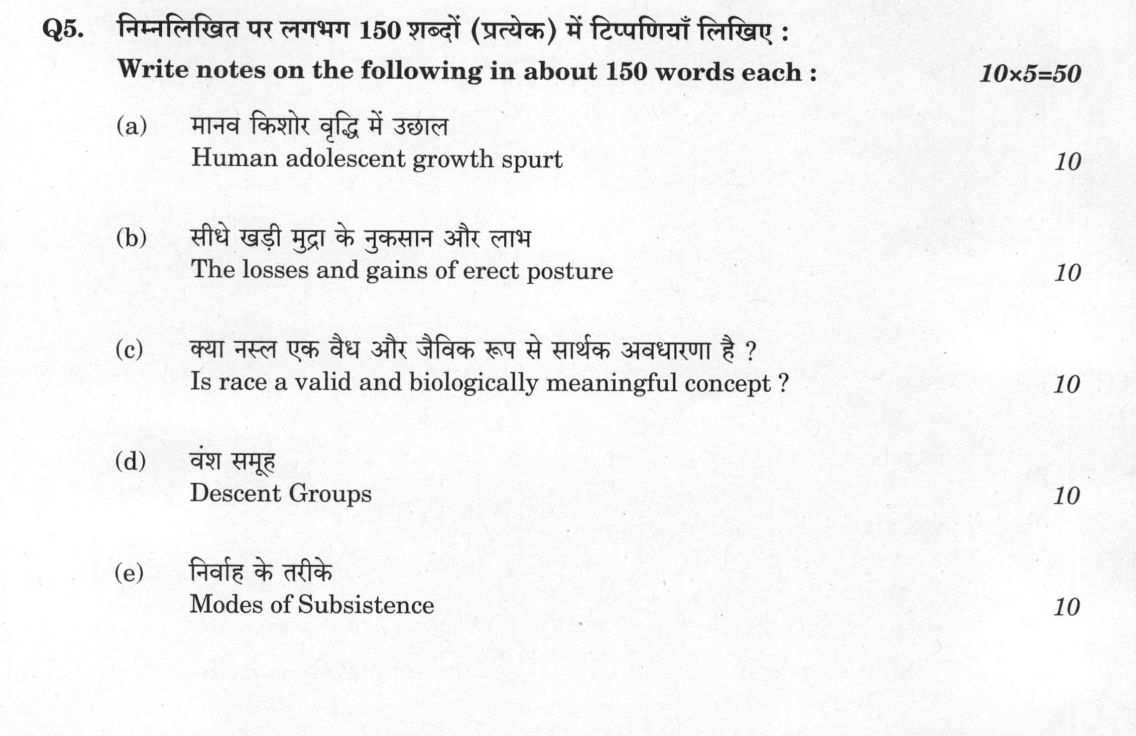
Write notes on the following in about 150 words each: (a) Human adolescent growth spurt (10 marks) (b) The losses and gains of…
Write notes on the following in about 150 words each: Human adolescent growth spurt 10 marks
The losses and gains of erect posture 10 marks
Is race a valid and biologically meaningful concept? 10 marks
Descent Groups 10 marks
Modes of Subsistence 10 marks
हिंदी में प्रश्न पढ़ें
निम्नलिखित पर लगभग 150 शब्दों (प्रत्येक) में टिप्पणियाँ लिखिए : मानव किशोर वृद्धि में उछाल (10 अंक)
सीधे खड़ी मुद्रा के नुकसान और लाभ (10 अंक)
क्या नस्ल एक वैध और जैविक रूप से सार्थक अवधारणा है ? (10 अंक)
वंश समूह (10 अंक)
निर्वाह के तरीके (10 अंक)
Model answer
Written by UPSC Answer Check against this question's marking rubric, to the 150-word length. UPSC does not publish answers for Mains — this is one way to score well, not an official key.
(a) Human Adolescent Growth Spurt
The human adolescent growth spurt is a unique, post-infancy acceleration in somatic growth velocity, marking the transition from childhood to adulthood. Unlike other primates that exhibit a decelerating growth curve from birth, humans experience a distinct secondary peak governed by neuroendocrine mechanisms. This phase is triggered by the activation of the hypothalamic-pituitary-gonadal axis, driving the synergistic action of growth hormone (GH), insulin-like growth factor 1 (IGF-1), and gonadal steroids including estrogens and androgens. Sexual dimorphism is pronounced: females initiate the spurt roughly two years earlier (around 10–12 years) due to estrogen surges, whereas males initiate it later (around 12–14 years), attaining greater peak height velocity and bone mass due to prolonged pre-pubertal growth and testosterone-driven skeletal elongation. Evolutionarily, as highlighted by Barry Bogin, this delayed spurt extends the learning window for complex socio-cognitive skills while facilitating rapid pelvic remodeling and metabolic preparation necessary for successful reproductive maturation.
(b) The Losses and Gains of Erect Posture
The evolutionary transition to habitual bipedalism in hominins represented a fundamental adaptive shift with significant anatomical trade-offs.
The evolutionary gains include the liberation of the upper extremities from locomotion, enabling precision-grip tool manufacture, manual transport of resources, and enhanced food sharing. Bipedalism elevated the visual horizon, enhancing predator detection across open savanna ecosystems, and improved thermal efficiency by presenting a reduced surface area to direct solar radiation while optimizing convective cooling.
Conversely, the anatomical losses include the obstetric dilemma, where the narrowing and anteroposterior reorganization of the pelvic canal for efficient locomotion conflicted with encephalization, resulting in altricial births and high maternal mortality. Biomechanical stresses from supporting the entire body mass on a vertical axis produced chronic vulnerabilities, including lumbar lordosis, intervertebral disc herniation, knee osteoarthritis, and impaired venous return leading to varicose veins and hemorrhoids, alongside localized UV radiation stress concentrated on the cranial vertex.
(c) Is Race a Valid and Biologically Meaningful Concept?
Modern physical anthropology rejects the concept of biological race, deeming it an invalid typological construct unsupported by contemporary population genetics. Early typologists, such as Linnaeus, Blumenbach, and Hooton, erroneously classified human biodiversity into discrete, static, and hierarchically ranked biological units based on subjective phenotypic markers like skin reflectance, cranial index, and hair form.
Empirical evidence from population genetics refutes these categorical boundaries. Richard Lewontin’s seminal 1972 study demonstrated that approximately 85% of total human genetic variation occurs within individual local populations, while only 6–10% differentiates geographically separated continental groups. Human biological variation is continuous, non-concordant, and clinal, distributed along geographical gradients shaped by natural selection, genetic drift, and gene flow rather than discrete packages, as synthesized in Frank Livingstone’s dictum that "there are no races, only clines." Consequently, race represents a potent socio-cultural categorization rather than a valid, objective taxonomic reality.
(d) Descent Groups
A descent group is a corporate social entity whose membership is established through genealogical reckoning from a recognized real or apical ancestor. These structural units form the core of kinship organization, regulating alliance, property rights, and political authority across generations.
Descent systems are classified into unilineal, bilateral, and ambilineal patterns. Unilineal systems trace descent exclusively through a single parentage: patrilineal (agnatic) descent traces connection through male lines, observed among the Nuer and dominant Indian caste groups, whereas matrilineal (uterine) descent traces affiliation through female lines, seen among the Khasi of Meghalaya and the Nayars of Kerala. Ambilineal systems permit an individual to choose affiliation through either parent based on pragmatic or ecological imperatives, while bilateral systems trace descent symmetrically through both maternal and paternal kin, typical of foraging bands and modern industrialized societies. Corporate descent groups function as enduring legal personalities, controlling ancestral property, organizing collective ancestor rituals, mobilizing defense, and enforcing lineage exogamy.
(e) Modes of Subsistence
Modes of subsistence denote the institutionalized strategies through which human societies harness environmental energy to meet biological and social needs, directly shaping carrying capacity and socio-political complexity.
Foraging represents an extractive strategy reliant on wild flora and fauna, characterized by low population density, nomadism, band-level egalitarianism, and minimal environmental transformation, as exemplified by the Andamanese Jarawas. Pastoralism relies on the husbandry of domesticated herbivores in marginal arid or montane ecosystems, utilizing nomadic or transhumant mobility, medium carrying capacity, and segmentary lineages, seen among the Toda and Bakkarwals. Horticulture involves small-scale, non-intensive cultivation utilizing hand tools and slash-and-burn (jhum) techniques, generating moderate food surpluses that sustain village settlements and segmentary clans. Agriculture utilizes intensive techniques, including animal draft power, irrigation, terracing, and crop rotation, generating large, stable surpluses. This high carrying capacity supports dense sedentary populations, specialized division of labor, social stratification, and centralized state systems, reflecting the interplay between ecological constraints and socio-cultural evolution.
What "Write short notes" is asking you to do
Five or six self-contained answers, marked separately, typically 10 marks and about 150 words each. Each note must carry its own definition, its two or three defining features and a line on why it matters; a common introduction or conclusion across the notes earns nothing.
Structure that answers it
Per note: one-line definition or identification → two or three features, mechanisms or named examples → one line of significance or Indian application
Where marks are lost
Writing the first two notes at essay length and rationing the rest. Each note is marked on its own, so marks surrendered on a compressed or unattempted note cannot be won back by the long ones.
How this answer will be evaluated
Approach
Framework: UPSC Anthropology Paper I (Physical Anthropology & Social Anthropology). (a) write short notes: define > 3-4 key features > one example > one-line significance | (b) write short notes: define > 3-4 key features > one example > one-line significance | (c) comment: context > arguments both sides > judgment > close | (d) write short notes: define > 3-4 key features > one example > one-line significance | (e) write short notes: define > 3-4 key features > one example > one-line significance Full marks: Precise definitions, clear distinction between concepts, specific examples, and correct biological/anthropological terminology.
Key points expected
- Define adolescent growth spurt
- Mention role of growth hormone (GH)
- Note sexual dimorphism in timing
- Mention skeletal maturation
- Mention 'gains' (e.g., freeing hands, field of view)
- Mention 'losses' (e.g., back pain, hip issues)
- Link to hominin evolution
- Mention energy efficiency
Evaluation rubric
Each sub-part is marked on its own, against the marks and word limit printed on the paper.
- (a) Define adolescent growth spurt and its biological mechanisms. 10 marks · 150 words
write short notes— define → 3-4 key features → one example → one-line significance
Must cover
- Define adolescent growth spurt
- Mention role of growth hormone (GH)
- Note sexual dimorphism in timing
- Mention skeletal maturation
Loses marks
- Confusing with childhood growth
- Ignoring hormonal control
Earns more
- Reference to Tanner stages
- Mention of peak height velocity
- Link to puberty onset
Extra mark
- Labelled diagram of growth curve
- Mention of specific age ranges
- (b) List the biological advantages and disadvantages of bipedalism. 10 marks · 150 words
write short notes— define → 3-4 key features → one example → one-line significance
Must cover
- Mention 'gains' (e.g., freeing hands, field of view)
- Mention 'losses' (e.g., back pain, hip issues)
- Link to hominin evolution
- Mention energy efficiency
Loses marks
- Focusing only on social aspects
- Ignoring the 'losses' side
Earns more
- Reference to 'knuckle-walking' comparison
- Mention of pelvic changes
- Reference to 'obstetric dilemma'
Extra mark
- Sketch of pelvic structure
- Mention of specific fossil evidence (e.g., Lucy)
- (c) Critically evaluate the biological validity of the concept of race. 10 marks · 150 words
comment— context → arguments both sides → judgment → close
Must cover
- Define 'race' in biological context
- Mention clinal variation vs. discrete groups
- Mention genetic overlap between populations
- State conclusion on validity
Loses marks
- Treating race as purely social without biological critique
- Supporting racial hierarchy
Earns more
- Reference to Lewontin's 1972 study
- Mention of 'social construction' of race
- Reference to specific genes (e.g., sickle cell)
Extra mark
- Mention of specific anthropologists (e.g., Coon vs. Dobzhansky)
- Reference to modern genomic studies
- (d) Define descent groups and their types (lineage, clan, moiety). 10 marks · 150 words
write short notes— define → 3-4 key features → one example → one-line significance
Must cover
- Define descent group
- Distinguish lineage from clan
- Mention unilineal vs. cognatic descent
- Give an example
Loses marks
- Confusing descent with residence
- Ignoring the 'group' aspect
Earns more
- Mention of 'moiety' or 'phratry'
- Reference to Indian tribes (e.g., Gonds, Nairs)
- Mention of 'segmentary lineage'
Extra mark
- Kinship chart of a lineage
- Reference to specific ethnographer (e.g., Radcliffe-Brown)
- (e) List and describe the main modes of subsistence. 10 marks · 150 words
write short notes— define → 3-4 key features → one example → one-line significance
Must cover
- List foraging/hunting-gathering
- List horticulture/agriculture
- List pastoralism
- List industrial/urban
Loses marks
- Listing only two modes
- Confusing subsistence with exchange
Earns more
- Mention of 'intensive agriculture'
- Reference to Indian context (e.g., Bhil foraging)
- Mention of 'surplus' production
Extra mark
- Table comparing modes
- Reference to specific tribal economy
Practice this exact question
Write your answer and it is marked point by point against the model answer above — what you covered, what you missed, what you got wrong.
Evaluate my answer →More from Anthropology 2021 Paper I
- Q2 (a) What are the physical and cultural characteristics of Homo erectus? Discuss its phylo…
- Q3 (a) How do political organisations of simple societies establish power, authority and leg…
- Q4 (a) Elaborate the scope of anthropology and elucidate its uniqueness in the field of othe…
- Q5 Write notes on the following in about 150 words each: (a) Human adolescent growth spurt (…
- Q6 (a) What is acclimatization? Discuss adaptive responses to high altitude and cold climate…
- Q7 (a) Critically evaluate different types of social stratifications with suitable examples.…
- Q8 (a) Discuss various tools of data collection in conducting anthropological research. (20…