Paper I — Q8
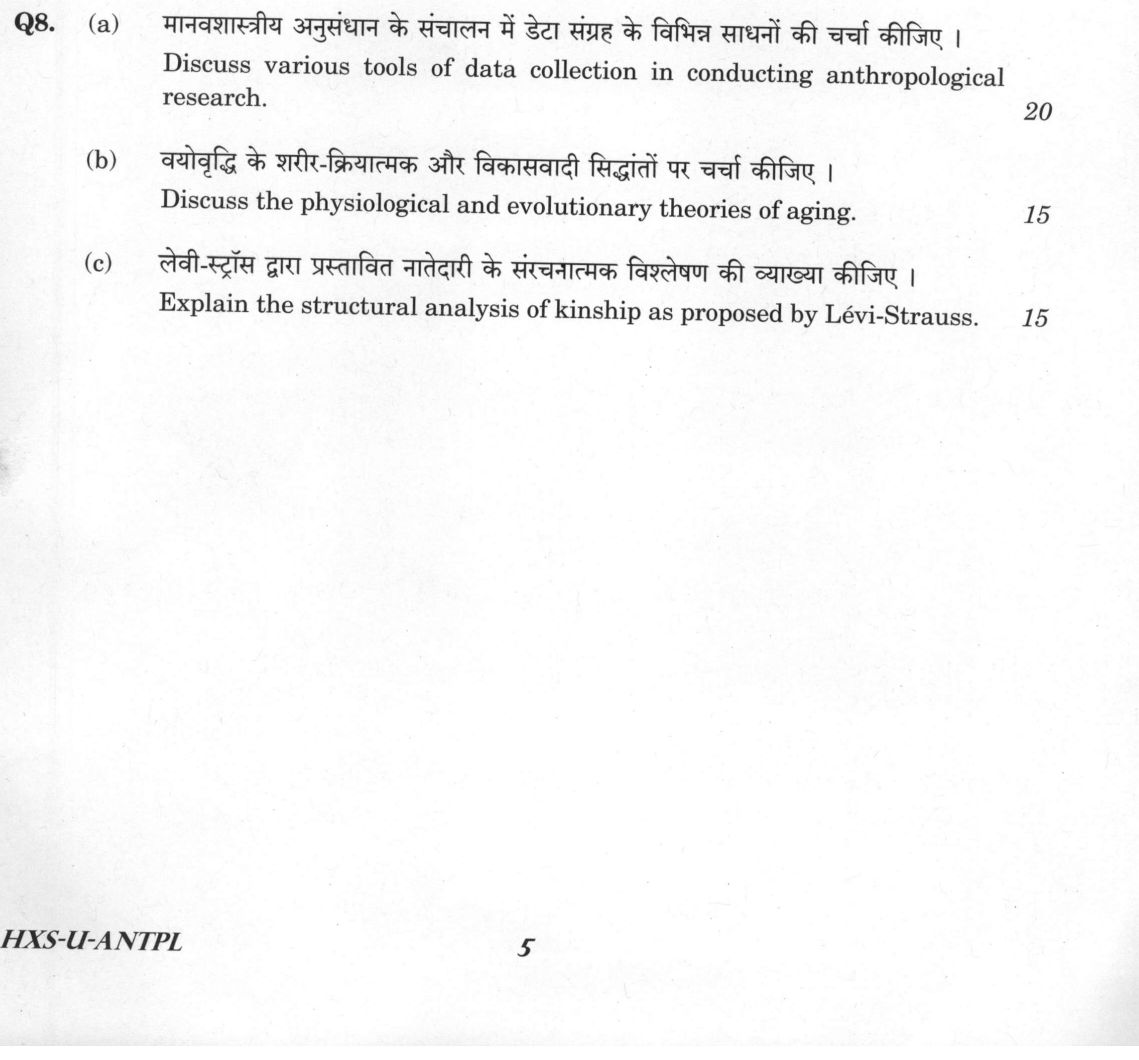
(a) Discuss various tools of data collection in conducting anthropological research. (20 marks) (b) Discuss the physiological and…
Discuss various tools of data collection in conducting anthropological research. 20 marks
Discuss the physiological and evolutionary theories of aging. 15 marks
Explain the structural analysis of kinship as proposed by Lévi-Strauss. 15 marks
हिंदी में प्रश्न पढ़ें
मानवशास्त्रीय अनुसंधान के संचालन में डेटा संग्रह के विभिन्न साधनों की चर्चा कीजिए । (20 अंक)
वयोवृद्धि के शरीर-क्रियात्मक और विकासवादी सिद्धांतों पर चर्चा कीजिए । (15 अंक)
लेवी-स्ट्रॉस द्वारा प्रस्तावित नातेदारी के संरचनात्मक विश्लेषण की व्याख्या कीजिए । (15 अंक)
Model answer
Written by UPSC Answer Check against this question's marking rubric, to the expected length. UPSC does not publish answers for Mains — this is one way to score well, not an official key.
Anthropology unites rigorous empirical field methods, biological evolution, and socio-cultural structures to understand the human condition in its bio-cultural entirety.
Tools of Data Collection in Anthropological Research
Anthropological methodology relies on qualitative and quantitative tools to capture both emic (insider) and etic (outsider) perspectives. The foundational primary tool is participant observation, established by Bronislaw Malinowski during his fieldwork in the Trobriand Islands, allowing researchers to grasp the native’s point of view and document the imponderabilia of daily life. This is complemented by key-informant interviews (structured, semi-structured, and open-ended), the extended case study method developed by the Manchester School to analyze social conflicts, and the genealogical method pioneered by W.H.R. Rivers to trace kinship lines, property inheritance, and demographic shifts.
Secondary tools include colonial census data, historical archival records, life histories, and visual methods such as ethnographic photography and film. While quantitative approaches yield macro-level demographic metrics, qualitative tools provide contextual depth and nuanced cultural meanings. Contemporary field research incorporates methodological innovations such as digital and virtual ethnography to study online communities, Geographic Information System (GIS) mapping for spatial-ecological analyses of indigenous habitats, and mixed-method triangulation that integrates statistical surveys with deep qualitative narratives to ensure empirical validity.
Physiological and Evolutionary Theories of Aging
Aging (senescence) is understood through proximate physiological mechanisms and ultimate evolutionary frameworks.
Physiological theories explain the direct biochemical processes of somatic deterioration. Cellular senescence and the Hayflick limit demonstrate that normal human cells have a finite capacity for division, driven by progressive telomere shortening with each replication cycle. Denham Harman’s free radical theory posits that accumulated oxidative damage from reactive oxygen species impairs mitochondrial function and cellular components. Additionally, neuroendocrine theories emphasize the progressive dysregulation of homeostatic systems, notably the hypothalamic-pituitary-adrenal axis, leading to hormonal declines and reduced systemic adaptability.
Evolutionary theories explain why natural selection permits senescence. George Williams’s antagonistic pleiotropy theory posits that alleles offering adaptive reproductive advantages in early life are selected for, even if they cause physiological decline in post-reproductive life. Thomas Kirkwood’s disposable soma theory frames aging as an optimal resource-allocation trade-off between somatic maintenance and reproductive effort. Furthermore, the grandmother hypothesis accounts for extended post-menopausal longevity in human females through kin selection, where grandmothers enhance inclusive fitness by provisioning grandchildren. Synthetically, while physiological theories elucidate the proximate molecular breakdowns, evolutionary theories account for life-history variations and interspecies differences in lifespan.
Lévi-Strauss’s Structural Analysis of Kinship
Claude Lévi-Strauss revolutionized kinship studies by formulating Alliance Theory, shifting the focus from British structural-functionalist Descent Theory (championed by Radcliffe-Brown and Meyer Fortes) toward marriage as an ongoing system of communication and exchange. In The Elementary Structures of Kinship, he argued that the human mind is universally structured around unconscious binary oppositions, fundamentally that of nature versus culture (analogous to the raw versus the cooked).
The universal prohibition of incest serves as the crucial mechanism bridging nature and culture; by forbidding sexual access to female kin, it mandates exogamy and compels distinct groups to enter into reciprocal social alliances. Lévi-Strauss identified the "atom of kinship" as the elementary, irreducible structure composed of four terms: brother, sister, father, and son, which systematically unites the relations of consanguinity, affinity, and filiation alongside the avunculate. Kinship networks are organized around models of restricted exchange (direct reciprocity) or generalized exchange (indirect, circular reciprocity), cementing long-term organic solidarity. However, British anthropologist Edmund Leach critically questioned this structural model, arguing that its abstract, mathematical formalism overemphasized mental templates at the expense of empirical reality, localized political power, and individual human agency.
Methodological rigor across qualitative and quantitative data collection provides the empirical bedrock upon which both biological senescence and the structural organization of society are holistically theorized, ensuring a dynamic synthesis of biological reality and cultural form in anthropological inquiry.
What "Discuss" is asking you to do
Lay the issue out from more than one side — how it arose, what is claimed for it, what is held against it, and where it now stands. UPSC attaches discuss to broad topics with several live dimensions, so coverage of the dimensions earns more than the strength of your opinion.
Structure that answers it
Set the issue up → the case as it is made → the case against → the dimension both sides leave out → where the balance now lies
Where marks are lost
Listing facts with no thread between them, or arguing one side throughout and calling it a discussion.
How this answer will be evaluated
Approach
(a) discuss: intro > 3-4 dimensions > example > balanced close | (b) discuss: intro > 3-4 dimensions > example > balanced close | (c) explain: definition/context > points in order > small example > short close Full marks: Comprehensive coverage of all required points with specific examples and clear distinctions.
Key points expected
- Participatory observation and fieldwork
- Interviews (structured/unstructured) and life histories
- Questionnaires and surveys
- Secondary sources (archives, census, genealogies)
- Physiological theories (e.g., cellular damage, telomeres)
- Evolutionary theories (e.g., mutation accumulation, antagonistic pleiotropy)
- Distinction between physiological and evolutionary
- Concept of senescence
Evaluation rubric
Each sub-part is marked on its own, against the marks and word limit printed on the paper.
- (a) Overview of primary and secondary data collection methods in anthropology. 20 marks
discuss— intro → 3-4 dimensions → example → balanced close
Must cover
- Participatory observation and fieldwork
- Interviews (structured/unstructured) and life histories
- Questionnaires and surveys
- Secondary sources (archives, census, genealogies)
Loses marks
- Sociological methods without anthropological context
- Listing tools without explaining their application
- Ignoring the role of fieldwork
Earns more
- Ethnographic case (e.g., Malinowski in Trobriands)
- Distinction between primary and secondary data
- Role of genealogical method
- Use of visual/photographic records
Extra mark
- Mention of specific Indian tribal survey (e.g., Census of India)
- Reference to specific fieldwork site
- (b) Explanation of biological and evolutionary perspectives on the aging process. 15 marks
discuss— intro → 3-4 dimensions → example → balanced close
Must cover
- Physiological theories (e.g., cellular damage, telomeres)
- Evolutionary theories (e.g., mutation accumulation, antagonistic pleiotropy)
- Distinction between physiological and evolutionary
- Concept of senescence
Loses marks
- Confusing physiological with social aging
- Vague generalities without specific theories
- Ignoring the evolutionary aspect
Earns more
- Mention of specific scientists (e.g., Medawar, Williams)
- Reference to human longevity data
- Link to biological anthropology context
Extra mark
- Reference to specific primate study
- Mention of specific gene (e.g., FOXO3)
- (c) Outline of Lévi-Strauss's structuralist approach to kinship systems. 15 marks
explain— definition/context → points in order → small example → short close
Must cover
- Elementary vs. Complex structures
- Exchange of women (marriage rules)
- Binary oppositions (nature/culture)
- Role of cross-cousin marriage
Loses marks
- Confusing with Radcliffe-Brown's functionalism
- Ignoring the structuralist method
- Vague description without specific concepts
Earns more
- Mention of specific kinship terms (e.g., avunculate)
- Reference to specific society (e.g., Australian aborigines)
- Concept of 'bride-price' as exchange
Extra mark
- Reference to 'The Elementary Structures of Kinship'
- Mention of specific kinship chart
Practice this exact question
Write your answer and it is marked point by point against the model answer above — what you covered, what you missed, what you got wrong.
Evaluate my answer →More from Anthropology 2021 Paper I
- Q5 Write notes on the following in about 150 words each: (a) Human adolescent growth spurt (…
- Q6 (a) What is acclimatization? Discuss adaptive responses to high altitude and cold climate…
- Q7 (a) Critically evaluate different types of social stratifications with suitable examples.…
- Q8 (a) Discuss various tools of data collection in conducting anthropological research. (20…