Paper I — Q6
(a) What is acclimatization? Discuss adaptive responses to high altitude and cold climate. (20 marks) (b) How are the cases of…
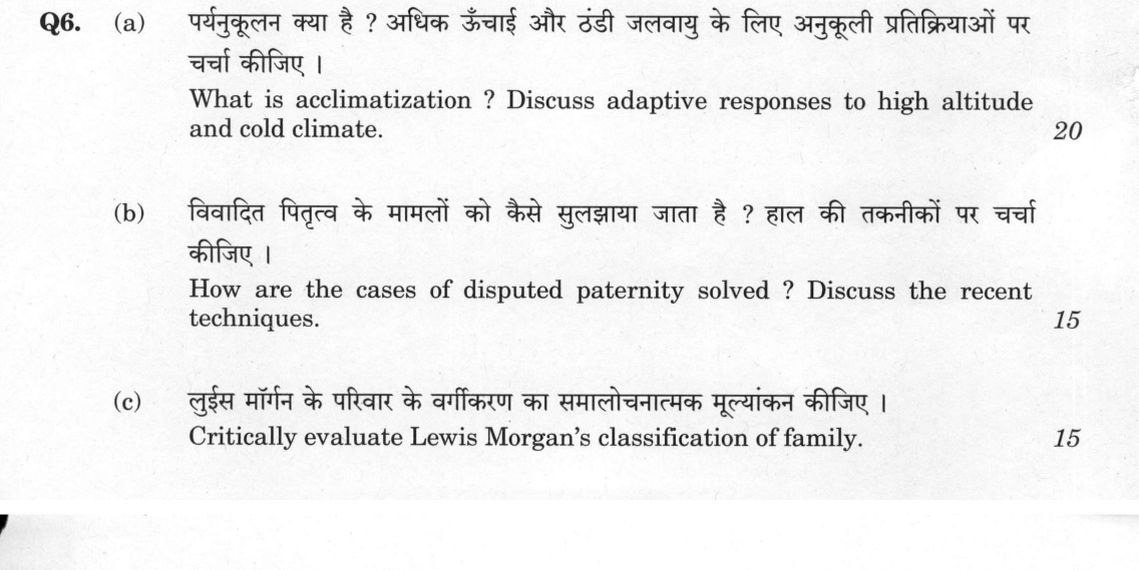
What is acclimatization? Discuss adaptive responses to high altitude and cold climate. 20 marks
How are the cases of disputed paternity solved? Discuss the recent techniques. 15 marks
Critically evaluate Lewis Morgan's classification of family. 15 marks
हिंदी में प्रश्न पढ़ें
पर्यनुकूलन क्या है ? अधिक ऊँचाई और ठंडी जलवायु के लिए अनुकूली प्रतिक्रियाओं पर चर्चा कीजिए । (20 अंक)
विवादित पितृत्व के मामलों को कैसे सुलझाया जाता है ? हाल की तकनीकों पर चर्चा कीजिए । (15 अंक)
लुईस मॉर्गन के परिवार के वर्गीकरण का समालोचनात्मक मूल्यांकन कीजिए । (15 अंक)
Model answer
Written by UPSC Answer Check against this question's marking rubric, to the expected length. UPSC does not publish answers for Mains — this is one way to score well, not an official key.
Acclimatization and Kinship: Physiological and Social Adaptations
Acclimatization refers to the physiological adjustments an individual undergoes in response to environmental stressors, distinct from genetic adaptation which occurs over generations. In high-altitude environments, the primary challenge is hypoxia. The immediate response is the hypoxic ventilatory response, increasing breathing rate to boost oxygen intake. Over weeks, the body produces erythropoietin, stimulating red blood cell production (polycythemia) to enhance oxygen-carrying capacity. Concurrently, the affinity of hemoglobin for oxygen decreases via increased 2,3-DPG, facilitating oxygen release to tissues. Long-term acclimatization involves increased capillary density in muscles. Genetically, populations like the Tibetans and Andeans show distinct adaptations; Tibetans possess EPAS1 mutations allowing efficient oxygen use without excessive polycythemia, a pattern observed in Himalayan groups like the Lahaul-Spiti and Sikkimese. In cold climates, thermoregulation relies on peripheral vasoconstriction to conserve heat and shivering thermogenesis. Non-shivering thermogenesis utilizes brown adipose tissue. Morphological adaptations, though genetic, follow Bergmann’s rule (larger body size in colder regions) and Allen’s rule (shorter limbs), seen in the Gaddi shepherds and Brokpa communities of the Himalayas.
Resolving Disputed Paternity
Historically, paternity disputes were resolved using serological markers such as ABO blood groups, the MN system, and serum protein polymorphisms. While these systems could exclude a man as the father with high probability, their power of exclusion was limited compared to modern methods. When High Resolution Antigen (HLA) typing was introduced, the combined power of exclusion approached or exceeded 99%, allowing for high probabilities of paternity, though not absolute certainty. The advent of DNA profiling, pioneered by Alec Jeffreys, revolutionized this field. Short Tandem Repeat (STR) analysis is the current gold standard, examining highly polymorphic loci. The Paternity Index (PI) for each locus is multiplied to yield the Combined Paternity Index (CPI), which quantifies the likelihood of paternity relative to a random man. Y-chromosome and mitochondrial DNA testing further assist in lineage verification. In India, these tests are admissible under the Indian Evidence Act, 1872, specifically Section 45 (expert opinion) and Section 164 (examination of accused), provided strict chain-of-custody protocols are maintained to ensure legal validity.
Critique of Lewis Morgan’s Family Classification
Lewis Morgan’s Ancient Society proposed a unilineal evolutionary sequence of family forms: consanguine, punaluan, syndyasmian, patriarchal, and monogamous. He argued that the monogamous family, the final stage, was founded on property rights and male supremacy, marking the transition from savagery to civilization. This scheme was deeply influential, shaping Marx and Engels’ materialist interpretation of history. However, it has been heavily critiqued. Bronislaw Malinowski argued that Morgan relied on "survivals" in modern societies to reconstruct past stages, a methodological flaw that ignored the dynamic nature of social institutions. A.R. Radcliffe-Brown, from a functionalist perspective, criticized the teleological assumption that all societies progress through identical stages, noting that family structures are adapted to specific ecological and social needs rather than following a universal ladder. W.H.R. Rivers’ kinship studies further undermined Morgan’s claims by demonstrating the complexity and diversity of kinship terminologies that did not fit neatly into Morgan’s categories.
Conclusion
While Morgan’s work was historically significant in establishing the study of kinship and influencing social theory, his unilineal evolutionary model is now rejected. Contemporary anthropology recognizes the diversity of family forms and the complex interplay of biology, culture, and environment. The study of physiological acclimatization and the legal resolution of paternity via DNA both highlight how scientific precision has replaced speculative evolutionary narratives, allowing for a more nuanced understanding of human adaptation and social organization.
What "Discuss" is asking you to do
Lay the issue out from more than one side — how it arose, what is claimed for it, what is held against it, and where it now stands. UPSC attaches discuss to broad topics with several live dimensions, so coverage of the dimensions earns more than the strength of your opinion.
Structure that answers it
Set the issue up → the case as it is made → the case against → the dimension both sides leave out → where the balance now lies
Where marks are lost
Listing facts with no thread between them, or arguing one side throughout and calling it a discussion.
How this answer will be evaluated
Approach
Framework: UPSC Anthropology Paper I (Physical & Social Anthropology). (a) discuss: intro > 3-4 dimensions > example > balanced close | (b) discuss: intro > 3-4 dimensions > example > balanced close | (c) critically evaluate: positives > negatives/limits > conditions/safeguards > conclusion Full marks: Comprehensive, accurate, well-structured, with specific examples and critical analysis.
Key points expected
- Define acclimatization vs adaptation
- High altitude: Erythrocytosis, increased lung capacity
- Cold climate: Counter-current heat exchange, shivering
- Mention specific ethnic groups (e.g., Sherpa, Inuit)
- Mention ABO/Rh blood group limitations
- Explain DNA profiling (STR analysis)
- Mention PCR (Polymerase Chain Reaction)
- Reference to legal/forensic application
Evaluation rubric
Each sub-part is marked on its own, against the marks and word limit printed on the paper.
- (a) Define acclimatization and detail physiological adaptations to hypoxia and cold. 20 marks
discuss— intro → 3-4 dimensions → example → balanced close
Must cover
- Define acclimatization vs adaptation
- High altitude: Erythrocytosis, increased lung capacity
- Cold climate: Counter-current heat exchange, shivering
- Mention specific ethnic groups (e.g., Sherpa, Inuit)
Loses marks
- Confusing acclimatization with genetic adaptation
- Vague physiological terms without mechanism
Earns more
- Mention specific enzymes (e.g., dehydrogenase)
- Reference to specific studies (e.g., Sherpa hemoglobin)
- Distinction between acclimatization and acclimation
Extra mark
- Labelled diagram of counter-current exchange
- Reference to specific Indian high-altitude tribes
- (b) Explain methods for resolving disputed paternity using recent forensic techniques. 15 marks
discuss— intro → 3-4 dimensions → example → balanced close
Must cover
- Mention ABO/Rh blood group limitations
- Explain DNA profiling (STR analysis)
- Mention PCR (Polymerase Chain Reaction)
- Reference to legal/forensic application
Loses marks
- Focusing only on blood groups
- Ignoring the 'recent techniques' aspect
Earns more
- Mention specific markers (e.g., Y-chromosome, mtDNA)
- Reference to specific Indian legal cases or laws
- Mention paternity index calculation
Extra mark
- Diagram of DNA gel electrophoresis
- Reference to specific forensic lab (e.g., FSL)
- (c) Assess the strengths and limitations of Lewis Morgan's family classification. 15 marks
critically evaluate— positives → negatives/limits → conditions/safeguards → conclusion
Must cover
- Outline Morgan's stages (Consanguine, Punaluan, etc.)
- Critique the unilinear evolutionism
- Mention specific criticisms (e.g., by Malinowski or Radcliffe-Brown)
- Assess the validity of the 'family' concept
Loses marks
- Describing Morgan without critique
- Ignoring the 'critical' aspect of the command word
Earns more
- Mention specific works (e.g., Ancient Society)
- Reference to specific anthropological schools (e.g., Functionalism)
- Mention specific counter-examples
Extra mark
- Comparison with modern kinship theory
- Reference to specific Indian family structures
Practice this exact question
Write your answer and it is marked point by point against the model answer above — what you covered, what you missed, what you got wrong.
Evaluate my answer →More from Anthropology 2021 Paper I
- Q3 (a) How do political organisations of simple societies establish power, authority and leg…
- Q4 (a) Elaborate the scope of anthropology and elucidate its uniqueness in the field of othe…
- Q5 Write notes on the following in about 150 words each: (a) Human adolescent growth spurt (…
- Q6 (a) What is acclimatization? Discuss adaptive responses to high altitude and cold climate…
- Q7 (a) Critically evaluate different types of social stratifications with suitable examples.…
- Q8 (a) Discuss various tools of data collection in conducting anthropological research. (20…