Paper I — Q3
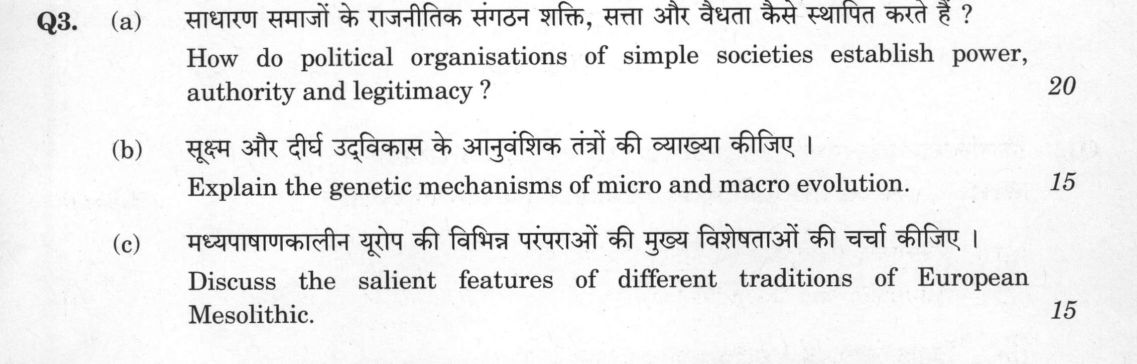
(a) How do political organisations of simple societies establish power, authority and legitimacy? (20 marks) (b) Explain the…
How do political organisations of simple societies establish power, authority and legitimacy? 20 marks
Explain the genetic mechanisms of micro and macro evolution. 15 marks
Discuss the salient features of different traditions of European Mesolithic. 15 marks
हिंदी में प्रश्न पढ़ें
साधारण समाजों के राजनीतिक संगठन शक्ति, सत्ता और वैधता कैसे स्थापित करते हैं ? (20 अंक)
सूक्ष्म और दीर्घ उद्विकास के आनुवंशिक तंत्रों की व्याख्या कीजिए । (15 अंक)
मध्यपाषाणकालीन यूरोप की विभिन्न परंपराओं की मुख्य विशेषताओं की चर्चा कीजिए । (15 अंक)
Model answer
Written by UPSC Answer Check against this question's marking rubric, to the expected length. UPSC does not publish answers for Mains — this is one way to score well, not an official key.
Political Organization and Evolutionary Mechanisms
The interplay between social organization and biological evolution forms the core of anthropological inquiry. To understand human diversity, one must examine how simple societies structure authority and how genetic processes drive evolutionary change.
Political Organizations in Simple Societies In band and tribal societies, political organization is distinct from state-level governance. Power is the capacity to influence others, often through charisma or wealth; authority is institutionalized power backed by social norms; and legitimacy is the recognized right to rule. Unlike centralized states, acephalous (headless) societies rely on egalitarian ethos and consensus.
In band societies, such as the Ju/’hoansi San, decision-making is informal and consensus-based. There is no formal council of elders; instead, leadership is situational, with individuals gaining influence through skill or generosity. Authority is fluid, and "power" is often checked by mechanisms like ridicule or ostracism to prevent dominance.
In tribal societies, more structured mechanisms emerge. The Big Man system, exemplified by the Trobriand Islanders, relies on personal prestige. A Big Man gains authority not through coercion but by redistributing wealth and hosting feasts, thereby creating reciprocal obligations. Legitimacy here stems from demonstrated competence and generosity.
Ritual and Kinship also play crucial roles. Among the Nuer, the Leopard-Skin Chief holds ritual authority but lacks executive power. His role is to mediate disputes and maintain social harmony, deriving legitimacy from spiritual symbolism rather than force. Kinship networks and age-grades further distribute authority, ensuring that power remains diffused and accountable to the community.
Genetic Mechanisms of Micro and Macro Evolution Evolution operates at two levels: microevolution (changes in allele frequencies within populations) and macroevolution (large-scale patterns over geological time).
Microevolution is driven by four primary mechanisms:
- Mutation: The ultimate source of genetic variation. This includes spontaneous errors during DNA replication and induced mutations caused by mutagens such as radiation or chemicals.
- Natural Selection: Differential survival and reproduction based on heritable traits, shifting allele frequencies toward adaptive phenotypes.
- Genetic Drift: Random changes in allele frequencies, particularly significant in small populations. This includes the founder effect (new population started by a few individuals) and bottlenecks (drastic reduction in population size).
- Gene Flow: The transfer of alleles between populations through migration, which can introduce new variation or homogenize populations.
Macroevolution involves large-scale genetic changes that lead to speciation and new forms. Key genetic mechanisms include:
- Gene Duplication: Allows one copy of a gene to maintain original function while the other accumulates mutations, potentially leading to new functions (e.g., globin genes).
- Polyploidy: Whole-genome duplication, common in plants, can instantly create reproductive isolation and new species.
- Chromosomal Rearrangements: Inversions, translocations, or fusions can disrupt recombination, facilitating speciation.
- Regulatory Mutations: Changes in gene expression (when, where, and how much a gene is expressed) rather than protein structure, driving morphological diversity.
- Hybridization: Genetic exchange between distinct species can introduce novel combinations, sometimes leading to new lineages.
These mechanisms connect micro-level changes to macro-level patterns like adaptive radiation and punctuated equilibrium.
European Mesolithic Traditions The European Mesolithic (c. 10,000–6,000 BCE) is characterized by regional adaptations to post-glacial environments.
Northwestern Europe (Maglemosian): Focused on coastal and wetland resources. Key features include bone and antler tools, fish hooks, and dugout canoes. The economy relied heavily on fishing and hunting seals and deer.
Southwestern Europe (Azilian): Adapted to forested environments. Characterized by microlithic tools and distinctive painted pebbles, possibly used as amulets or markers. The diet included aurochs, deer, and small game.
Eastern Europe (Kunda-Swiderian): Adapted to boreal forests. The Kunda culture used tanged points for hunting reindeer and elk. The later Swiderian culture introduced more refined microliths and is associated with the transition to sedentism.
The Mesolithic-Neolithic transition in Europe was gradual, involving the domestication of plants and animals, increased sedentism, and demographic shifts. This parallels the Indian Mesolithic (e.g., Bhimbetka, Langhnaj), where rock art and microliths indicate a shift from pure foraging to proto-agricultural practices.
Conclusion Political structures in simple societies rely on consensus and ritual legitimacy rather than coercion, reflecting a social adaptation to egalitarianism. Simultaneously, genetic mechanisms from mutation to polyploidy drive biological evolution, while cultural adaptations like those in the Mesolithic demonstrate human flexibility. Together, these processes illustrate the integrated nature of human evolution.
What "Explain" is asking you to do
Make the working of something clear — what sets it off, what follows from what, and what it produces. Explain is the Commission's mechanism word: it dominates the technical papers and the “explain why” stems, where the marks sit in the causal chain and not in the label.
Structure that answers it
State what it is → the initiating condition → the chain of cause, step by step → an instance where it plays out → what the chain produces
Where marks are lost
Describing what something looks like instead of why it works that way. Naming the stages without linking them reads as description too.
How this answer will be evaluated
Approach
(a) explain: definition/context > points in order > small example > short close | (b) explain: definition/context > points in order > small example > short close | (c) discuss: intro > 3-4 dimensions > example > balanced close Full marks: Comprehensive, well-structured, with specific examples and theoretical grounding.
Key points expected
- Define power, authority, and legitimacy
- Explain role of elders and chiefs
- Discuss consensus and ritual authority
- Provide ethnographic examples
- Define micro and macro evolution
- Explain mutation and recombination
- Discuss natural selection and drift
- Link mechanisms to evolutionary change
Evaluation rubric
Each sub-part is marked on its own, against the marks and word limit printed on the paper.
- (a) Mechanisms of power, authority, and legitimacy in simple societies. 20 marks
explain— definition/context → points in order → small example → short close
Must cover
- Define power, authority, and legitimacy
- Explain role of elders and chiefs
- Discuss consensus and ritual authority
- Provide ethnographic examples
Loses marks
- Sociological definitions without anthropological context
- Ignoring the 'simple society' constraint
- Confusing state power with tribal authority
Earns more
- Reference to Malinowski or Radcliffe-Brown
- Mention of specific tribal case
- Distinction between power and authority
- Discussion of sanctions
Extra mark
- Reference to Indian tribal context
- Mention of specific recent policy
- (b) Genetic mechanisms driving micro and macro evolution. 15 marks
explain— definition/context → points in order → small example → short close
Must cover
- Define micro and macro evolution
- Explain mutation and recombination
- Discuss natural selection and drift
- Link mechanisms to evolutionary change
Loses marks
- Lamarckian explanations
- Ignoring genetic basis of evolution
- Confusing micro and macro mechanisms
Earns more
- Mention of Hardy-Weinberg equilibrium
- Reference to specific geneticist
- Distinction between gene and species level
- Example of a specific mutation
Extra mark
- Reference to human evolution example
- Mention of specific fossil evidence
- (c) Salient features of different European Mesolithic traditions. 15 marks
discuss— intro → 3-4 dimensions → example → balanced close
Must cover
- Define European Mesolithic
- Identify different traditions
- Describe tool technologies
- Discuss subsistence strategies
Loses marks
- Generalizing all Mesolithic as one
- Ignoring regional variations
- Confusing Mesolithic with Neolithic
Earns more
- Mention of specific sites
- Reference to specific archaeologist
- Discussion of climate impact
- Comparison of traditions
Extra mark
- Reference to specific tool type
- Mention of specific animal species
Practice this exact question
Write your answer and it is marked point by point against the model answer above — what you covered, what you missed, what you got wrong.
Evaluate my answer →More from Anthropology 2021 Paper I
- Q1 Write notes on the following in about 150 words each: (a) Animism and Deep Ecology (10 ma…
- Q2 (a) What are the physical and cultural characteristics of Homo erectus? Discuss its phylo…
- Q3 (a) How do political organisations of simple societies establish power, authority and leg…
- Q4 (a) Elaborate the scope of anthropology and elucidate its uniqueness in the field of othe…
- Q5 Write notes on the following in about 150 words each: (a) Human adolescent growth spurt (…
- Q6 (a) What is acclimatization? Discuss adaptive responses to high altitude and cold climate…