Paper I — Q7
(a) Critically evaluate different types of social stratifications with suitable examples. (20 marks) (b) Discuss the bio-social…
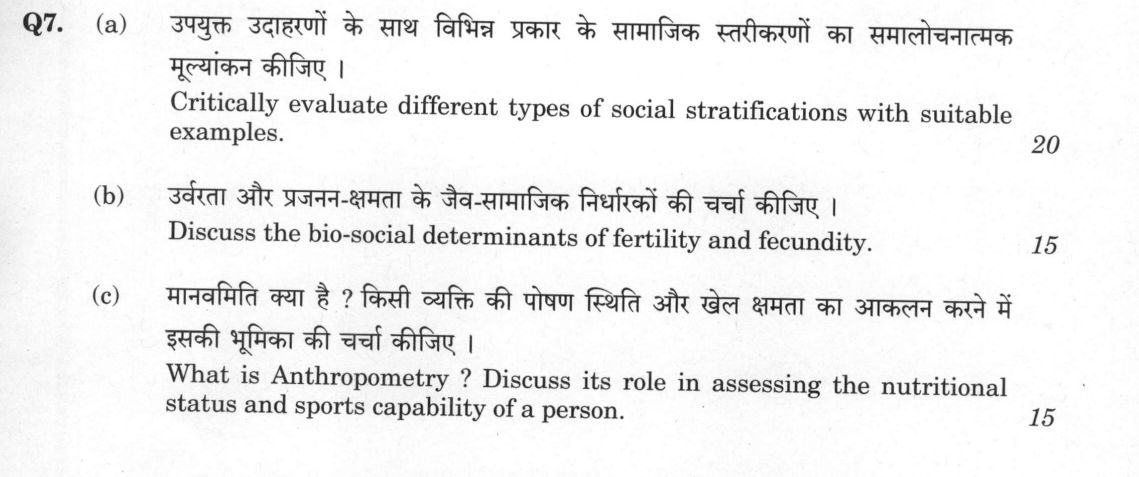
Critically evaluate different types of social stratifications with suitable examples. 20 marks
Discuss the bio-social determinants of fertility and fecundity. 15 marks
What is Anthropometry? Discuss its role in assessing the nutritional status and sports capability of a person. 15 marks
हिंदी में प्रश्न पढ़ें
उपयुक्त उदाहरणों के साथ विभिन्न प्रकार के सामाजिक स्तरीकरणों का समालोचनात्मक मूल्यांकन कीजिए । (20 अंक)
उर्वरता और प्रजनन-क्षमता के जैव-सामाजिक निर्धारकों की चर्चा कीजिए । (15 अंक)
मानवमिति क्या है ? किसी व्यक्ति की पोषण स्थिति और खेल क्षमता का आकलन करने में इसकी भूमिका की चर्चा कीजिए । (15 अंक)
Model answer
Written by UPSC Answer Check against this question's marking rubric, to the expected length. UPSC does not publish answers for Mains — this is one way to score well, not an official key.
Social stratification, fertility dynamics, and anthropometric assessment represent the triad of structural, demographic, and biological lenses through which anthropology interprets human society. To understand contemporary inequality and health outcomes, one must critically evaluate the theoretical frameworks of stratification while analyzing the bio-social drivers of reproduction and the applied utility of body measurements.
Critical Evaluation of Social Stratification Social stratification is the hierarchical arrangement of individuals into layers. A critical evaluation requires distinguishing between closed systems, such as caste and estate, and open systems, like class. Max Weber’s three-component theory posits that stratification arises from class (economic status), status (social prestige), and party (political power). In contrast, Karl Marx’s conflict perspective reduces stratification to the economic base, viewing society as a struggle between the bourgeoisie and proletariat.
In the Indian context, the caste system exemplifies a closed stratification system. The traditional jajmani system enforced endogamy and occupational rigidity, limiting social mobility. However, contemporary India displays a hybrid character. While caste as a status group persists, economic class is increasingly determining life chances, creating a "class-caste" nexus. For instance, Dalit entrepreneurs in urban centers may achieve high economic status but often face status-based discrimination, illustrating the limitations of purely economic models.
Theoretically, the functionalist view of Davis and Moore argues that stratification is necessary to ensure the most talented individuals fill the most important roles, thereby maintaining social stability. Conversely, conflict theorists argue that stratification is a mechanism of exploitation where the elite hoard resources. A critical verdict reveals that neither theory is sufficient alone. Functionalism fails to explain the persistence of inequality despite meritocratic claims, while conflict theory underestimates the role of cultural capital and social networks in mobility. In the American context, the "middle class" ideal masks significant stratification based on race and wealth, demonstrating that open systems are not inherently meritocratic. Thus, stratification is best understood as a dynamic interplay of economic, social, and political forces rather than a static hierarchy.
Bio-Social Determinants of Fertility and Fecundity Fecundity refers to the biological capacity to reproduce, while fertility is the actual number of children born. These are distinct concepts influenced by a complex matrix of bio-social determinants.
Biologically, fertility is constrained by age at menarche and menopause, genetic factors, and overall health status. Chronic diseases, malnutrition, and infectious agents like malaria can suppress fecundity. Socially, the "fertility transition" is driven by education, economic status, family structure, and contraceptive use. Higher female education correlates with delayed marriage and lower fertility rates, as seen in the demographic contrasts within India.
According to NFHS-5 data, the Total Fertility Rate (TFR) in Kerala and Tamil Nadu is 1.8, significantly lower than the national average of 2.0. This divergence is not merely biological but socio-economic. Kerala’s high female literacy and widespread access to family planning services have driven fertility down, whereas states with lower female empowerment retain higher fertility rates. The social determinant of economic status is crucial; as household income rises, the opportunity cost of child-rearing increases, leading to smaller family sizes. Thus, fertility is not a fixed biological trait but a social outcome mediated by health, education, and economic agency.
Anthropometry: Nutritional and Sports Assessment Anthropometry is the science of measuring the human body, including stature, weight, skinfold thickness, and circumferences. While often associated with Alphonse Bertillon, whose system was primarily for criminal identification, the scientific application of anthropometry in physical anthropology was significantly advanced by Aleš Hrdlička and others in the early 20th century to study human variation.
In assessing nutritional status, anthropometry provides objective, non-invasive indicators. The Body Mass Index (BMI) and Mid-Upper Arm Circumference (MUAC) are standard tools used in the Integrated Child Development Services (ICDS) scheme to screen for malnutrition. Indices for wasting (low weight-for-height) and stunting (low height-for-age) help identify acute and chronic malnutrition, respectively, guiding public health interventions.
In sports science, anthropometry is vital for talent identification and somatotyping. The International Society for the Advancement of Kinanthropometry (ISAK) provides standardized protocols for measuring body composition. In Indian sports academies, such as those under the National Sports Promotion Scheme, anthropometric data helps classify athletes into ectomorph, mesomorph, or endomorph types. For example, a mesomorphic build is often correlated with strength and power sports, while an ectomorphic build may suit endurance events. This data allows coaches to tailor training regimens and predict athletic potential, optimizing performance outcomes.
Conclusion In conclusion, a critical evaluation of stratification reveals it as a fluid, multi-dimensional structure rather than a rigid hierarchy. When integrated with the bio-social analysis of fertility and the applied precision of anthropometry, anthropology offers a holistic framework for understanding human development. This triad underscores that biological potential is always mediated by social structures, requiring policy interventions that address both economic inequality and health determinants.
What "Critically evaluate" is asking you to do
Judge how well something has performed against the standard it set for itself — its stated aim, mandate or promise — and commit to a verdict. Name the yardstick before you judge; an unanchored judgement reads as opinion. “Critically” is not a section added at the end: name the yardstick you are judging by — the evidence, the stated objective, a constitutional principle, a rival explanation — and let a verdict close each part of the body. Where the question quotes a claim, that verdict must land on the claim itself, accepted, qualified or rejected, and not on the theme in general.
Structure that answers it
Name the yardstick — stated aim, mandate or benchmark → performance against it → shortfall against it → why the gap exists → verdict
Where marks are lost
Merits in one paragraph, demerits in the next, and a conclusion calling for a balanced and holistic approach. That is a survey with the judgement left out and it holds the answer in the middle band. The opposite error is reading “critically” as permission to attack — and with the odd pairings, critically describe or critically explain, the exposition still carries most of the marks, the judgement being a layer on it rather than a substitute for it.
How this answer will be evaluated
Approach
Framework: UPSC Anthropology Paper 1 (Social Anthropology & Biological Anthropology). (a) critically evaluate: positives > negatives/limits > conditions/safeguards > conclusion | (b) discuss: intro > 3-4 dimensions > example > balanced close | (c) explain: definition/context > points in order > small example > short close Full marks: Comprehensive, critical, and well-structured with specific examples and theoretical references.
Key points expected
- Define social stratification and its criteria
- Distinguish caste, class, and estate systems
- Provide suitable examples for each type
- Critically evaluate the rigidity and fluidity of systems
- Define fertility and fecundity
- Identify biological determinants (age, health)
- Identify social determinants (marriage, education)
- Link biological and social factors
Evaluation rubric
Each sub-part is marked on its own, against the marks and word limit printed on the paper.
- (a) Critical analysis of social stratification types with examples. 20 marks
critically evaluate— positives → negatives/limits → conditions/safeguards → conclusion
Must cover
- Define social stratification and its criteria
- Distinguish caste, class, and estate systems
- Provide suitable examples for each type
- Critically evaluate the rigidity and fluidity of systems
Loses marks
- Descriptive listing without critical evaluation
- Confusing caste with class
- Ignoring the 'suitable examples' requirement
Earns more
- Reference to Kroeber or Srinivas
- Mention of 'Dominant Caste' concept
- Comparison of Western class vs Indian caste
- Reference to 'Sanskritization' or 'Westernization'
Extra mark
- Reference to specific tribal stratification (e.g., Naga)
- Mention of modern mobility (e.g., Dalit politics)
- (b) Discussion of biological and social factors affecting fertility. 15 marks
discuss— intro → 3-4 dimensions → example → balanced close
Must cover
- Define fertility and fecundity
- Identify biological determinants (age, health)
- Identify social determinants (marriage, education)
- Link biological and social factors
Loses marks
- Confusing fertility with fecundity
- Ignoring biological factors
- Ignoring social factors
Earns more
- Mention of 'Demographic Transition Theory'
- Reference to 'Total Fertility Rate' (TFR)
- Discussion of 'Fertility vs Fecundity' gap
- Mention of 'Contraceptive use' as a factor
Extra mark
- Reference to specific Indian demographic data
- Mention of 'Maternal Mortality' impact
- (c) Definition of anthropometry and its role in nutrition/sports. 15 marks
explain— definition/context → points in order → small example → short close
Must cover
- Define anthropometry
- Explain role in assessing nutritional status
- Explain role in assessing sports capability
- Mention specific measurements (height, weight, BMI)
Loses marks
- Defining anthropometry incorrectly
- Ignoring the 'sports capability' aspect
- Ignoring the 'nutritional status' aspect
Earns more
- Mention of 'Body Mass Index' (BMI)
- Reference to 'Body Composition' analysis
- Mention of 'Somatotypes' (Endomorph, Mesomorph)
- Reference to 'Growth Charts'
Extra mark
- Mention of 'DEXA scan' or 'Bioimpedance'
- Reference to 'Sports Anthropometry' applications
Practice this exact question
Write your answer and it is marked point by point against the model answer above — what you covered, what you missed, what you got wrong.
Evaluate my answer →More from Anthropology 2021 Paper I
- Q4 (a) Elaborate the scope of anthropology and elucidate its uniqueness in the field of othe…
- Q5 Write notes on the following in about 150 words each: (a) Human adolescent growth spurt (…
- Q6 (a) What is acclimatization? Discuss adaptive responses to high altitude and cold climate…
- Q7 (a) Critically evaluate different types of social stratifications with suitable examples.…
- Q8 (a) Discuss various tools of data collection in conducting anthropological research. (20…