Paper I — Q2
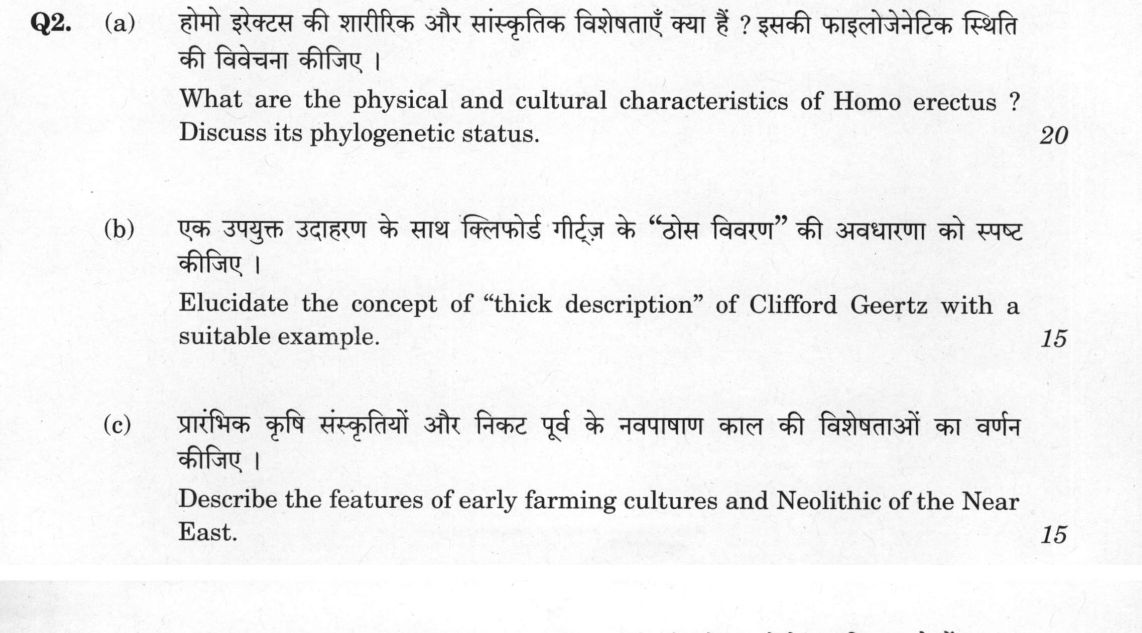
(a) What are the physical and cultural characteristics of Homo erectus? Discuss its phylogenetic status. (20 marks) (b) Elucidate…
What are the physical and cultural characteristics of Homo erectus? Discuss its phylogenetic status. 20 marks
Elucidate the concept of "thick description" of Clifford Geertz with a suitable example. 15 marks
Describe the features of early farming cultures and Neolithic of the Near East. 15 marks
हिंदी में प्रश्न पढ़ें
होमो इरेक्टस की शारीरिक और सांस्कृतिक विशेषताएँ क्या हैं ? इसकी फाइलोजेनेटिक स्थिति की विवेचना कीजिए। (20 अंक)
एक उपयुक्त उदाहरण के साथ क्लिफोर्ड गीर्ट्ज के "थोस विवरण" की अवधारणा को स्पष्ट कीजिए। (15 अंक)
प्रारंभिक कृषि संस्कृतियों और निकट पूर्व के नवपाषाण काल की विशेषताओं का वर्णन कीजिए। (15 अंक)
Model answer
Written by UPSC Answer Check against this question's marking rubric, to the expected length. UPSC does not publish answers for Mains — this is one way to score well, not an official key.
Homo erectus: Biology, Culture, and Phylogeny
Homo erectus represents a pivotal transition in human evolution, characterized by significant anatomical modernization and the first major dispersal out of Africa. Understanding its physical and cultural traits, alongside its contested phylogenetic status, is essential for grasping the trajectory of hominin evolution.
Physical and Cultural Characteristics Physically, H. erectus exhibits a cranial capacity ranging from 900 to 1100 cc, a significant increase over earlier hominins. The skull features a low, long vault, a prominent sagittal keel, and an occipital torus, with persistent prognathism and reduced dentition. Postcranially, the species displays adaptations for efficient bipedalism and endurance running, including longer limbs and a modern-like pelvic structure.
Culturally, H. erectus is associated with the Acheulian tool industry, defined by bifacial handaxes that demonstrate improved planning and symmetry. The controlled use of fire is a hallmark of this period, facilitating cooking and social cohesion. Evidence suggests a shift towards hunting and scavenging, supported by the establishment of home bases or shelters. Crucially, H. erectus achieved the earliest geographic dispersal out of Africa, with fossils found at Dmanisi (Georgia), Java (Indonesia), and Zhoukoudian (China), indicating a wide ecological range.
Phylogenetic Status The phylogenetic status of H. erectus remains debated, primarily concerning its relationship to Homo ergaster and its role in the lineage leading to Homo sapiens. Two main perspectives exist: the single-species hypothesis, which views African and Asian populations as a single, variable species, and the regional continuity model, which posits distinct regional lineages evolving in parallel.
In cladistic terms, H. erectus is often considered a direct ancestor or a close sister group to later archaic humans. However, its relationship to Homo heidelbergensis is complex; while some view H. heidelbergensis as a direct descendant of H. erectus, others argue for a more complex branching pattern involving Homo antecessor. It is critical to note that H. antecessor, known from Atapuerca in Spain, is part of the European lineage and is not an intermediate chronospecies in the African lineage leading to modern humans. The African lineage leading to Homo sapiens is more closely associated with Homo heidelbergensis or Homo rhodesiensis. Thus, H. erectus may represent a side branch that went extinct in Asia, while the African lineage continued to evolve into modern humans, or it may be the direct ancestor of both, depending on the model adopted.
Thick Description: Geertz’s Interpretive Anthropology Clifford Geertz’s concept of "thick description" moves beyond the mere recording of behavior ("thin description") to interpret the layered meanings embedded in cultural actions. Geertz views culture as "webs of significance" that humans themselves spin and in which they are suspended. The anthropologist’s task is to decipher these symbols through an emic perspective, understanding how actors perceive their own world.
A suitable example is Geertz’s analysis of the Balinese cockfight. A thin description would note the physical act of fighting roosters and betting. A thick description, however, reveals that the cockfight is a "text" to be read. It encodes deeper social tensions, status hierarchies, and cosmological meanings. The roosters are proxies for the men, and the fight reflects the competitive dynamics of Balinese society, allowing for the expression of aggression in a controlled, ritualized manner. This illustrates how surface actions are saturated with cultural meaning that is invisible without interpretive analysis.
Early Farming and the Neolithic of the Near East The Neolithic Revolution in the Near East, particularly the Fertile Crescent, marked the transition from foraging to farming. Key features include the domestication of wheat, barley, and legumes, leading to sedentism and the establishment of village settlements. Archaeological evidence shows the development of storage facilities, ground stone tools for processing grain, and the emergence of pottery. Social complexity increased, with evidence of ritual elaboration and monumental architecture.
The Near East is specific in its chronology, divided into Pre-Pottery Neolithic A (PPNA) and B (PPNB) phases. Key sites include Jericho, Çatalhöyük, and ‘Ain Ghazal. The timing of this transition is linked to the end of the Younger Dryas cold period, which may have driven demographic pressure and the need for reliable food sources. Theories range from the "oasis hypothesis" to coevolutionary models, but the consensus emphasizes a gradual process of selection and domestication rather than a sudden invention.
Conclusion In conclusion, Homo erectus bridges the gap between early hominins and later archaic humans, while Geertz’s thick description provides the methodological framework to understand the cultural complexity that emerged with the Neolithic. Together, these concepts highlight the interplay between biological evolution and cultural innovation in shaping the human experience.
What "Discuss" is asking you to do
Lay the issue out from more than one side — how it arose, what is claimed for it, what is held against it, and where it now stands. UPSC attaches discuss to broad topics with several live dimensions, so coverage of the dimensions earns more than the strength of your opinion.
Structure that answers it
Set the issue up → the case as it is made → the case against → the dimension both sides leave out → where the balance now lies
Where marks are lost
Listing facts with no thread between them, or arguing one side throughout and calling it a discussion.
How this answer will be evaluated
Approach
Framework: UPSC Anthropology Paper 1 (Physical & Social). (a) discuss: intro > 3-4 dimensions > example > balanced close | (b) explain: definition/context > points in order > small example > short close | (c) describe: define > structure or process in order > labelled diagram > significance Full marks: Comprehensive, specific, well-structured, with named sites/thinkers and diagrams.
Key points expected
- Physical traits: bipedalism, brain size, robust build
- Cultural traits: stone tools, fire use, migration
- Phylogenetic status: link to H. sapiens
- Mention key sites: Java, Peking, Africa
- Define 'thick description' (interpretive anthropology)
- Contrast with 'thin description' (Ryle)
- Provide a suitable example (e.g., winking)
- Explain the role of context in meaning
Evaluation rubric
Each sub-part is marked on its own, against the marks and word limit printed on the paper.
- (a) Physical/cultural traits of Homo erectus and its phylogenetic status. 20 marks
discuss— intro → 3-4 dimensions → example → balanced close
Must cover
- Physical traits: bipedalism, brain size, robust build
- Cultural traits: stone tools, fire use, migration
- Phylogenetic status: link to H. sapiens
- Mention key sites: Java, Peking, Africa
Loses marks
- Confusing H. erectus with H. habilis
- Ignoring the phylogenetic status part
- No mention of specific fossil sites
Earns more
- Mention specific tool industries (Oldowan/Acheulean)
- Reference to specific fossils (Nariokotome, Dmanisi)
- Discussion of 'Out of Africa' vs 'Multiregional' debate
Extra mark
- Labelled skull or tool diagram
- Specific dates (e.g., 1.8 Ma)
- (b) Clifford Geertz's 'thick description' concept with a suitable example. 15 marks
explain— definition/context → points in order → small example → short close
Must cover
- Define 'thick description' (interpretive anthropology)
- Contrast with 'thin description' (Ryle)
- Provide a suitable example (e.g., winking)
- Explain the role of context in meaning
Loses marks
- Treating it as a general description method
- No example provided
- Confusing with 'thick data' in other fields
Earns more
- Reference to Clifford Geertz's 'The Interpretation of Cultures'
- Mention of 'webs of significance'
- Link to ethnographic fieldwork methodology
Extra mark
- Specific quote from Geertz
- Comparison with other interpretive anthropologists
- (c) Features of early farming cultures and Neolithic of the Near East. 15 marks
describe— define → structure or process in order → labelled diagram → significance
Must cover
- Define 'Neolithic Revolution' in Near East context
- List key features: domestication, settlement, tools
- Mention specific sites (e.g., Jericho, Çatalhöyük)
- Describe social changes (hierarchy, storage)
Loses marks
- Confusing with Neolithic of other regions
- No mention of specific sites
- Ignoring the 'farming' aspect
Earns more
- Mention specific crops (wheat, barley)
- Reference to 'Pre-Pottery Neolithic' (PPN) phases
- Discussion of 'Natufian' precursor culture
Extra mark
- Map of Near East sites
- Specific dates for Neolithic phases
Practice this exact question
Write your answer and it is marked point by point against the model answer above — what you covered, what you missed, what you got wrong.
Evaluate my answer →More from Anthropology 2021 Paper I
- Q1 Write notes on the following in about 150 words each: (a) Animism and Deep Ecology (10 ma…
- Q2 (a) What are the physical and cultural characteristics of Homo erectus? Discuss its phylo…
- Q3 (a) How do political organisations of simple societies establish power, authority and leg…
- Q4 (a) Elaborate the scope of anthropology and elucidate its uniqueness in the field of othe…
- Q5 Write notes on the following in about 150 words each: (a) Human adolescent growth spurt (…