Paper II — Q1
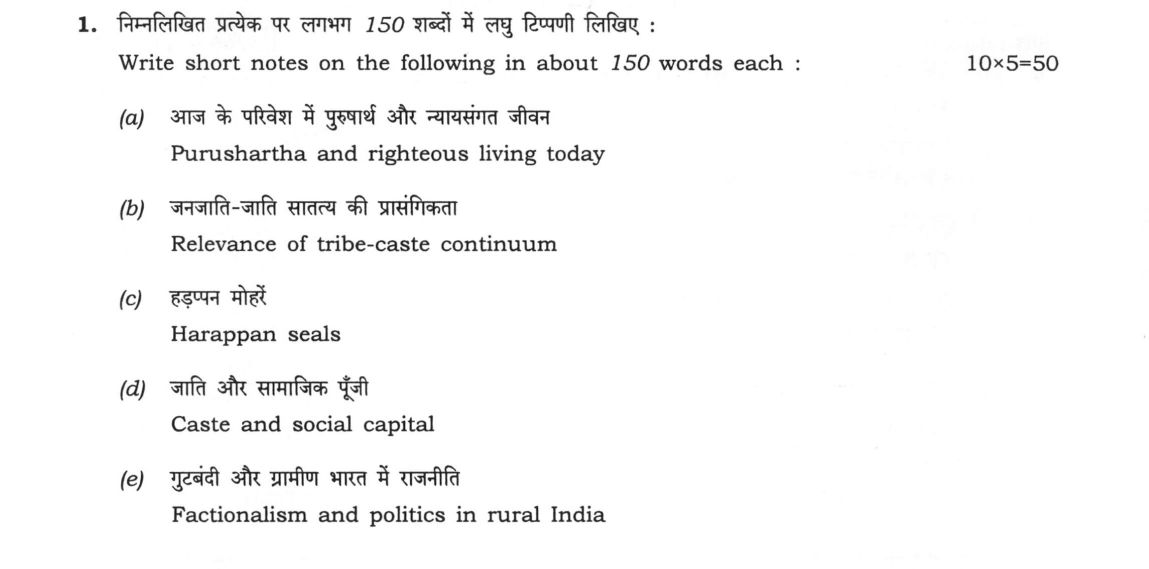
Write short notes on the following in about 150 words each: (a) Purushartha and righteous living today (10 marks) (b) Relevance…
Write short notes on the following in about 150 words each: Purushartha and righteous living today 10 marks
Relevance of tribe-caste continuum 10 marks
Harappan seals 10 marks
Caste and social capital 10 marks
Factionalism and politics in rural India 10 marks
हिंदी में प्रश्न पढ़ें
निम्नलिखित प्रत्येक पर लगभग 150 शब्दों में लघु टिप्पणी लिखिए : आज के परिवेश में पुरुषार्थ और न्यायसंगत जीवन (10 अंक)
जनजाति-जाति सातत्य की प्रासंगिकता (10 अंक)
हड़प्पन मोहरे (10 अंक)
जाति और सामाजिक पूँजी (10 अंक)
गुटबंदी और ग्रामीण भारत में राजनीति (10 अंक)
Model answer
Written by UPSC Answer Check against this question's marking rubric, to the 150-word length. UPSC does not publish answers for Mains — this is one way to score well, not an official key.
(a) Purushartha and Righteous Living Today
Purushartha refers to the classical Hindu blueprint of fourfold human pursuits: Dharma (moral duty and righteousness), Artha (material wealth and security), Kama (sensual and aesthetic fulfillment), and Moksha (spiritual liberation). These pursuits exist in an integrated hierarchical matrix where Dharma serves as the foundational regulator of Artha and Kama, directing human action toward the ultimate goal of Moksha. In contemporary society, this paradigm holds critical relevance for ethical living. Unchecked pursuit of Artha and Kama has precipitated consumerism, corporate malfeasance, and environmental degradation; regulating them through Dharma restores moral balance. In the corporate sphere, it underpins stakeholder capitalism and ethical wealth generation (Corporate Social Responsibility). At an individual level, Purushartha provides a framework for work-life balance and mental health by checking unbridled materialism. Furthermore, expanding Dharma to encompass environmental stewardship (Prakriti Dharma) provides normative guidance to navigate modern ecological and ethical dilemmas.
(b) Relevance of Tribe-Caste Continuum
The tribe-caste continuum model, formulated by F.G. Bailey (1960) and elaborated by Surajit Sinha and M.N. Srinivas, conceptualizes tribes and castes not as rigid dichotomies, but as ideal polar types along a structural spectrum. Bailey posited that tribal systems operate on egalitarian, direct access to land through segmentary kin networks, while caste systems feature hierarchical, mediated control of resources (organic solidarity). Historically, communities traversed this continuum through Sanskritization, agrarian assimilation, and state formation. In contemporary India, this continuum retains sharp diagnostic relevance amid shifting identity politics. Instead of unidirectional absorption into the caste hierarchy, the dynamic has reversed toward "re-tribalization." Many intermediate peasant and agrarian castes (such as Kurmis, Gujjars, and Meiteis) demand Scheduled Tribe (ST) status under Article 342. Consequently, groups actively negotiate the continuum to assert ethnic distinctiveness and secure constitutional reservations rather than seeking higher ritual status within the varna hierarchy.
(c) Harappan Seals
Harappan seals, mostly cut from steatite (soapstone) and occasionally made of faience, terracotta, and chert, represent the hallmark of Bronze Age glyptic art. Measuring typically 2x2 cm with a perforated boss on the reverse for handling, they exhibit intaglio carvings of realistic animal motifs—predominantly the unicorn, followed by the humped bull, elephant, rhinoceros, and composite beasts—alongside inscriptions in the undeciphered, boustrophedon Indus script. Functionally, clay impressions found on trade packages (such as at Lothal) demonstrate their administrative use in securing merchant property and validating long-distance trade with Mesopotamia. The seals also carried profound socio-religious and symbolic meanings. Sir John Marshall interpreted the "Pashupati seal" from Mohenjo-daro as a proto-Shiva archetype surrounded by beasts, while Asko Parpola used Dravidian linguistic and astral models to decipher seal iconography. Their standardization across widespread settlements underscores centralized civic governance and institutionalized economic networks across the Harappan civilization.
(d) Caste and Social Capital
Applying Pierre Bourdieu’s framework of social capital—the aggregate of actual or potential resources linked to durable networks of mutual acquaintance—caste functions as an institutionalized network of trust, reciprocity, and social closure. Caste operates largely as "bonding social capital," fostering strong intra-group solidarity and mutual aid. Historically, mercantile castes like the Marwaris and Chettiars converted endogamous caste ties into informal credit networks, information pools, and risk-sharing systems. However, as Robert Putnam's dichotomy illustrates, intense bonding social capital within castes often obstructs "bridging social capital," reinforcing inter-caste cleavages, social exclusion, and structural inequality. In modern democratic India, as Anirudh Krishna demonstrates, caste has reorganized into horizontal caste associations (sabhas). These associations aggregate collective social capital to negotiate with state institutions, access developmental benefits, and mobilize voter bases, transforming primordial caste ties into instruments of modern economic mobility and democratic bargaining.
(e) Factionalism and Politics in Rural India
Factionalism in rural India refers to informal, non-permanent, conflict-oriented interest groups led by rival patrons competing for political power, status, and state resources. Unlike castes, factions are structurally vertical, cutting across jatis through patron-client ties, debt obligations, and kinship networks. In foundational ethnographic literature, Oscar Lewis (Group Dynamics in a North Indian Village) identified factions in Rampur as locus-of-power units anchored in kinship lineages (dhadhas). André Béteille’s study of Sripuram demonstrated a shift from cumulative inequalities (where Brahmins held land, status, and authority) to dispersed inequalities, creating multi-caste political alliances. F.G. Bailey similarly highlighted how caste serves as a strategic "political resource" in village factional disputes. Within Panchayati Raj institutions, factional competition often impedes inclusive governance through clientelist resource distribution; nevertheless, it also fractures dominant-caste monopolies, compelling elites to build broad cross-caste coalitions and expanding competitive democratic participation at the grassroots level.
What "Write short notes" is asking you to do
Five or six self-contained answers, marked separately, typically 10 marks and about 150 words each. Each note must carry its own definition, its two or three defining features and a line on why it matters; a common introduction or conclusion across the notes earns nothing.
Structure that answers it
Per note: one-line definition or identification → two or three features, mechanisms or named examples → one line of significance or Indian application
Where marks are lost
Writing the first two notes at essay length and rationing the rest. Each note is marked on its own, so marks surrendered on a compressed or unattempted note cannot be won back by the long ones.
How this answer will be evaluated
Approach
Framework: UPSC Anthropology Paper II (Sociology & Social Anthropology). (a) write short notes: define > 3-4 key features > one example > one-line significance | (b) write short notes: define > 3-4 key features > one example > one-line significance | (c) write short notes: define > 3-4 key features > one example > one-line significance | (d) write short notes: define > 3-4 key features > one example > one-line significance | (e) write short notes: define > 3-4 key features > one example > one-line significance Full marks: Precise definitions, named theorists, specific examples, clear structure
Key points expected
- Define Dharma, Artha, Kama, Moksha
- Link Dharma to modern 'righteous living'
- One example of Artha/Kama conflict
- One line on contemporary relevance
- Define Tribe-Caste continuum
- Mention Sanskritization (M.N. Srinivas)
- One example of tribal caste-ization
- Significance for social mobility
Evaluation rubric
Each sub-part is marked on its own, against the marks and word limit printed on the paper.
- (a) Define Purushartha and apply its four aims to contemporary ethical dilemmas. · 150 words
write short notes— define → 3-4 key features → one example → one-line significance
Must cover
- Define Dharma, Artha, Kama, Moksha
- Link Dharma to modern 'righteous living'
- One example of Artha/Kama conflict
- One line on contemporary relevance
Loses marks
- Treating as purely religious text
- Ignoring the 'today' aspect
Earns more
- Reference to Manusmriti or Gita
- Mention of 'Svadharm'
Extra mark
- Reference to specific modern ethical code
- (b) Explain the continuum concept and its significance in Indian social structure. · 150 words
write short notes— define → 3-4 key features → one example → one-line significance
Must cover
- Define Tribe-Caste continuum
- Mention Sanskritization (M.N. Srinivas)
- One example of tribal caste-ization
- Significance for social mobility
Loses marks
- Treating tribe and caste as static
- Ignoring the 'continuum' aspect
Earns more
- Reference to G.S. Ghurye
- Mention of 'Sanskritization' vs 'Westernization'
Extra mark
- Specific tribal example (e.g., Bhils, Gonds)
- (c) Describe Harappan seals and their significance in understanding the civilization. · 150 words
write short notes— define → 3-4 key features → one example → one-line significance
Must cover
- Material (steatite) and size
- Key motifs (unicorn, bull, tree)
- Undeciphered script
- Significance for trade/administration
Loses marks
- Confusing with other Indus Valley artifacts
- Ignoring the script aspect
Earns more
- Mention of 'Pashupati' seal
- Reference to 'Indus script'
Extra mark
- Specific site (e.g., Mohenjo-daro, Harappa)
- (d) Analyze how caste functions as a source of social capital in India. · 150 words
write short notes— define → 3-4 key features → one example → one-line significance
Must cover
- Define social capital (Bourdieu)
- Caste as network for resources
- One example of caste-based capital
- Critique of caste capital
Loses marks
- Ignoring the 'capital' aspect
- Treating caste as purely oppressive
Earns more
- Reference to Pierre Bourdieu
- Mention of 'Jati' networks
Extra mark
- Specific example of caste-based business
- (e) Explain factionalism and its impact on rural Indian politics. · 150 words
write short notes— define → 3-4 key features → one example → one-line significance
Must cover
- Define factionalism
- Role of caste/kinship in factions
- One example of rural faction
- Impact on democratic process
Loses marks
- Ignoring the 'rural' context
- Treating as purely urban phenomenon
Earns more
- Reference to 'Jajmani' system
- Mention of 'vote banks'
Extra mark
- Specific state/region example
Practice this exact question
Write your answer and it is marked point by point against the model answer above — what you covered, what you missed, what you got wrong.
Evaluate my answer →More from Anthropology 2021 Paper II
- Q1 Write short notes on the following in about 150 words each: (a) Purushartha and righteous…
- Q2 (a) Critically discuss the origin of Indus Valley Civilization. Mention the evidences of…
- Q3 (a) Explain the impact of the concept of nature-man-spirit complex on sustainable use of…
- Q4 (a) Discuss the contributions of N. K. Bose in understanding tribal communities and their…