Paper II — Q2
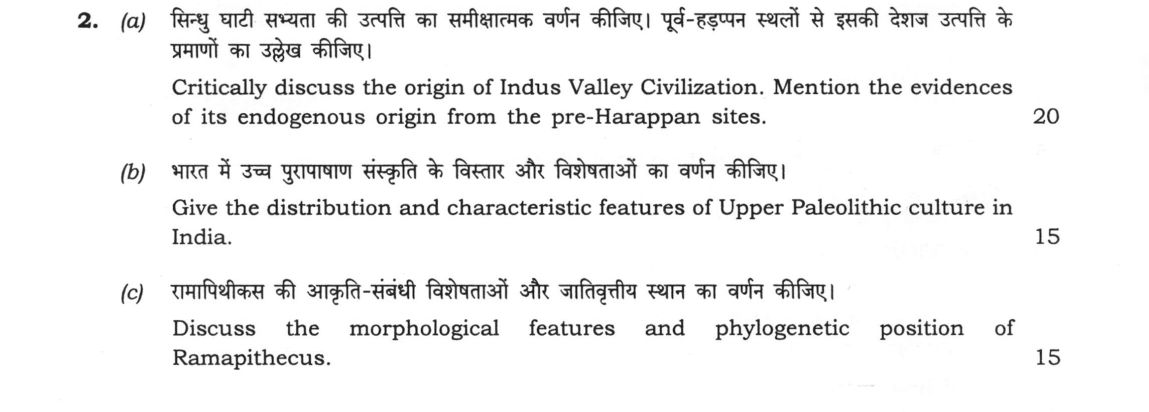
(a) Critically discuss the origin of Indus Valley Civilization. Mention the evidences of its endogenous origin from the…
Critically discuss the origin of Indus Valley Civilization. Mention the evidences of its endogenous origin from the pre-Harappan sites. 20 marks
Give the distribution and characteristic features of Upper Paleolithic culture in India. 15 marks
Discuss the morphological features and phylogenetic position of Ramapithecus. 15 marks
हिंदी में प्रश्न पढ़ें
सिन्धु घाटी सभ्यता की उत्पत्ति का समीक्षात्मक वर्णन कीजिए। पूर्व-हड़प्पन स्थलों से इसकी देशज उत्पत्ति के प्रमाणों का उल्लेख कीजिए। (20 अंक)
भारत में उच्च पुरापाषाण संस्कृति के विस्तार और विशेषताओं का वर्णन कीजिए। (15 अंक)
रामापिथेकस की आकृति-संबंधी विशेषताओं और जातिवृत्तीय स्थान का वर्णन कीजिए। (15 अंक)
Model answer
Written by UPSC Answer Check against this question's marking rubric, to the expected length. UPSC does not publish answers for Mains — this is one way to score well, not an official key.
Origin of the Indus Valley Civilization
The debate on the origin of the Indus Valley Civilization (IVC) has shifted from diffusionist models to an endogenous perspective. Early scholars like Mortimer Wheeler proposed a "Minoan" influence, suggesting a sudden collapse of a foreign culture. However, critical analysis of archaeological stratigraphy supports an indigenous, gradual evolution. The endogenous theory posits that the mature Harappan phase emerged from distinct pre-Harappan cultures through local adaptation and integration.
Key evidence lies in the continuity observed at sites like Mehrgarh in Baluchistan. Here, the transition from Neolithic agriculture to the Early Harappan phase is seamless, showing the development of standardized weights and pottery. In the Sindh region, the Amri and Kot Diji cultures demonstrate a clear technological progression in pottery and urban planning. Kot Diji, in particular, shows the emergence of the "Kot Diji ware" which persists into the Mature Harappan phase, indicating cultural continuity rather than replacement. Similarly, Kalibangan’s Period I reveals early urban planning features, such as aligned streets and granaries, predating the mature phase. While pre-Harappan sites feature potters’ marks and graffiti, the complex Harappan script is a distinct mature-phase development, not a direct continuation of these earlier symbols.
The debate between Wheeler’s diffusionism and the endogenous views of scholars like W.N. Fairservis and G. Possehl is central. Fairservis emphasized the role of local ecological adaptation, while Possehl highlighted the regional variants like the Sothi-Siswal, Anarta, and Padri cultures. These regional diversities, which eventually converged into the standardized Harappan system, strongly support an indigenous origin. The absence of a single point of origin and the presence of parallel developments across the Indus basin confirm that the IVC was a product of long-term, local socio-economic evolution.
Upper Paleolithic Culture in India
The Upper Paleolithic (UP) in India, dating roughly from 40,000 to 10,000 BP, is characterized by a significant shift in technology and subsistence. Its distribution is widespread, with key sites including Bhimbetka in Madhya Pradesh, the Belan Valley in Uttar Pradesh, Patne in Bihar, and the caves of Kurnool in Andhra Pradesh.
Technologically, the UP is defined by the dominance of blade and burin technology. Unlike the earlier Middle Paleolithic, which relied on flake tools, UP assemblages feature fine, parallel-sided blades and specialized tools like burins for engraving. Bone tools, such as awls and needles, also appear, indicating advanced craft production. Sites like Chopani-Mando in the Belan Valley and Baghor II in Madhya Pradesh provide crucial radiocarbon dates, anchoring the UP chronology in India.
The economy was strictly hunting and gathering. Faunal evidence from sites like Bhimbetka shows a reliance on large game such as deer and wild boar, alongside smaller fauna. There is no evidence of pastoralism, which is a Neolithic development. The UP is also marked by the emergence of symbolic behavior. The rock art at Bhimbetka, featuring hand stencils and hunting scenes, represents some of the earliest known artistic expressions in India. These sites, both cave and open-air, reflect a society that was increasingly mobile, technologically sophisticated, and culturally complex, laying the groundwork for the subsequent Mesolithic and Neolithic transitions.
Ramapithecus: Morphology and Phylogeny
Ramapithecus is a fossil primate genus primarily known from the Siwalik deposits of India and Pakistan, as well as sites in Turkey and Kenya. Morphologically, it exhibits features that sparked intense debate. It possesses thick enamel on its molars, reduced canines, and a parabolic dental arcade, which differ from the U-shaped arcade of typical apes. Its facial structure is prognathous, and the cranial capacity is estimated to be around 70-80 cc.
The phylogenetic position of Ramapithecus has been a subject of significant controversy. Initially, based on limited cranial material, E. Simons and D. Pilbeam argued in the 1970s that Ramapithecus was an early hominid ancestor, distinct from the orang-utan lineage. This view suggested that human evolution began in Asia. However, subsequent discoveries of more complete cranial and post-cranial material from the Siwaliks and other regions led to a re-evaluation.
Modern consensus, supported by scholars like P. Andrews and J. Kelley, classifies Ramapithecus as an ancestral form of the orang-utan (Pongo), not a direct ancestor of Homo. The dental and cranial features previously attributed to hominid ancestry are now understood as adaptations within the Ponginae subfamily. The distinction from Sivapithecus, another Siwalik primate, is also clearer now, with Ramapithecus showing more derived traits towards the modern orang-utan. This reclassification underscores the importance of comprehensive fossil evidence in phylogenetic debates and confirms that the primary lineage of human evolution is rooted in Africa, not Asia.
Conclusion
These three strands—urban origins, Paleolithic foundations, and hominid evolution—collectively demonstrate India’s crucial position in Old World prehistory. The endogenous origin of the IVC highlights indigenous cultural complexity, the Upper Paleolithic reveals the technological and symbolic roots of modern human behavior, and the Ramapithecus debate illustrates the rigorous scientific process of refining evolutionary narratives. Together, they affirm India’s role as a vital region for understanding the deep history of human civilization and biological evolution.
What "Critically discuss" is asking you to do
Lay the issue out from more than one side — how it arose, what is claimed for it, what is held against it, and where it now stands. UPSC attaches discuss to broad topics with several live dimensions, so coverage of the dimensions earns more than the strength of your opinion. “Critically” is not a section added at the end: name the yardstick you are judging by — the evidence, the stated objective, a constitutional principle, a rival explanation — and let a verdict close each part of the body. Where the question quotes a claim, that verdict must land on the claim itself, accepted, qualified or rejected, and not on the theme in general.
Structure that answers it
Set the issue up → the case as it is made → the case against → the dimension both sides leave out → where the balance now lies
Where marks are lost
Merits in one paragraph, demerits in the next, and a conclusion calling for a balanced and holistic approach. That is a survey with the judgement left out and it holds the answer in the middle band. The opposite error is reading “critically” as permission to attack — and with the odd pairings, critically describe or critically explain, the exposition still carries most of the marks, the judgement being a layer on it rather than a substitute for it.
How this answer will be evaluated
Approach
(a) discuss: intro > 3-4 dimensions > example > balanced close | (b) explain: definition/context > points in order > small example > short close | (c) discuss: intro > 3-4 dimensions > example > balanced close Full marks: Comprehensive, critical, and specific; names sites, scholars, and features; uses diagrams where appropriate.
Key points expected
- Critique of Aryan invasion and Indigenist origin theories
- Evidence from Rakhigarhi and Balathal (endogenous)
- Continuity from pre-Harappan to Harappan phases
- Mention of specific pre-Harappan sites (e.g., Hakra, Sothi)
- Distribution in river valleys (Narmada, Ganga, Kosi)
- Features: microliths, bone tools, burins
- Mention of specific sites (e.g., Bagor, Kurnool)
- Transition from Lower to Upper Paleolithic
Evaluation rubric
Each sub-part is marked on its own, against the marks and word limit printed on the paper.
- (a) Critical analysis of IVC origin theories and endogenous evidence from pre-Harappan sites. 20 marks
discuss— intro → 3-4 dimensions → example → balanced close
Must cover
- Critique of Aryan invasion and Indigenist origin theories
- Evidence from Rakhigarhi and Balathal (endogenous)
- Continuity from pre-Harappan to Harappan phases
- Mention of specific pre-Harappan sites (e.g., Hakra, Sothi)
Loses marks
- Treating Aryan invasion as established fact
- Ignoring the 'critical' aspect of the command word
- Vague references to 'ancient culture' without site names
Earns more
- Reference to DNA studies (Rakhigarhi)
- Mention of specific scholars (e.g., Kenoyer, Possehl)
- Discussion of cultural continuity in pottery/weights
Extra mark
- Labelled map of pre-Harappan sites
- Reference to specific recent excavation reports
- (b) Geographical distribution and key features of Upper Paleolithic culture in India. 15 marks
explain— definition/context → points in order → small example → short close
Must cover
- Distribution in river valleys (Narmada, Ganga, Kosi)
- Features: microliths, bone tools, burins
- Mention of specific sites (e.g., Bagor, Kurnool)
- Transition from Lower to Upper Paleolithic
Loses marks
- Confusing Upper Paleolithic with Mesolithic
- Ignoring the 'distribution' aspect of the question
- Vague descriptions of tools without specific names
Earns more
- Mention of specific tool types (e.g., scrapers, points)
- Reference to specific scholars (e.g., Ghosh, Corbeil)
- Discussion of climatic factors (Pleistocene-Holocene transition)
Extra mark
- Sketch of a microlith or burin
- Reference to specific stratigraphic layers
- (c) Morphological features and phylogenetic position of Ramapithecus. 15 marks
discuss— intro → 3-4 dimensions → example → balanced close
Must cover
- Morphology: small size, flat face, small canines
- Phylogenetic position: debate (ancestor vs. side branch)
- Mention of specific sites (e.g., Siwalik Hills)
- Comparison with Australopithecus and Homo
Loses marks
- Treating Ramapithecus as a direct ancestor without debate
- Ignoring the 'morphological' aspect of the question
- Vague descriptions of features without specific names
Earns more
- Reference to specific scholars (e.g., Le Gros Clark, Pilbeam)
- Discussion of dental morphology (premolars, molars)
- Mention of specific fossil specimens (e.g., Ramapithecus punjabensis)
Extra mark
- Sketch of Ramapithecus skull
- Reference to specific phylogenetic trees
Practice this exact question
Write your answer and it is marked point by point against the model answer above — what you covered, what you missed, what you got wrong.
Evaluate my answer →More from Anthropology 2021 Paper II
- Q1 Write short notes on the following in about 150 words each: (a) Purushartha and righteous…
- Q2 (a) Critically discuss the origin of Indus Valley Civilization. Mention the evidences of…
- Q3 (a) Explain the impact of the concept of nature-man-spirit complex on sustainable use of…
- Q4 (a) Discuss the contributions of N. K. Bose in understanding tribal communities and their…
- Q5 Write short notes on the following in about 150 words each: (a) Urbanization and tribal i…