Paper II — Q5
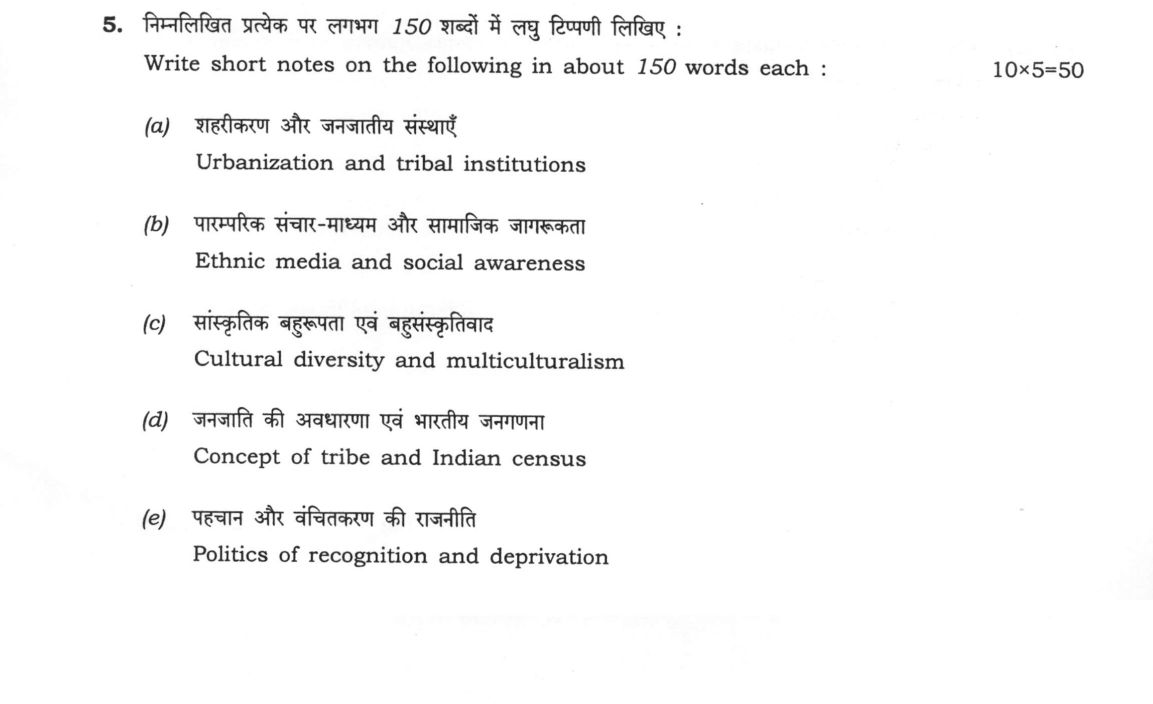
Write short notes on the following in about 150 words each: (a) Urbanization and tribal institutions (10 marks) (b) Ethnic media…
Write short notes on the following in about 150 words each: Urbanization and tribal institutions 10 marks
Ethnic media and social awareness 10 marks
Cultural diversity and multiculturalism 10 marks
Concept of tribe and Indian census 10 marks
Politics of recognition and deprivation 10 marks
हिंदी में प्रश्न पढ़ें
निम्नलिखित प्रत्येक पर लगभग 150 शब्दों में लघु टिप्पणी लिखिए : शहरीकरण और जनजातीय संस्थाएं (10 अंक)
पारंपरिक संचार-माध्यम और सामाजिक जागरूकता (10 अंक)
सांस्कृतिक बहुरूपता एवं बहुसंस्कृतिवाद (10 अंक)
जनजाति की अवधारणा एवं भारतीय जनगणना (10 अंक)
पहचान और वंचितकरण की राजनीति (10 अंक)
Model answer
Written by UPSC Answer Check against this question's marking rubric, to the 150-word length. UPSC does not publish answers for Mains — this is one way to score well, not an official key.
Urbanization and Tribal Institutions Urbanization acts as a primary driver of institutional transformation among tribal communities, disrupting traditional social structures through migration and economic integration. The exodus from rural heartlands to urban centers like Mumbai, Delhi, and Bangalore leads to the erosion of collective institutions such as village councils (Gram Sabha) and sacred groves, which rely on physical proximity and agrarian rhythms. This process is often described as "de-tribalization," where tribal identity dilutes under the pressure of caste-based urban hierarchies and market logic. However, a counter-trend of "re-tribalization" emerges as migrants form ethnic enclaves to preserve cultural markers and access state benefits. For instance, tribal migrants in Delhi often maintain distinct residential clusters to sustain kinship networks. Yet, this urban adaptation frequently results in the alienation from ancestral lands, as seen in the displacement of Adivasis in Bastar for industrial projects, forcing a shift from subsistence to wage labor. Consequently, traditional institutions do not vanish but hybridize, adapting to urban legal and economic frameworks while retaining symbolic significance for identity preservation. The challenge lies in balancing modernization with the protection of communal autonomy, ensuring that urbanization does not merely extract labor but also respects the institutional integrity of tribal societies.
Ethnic Media and Social Awareness Ethnic media, comprising community radio, indigenous language press, and digital platforms, serves as a critical tool for social awareness and identity mobilization among tribal groups. Unlike mainstream media, which often marginalizes tribal narratives, ethnic media provides a space for self-representation, allowing communities to articulate their grievances, cultural heritage, and political demands. This medium plays a pivotal role in consciousness-raising, enabling tribes to understand their legal rights and mobilize for resource control. For example, All India Radio’s tribal language broadcasts and community radio stations in the Khasi Hills have been instrumental in disseminating information about land rights and health services, bridging the information gap in remote areas. Furthermore, ethnic media facilitates the construction of a collective political identity, transforming cultural distinctiveness into a basis for rights claims. It acts as a counter-narrative to state-centric development discourses, highlighting issues like displacement and environmental degradation. The rise of digital ethnic media has further amplified these voices, allowing for real-time coordination of protests and advocacy. Thus, ethnic media is not merely a communication channel but a site of political agency, empowering tribal communities to engage with the state and society on their own terms, fostering a sense of dignity and belonging in a pluralistic democracy.
Cultural Diversity and Multiculturalism Cultural diversity is an empirical fact of Indian society, characterized by the coexistence of distinct languages, religions, and customs. Multiculturalism, conversely, is a normative political framework that seeks to manage this diversity through policies of recognition and accommodation. While diversity describes the "what," multiculturalism addresses the "how" of living together. In the Indian context, constitutional pluralism provides the legal architecture for this, with Articles 29 and 30 protecting the right of minorities to conserve their language, script, and culture, and Article 350A requiring states to endeavor to provide adequate facilities for instruction in the mother tongue at the primary stage. This is not a mandate but a directive principle aimed at reducing linguistic alienation. Theoretical perspectives, such as those by Charles Taylor and Bhikhu Parekh, argue that multiculturalism is essential for justice, as it validates the self-understanding of diverse groups. However, critics argue that excessive emphasis on difference can fragment national unity. In India, the challenge is to balance the protection of tribal and minority cultures with the integration of a common civic identity. The state’s role is to ensure that cultural diversity does not lead to social fragmentation but rather enriches the national fabric, fostering a society where difference is respected without becoming a barrier to equality or development.
Concept of Tribe and Indian Census The concept of "tribe" in India is historically contingent, shaped by colonial census operations and post-independence constitutional definitions. The 1871 Census introduced the distinction between "caste" and "tribe," largely based on the presence of totemism, exogamy, and geographical isolation. This colonial categorization was administrative, often conflating social and political identities. Post-independence, the Constitution (Scheduled Tribes) Order, 1950, under Article 342, formalized the ST category, which the 1951 Census subsequently used for enumeration. The criteria for inclusion, later refined by the Lokur Committee in 1978, include primitive traits, distinctive culture, geographical isolation, and shyness of contact with the community at large. These are administrative criteria recommended by the committee to guide identification, not necessarily inherent sociological definitions. The Xaxa Committee (1993) critiqued the rigidity of these categories, arguing that they freeze a dynamic social reality. The census continues to face challenges in accurately capturing the fluid boundaries of tribal identity, especially in areas of caste-tribe interface. Thus, the "tribe" is less a fixed anthropological entity and more a legal-administrative category that determines access to state resources and protections, reflecting the complex interplay between identity, power, and policy in Indian governance.
Politics of Recognition and Deprivation The politics of recognition and deprivation centers on the dual struggle for cultural validation and material redistribution, a framework elucidated by Nancy Fraser. For tribal communities, recognition involves the state acknowledging their distinct cultural identity and historical rights, while deprivation refers to the structural economic and social marginalization they face. In India, this manifests in debates over ST reservation and sub-categorization. The demand for sub-categorization within the ST list, as seen in the case of the Gond and other tribes, highlights the internal hierarchies and the uneven distribution of benefits. Recognition is not just symbolic; it is linked to access to land, forests, and development funds. The Forest Rights Act, 2006, represents a form of recognition by legally affirming the rights of forest-dwelling communities. However, the politics of deprivation persist as many tribes remain excluded from the mainstream economy, leading to demands for targeted welfare schemes. The tension lies in balancing universal citizenship with particularistic claims. A just approach requires both the redistribution of resources to address economic deprivation and the recognition of cultural distinctiveness to ensure dignity. This dual focus is essential for addressing the multidimensional nature of tribal marginalization, ensuring that equality is not merely formal but substantive.
What "Write short notes" is asking you to do
Five or six self-contained answers, marked separately, typically 10 marks and about 150 words each. Each note must carry its own definition, its two or three defining features and a line on why it matters; a common introduction or conclusion across the notes earns nothing.
Structure that answers it
Per note: one-line definition or identification → two or three features, mechanisms or named examples → one line of significance or Indian application
Where marks are lost
Writing the first two notes at essay length and rationing the rest. Each note is marked on its own, so marks surrendered on a compressed or unattempted note cannot be won back by the long ones.
How this answer will be evaluated
Approach
Framework: UPSC Anthropology Paper II (Sociology of Indian Society). (a) write short notes: define > 3-4 key features > one example > one-line significance | (b) write short notes: define > 3-4 key features > one example > one-line significance | (c) write short notes: define > 3-4 key features > one example > one-line significance | (d) write short notes: define > 3-4 key features > one example > one-line significance | (e) write short notes: define > 3-4 key features > one example > one-line significance Full marks: Precise definitions, clear distinction between concepts, specific tribal examples, and strong analytical linkages.
Key points expected
- Define urbanization in the tribal context
- Identify 3-4 key features of institutional change
- Provide one specific tribal example
- Conclude with one line on significance
- Define ethnic media (radio, print, digital)
- Identify 3-4 key features of its function
- Define cultural diversity
- Define multiculturalism
Evaluation rubric
Each sub-part is marked on its own, against the marks and word limit printed on the paper.
- (a) Define urbanization and analyze its specific impact on tribal social structures. 10 marks · 150 words
write short notes— define → 3-4 key features → one example → one-line significance
Must cover
- Define urbanization in the tribal context
- Identify 3-4 key features of institutional change
- Provide one specific tribal example
- Conclude with one line on significance
Loses marks
- General urbanization theory without tribal focus
- Ignoring the 'institutional' aspect of the prompt
- Sociological generalities without anthropological grounding
Earns more
- Mention specific tribal migration patterns
- Reference specific urban tribal settlements
- Discuss economic shifts in tribal labor
- Mention specific tribal institutions affected
Extra mark
- Cite specific urban tribal policy
- Name a specific tribal urban settlement
- (b) Define ethnic media and explain its role in fostering social awareness. 10 marks · 150 words
write short notes— define → 3-4 key features → one example → one-line significance
Must cover
- Define ethnic media (radio, print, digital)
- Identify 3-4 key features of its function
- Provide one specific tribal example
- Conclude with one line on significance
Loses marks
- General media theory without ethnic focus
- Ignoring the 'social awareness' aspect
- Vague examples without specific tribal context
Earns more
- Mention specific tribal media outlets
- Discuss role in preserving tribal language
- Reference specific social issues addressed
- Mention digital media's role in tribal awareness
Extra mark
- Cite specific tribal media initiative
- Name a specific tribal social issue addressed
- (c) Define cultural diversity and distinguish it from multiculturalism. 10 marks · 150 words
write short notes— define → 3-4 key features → one example → one-line significance
Must cover
- Define cultural diversity
- Define multiculturalism
- Identify 3-4 key features of their relationship
- Provide one specific Indian example
Loses marks
- Confusing diversity with multiculturalism
- Ignoring the Indian context
- Vague definitions without clear distinction
Earns more
- Discuss India's constitutional framework for diversity
- Reference specific tribal cultural practices
- Mention challenges to multiculturalism in India
- Discuss the role of the state in managing diversity
Extra mark
- Cite specific constitutional article on culture
- Name a specific tribal cultural festival
- (d) Define the concept of a tribe and explain its treatment in the Indian census. 10 marks · 150 words
write short notes— define → 3-4 key features → one example → one-line significance
Must cover
- Define the anthropological concept of a tribe
- Explain the criteria used in the Indian census
- Identify 3-4 key features of the census approach
- Provide one specific tribal example
Loses marks
- Ignoring the specific 'Indian census' aspect
- Vague definition of 'tribe' without anthropological grounding
- Failing to distinguish between 'tribe' and 'ST' status
Earns more
- Mention the three criteria for ST status (primitive traits, distinct culture, backwardness)
- Reference specific tribal groups recognized in the census
- Discuss the limitations of the census approach
- Mention the role of the Backward Classes Commission
Extra mark
- Cite specific census year data
- Name a specific tribal group's recognition history
- (e) Define the politics of recognition and its link to deprivation. 10 marks · 150 words
write short notes— define → 3-4 key features → one example → one-line significance
Must cover
- Define the politics of recognition
- Define the politics of deprivation
- Identify 3-4 key features of their interplay
- Provide one specific tribal example
Loses marks
- Confusing recognition with deprivation
- Ignoring the 'politics' aspect of the prompt
- Vague examples without specific tribal context
Earns more
- Mention specific tribal movements for recognition
- Reference specific economic deprivations faced by tribes
- Discuss the role of identity in political mobilization
- Mention specific government policies addressing deprivation
Extra mark
- Cite specific tribal movement
- Name a specific government policy for tribal welfare
Practice this exact question
Write your answer and it is marked point by point against the model answer above — what you covered, what you missed, what you got wrong.
Evaluate my answer →More from Anthropology 2021 Paper II
- Q2 (a) Critically discuss the origin of Indus Valley Civilization. Mention the evidences of…
- Q3 (a) Explain the impact of the concept of nature-man-spirit complex on sustainable use of…
- Q4 (a) Discuss the contributions of N. K. Bose in understanding tribal communities and their…
- Q5 Write short notes on the following in about 150 words each: (a) Urbanization and tribal i…
- Q6 (a) Discuss the impact of the Forest Rights Act (2006) on the livelihood and culture of t…
- Q7 (a) Explain the impact of successive Land Acquisition Acts on tribal social organization.…
- Q8 (a) Examine how structural transformation in economy is affecting traditional social rela…