Paper II — Q4
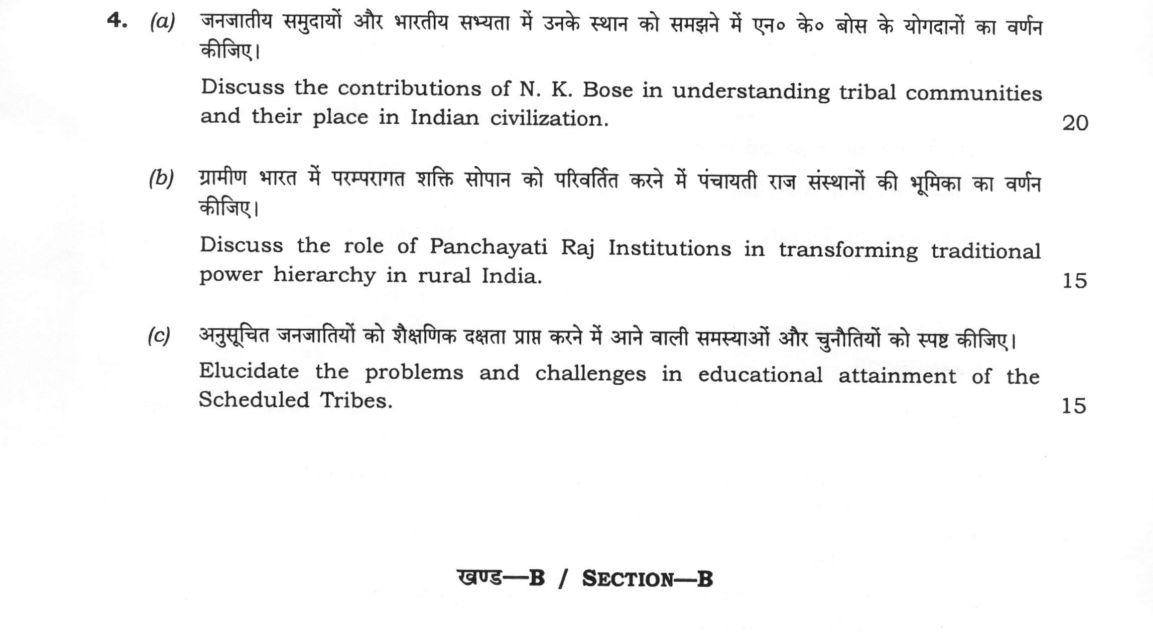
(a) Discuss the contributions of N. K. Bose in understanding tribal communities and their place in Indian civilization. (20…
Discuss the contributions of N. K. Bose in understanding tribal communities and their place in Indian civilization. 20 marks
Discuss the role of Panchayati Raj Institutions in transforming traditional power hierarchy in rural India. 15 marks
Elucidate the problems and challenges in educational attainment of the Scheduled Tribes. 15 marks
हिंदी में प्रश्न पढ़ें
जनजातीय समुदायों और भारतीय सभ्यता में उनके स्थान को समझने में एन० के० बोस के योगदानों का वर्णन कीजिए। (20 अंक)
ग्रामीण भारत में परंपरागत शक्ति सोपान को परिवर्तित करने में पंचायती राज संस्थानों की भूमिका का वर्णन कीजिए। (15 अंक)
अनुसूचित जनजातियों को शैक्षणिक दक्षता प्राप्त करने में आने वाली समस्याओं और चुनौतियों को स्पष्ट कीजिए। (15 अंक)
Model answer
Written by UPSC Answer Check against this question's marking rubric, to the expected length. UPSC does not publish answers for Mains — this is one way to score well, not an official key.
N.K. Bose’s Anthropological Legacy and Tribal Empowerment
N.K. Bose’s anthropological work remains pivotal in understanding the dynamic interface between tribal communities and the broader Indian civilization. His scholarship, combined with contemporary governance mechanisms like Panchayati Raj Institutions (PRIs) and the ongoing challenges in tribal education, forms the triad of tribal development discourse in India.
N.K. Bose’s Contributions to Tribal Studies
N.K. Bose is best known for his concept of the "Hindu method of tribal absorption," which posits that tribal communities in India have historically been integrated into the caste system through gradual cultural and economic assimilation rather than violent conquest. Through extensive fieldwork among the Juangs and Bhumij tribes of Orissa (now Odisha) and Bihar, Bose demonstrated that tribal identity is not static but fluid, shaped by interactions with non-tribal society. He critically rejected rigid racial classifications and isolationist policies that viewed tribes as primitive relics. Instead, he emphasized the tribe-caste continuum, arguing that tribal transformation is driven by cultural and economic processes. Bose’s integrative vision challenged the binary of "preservation vs. development," suggesting that tribal communities are active agents in their own social evolution. This perspective informs current debates, advocating for development policies that respect tribal agency while facilitating their integration into the national mainstream without erasing their distinct identities.
PRIs and the Transformation of Rural Power Hierarchies
The 73rd Constitutional Amendment Act (1992) institutionalized Panchayati Raj Institutions (PRIs) as a tier of government, mandating the reservation of seats for Scheduled Tribes (STs) in proportion to their population. This constitutional provision has significantly altered traditional power structures in rural India, which were historically dominated by upper castes and landed elites. By ensuring ST representation in local governance, PRIs have democratized decision-making processes, allowing tribal voices to influence resource allocation and development planning. However, tensions persist between elected PRIs and traditional tribal councils, particularly in Fifth Schedule areas. The Panchayats (Extension to Scheduled Areas) Act, 1996 (PESA), recognizes the authority of Gram Sabhas in these regions, often leading to jurisdictional conflicts with PRIs. For instance, in many tribal districts of Jharkhand and Chhattisgarh, traditional leaders sometimes bypass elected Panchayats, highlighting the complex interplay between statutory democracy and customary governance.
Challenges in Tribal Educational Attainment
Despite policy interventions, Scheduled Tribes face significant barriers in educational attainment. Structural issues include a profound language gap, as the medium of instruction often differs from the mother tongue, hindering early learning. Teacher absenteeism and inadequate hostel facilities further exacerbate dropout rates, particularly in remote areas. Curriculum alienation, which fails to reflect tribal lifeworlds, also diminishes student engagement. Socio-cultural factors play a critical role; parental aspiration deficits, seasonal migration for labor, and child labor constrain educational access. Gender disparity remains a persistent challenge, with girls often prioritized for domestic roles over schooling. Data from the Census 2011 indicates that while the national literacy rate stands at 74.04%, the ST literacy rate lags significantly, underscoring the depth of these disparities. ASER reports further highlight learning deficits among tribal children, even where enrollment is high.
Conclusion
In conclusion, N.K. Bose’s integrative anthropology provides a theoretical foundation for understanding tribal dynamics, while PRIs offer a governance framework for democratization. However, the efficacy of these institutions is limited by deep-seated educational challenges. A holistic approach that combines Bose’s insights on cultural continuity, robust PRI implementation that respects PESA mandates, and targeted educational reforms addressing language and infrastructure gaps is essential for genuine tribal empowerment in contemporary India.
What "Discuss" is asking you to do
Lay the issue out from more than one side — how it arose, what is claimed for it, what is held against it, and where it now stands. UPSC attaches discuss to broad topics with several live dimensions, so coverage of the dimensions earns more than the strength of your opinion.
Structure that answers it
Set the issue up → the case as it is made → the case against → the dimension both sides leave out → where the balance now lies
Where marks are lost
Listing facts with no thread between them, or arguing one side throughout and calling it a discussion.
How this answer will be evaluated
Approach
Framework: Anthropology Paper II: Tribal India & Social Change. (a) discuss: intro > 3-4 dimensions > example > balanced close | (b) discuss: intro > 3-4 dimensions > example > balanced close | (c) challenges: 3-4 challenges > solutions mapped to them > conclusion Full marks: Precise theoretical application, named examples, and clear link to Indian context.
Key points expected
- Define 'Tribal Civilization' concept
- Explain 'Tribal Continuum' theory
- Link tribes to Aryan/Dravidian synthesis
- Mention 'Tribal India' book
- Identify traditional hierarchies (Zamindar, Moneylender)
- Explain 73rd Amendment's role
- Discuss 'Gram Sabha' as a tool
- Mention 'Reservation' for SC/ST/OBC
Evaluation rubric
Each sub-part is marked on its own, against the marks and word limit printed on the paper.
- (a) N.K. Bose's theoretical framework on tribal integration and civilization. 20 marks
discuss— intro → 3-4 dimensions → example → balanced close
Must cover
- Define 'Tribal Civilization' concept
- Explain 'Tribal Continuum' theory
- Link tribes to Aryan/Dravidian synthesis
- Mention 'Tribal India' book
Loses marks
- Confusing N.K. Bose with N.K. Bhat
- Treating tribes as 'primitive' without nuance
- Ignoring the 'civilization' aspect of the question
Earns more
- Reference to 'Tribal Continuum' diagram
- Comparison with Dumont's 'Homo Hierarchicus'
- Mention of specific tribal examples (e.g., Gonds, Bhils)
- Critique of his 'civilization' bias
Extra mark
- Reference to 'Tribal India' (1955) publication date
- Mention of his role in Anthropological Survey of India
- (b) Panchayati Raj's impact on traditional rural power structures. 15 marks
discuss— intro → 3-4 dimensions → example → balanced close
Must cover
- Identify traditional hierarchies (Zamindar, Moneylender)
- Explain 73rd Amendment's role
- Discuss 'Gram Sabha' as a tool
- Mention 'Reservation' for SC/ST/OBC
Loses marks
- Ignoring the 'traditional' power hierarchy
- Treating Panchayati Raj as purely administrative
- Failing to link to 'rural India' context
Earns more
- Reference to 'Gramin Panchayat' structure
- Mention of 'Sarpanch' role
- Discussion of 'Social Capital' building
- Example of a specific state's Panchayati Raj
Extra mark
- Reference to '73rd Constitutional Amendment Act, 1992'
- Mention of 'Panchayati Raj Act' of a specific state
- (c) Problems and challenges in ST educational attainment. 15 marks
challenges— 3-4 challenges → solutions mapped to them → conclusion
Must cover
- Identify 'Geographic' barriers (remote areas)
- Explain 'Linguistic' barriers (mother tongue)
- Discuss 'Socio-economic' factors (poverty)
- Mention 'Dropout' rates
Loses marks
- Ignoring the 'Scheduled Tribes' specific context
- Treating education as purely a 'policy' issue
- Failing to address 'attainment' (outcomes)
Earns more
- Reference to 'NEP 2020' provisions
- Mention of 'Hostel' facilities
- Discussion of 'Digital Divide'
- Example of a specific ST group's education
Extra mark
- Reference to 'Article 46' of the Constitution
- Mention of 'Tribal Sub-Plan' (TSP)
Practice this exact question
Write your answer and it is marked point by point against the model answer above — what you covered, what you missed, what you got wrong.
Evaluate my answer →More from Anthropology 2021 Paper II
- Q1 Write short notes on the following in about 150 words each: (a) Purushartha and righteous…
- Q2 (a) Critically discuss the origin of Indus Valley Civilization. Mention the evidences of…
- Q3 (a) Explain the impact of the concept of nature-man-spirit complex on sustainable use of…
- Q4 (a) Discuss the contributions of N. K. Bose in understanding tribal communities and their…
- Q5 Write short notes on the following in about 150 words each: (a) Urbanization and tribal i…
- Q6 (a) Discuss the impact of the Forest Rights Act (2006) on the livelihood and culture of t…
- Q7 (a) Explain the impact of successive Land Acquisition Acts on tribal social organization.…