Paper II — Q8
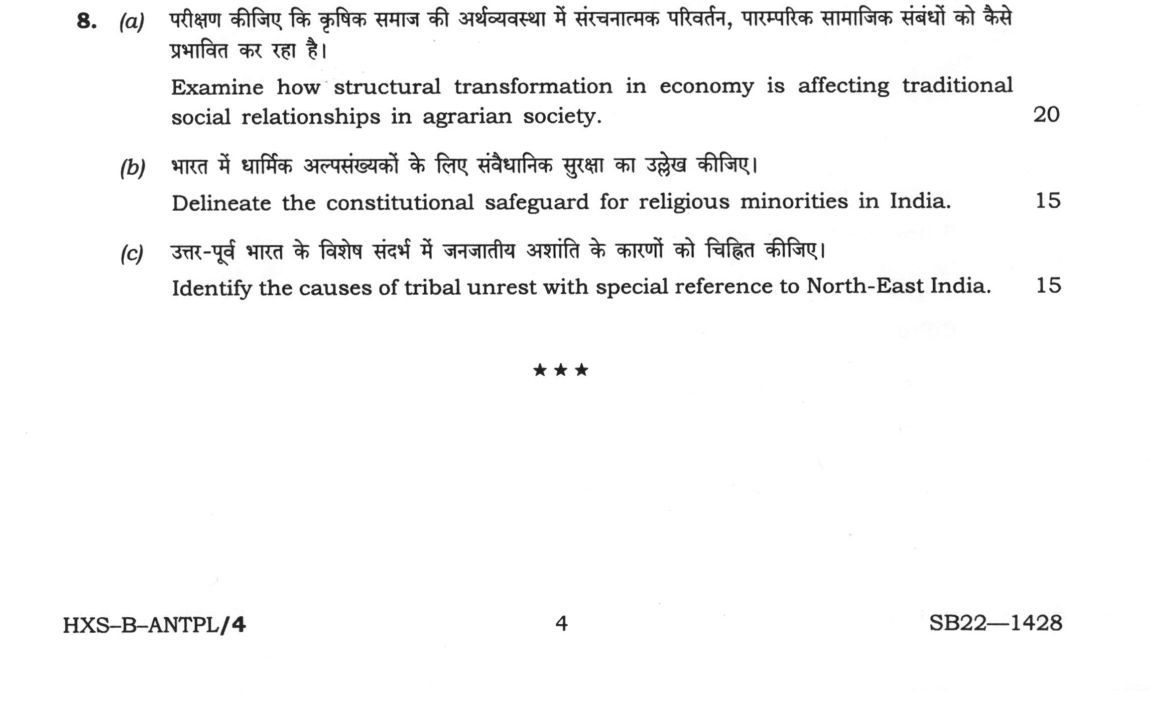
(a) Examine how structural transformation in economy is affecting traditional social relationships in agrarian society. (20…
Examine how structural transformation in economy is affecting traditional social relationships in agrarian society. 20 marks
Delineate the constitutional safeguard for religious minorities in India. 15 marks
Identify the causes of tribal unrest with special reference to North-East India. 15 marks
हिंदी में प्रश्न पढ़ें
परीक्षण कीजिए कि कृषिक समाज की अर्थव्यवस्था में संरचनात्मक परिवर्तन, पारंपरिक सामाजिक संबंधों को कैसे प्रभावित कर रहा है। (20 अंक)
भारत में धार्मिक अल्पसंख्यकों के लिए संवैधानिक सुरक्षा का उल्लेख कीजिए। (15 अंक)
उत्तर-पूर्व भारत के विशेष संदर्भ में जनजातीय अशांति के कारणों को चिह्नित कीजिए। (15 अंक)
Model answer
Written by UPSC Answer Check against this question's marking rubric, to the expected length. UPSC does not publish answers for Mains — this is one way to score well, not an official key.
Structural Transformation and Social Change in India
The interplay between economic restructuring, constitutional protections, and regional unrest defines the contemporary Indian social landscape. This answer examines how agrarian shifts disrupt traditional bonds, delineates legal safeguards for religious minorities, and identifies the drivers of tribal unrest in the North-East.
Structural Transformation in Agrarian Society
The Green Revolution and subsequent mechanization have fundamentally altered agrarian social relationships, shifting them from caste-based interdependence to class-based contractual relations. Traditionally, the jajmani system ensured a symbiotic exchange where landowners provided produce and laborers, artisans, and religious specialists provided services, binding communities through ritual and social obligation. However, the introduction of high-yielding varieties and tractors has displaced this patron-client structure. Mechanization has reduced the demand for unskilled manual labor, leading to the displacement of traditional agricultural workers and forcing a migration to urban centers or informal sectors. Consequently, the rigid caste-based occupational interdependence is declining, replaced by a market-driven labor force where wages are determined by supply and demand rather than social status.
This economic shift has fostered the emergence of a capitalist farmer class, particularly among dominant castes, who now operate as profit-oriented entrepreneurs rather than feudal landlords. As a result, class consciousness is beginning to supersede caste solidarity in political and economic spheres. Furthermore, changing gender roles are evident as women increasingly participate in agricultural production and off-farm employment, challenging traditional patriarchal norms. The erosion of the jajmani system signifies a move towards individualistic, contractual social relations, where economic utility replaces social duty, thereby weakening the traditional social fabric of the village.
Constitutional Safeguards for Religious Minorities
The Indian Constitution provides a robust framework for protecting religious minorities, primarily through Part III (Fundamental Rights) and Part IV (Directive Principles). Articles 25 to 28 guarantee freedom of conscience, profession, practice, and propagation of religion. Article 25 ensures the right to freely profess and practice religion, subject to public order, morality, and health. Article 26 allows religious denominations to manage their own affairs in matters of religion, including the right to establish and maintain institutions. Article 27 prohibits entry into any place of worship on grounds of caste, race, sex, or birth, while Article 28 prohibits religious instruction in educational institutions wholly maintained out of State funds, with exceptions for institutions maintained by a religious denomination.
Beyond freedom of religion, Articles 29 and 30 provide cultural and educational safeguards. Article 29(1) protects the interest of any section of citizens having a distinct language, script, or culture, ensuring that no citizen is denied admission to any educational institution maintained by the State or aided by the State on grounds of religion, race, caste, or place of birth. Article 30 specifically empowers all minorities, whether on religious or linguistic grounds, to establish and administer educational institutions of their choice. These provisions ensure that religious minorities are not only protected from state interference but are also empowered to preserve their identity and contribute to the nation’s educational and cultural heritage.
Causes of Tribal Unrest in North-East India
Tribal unrest in North-East India is driven by a complex mix of economic, political, and demographic factors. A primary cause is land alienation and encroachment by non-tribals, which threatens the subsistence-based tribal economy. Development projects such as dams, mining, and industrial zones have led to the displacement of tribal communities without adequate rehabilitation, exacerbating feelings of marginalization.
Ethnic identity assertion plays a crucial role, as tribes seek recognition of their distinct cultural and linguistic identities. This is often linked to demands for greater autonomy, with some groups preferring the Sixth Schedule (which provides for autonomous district councils) over statehood, while others seek separate statehood to protect their interests. The influx of migrants has altered the demographic balance, creating fears of cultural dilution and resource competition.
Additionally, the presence of insurgencies linked to resource control and political grievances has fueled unrest. The Armed Forces Special Powers Act (AFSPA) has been a source of contention, with human rights concerns regarding its use in these regions adding to the sense of alienation. The combination of economic deprivation, political exclusion, and demographic anxiety creates a fertile ground for unrest, demanding a holistic approach to development and governance.
Conclusion
In conclusion, structural transformation in the agrarian sector is dismantling traditional social hierarchies, while the Constitution provides essential safeguards for religious minorities to preserve their identity. However, in the North-East, the failure to address tribal grievances regarding land, autonomy, and demographic change has led to persistent unrest. Addressing these interconnected dimensions of social change requires a balanced approach that respects traditional values, upholds constitutional rights, and ensures inclusive development for all sections of society.
What "Examine" is asking you to do
Test the proposition the question puts to you and return a finding on how far it holds. Examine stems carry a claim, or ask whether something has happened, and expect evidence weighed both ways before the extent is stated — often with remedial measures attached.
Structure that answers it
Restate the claim as the question frames it → evidence that supports it → evidence that undercuts it → the conditions under which it holds → verdict on how far it stands
Where marks are lost
Stopping at description. An examination has to reach a finding, and “examine with justification” means the extent must be stated, not implied.
How this answer will be evaluated
Approach
Framework: UPSC Anthropology Paper II (Sociology & Social Anthropology). (a) examine: intro > how/why with reasoning > evidence > conclusion | (b) describe: define > structure or process in order > labelled diagram > significance | (c) analyse: intro > causes > effects > stakeholders/linkages > way forward Full marks: Comprehensive analysis with specific examples, named theories/articles, and clear connections between economic, social, and political dimensions
Key points expected
- Define structural transformation in agrarian economy
- Link economic change to social relationship shifts
- Provide specific agrarian society examples
- Analyze impact on traditional social structures
- Identify specific constitutional articles
- Explain protection mechanisms for minorities
- Cover fundamental rights provisions
- Mention special safeguards and protections
Evaluation rubric
Each sub-part is marked on its own, against the marks and word limit printed on the paper.
- (a) Examine how structural transformation in economy is affecting traditional social relationships in agrarian society. 20 marks
examine— intro → how/why with reasoning → evidence → conclusion
Must cover
- Define structural transformation in agrarian economy
- Link economic change to social relationship shifts
- Provide specific agrarian society examples
- Analyze impact on traditional social structures
Loses marks
- Generic economic discussion without social focus
- No specific agrarian examples
- Failure to connect economy to social relations
Earns more
- Reference to specific economic transformation theories
- Discussion of land relations changes
- Analysis of class structure shifts
- Examination of kinship system modifications
Extra mark
- Reference to specific Indian agrarian studies
- Mention of contemporary economic policies
- (b) Delineate the constitutional safeguard for religious minorities in India. 15 marks
describe— define → structure or process in order → labelled diagram → significance
Must cover
- Identify specific constitutional articles
- Explain protection mechanisms for minorities
- Cover fundamental rights provisions
- Mention special safeguards and protections
Loses marks
- Vague constitutional references without article numbers
- No specific protection mechanisms
- Confusing religious freedom with minority rights
Earns more
- Reference to Article 25-28
- Discussion of Article 30 educational rights
- Mention of Article 31A-31B
- Reference to minority education institutions
Extra mark
- Mention of specific Supreme Court judgments
- Reference to minority rights commission
- (c) Identify the causes of tribal unrest with special reference to North-East India. 15 marks
analyse— intro → causes → effects → stakeholders/linkages → way forward
Must cover
- Identify specific causes of tribal unrest
- Provide North-East India specific examples
- Analyze political, economic, social factors
- Examine tribal identity and autonomy issues
Loses marks
- Generic tribal issues without North-East focus
- No specific state or tribal group examples
- Failure to analyze multiple cause categories
Earns more
- Reference to specific North-East states
- Discussion of land rights issues
- Analysis of ethnic identity conflicts
- Mention of specific tribal groups
Extra mark
- Reference to specific tribal movements
- Mention of Sixth Schedule provisions
Practice this exact question
Write your answer and it is marked point by point against the model answer above — what you covered, what you missed, what you got wrong.
Evaluate my answer →More from Anthropology 2021 Paper II
- Q5 Write short notes on the following in about 150 words each: (a) Urbanization and tribal i…
- Q6 (a) Discuss the impact of the Forest Rights Act (2006) on the livelihood and culture of t…
- Q7 (a) Explain the impact of successive Land Acquisition Acts on tribal social organization.…
- Q8 (a) Examine how structural transformation in economy is affecting traditional social rela…