Paper II — Q7
(a) Explain the impact of successive Land Acquisition Acts on tribal social organization. (20 marks) (b) Discuss the problems…
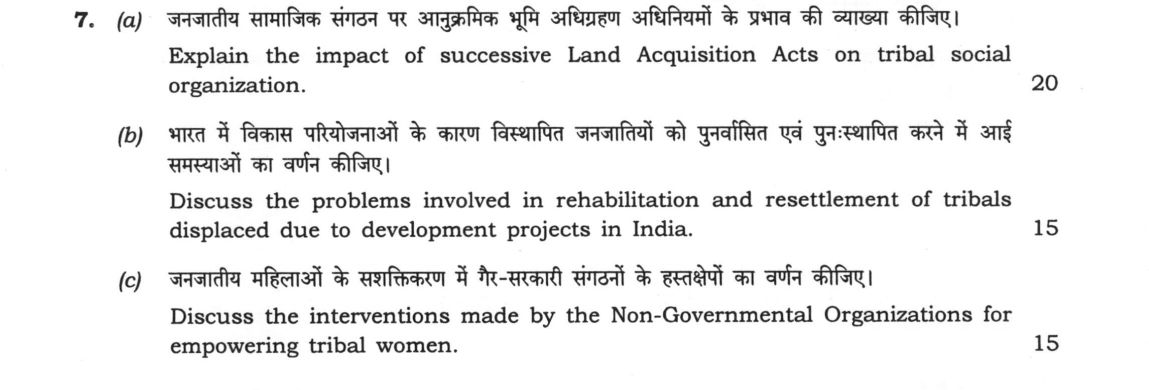
Explain the impact of successive Land Acquisition Acts on tribal social organization. 20 marks
Discuss the problems involved in rehabilitation and resettlement of tribals displaced due to development projects in India. 15 marks
Discuss the interventions made by the Non-Governmental Organizations for empowering tribal women. 15 marks
हिंदी में प्रश्न पढ़ें
जनजातीय सामाजिक संगठन पर आनुक्रमिक भूमि अधिग्रहण अधिनियमों के प्रभाव की व्याख्या कीजिए। (20 अंक)
भारत में विकास परियोजनाओं के कारण विस्थापित जनजातियों को पुनर्वासित एवं पुनःस्थापित करने में आई समस्याओं का वर्णन कीजिए। (15 अंक)
जनजातीय महिलाओं के सशक्तिकरण में गैर-सरकारी संगठनों के हस्तक्षेपों का वर्णन कीजिए। (15 अंक)
Model answer
Written by UPSC Answer Check against this question's marking rubric, to the expected length. UPSC does not publish answers for Mains — this is one way to score well, not an official key.
Tribal social organization is intrinsically anchored in communal land tenure, making state-led land alienation and displacement fundamentally disruptive to kinship systems, community authority, and gender relations.
Impact of Land Acquisition Acts on Tribal Social Organization
The colonial Land Acquisition Act (LAA) of 1894 institutionalized the doctrine of eminent domain, delegitimizing uncodified customary usufructuary rights and transforming corporate lineage land into state property. This legal dispossession continued post-independence until the Right to Fair Compensation and Transparency in Land Acquisition, Rehabilitation and Resettlement (RFCTLARR) Act 2013 introduced mandatory Social Impact Assessments and consent clauses under PESA (1996) and FRA (2006), though implementation loopholes persist.
Causally, the imposition of individual property titles disrupted lineage-based systems like jhum (shifting cultivation) among groups like the Hill Reddis and Baigas. Because shifting cultivation relied on clan-based labour-pooling and redistributive ethics, state privatization fragmented corporate landholding into individual plots, weakening clan solidarity. Consequently, traditional political institutions like the Manki-Munda system among the Ho and Parha panchayats among the Oraon lost their customary jurisdiction over resource allocation and dispute settlement.
Furthermore, because LAA frameworks historically recognized only male household heads for compensatory titles, women lost their traditional usufruct rights over swiddens and Common Property Resources (CPRs). Deprived of autonomous subsistence bases, self-sufficient tribal households underwent proletarianization, becoming low-wage, informal agrarian or industrial labourers. The resulting distress male out-migration fractured exogamous clan territoriality, altered lineage-based marriage customs, and strained extended kinship safety nets.
Problems in Rehabilitation and Resettlement of Displaced Tribals
Development-induced displacement has historically disproportionately affected Scheduled Tribes, who constitute over 40% of India’s displaced population. The primary structural bottleneck is the state's inability to implement the 'land-for-land' mandate. Monetary compensation is often delayed and inadequate, rapidly lost to market exploitation in monetized non-tribal economies without restoring lost CPR access.
Socio-culturally, relocation to mechanical resettlement colonies causes acute cultural alienation. Separation from ancestral spaces—such as sarna (sacred groves) and sasandiri (burial grounds)—severs the vital link between lineage continuity and territorial spirits. Additionally, resettlement frequently triggers intra-community friction between project-affected families and host populations competing for grazing lands, minor forest produce, and basic infrastructure.
State interventions, including the National R&R Policy 2003 and the National Rehabilitation and Resettlement Policy (NRRR) 2007, suffered from institutional fragmentation and lacked legally binding enforceability. These systemic implementation deficits are exemplified by the Sardar Sarovar Project in the Narmada Valley, where tens of thousands of displaced Bhil and Gond families faced non-viable agricultural land allotments, fragmented resettlement sites, and extensive bureaucratic exclusion from compensatory entitlements.
NGO Interventions in Empowering Tribal Women
Civil society organizations have addressed systemic marginalization through multifaceted interventions:
Economic Mobilization: Organizations like MYRADA and Dhan Foundation have instituted Self-Help Groups (SHGs) and microcredit collectives, reducing usurious debt and promoting value-addition in Non-Timber Forest Produce (NTFP), thereby bolstering women's household bargaining power.
Political and Legal Empowerment: Organizations like the National Forum of Forest People and Forest Workers (NFFPFW) and the People’s Union for Civil Liberties (PUCL) have mobilized tribal women to claim joint titles under the Forest Rights Act (2006) and supported leadership capacity in PESA-mandated gram sabhas.
Health and Education: SEWA has built grassroots maternal and reproductive healthcare infrastructure, while Eklavya has pioneered bilingual, culturally contextualized educational curricula to bridge literacy gaps among tribal girls.
Limitations: However, these interventions frequently face elite capture by better-off families within dominant tribes, recurrent financial dependency on external donor agendas, and limited structural scalability. Additionally, state-NGO tensions often arise when mobilization against predatory land acquisition is treated as obstructive to national development goals.
Empowerment of tribal communities necessitates moving beyond top-down compensatory frameworks to genuine recognition of indigenous self-governance, where customary collective land rights and grassroots civil society actions converge to safeguard tribal autonomy and dignity.
What "Explain" is asking you to do
Make the working of something clear — what sets it off, what follows from what, and what it produces. Explain is the Commission's mechanism word: it dominates the technical papers and the “explain why” stems, where the marks sit in the causal chain and not in the label.
Structure that answers it
State what it is → the initiating condition → the chain of cause, step by step → an instance where it plays out → what the chain produces
Where marks are lost
Describing what something looks like instead of why it works that way. Naming the stages without linking them reads as description too.
How this answer will be evaluated
Approach
Framework: UPSC Anthropology Paper II (Sociology of Tribes). (a) explain: definition/context > points in order > small example > short close | (b) discuss: intro > 3-4 dimensions > example > balanced close | (c) discuss: intro > 3-4 dimensions > example > balanced close Full marks: Comprehensive, well-structured, with specific examples and critical analysis.
Key points expected
- Trace evolution from 1894 Act to 2013 LARR Act
- Link land alienation to loss of collective identity
- Explain shift from community to individual ownership
- Mention specific tribal displacement or alienation cases
- Identify specific development projects (dams, mines, SEZs)
- Analyze the 'compensation' vs 'rehabilitation' gap
- Discuss loss of livelihood and cultural dislocation
- Mention the role of the Rehabilitation and Resettlement (R&R) policy
Evaluation rubric
Each sub-part is marked on its own, against the marks and word limit printed on the paper.
- (a) Chronological analysis of how land laws dismantled tribal social structures. 20 marks
explain— definition/context → points in order → small example → short close
Must cover
- Trace evolution from 1894 Act to 2013 LARR Act
- Link land alienation to loss of collective identity
- Explain shift from community to individual ownership
- Mention specific tribal displacement or alienation cases
Loses marks
- General discussion of land laws without tribal focus
- Ignoring the social consequences of land loss
- Failing to mention the 1894 Act as the starting point
Earns more
- Reference to FRA 2006 as a corrective measure
- Mention of specific tribal groups (e.g., Santhal, Gond)
- Discussion of 'alienation' vs 'displacement' distinction
- Reference to the 2015 Land Rights Act
Extra mark
- Mention of specific court judgments on land rights
- Reference to specific state-level land policies
- (b) Critical analysis of the failures in rehabilitating displaced tribal populations. 15 marks
discuss— intro → 3-4 dimensions → example → balanced close
Must cover
- Identify specific development projects (dams, mines, SEZs)
- Analyze the 'compensation' vs 'rehabilitation' gap
- Discuss loss of livelihood and cultural dislocation
- Mention the role of the Rehabilitation and Resettlement (R&R) policy
Loses marks
- Vague discussion of 'development' without specific examples
- Ignoring the social and cultural dimensions of displacement
- Failing to mention the 2007 R&R Policy
Earns more
- Reference to the Sardar Sarovar Dam case
- Mention of the 2007 R&R Policy
- Discussion of 'in-situ' vs 'ex-situ' rehabilitation
- Reference to the Narmada Bachao Andolan
Extra mark
- Mention of specific NGOs working on R&R
- Reference to specific court orders on R&R
- (c) Evaluation of NGO strategies for tribal women's empowerment. 15 marks
discuss— intro → 3-4 dimensions → example → balanced close
Must cover
- Identify specific NGOs (e.g., SEWA, CSDS, PRADAN)
- Describe specific interventions (SHGs, skill training, legal aid)
- Analyze the impact on economic and social status
- Discuss the challenges faced by these interventions
Loses marks
- General discussion of women's empowerment without tribal focus
- Ignoring the specific challenges faced by tribal women
- Failing to mention specific NGOs or interventions
Earns more
- Reference to the Self-Help Group (SHG) model
- Mention of specific tribal women's organizations
- Discussion of the intersection of gender and tribal identity
- Reference to the National Rural Livelihoods Mission (NRLM)
Extra mark
- Mention of specific success stories of tribal women
- Reference to specific government-NGO partnerships
Practice this exact question
Write your answer and it is marked point by point against the model answer above — what you covered, what you missed, what you got wrong.
Evaluate my answer →More from Anthropology 2021 Paper II
- Q4 (a) Discuss the contributions of N. K. Bose in understanding tribal communities and their…
- Q5 Write short notes on the following in about 150 words each: (a) Urbanization and tribal i…
- Q6 (a) Discuss the impact of the Forest Rights Act (2006) on the livelihood and culture of t…
- Q7 (a) Explain the impact of successive Land Acquisition Acts on tribal social organization.…
- Q8 (a) Examine how structural transformation in economy is affecting traditional social rela…