Paper II — Q6
(a) Discuss the impact of the Forest Rights Act (2006) on the livelihood and culture of tribal people in India. (20 marks) (b)…
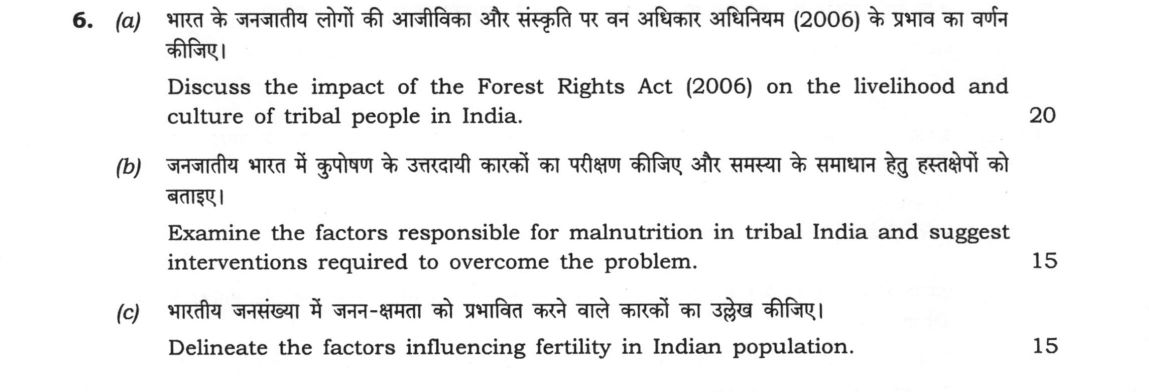
Discuss the impact of the Forest Rights Act (2006) on the livelihood and culture of tribal people in India. 20 marks
Examine the factors responsible for malnutrition in tribal India and suggest interventions required to overcome the problem. 15 marks
Delineate the factors influencing fertility in Indian population. 15 marks
हिंदी में प्रश्न पढ़ें
भारत के जनजातीय लोगों की आजीविका और संस्कृति पर वन अधिकार अधिनियम (2006) के प्रभाव का वर्णन कीजिए। (20 अंक)
जनजातीय भारत में कुपोषण के उत्तरदायी कारकों का परीक्षण कीजिए और समस्या के समाधान हेतु हस्तक्षेपों को बताइए। (15 अंक)
भारतीय जनसंख्या में जनन-क्षमता को प्रभावित करने वाले कारकों का उल्लेख कीजिए। (15 अंक)
Model answer
Written by UPSC Answer Check against this question's marking rubric, to the expected length. UPSC does not publish answers for Mains — this is one way to score well, not an official key.
The Scheduled Tribes and Other Traditional Forest Dwellers (Recognition of Forest Rights) Act, 2006 (FRA), alongside targeted public health measures and socioeconomic determinants, plays a pivotal role in shaping tribal well-being, nutritional outcomes, and India's broader demographic transition.
Impact of Forest Rights Act (2006) on Tribal Livelihood and Culture
The FRA (2006) was enacted to redress historical injustices by securing Individual Forest Rights (IFR) for cultivation, Community Forest Rights (CFR) for grazing and Minor Forest Produce (MFP) collection, and Habitat Rights for Particularly Vulnerable Tribal Groups (PVTGs) under Section 3(1)(e).
In terms of livelihood, tenurial security has curbed arbitrary evictions and incentivized soil and water conservation. By transferring ownership and disposal rights of non-timber forest produce (such as tendu leaves and bamboo) to Gram Sabhas, the Act has diminished the monopsony of middle-men and enhanced household incomes. For instance, Mendha Lekha in Maharashtra mobilized CFR provisions to achieve self-sustained revenue from bamboo harvesting.
Culturally, the Act safeguards sacred landscapes, burial grounds, and sacred groves (sarnas or devasthans). The landmark 2013 Niyamgiri Gram Sabha resolutions by the Dongria Kondh demonstrated how statutory habitat rights empower tribes to protect culturally sacred hills from bauxite mining, thereby preserving their ritual ecology and distinct ethnic identity.
Nonetheless, implementation is hindered by systemic bottlenecks. High rates of claim rejections by Sub-Divisional and District Level Committees, procedural delays, and bureaucratic bypass of Gram Sabhas undermine the statute. In regions like Bastar and the Nilgiris, conflicting wildlife conservation notifications and delays in conferring CFR titles continue to leave tribal livelihoods precarious and cultural ties to the forest vulnerable.
Malnutrition in Tribal India: Factors and Interventions
Malnutrition among tribal populations is driven by intersecting ecological, socioeconomic, and healthcare factors:
- Ecological factors: Forest degradation and curbs on traditional swidden cultivation (jhum) have depleted access to diverse wild foods, tubers, and traditional millets, replacing balanced wild diets with carbohydrate-dense PDS staples.
- Socioeconomic factors: Chronic poverty, land alienation, seasonal distress migration, and low agricultural productivity restrict dietary diversity and purchasing power.
- Healthcare barriers: Geographic isolation of tribal hamlets (tolas), high vacancy rates in tribal Primary Health Centres (PHCs), language barriers, and deep mistrust of non-tribal healthcare providers impede antenatal care and immunization.
To mitigate this crisis, interventions must be two-pronged:
- Nutrition-specific interventions: Restructure the Integrated Child Development Services (ICDS) and POSHAN Abhiyaan by incorporating locally sourced traditional millets, eggs, and wild tubers into supplementary feeding; scale up micronutrient supplementation; and effectively ring-fence funds under the Tribal Sub-Plan (TSP).
- Nutrition-sensitive interventions: Fast-track FRA title distribution to encourage backyard nutrition gardens; expand MGNREGA works toward tribal water harvesting; support community-managed kitchens during lean seasons; and train indigenous ASHA and Anganwadi workers to deliver culturally acceptable maternal and child health interventions.
Factors Influencing Fertility in the Indian Population
Fertility dynamics in India are mediated through proximate determinants and broader socioeconomic conditions:
- Proximate Determinants: Following Bongaarts' model, fertility is directly moderated by the universality and age of marriage (early female marriage sustains higher fertility in rural tracts), length of postpartum amenorrhea via extended breastfeeding, and the Contraceptive Prevalence Rate (CPR), which remains heavily skewed toward female sterilization rather than spacing methods.
- Socioeconomic Factors: Female educational attainment exerts an inverse effect on the Total Fertility Rate (TFR). Urbanization, female workforce participation, and access to clean energy lower desired family size. Deep-seated son preference (manifested in the stopping rule) continues to sustain higher fertility in several regions. While minor religious differentials exist, they are primarily driven by underlying literacy and income disparities.
- Regional Variations and Policy Impact: India displays marked demographic divergence. Southern states (such as Kerala and Tamil Nadu) achieved below-replacement TFR (<1.8) decades ago through high female literacy, lower infant mortality rates, and accessible healthcare. Conversely, high-focus northern states (Bihar, Uttar Pradesh) are still in an earlier phase of the demographic transition. Targeted policy interventions—including the National Population Policy (2000), Janani Suraksha Yojana (JSY), and Mission Parivar Vikas—have accelerated fertility decline, bringing India’s overall TFR to 2.0 (NFHS-5).
Way Forward
Sustaining India’s human development trajectory requires an integrated approach: realizing the tenurial and cultural guarantees of the FRA to restore tribal ecological livelihoods, decentralizing nutrition governance through indigenous food systems, and bridging regional health disparities to ensure an equitable, nationwide demographic transition.
What "Discuss" is asking you to do
Lay the issue out from more than one side — how it arose, what is claimed for it, what is held against it, and where it now stands. UPSC attaches discuss to broad topics with several live dimensions, so coverage of the dimensions earns more than the strength of your opinion.
Structure that answers it
Set the issue up → the case as it is made → the case against → the dimension both sides leave out → where the balance now lies
Where marks are lost
Listing facts with no thread between them, or arguing one side throughout and calling it a discussion.
How this answer will be evaluated
Approach
Framework: Anthropology Paper II: Socio-cultural & Biological Anthropology. (a) discuss: intro > 3-4 dimensions > example > balanced close | (b) explain: definition/context > points in order > small example > short close | (c) explain: definition/context > points in order > small example > short close Full marks: Comprehensive, specific, and well-structured with tribal context.
Key points expected
- FRA 2006 rights and impact
- Tribal malnutrition factors and interventions
- Indian fertility factors and demographic transition
Evaluation rubric
Each sub-part is marked on its own, against the marks and word limit printed on the paper.
- (a) Analyze FRA 2006's impact on tribal livelihood and culture. 20 marks
discuss— intro → 3-4 dimensions → example → balanced close
Must cover
- Define FRA 2006 rights (land, forest, F&N)
- Livelihood impact: shifting to settled agriculture
- Cultural impact: forest as sacred space
- Balanced view: benefits vs. implementation gaps
Loses marks
- Ignoring the 'culture' aspect
- Treating FRA as a general forest law
- No mention of tribal agency
Earns more
- Mention specific tribal groups (e.g., Gond, Munda)
- Reference to Gram Sabha role
- Link to PESA Act
- Mention of 'Van Dhan' scheme
Extra mark
- Cite specific FRA implementation statistics
- Reference to specific Supreme Court judgment
- (b) Examine malnutrition factors in tribal India and suggest interventions. 15 marks
explain— definition/context → points in order → small example → short close
Must cover
- Factors: diet, geography, health access
- Interventions: PDS, ICDS, nutrition security
- Link to tribal food systems
- Specific tribal context (e.g., NE India)
Loses marks
- Generic malnutrition answer without tribal focus
- Ignoring the 'interventions' part
- No mention of specific tribal groups
Earns more
- Mention 'Anemia' prevalence in tribes
- Reference to 'Poshan Abhiyaan'
- Mention of 'MGNREGA' for nutrition
- Specific tribal diet examples
Extra mark
- Cite specific malnutrition statistics
- Reference to specific tribal health program
- (c) Explain factors influencing fertility in Indian population. 15 marks
explain— definition/context → points in order → small example → short close
Must cover
- Factors: education, urbanization, contraception
- Link to demographic transition
- Specific Indian context (e.g., South vs. North)
- Mention of 'Total Fertility Rate'
Loses marks
- Generic fertility answer without Indian focus
- Ignoring the 'factors' part
- No mention of specific Indian states
Earns more
- Mention 'National Family Health Survey'
- Reference to 'Reproductive Health' policy
- Mention of 'Maternal Mortality Rate'
- Specific state examples (e.g., Kerala vs. Bihar)
Extra mark
- Cite specific fertility statistics
- Reference to specific demographic study
Practice this exact question
Write your answer and it is marked point by point against the model answer above — what you covered, what you missed, what you got wrong.
Evaluate my answer →More from Anthropology 2021 Paper II
- Q3 (a) Explain the impact of the concept of nature-man-spirit complex on sustainable use of…
- Q4 (a) Discuss the contributions of N. K. Bose in understanding tribal communities and their…
- Q5 Write short notes on the following in about 150 words each: (a) Urbanization and tribal i…
- Q6 (a) Discuss the impact of the Forest Rights Act (2006) on the livelihood and culture of t…
- Q7 (a) Explain the impact of successive Land Acquisition Acts on tribal social organization.…
- Q8 (a) Examine how structural transformation in economy is affecting traditional social rela…