Paper II — Q3
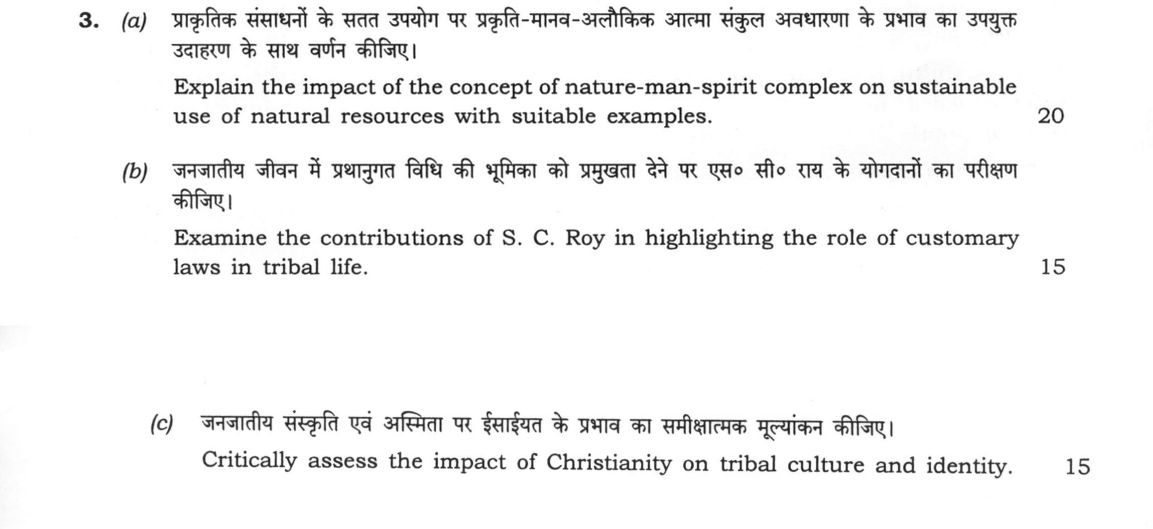
(a) Explain the impact of the concept of nature-man-spirit complex on sustainable use of natural resources with suitable…
Explain the impact of the concept of nature-man-spirit complex on sustainable use of natural resources with suitable examples. 20 marks
Examine the contributions of S. C. Roy in highlighting the role of customary laws in tribal life. 15 marks
Critically assess the impact of Christianity on tribal culture and identity. 15 marks
हिंदी में प्रश्न पढ़ें
प्राकृतिक संसाधनों के सतत उपयोग पर प्रकृति-मानव-आत्मा संकुल अवधारणा के प्रभाव का उपयुक्त उदाहरण के साथ वर्णन कीजिए। (20 अंक)
जनजातीय जीवन में प्रथानुगत विधि की भूमिका को प्रमुखता देने पर एस० सी० राय के योगदानों का परीक्षण कीजिए। (15 अंक)
जनजातीय संस्कृति एवं अस्मिता पर ईसाईयत के प्रभाव का समीक्षात्मक मूल्यांकन कीजिए। (15 अंक)
Model answer
Written by UPSC Answer Check against this question's marking rubric, to the expected length. UPSC does not publish answers for Mains — this is one way to score well, not an official key.
The Nature-Man-Spirit Complex and Sustainable Resource Use
The concept of the nature-man-spirit complex posits a holistic worldview where the human, natural, and supernatural realms are inextricably linked. Rooted in the functionalist traditions of Malinowski and Radcliffe-Brown, this framework suggests that social institutions, including religion, serve to maintain equilibrium between human needs and environmental constraints. In tribal societies, this interconnection manifests as a system of ritual prohibitions and sacred spaces that function as informal conservation mechanisms, ensuring the sustainable use of natural resources without the need for state enforcement.
The causal mechanism is clear: spiritual reverence translates into behavioral restriction. For instance, sacred groves such as the kavu in Kerala and devban in Himachal Pradesh are protected by strict taboos against harvesting or hunting. These areas, often dedicated to local deities, act as biodiversity hotspots, preserving endemic species and regulating water cycles. Similarly, seasonal taboos restrict fishing or logging during breeding or growing seasons, allowing ecosystems to regenerate. This ritualized conservation is not merely symbolic; it is a functional adaptation that prevents resource depletion, demonstrating how indigenous knowledge systems integrate ecological sustainability into cultural identity.
S. C. Roy and Customary Laws in Tribal Life
S. C. Roy’s seminal work, The Mundas and Their Country, provides a critical examination of how customary laws regulate tribal life independently of the state apparatus. Roy’s methodology, characterized by an insider-outsider perspective, allowed him to document the intricate social fabric of the Munda people with nuance and respect. He highlighted that customary laws are not static relics but dynamic systems that manage social cohesion, land tenure, and conflict resolution.
Roy demonstrated that Munda customary law governs marriage through the sanga system, which regulates alliances and social status. Regarding inheritance, he clarified that while Munda society is patrilineal, property distribution is not strictly governed by male primogeniture. Instead, inheritance practices are more nuanced, often involving shared family assets and specific rights for daughters, challenging colonial legal impositions that sought to simplify tribal structures into rigid Western categories. Furthermore, Roy documented the role of village councils in dispute resolution, showing how these bodies maintain social order through consensus and mediation rather than punitive state law. His work was a significant advocacy for tribal autonomy, arguing that colonial legal imposition disrupted these self-regulating systems and exacerbated marginalization.
Christianity’s Impact on Tribal Culture and Identity
The impact of Christianity on tribal culture is dualistic, requiring a critical assessment of both its developmental contributions and its cultural disruptions. On the positive side, Christian missions have been instrumental in providing education and healthcare, particularly in regions like Nagaland and Mizoram. The establishment of schools and hospitals by missionaries significantly improved literacy rates and life expectancy, empowering tribal communities with tools for political and economic participation.
However, this progress has come at the cost of cultural erosion. The denigration of traditional religions and rituals has led to identity fragmentation among converts, such as the Oraon, Munda, and Khasi. The imposition of foreign languages and values has sometimes resulted in the loss of indigenous linguistic heritage and traditional knowledge systems. While some communities have adopted syncretic practices, blending Christian and traditional elements, others have experienced a profound identity crisis, feeling disconnected from their ancestral roots.
It is important to distinguish between religious conversion and political mobilization. Movements like the Jharkhand Mukti Morcha are primarily political entities advocating for tribal rights and autonomy, rather than religious movements aimed at reclaiming specific faiths like Sarna, although they may support such cultural demands. The Naga Baptist conventions, on the other hand, illustrate how tribal churches can assert autonomy, shaping a distinct Christian identity that is both modern and rooted in local context.
Conclusion
In conclusion, the nature-man-spirit complex offers a viable model for sustainable resource management, while S. C. Roy’s work underscores the sophistication of tribal customary laws. The Christian mission’s legacy is complex, offering developmental gains but risking cultural homogenization. Contemporary policy must recognize the value of indigenous knowledge systems and support tribal autonomy, ensuring that modernization does not come at the expense of cultural integrity and ecological balance.
What "Explain" is asking you to do
Make the working of something clear — what sets it off, what follows from what, and what it produces. Explain is the Commission's mechanism word: it dominates the technical papers and the “explain why” stems, where the marks sit in the causal chain and not in the label.
Structure that answers it
State what it is → the initiating condition → the chain of cause, step by step → an instance where it plays out → what the chain produces
Where marks are lost
Describing what something looks like instead of why it works that way. Naming the stages without linking them reads as description too.
How this answer will be evaluated
Approach
Framework: UPSC Anthropology Paper II (Sociology and Social Anthropology). (a) explain: definition/context > points in order > small example > short close | (b) examine: intro > how/why with reasoning > evidence > conclusion | (c) critically evaluate: positives > negatives/limits > conditions/safeguards > conclusion Full marks: Comprehensive, well-structured, with specific examples and critical analysis.
Key points expected
- Define the nature-man-spirit complex (animism/spiritual ecology)
- Link spiritual beliefs to specific sustainable practices (e.g., sacred groves)
- Provide at least two distinct Indian tribal examples
- Explain the mechanism of social control via spiritual belief
- Identify S.C. Roy's key works (e.g., 'Tribal India')
- Explain his argument on the autonomy of tribal customary law
- Discuss his critique of the application of state law to tribes
- Highlight his view on the 'Tribal Code' or customary justice
Evaluation rubric
Each sub-part is marked on its own, against the marks and word limit printed on the paper.
- (a) Define the nature-man-spirit complex and explain its role in sustainable resource use with examples. 20 marks
explain— definition/context → points in order → small example → short close
Must cover
- Define the nature-man-spirit complex (animism/spiritual ecology)
- Link spiritual beliefs to specific sustainable practices (e.g., sacred groves)
- Provide at least two distinct Indian tribal examples
- Explain the mechanism of social control via spiritual belief
Loses marks
- Generic environmentalism without tribal context
- Ignoring the 'spirit' component of the complex
- Sociological answer lacking anthropological depth
Earns more
- Mention specific tribes (e.g., Santhal, Gond, Munda)
- Reference specific resources (e.g., bamboo, forest, water)
- Contrast with modern conservation approaches
- Mention the concept of 'sacred groves' (Devan)
Extra mark
- Reference to specific policy (e.g., FRA 2006) protecting these practices
- Mention of a specific fieldworker (e.g., Verrier Elwin)
- (b) Examine S.C. Roy's contributions to highlighting the role of customary laws in tribal life. 15 marks
examine— intro → how/why with reasoning → evidence → conclusion
Must cover
- Identify S.C. Roy's key works (e.g., 'Tribal India')
- Explain his argument on the autonomy of tribal customary law
- Discuss his critique of the application of state law to tribes
- Highlight his view on the 'Tribal Code' or customary justice
Loses marks
- Confusing S.C. Roy with other tribal scholars (e.g., Verrier Elwin)
- General discussion of customary law without specific reference to Roy
- Ignoring his specific contribution to legal autonomy
Earns more
- Mention his role in the 'Tribal Code' committee
- Reference his work on the 'Tribal Areas' (excluded areas)
- Discuss his concept of 'Tribal Democracy'
- Mention his influence on the 5th/6th Schedule
Extra mark
- Specific reference to a case study he used (e.g., Santhal Parganas)
- Mention of his specific term 'Tribal Code'
- (c) Critically assess the impact of Christianity on tribal culture and identity. 15 marks
critically evaluate— positives → negatives/limits → conditions/safeguards → conclusion
Must cover
- Discuss the positive impacts (e.g., education, health, social reform)
- Discuss the negative impacts (e.g., cultural erosion, identity crisis)
- Analyze the impact on tribal identity (e.g., syncretism, conversion)
- Provide a balanced judgment on the overall impact
Loses marks
- One-sided view (only positive or only negative)
- Ignoring the agency of the tribes in the conversion process
- Generalizing without specific tribal examples
Earns more
- Mention specific missions (e.g., CMS, Baptist)
- Reference specific tribes (e.g., Khasi, Naga, Santhal)
- Discuss the concept of 'syncretism' or 'Christianization'
- Mention the role of missionaries in 'upliftment' vs 'conversion'
Extra mark
- Reference to a specific study (e.g., on Khasi or Naga conversion)
- Mention of a specific policy (e.g., Christian conversion laws)
Practice this exact question
Write your answer and it is marked point by point against the model answer above — what you covered, what you missed, what you got wrong.
Evaluate my answer →More from Anthropology 2021 Paper II
- Q1 Write short notes on the following in about 150 words each: (a) Purushartha and righteous…
- Q2 (a) Critically discuss the origin of Indus Valley Civilization. Mention the evidences of…
- Q3 (a) Explain the impact of the concept of nature-man-spirit complex on sustainable use of…
- Q4 (a) Discuss the contributions of N. K. Bose in understanding tribal communities and their…
- Q5 Write short notes on the following in about 150 words each: (a) Urbanization and tribal i…
- Q6 (a) Discuss the impact of the Forest Rights Act (2006) on the livelihood and culture of t…