Paper I — Q1
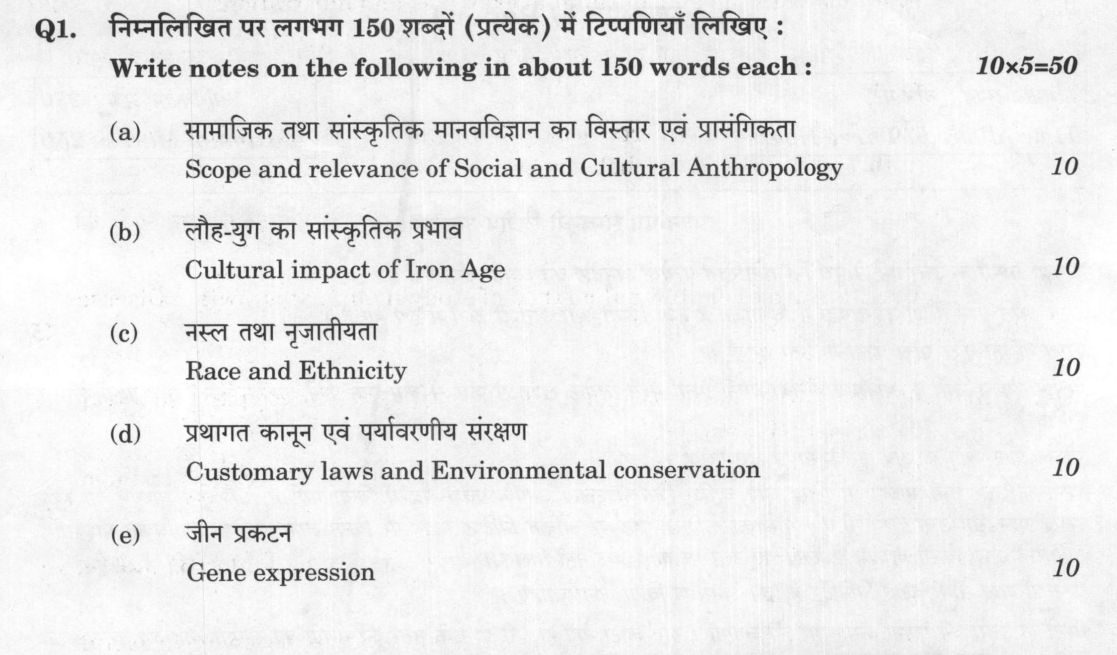
Write notes on the following in about 150 words each : 10×5=50 (a) Scope and relevance of Social and Cultural Anthropology…
Write notes on the following in about 150 words each : 10×5=50
Scope and relevance of Social and Cultural Anthropology 10
Cultural impact of Iron Age 10
Race and Ethnicity 10
Customary laws and Environmental conservation 10
Gene expression 10
हिंदी में प्रश्न पढ़ें
निम्नलिखित पर लगभग 150 शब्दों (प्रत्येक) में टिप्पणियाँ लिखिए :
सामाजिक तथा सांस्कृतिक मानवविज्ञान का विस्तार एवं प्रासंगिकता 10
लौह-युग का सांस्कृतिक प्रभाव 10
नस्ल तथा नृजातीयता 10
प्रथागत कानून एवं पर्यावरणीय संरक्षण 10
जीन प्रकटन 10
Model answer
Written by UPSC Answer Check against this question's marking rubric, to the 150-word length. UPSC does not publish answers for Mains — this is one way to score well, not an official key.
Social and Cultural Anthropology Social and Cultural Anthropology (SCA) is the branch of anthropology dedicated to the comparative study of living human societies, focusing on social organization, kinship, religion, and cultural patterns. Unlike Physical Anthropology, which deals with biological evolution, or Archaeology, which reconstructs past cultures from material remains, SCA employs ethnographic fieldwork to understand contemporary social realities. Its scope extends from micro-level interactions to macro-level structural analysis. In the Indian context, its relevance is paramount for policy formulation. The Anthropological Survey of India (ANSI) provides critical data for the identification of Scheduled Tribes and the implementation of the Fifth and Sixth Schedules. SCA informs development interventions by highlighting the socio-cultural dimensions of poverty, displacement, and conflict, such as in Naxal-affected areas. It also underpins the work of the National Human Rights Commission and tribal welfare ministries, ensuring that development does not erode indigenous identities. By bridging the gap between academic theory and administrative practice, SCA ensures that state policies are culturally sensitive and socially sustainable.
Cultural Impact of Iron Age The Iron Age, beginning around 1000 BCE in India, marked a transformative shift from the Neolithic/Chalcolithic era. The introduction of iron tools, particularly the iron ploughshare, significantly enhanced agricultural productivity, leading to surplus food production. This surplus supported population growth and the rise of complex social structures. Culturally, this period witnessed the emergence of the *Janapadas*—early political entities that laid the foundation for later Indian statehood. Urbanization accelerated with the rise of cities like Taxila and Pataliputra. In South India, the Megalithic cultures, such as those at Brahmagiri and Nagarjunakonda, exhibit distinct burial practices and iron usage, indicating regional variations in social complexity. The Iron Age also saw the crystallization of social stratification, with the Varna system becoming more rigid. The transition from pastoral to settled agrarian life redefined gender roles and labor divisions. Furthermore, the period saw the rise of new religious movements, including Buddhism and Jainism, which challenged existing orthodoxies. Thus, the Iron Age was not merely a technological phase but a socio-cultural revolution that shaped the political, economic, and religious landscape of ancient India.
Race and Ethnicity Race and ethnicity are distinct yet often conflated concepts. Race is a biological classification based on morphological and genetic traits, such as skin color, hair texture, and blood type. However, modern anthropology, following the UNESCO Statement on Race (1950), rejects the notion of discrete biological races, emphasizing that human variation is clinal and continuous. Ethnicity, conversely, is a cultural and subjective identity based on shared language, ancestry, religion, and historical memory. It is defined by boundary maintenance and self-ascription rather than objective biological markers. In India, the distinction is crucial for understanding social dynamics. The Jati system, while often mapped onto caste, operates as a complex ethnic-like identity within the Hindu fold, involving endogamy and social interaction. Conversely, tribal groups maintain distinct ethnic identities based on territory and customary law. Confusing race with ethnicity can lead to essentialist policies that ignore cultural agency. Recognizing ethnicity as a fluid, political construct allows for a more nuanced approach to minority rights and social integration, moving away from biological determinism toward cultural pluralism.
Customary Laws and Environmental Conservation Customary laws are unwritten, community-based norms governing resource use, often more effective than state legislation in local contexts. In India, these laws have historically facilitated environmental conservation through sacred groves and water management systems. For instance, the Khasi and Munda communities protect sacred groves (Sohra and Deo), which serve as biodiversity hotspots and water recharge zones. Similarly, traditional water conservation structures like the tanka in Rajasthan and khat in Maharashtra demonstrate indigenous hydrological knowledge. These practices are rooted in religious and social sanctions, ensuring compliance without the need for external enforcement. The Joint Forest Management (JFM) model, introduced in the 1990s, attempts to integrate these customary rights with state forest management, though it often faces challenges in balancing community autonomy with state control. Customary laws also regulate hunting, fishing, and grazing, preventing over-exploitation. In the face of climate change, reviving these indigenous practices is vital for sustainable development. They offer low-cost, high-impact solutions for ecosystem management, highlighting the value of traditional ecological knowledge in contemporary environmental policy.
Gene Expression Gene expression is the process by which information from a gene is used to direct the assembly of a protein, involving transcription (DNA to mRNA) and translation (mRNA to protein). It is not static; it is regulated by epigenetic mechanisms, such as DNA methylation and histone modification, which can alter gene activity without changing the DNA sequence. This regulation is crucial for human adaptation to environmental stressors. For example, in high-altitude populations like the Tibetans, specific variants of the EPAS1 gene, which encodes the HIF-2α transcription factor, are associated with lower hemoglobin levels. This adaptation reduces the risk of maladaptive polycythemia (excess red blood cells) rather than preventing hypoxia itself, allowing for efficient oxygen transport in low-oxygen environments. Similarly, lactase persistence in pastoralist communities is a result of gene-culture co-evolution, where dietary habits select for specific genetic variants. In India, studies on Andamanese populations and high-altitude tribes provide insights into how gene expression mediates survival in diverse ecological niches. Understanding gene expression thus bridges biology and anthropology, revealing how genetic potential interacts with culture and environment to shape human diversity.
What "Write short notes" is asking you to do
Five or six self-contained answers, marked separately, typically 10 marks and about 150 words each. Each note must carry its own definition, its two or three defining features and a line on why it matters; a common introduction or conclusion across the notes earns nothing.
Structure that answers it
Per note: one-line definition or identification → two or three features, mechanisms or named examples → one line of significance or Indian application
Where marks are lost
Writing the first two notes at essay length and rationing the rest. Each note is marked on its own, so marks surrendered on a compressed or unattempted note cannot be won back by the long ones.
How this answer will be evaluated
Approach
Framework: Anthropology Paper 1: Define > Theory/School > Ethnographic Evidence > Indian Application. (a) write short notes: define > 3-4 key features > one example > one-line significance | (b) write short notes: define > 3-4 key features > one example > one-line significance | (c) write short notes: define > 3-4 key features > one example > one-line significance | (d) write short notes: define > 3-4 key features > one example > one-line significance | (e) write short notes: define > 3-4 key features > one example > one-line significance Full marks: Precise definitions, named theorists/sites, clear distinction between concepts, strong Indian context.
Key points expected
- Define scope (social/cultural focus)
- State relevance to modern society
- Mention key sub-fields (kinship, ritual)
- One example of application
- Define Iron Age timeframe/context
- Mention agricultural revolution (plough)
- Link to social stratification/urbanization
- One specific cultural change
Evaluation rubric
Each sub-part is marked on its own, against the marks and word limit printed on the paper.
- (a) Define scope and relevance of Social and Cultural Anthropology. 10 marks · 150 words
write short notes— define → 3-4 key features → one example → one-line significance
Must cover
- Define scope (social/cultural focus)
- State relevance to modern society
- Mention key sub-fields (kinship, ritual)
- One example of application
Loses marks
- Sociology answers wearing anthropology labels
- Vague generalities without specific sub-fields
Earns more
- Mention Malinowski or Radcliffe-Brown
- Link to policy or development
- Distinguish from sociology
Extra mark
- Reference to specific Indian tribal study
- (b) Explain the cultural impact of the Iron Age. 10 marks · 150 words
write short notes— define → 3-4 key features → one example → one-line significance
Must cover
- Define Iron Age timeframe/context
- Mention agricultural revolution (plough)
- Link to social stratification/urbanization
- One specific cultural change
Loses marks
- Focusing only on metallurgy, not culture
- Ignoring social consequences of technology
Earns more
- Mention specific site (e.g., Ahar, Mehergarh)
- Link to Vedic period changes
- Mention trade expansion
Extra mark
- Sketch of iron tool or plough
- (c) Distinguish between Race and Ethnicity. 10 marks · 150 words
write short notes— define → 3-4 key features → one example → one-line significance
Must cover
- Define Race (biological/physical)
- Define Ethnicity (cultural/social)
- State key difference (nature vs nurture)
- Mention social construction of race
Loses marks
- Treating race as purely biological fact
- Confusing race with caste
Earns more
- Mention Cooley and Lewis
- Example of ethnic group (e.g., Gonds)
- Mention genetic continuity vs cultural markers
Extra mark
- Reference to specific anthropological debate
- (d) Link customary laws to environmental conservation. 10 marks · 150 words
write short notes— define → 3-4 key features → one example → one-line significance
Must cover
- Define customary laws (tribal norms)
- Explain role in resource management
- Mention specific practice (e.g., sacred groves)
- State relevance to modern conservation
Loses marks
- Ignoring the legal/customary aspect
- Generalizing without tribal examples
Earns more
- Mention specific tribe (e.g., Khasis, Santhals)
- Link to PESA Act or FRA
- Mention 'Kong' or 'Sarna' concepts
Extra mark
- Reference to specific sacred grove name
- (e) Explain the process of gene expression. 10 marks · 150 words
write short notes— define → 3-4 key features → one example → one-line significance
Must cover
- Define gene expression
- Mention Central Dogma (DNA->RNA->Protein)
- Explain transcription and translation
- Mention regulation (briefly)
Loses marks
- Confusing gene expression with mutation
- Ignoring the protein synthesis step
Earns more
- Mention specific gene (e.g., HBB)
- Link to anthropological context (e.g., sickle cell)
- Mention epigenetics
Extra mark
- Simple diagram of transcription/translation
Practice this exact question
Write your answer and it is marked point by point against the model answer above — what you covered, what you missed, what you got wrong.
Evaluate my answer →More from Anthropology 2023 Paper I
- Q1 Write notes on the following in about 150 words each : 10×5=50 (a) Scope and relevance of…
- Q2 (a) Discuss major species of Australopithecus discovered from South and East Africa. Desc…
- Q3 (a) What is hominization process ? Discuss the major trends in human evolution with the h…
- Q4 (a) Discuss the role of marriage regulations in traditional societies in India for streng…