Paper I — Q2
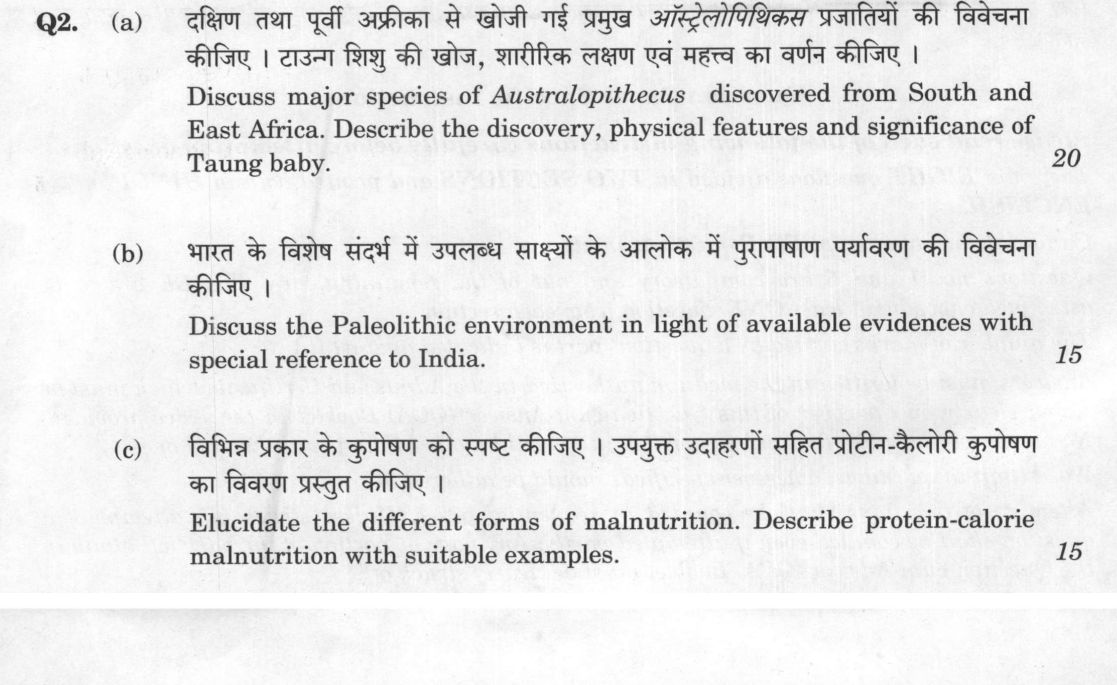
(a) Discuss major species of Australopithecus discovered from South and East Africa. Describe the discovery, physical features…
Discuss major species of Australopithecus discovered from South and East Africa. Describe the discovery, physical features and significance of Taung baby. 20 marks
Discuss the Paleolithic environment in light of available evidences with special reference to India. 15 marks
Elucidate the different forms of malnutrition. Describe protein-calorie malnutrition with suitable examples. 15 marks
हिंदी में प्रश्न पढ़ें
दक्षिण तथा पूर्वी अफ्रीका से खोजी गई प्रमुख ऑस्ट्रलोपिथिकस प्रजातियों की विवेचना कीजिए । टाउना शिशु की खोज, शारीरिक लक्षण एवं महत्व का वर्णन कीजिए । 20
भारत के विशेष संदर्भ में उपलब्ध साक्ष्यों के आलोक में पुरापाषाण पर्यावरण की विवेचना कीजिए । 15
विभिन्न प्रकार के कुपोषण को स्पष्ट कीजिए । उपयुक्त उदाहरणों सहित प्रोटीन-कैलोरी कुपोषण का विवरण प्रस्तुत कीजिए । 15
Model answer
Written by UPSC Answer Check against this question's marking rubric, to the expected length. UPSC does not publish answers for Mains — this is one way to score well, not an official key.
Human Biocultural Adaptation: Evolution, Environment, and Nutrition
The study of human origins, environmental adaptation, and nutritional status provides a holistic view of biocultural evolution. This answer addresses the Australopithecine fossil record, Paleolithic environmental reconstructions in India, and contemporary malnutrition patterns.
(a) Australopithecus Species and the Taung Child
Australopithecines are early hominins that inhabited Africa between 4.2 and 2 million years ago (mya). In East Africa, key species include A. anamensis (4.2–3.9 mya, Kenya/Ethiopia), A. afarensis (3.9–2.9 mya, Ethiopia/Kenya, famous for "Lucy"), A. garhi (2.5 mya, Ethiopia), and A. boisei (2.3–1.4 mya, Kenya/Tanzania, characterized by massive jaws). In South Africa, the major species are A. africanus (3.3–2.1 mya, South Africa) and A. robustus (2.0–1.2 mya, South Africa), the latter known for robust cranial features.
The Taung Child is a pivotal discovery. In 1924, Raymond Dart identified a juvenile cranium found in Taung, South Africa. Its significance lies in the position of the foramen magnum, which is located centrally beneath the skull, providing definitive evidence of bipedalism. The braincase was small (~405 cc), and the canines were reduced, distinguishing it from apes. Dart’s interpretation was initially controversial; contemporaries often rejected it as a hominin due to the small brain size, and it did not immediately overturn the Piltdown Man hypothesis (which was exposed as a hoax in 1953). However, Taung provided the first clear evidence of a bipedal hominin in Africa, shifting the focus of human origins from Asia to Africa and establishing the genus Australopithecus as a distinct lineage.
(b) Paleolithic Environment in India
The Paleolithic era in India (2.5 mya to 10,000 BP) is characterized by significant climatic fluctuations during the Pleistocene. Environmental reconstruction relies on geological, palynological (pollen), and faunal evidence.
Geological evidence shows that early Paleolithic sites like Attirampakkam (Tamil Nadu) are located in the Kortallayar river basin, indicating adaptation to inland riverine environments rather than coastal floodplains. In the arid margins of the Thar Desert, sites like Didwana (Rajasthan) show evidence of seasonal water sources and open grassland environments. The Hunsgi-Baichbal valleys in Karnataka reveal a transition from forested to more open landscapes, supported by faunal remains.
Faunal assemblages provide critical insights. The Narmada and Godavari valleys yield fossils of Elephas namadicus, indicating a tropical savanna environment, distinct from the Elephas hysudricus found in older Siwalik deposits. Palynological studies at Bhimbetka (Madhya Pradesh) show a shift from dense deciduous forests in the Lower Paleolithic to more open grasslands in the Middle Paleolithic, correlating with the Soan and Madras tool industries. These adaptations demonstrate how Indian hominins utilized diverse ecozones, from the tropical forests of the Deccan to the arid zones of the northwest.
(c) Forms of Malnutrition and PEM
Malnutrition is a multidimensional condition encompassing undernutrition, overnutrition, and micronutrient deficiencies. Undernutrition is measured by anthropometric indicators such as weight-for-age (wasting), height-for-age (stunting), and weight-for-height (underweight). Micronutrient deficiencies include iron-deficiency anemia, vitamin A deficiency, and iodine deficiency. Overnutrition, or obesity, is increasingly prevalent in urban India.
Protein-Calorie Malnutrition (PCM) is a severe form of undernutrition with two distinct clinical presentations:
- Kwashiorkor: This results from severe protein deficiency in the presence of adequate or high carbohydrate/calorie intake. Symptoms include edema (swelling), fatty liver, hair depigmentation, and skin lesions. It is often seen in weaning children in regions like the Nilgiris or Bastar where diets are carbohydrate-heavy but protein-poor.
- Marasmus: This results from severe calorie and protein deficiency, leading to extreme wasting, loss of subcutaneous fat, and muscle atrophy. It is common in infants and young children in areas with food insecurity.
In India, the Integrated Child Development Services (ICDS) and National Family Health Survey (NFHS-5) data highlight the prevalence of stunting and wasting, particularly in tribal belts and rural central India. Addressing PCM requires a combination of nutritional supplementation, dietary diversification, and public health interventions.
Conclusion
The study of Australopithecines, Paleolithic environments, and modern malnutrition illustrates the continuous thread of human adaptation. From the bipedalism of Taung to the tool-making of the Hunsgi valley and the nutritional challenges of today, human biology and culture are inextricably linked. Understanding these dynamics is crucial for addressing contemporary health and historical origins.
What "Discuss" is asking you to do
Lay the issue out from more than one side — how it arose, what is claimed for it, what is held against it, and where it now stands. UPSC attaches discuss to broad topics with several live dimensions, so coverage of the dimensions earns more than the strength of your opinion.
Structure that answers it
Set the issue up → the case as it is made → the case against → the dimension both sides leave out → where the balance now lies
Where marks are lost
Listing facts with no thread between them, or arguing one side throughout and calling it a discussion.
How this answer will be evaluated
Approach
Framework: UPSC Anthropology Paper 1 (Physical Anthropology & Prehistory). (a) discuss: intro > 3-4 dimensions > example > balanced close | (b) discuss: intro > 3-4 dimensions > example > balanced close | (c) explain: definition/context > points in order > small example > short close Full marks: Comprehensive coverage of all sub-parts with specific examples, clear distinctions, and anthropological context.
Key points expected
- List major species (e.g., A. africanus, A. robustus, A. boisei)
- State discovery details of Taung baby (1924, Raymond Dart)
- Describe physical features (bipedal pelvis, small brain, large foramen magnum)
- Explain significance (bipedalism precedes brain expansion)
- Define Paleolithic environment (climate, flora, fauna)
- Cite Indian sites (e.g., Bhimbetka, Belan valley, Hunsgi)
- Link tool types (choppers, hand axes) to environmental adaptation
- Mention evidence of hunting/gathering lifestyle
Evaluation rubric
Each sub-part is marked on its own, against the marks and word limit printed on the paper.
- (a) Overview of Australopithecus species and detailed profile of the Taung baby. 20 marks
discuss— intro → 3-4 dimensions → example → balanced close
Must cover
- List major species (e.g., A. africanus, A. robustus, A. boisei)
- State discovery details of Taung baby (1924, Raymond Dart)
- Describe physical features (bipedal pelvis, small brain, large foramen magnum)
- Explain significance (bipedalism precedes brain expansion)
Loses marks
- Confusing Australopithecus with Homo erectus
- Omitting the significance of the Taung baby
- Failing to distinguish between South and East African finds
Earns more
- Mention specific sites (Olduvai Gorge, Swartkrans)
- Reference Raymond Dart's 'Australopithecus' paper
- Compare cranial capacity of Taung vs. modern humans
Extra mark
- Labelled diagram of Taung skull showing foramen magnum position
- Mention specific dates of other major Australopithecus finds
- (b) Analysis of Paleolithic environmental conditions in India based on evidence. 15 marks
discuss— intro → 3-4 dimensions → example → balanced close
Must cover
- Define Paleolithic environment (climate, flora, fauna)
- Cite Indian sites (e.g., Bhimbetka, Belan valley, Hunsgi)
- Link tool types (choppers, hand axes) to environmental adaptation
- Mention evidence of hunting/gathering lifestyle
Loses marks
- Generalizing without specific Indian examples
- Confusing Paleolithic with Mesolithic or Neolithic
- Ignoring the 'environment' aspect and focusing only on tools
Earns more
- Reference specific climatic phases (Pleistocene)
- Mention specific fauna found (e.g., elephants, rhinoceros)
- Discuss the role of river valleys in settlement
Extra mark
- Mention specific excavators (e.g., H.D. Sankalia, R.S. Biswas)
- Reference specific rock art motifs at Bhimbetka
- (c) Explanation of malnutrition types and detailed description of PCM. 15 marks
explain— definition/context → points in order → small example → short close
Must cover
- List different forms of malnutrition (PCM, micronutrient, obesity)
- Define Protein-Calorie Malnutrition (PCM)
- Describe specific PCM conditions (Kwashiorkor, Marasmus)
- Provide suitable examples or symptoms for PCM
Loses marks
- Failing to distinguish between Kwashiorkor and Marasmus
- Ignoring the 'different forms' part of the question
- Providing only general health advice without anthropological context
Earns more
- Mention specific micronutrient deficiencies (e.g., Iron, Iodine)
- Reference specific Indian tribal contexts for malnutrition
- Mention specific government schemes (e.g., ICDS, PDS)
Extra mark
- Mention specific tribal groups affected (e.g., Santhal, Gond)
- Reference specific nutritional indices (e.g., BMI, MUAC)
Practice this exact question
Write your answer and it is marked point by point against the model answer above — what you covered, what you missed, what you got wrong.
Evaluate my answer →More from Anthropology 2023 Paper I
- Q1 Write notes on the following in about 150 words each : 10×5=50 (a) Scope and relevance of…
- Q2 (a) Discuss major species of Australopithecus discovered from South and East Africa. Desc…
- Q3 (a) What is hominization process ? Discuss the major trends in human evolution with the h…
- Q4 (a) Discuss the role of marriage regulations in traditional societies in India for streng…
- Q5 Write notes on the following in about 150 words each : 10×5=50 (a) Polygenic Inheritance…