Paper I — Q7
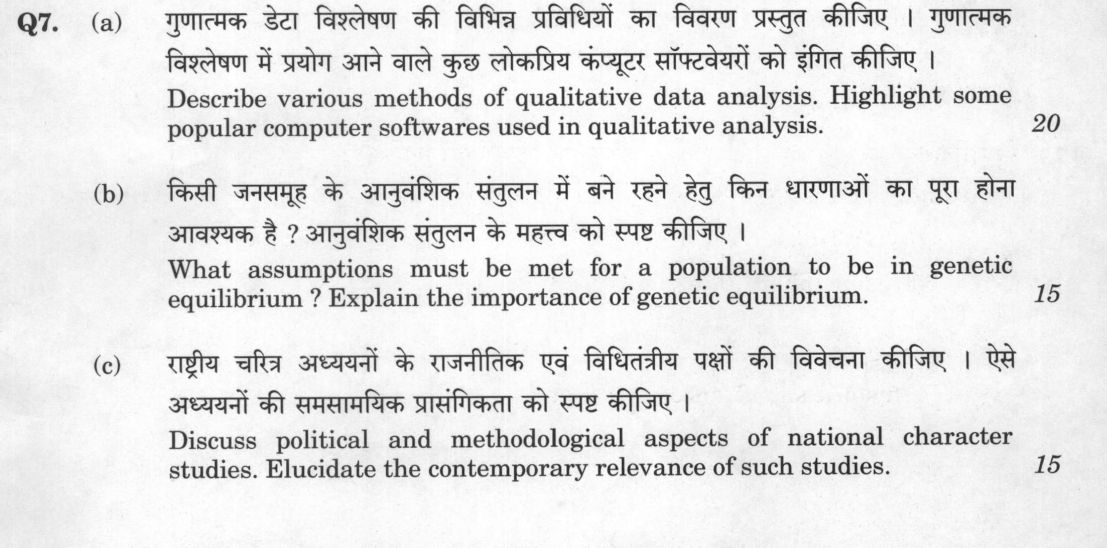
(a) Describe various methods of qualitative data analysis. Highlight some popular computer softwares used in qualitative…
Describe various methods of qualitative data analysis. Highlight some popular computer softwares used in qualitative analysis. 20 marks
What assumptions must be met for a population to be in genetic equilibrium ? Explain the importance of genetic equilibrium. 15 marks
Discuss political and methodological aspects of national character studies. Elucidate the contemporary relevance of such studies. 15 marks
हिंदी में प्रश्न पढ़ें
गुणात्मक डेटा विश्लेषण की विभिन्न प्रविधियों का विवरण प्रस्तुत कीजिए । गुणात्मक विश्लेषण में प्रयोग आने वाले कुछ लोकप्रिय कंप्यूटर सॉफ्टवेयरों को इंगित कीजिए । 20
किसी जनसमूह के आनुवंशिक संतुलन में बने रहने हेतु किन धारणाओं का पूरा होना आवश्यक है ? आनुवंशिक संतुलन के महत्व को स्पष्ट कीजिए । 15
राष्ट्रीय चरित्र अध्ययनों के राजनीतिक एवं विधितंत्रीय पक्षों की विवेचना कीजिए । ऐसे अध्ययनों की समसामयिक प्रासंगिकता को स्पष्ट कीजिए । 15
Model answer
Written by UPSC Answer Check against this question's marking rubric, to the expected length. UPSC does not publish answers for Mains — this is one way to score well, not an official key.
Methodological rigor across sociocultural and biological anthropology enables systematic analysis ranging from qualitative ethnographic texts to population genetics.
Methods of Qualitative Data Analysis and Software
Qualitative data analysis transforms unstructured field materials—such as ethnographic fieldnotes, interview transcripts, and visual archives—into coherent analytical structures.
Thematic Analysis systematically identifies, organizes, and interprets recurring patterns or themes across a dataset, following structured phases of coding and theme development.
Content Analysis categorizes and quantifies textual, visual, or audio data through systematic coding, bridging qualitative narrative interpretation and quantitative indices.
Grounded Theory Analysis employs an inductive framework formulated by Glaser and Strauss, building conceptual models directly from empirical observations through iterative stages of open, axial, and selective coding, governed by constant comparative analysis.
Narrative Analysis examines biographical accounts, oral testimonies, and life histories, focusing on the structural sequence and subjective meanings through which informants construct lived experiences.
Discourse Analysis investigates how language practices interact with institutional power structures and ideology, unpacking the socio-political contexts of knowledge production.
Computer-Assisted Qualitative Data Analysis Software (CAQDAS) enhances data management and analytical validity: NVivo provides multi-format media integration, sentiment analysis, hierarchical node structures, and cross-tabulation matrix queries. Atlas.ti utilizes visual semantic networks, quotation management, and co-occurrence tables to support grounded theory development. MAXQDA facilitates mixed-methods research by combining qualitative coding with quantitative variables, statistical charting, and spatial-temporal mapping.
Assumptions and Importance of Genetic Equilibrium
In anthropological genetics, the Hardy-Weinberg Equilibrium (HWE) provides a mathematical framework establishing that allele and genotype frequencies in a gene pool remain constant over generations in the absence of evolutionary disturbances. It is expressed as p + q = 1 for allele frequencies, and p² + 2pq + q² = 1 for genotype frequencies, where p and q represent dominant and recessive alleles.
For a population to maintain genetic equilibrium, five fundamental assumptions must be met: Random mating (panmixia), where every individual has an equal probability of mate selection without assortative mating or inbreeding; an infinitely large population size to eliminate random fluctuations caused by genetic drift; absence of mutations introducing new allelic variants; no gene flow (migration) causing allelic exchange between populations; and absence of natural selection, ensuring all genotypes possess equal reproductive fitness.
The importance of HWE lies in its function as a null model. Because natural human populations inevitably experience microevolutionary pressures, departures from equilibrium frequencies allow biological anthropologists to detect, measure, and analyze evolutionary forces—such as directional selection, founder effects, and endogamy—in shaping human genetic diversity and hereditary disease distribution.
Political and Methodological Aspects of National Character Studies
Developed during World War II and the early Cold War within the Culture and Personality school, national character studies sought to map distinct modal personalities of modern nation-states, exemplified by Ruth Benedict’s The Chrysanthemum and the Sword on wartime Japan.
Politically, these studies were aligned with military intelligence and geopolitical statecraft, often reflecting cultural essentialism and imperial administrative interests. Methodologically, restricted field access forced researchers to study "culture at a distance" through literature, media, and emigré interviews. This produced critical deficiencies: non-representative sampling, psychological reductionism that ignored internal socio-economic divisions, and overgeneralized stereotyping that framed entire nations as monolithic psychological units.
Contemporary cultural studies have moved beyond these essentialist frameworks to adopt intersectional approaches. However, the study of national character retains analytical relevance for deconstructing state-sponsored cultural nationalism, resolving identity-based ethnic conflicts, and evaluating soft power diplomacy and strategic geopolitical narratives.
Methodological reflexivity remains central across biological and sociocultural anthropology, ensuring that empirical baseline models and qualitative interpretive tools alike are applied with rigorous awareness of context, variation, and analytical limits.
What "Describe" is asking you to do
Give a full, ordered account of the thing named — its parts, stages or mechanism — in the sequence in which it actually exists or occurs. Most describe questions come from the science optionals, where the marks sit in correct technical detail and, where the stem says so, a labelled diagram.
Structure that answers it
One-line identification of the subject → the parts or stages in their real order, each with its defining detail → labelled diagram where the subject is structural → closing line on function or significance
Where marks are lost
Loose general prose where the examiner is ticking named parts, correct terminology and their sequence; and in the General Studies papers, turning to evaluation before the description is finished.
How this answer will be evaluated
Approach
Framework: UPSC Anthropology Paper 1 (Sociology/Physical). (a) describe: define > structure or process in order > labelled diagram > significance | (b) explain: definition/context > points in order > small example > short close | (c) discuss: intro > 3-4 dimensions > example > balanced close Full marks: Comprehensive, specific, and well-structured with named examples and clear distinctions.
Key points expected
- Define qualitative data analysis
- Describe 3-4 methods (e.g., Thematic, Grounded Theory)
- List 3-4 popular software (e.g., NVivo, ATLAS.ti)
- Briefly explain function of one software
- List 5 Hardy-Weinberg assumptions (no mutation, random mating, etc.)
- Define genetic equilibrium
- Explain importance as a null hypothesis
- Mention Hardy-Weinberg equation (p+q=1)
Evaluation rubric
Each sub-part is marked on its own, against the marks and word limit printed on the paper.
- (a) Outline qualitative analysis methods and list popular software tools. 20 marks
describe— define → structure or process in order → labelled diagram → significance
Must cover
- Define qualitative data analysis
- Describe 3-4 methods (e.g., Thematic, Grounded Theory)
- List 3-4 popular software (e.g., NVivo, ATLAS.ti)
- Briefly explain function of one software
Loses marks
- Confusing qualitative with quantitative methods
- Listing software without explaining its use
- Sociology answers wearing anthropology labels
Earns more
- Mention specific coding techniques
- Reference a specific study using software
- Distinguish between manual and computer-assisted analysis
Extra mark
- Mention specific version of software
- Reference a specific Indian qualitative study
- (b) List Hardy-Weinberg assumptions and explain the concept's importance. 15 marks
explain— definition/context → points in order → small example → short close
Must cover
- List 5 Hardy-Weinberg assumptions (no mutation, random mating, etc.)
- Define genetic equilibrium
- Explain importance as a null hypothesis
- Mention Hardy-Weinberg equation (p+q=1)
Loses marks
- Confusing genetic equilibrium with genetic drift
- Failing to list all 5 assumptions
- Sociology answers wearing anthropology labels
Earns more
- Explain how deviation indicates evolution
- Mention specific evolutionary forces (drift, selection)
- Reference a specific population study
Extra mark
- Draw a simple allele frequency graph
- Mention specific Indian tribal population study
- (c) Analyze political/methodological issues in national character studies and their relevance. 15 marks
discuss— intro → 3-4 dimensions → example → balanced close
Must cover
- Define national character studies
- Discuss political aspects (nationalism, identity)
- Discuss methodological aspects (bias, sampling)
- Explain contemporary relevance
Loses marks
- Confusing national character with national identity
- Failing to address both political and methodological aspects
- Sociology answers wearing anthropology labels
Earns more
- Reference specific national character studies (e.g., India, Japan)
- Mention specific methodological critiques
- Reference specific political context
Extra mark
- Mention specific contemporary policy
- Reference specific recent study
Practice this exact question
Write your answer and it is marked point by point against the model answer above — what you covered, what you missed, what you got wrong.
Evaluate my answer →More from Anthropology 2023 Paper I
- Q4 (a) Discuss the role of marriage regulations in traditional societies in India for streng…
- Q5 Write notes on the following in about 150 words each : 10×5=50 (a) Polygenic Inheritance…
- Q6 (a) Critically discuss the controversies related to fieldwork of Bronislaw Malinowski and…
- Q7 (a) Describe various methods of qualitative data analysis. Highlight some popular compute…
- Q8 (a) Critically examine Arjun Appadurai's conceptualization of global cultural economy. 20…