Paper I — Q5
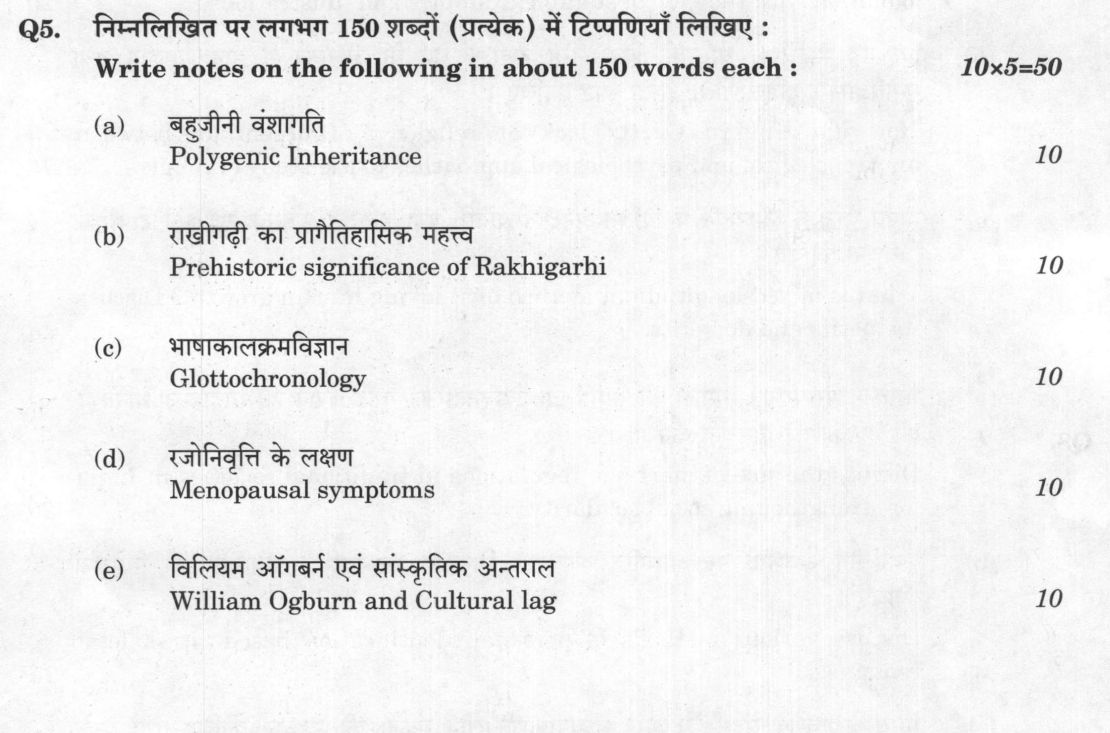
Write notes on the following in about 150 words each : 10×5=50 (a) Polygenic Inheritance 10 (b) Prehistoric significance of…
Write notes on the following in about 150 words each : 10×5=50
Polygenic Inheritance 10
Prehistoric significance of Rakhigarhi 10
Glottochronology 10
Menopausal symptoms 10
William Ogburn and Cultural lag 10
हिंदी में प्रश्न पढ़ें
निम्नलिखित पर लगभग 150 शब्दों (प्रत्येक) में टिप्पणियाँ लिखिए :
बहुजनी वंशागति 10
राखीगढ़ी का प्रागैतिहासिक महत्व 10
भाषाकालक्रमविज्ञान 10
रजोनिवृत्ति के लक्षण 10
विलियम ऑगबर्न एवं सांस्कृतिक अंतराल 10
Model answer
Written by UPSC Answer Check against this question's marking rubric, to the 150-word length. UPSC does not publish answers for Mains — this is one way to score well, not an official key.
1. Polygenic Inheritance Polygenic inheritance refers to the genetic control of a single quantitative trait by multiple gene pairs, each contributing additively to the phenotype. Unlike Mendelian single-gene traits, polygenic traits exhibit continuous variation rather than discrete categories, resulting in a normal distribution or bell curve in populations. This mechanism explains the gradational differences observed in anthropometric characteristics such as human skin colour, stature, and body mass index. R.A. Fisher’s polygenic theory (1918) established that the cumulative effect of many genes, each with a small individual effect, produces the continuous variation seen in nature. The heritability of these traits is high, though environmental factors like nutrition also play a significant role. For instance, while stature is genetically determined, it is heavily influenced by childhood diet. In anthropometry, understanding polygenic inheritance is crucial for interpreting population differences and evolutionary pressures. It clarifies that traits like skin pigmentation are not determined by a single "race gene" but by complex interactions of multiple loci. This perspective challenges simplistic racial typologies and supports the view of human variation as clinal and continuous. The study of polygenic traits also aids in medical anthropology, particularly in understanding susceptibility to complex diseases like diabetes or hypertension, which have both genetic and environmental components. Thus, polygenic inheritance provides a biological basis for understanding the complexity of human biological diversity.
2. Prehistoric Significance of Rakhigarhi Rakhigarhi, located in Hisar district, Haryana, is the largest excavated site of the Indus Valley Civilization (IVC), spanning approximately 350 hectares with seven distinct mounds. It represents the Mature Harappan phase and is significant for its urban planning, including a sophisticated drainage system and granaries. Unlike Mohenjo-daro, Rakhigarhi lacks a citadel, suggesting a different urban hierarchy or administrative structure. Archaeologically, it has yielded unique artifacts such as terracotta toys, beads, and pottery. Its most profound significance lies in the 2019 study by Narasimhan et al., which analyzed ancient DNA from Rakhigarhi skeletons. The findings revealed that the individuals lacked Steppe pastoralist and Iranian farmer-related ancestry, which is present in modern North Indians. This suggests that the IVC population was distinct from later Indo-Aryan migrants, supporting the theory that the IVC was a distinct genetic cluster. This finding has intensified the debate on the origins of Indo-Aryan languages and the nature of cultural continuity in the Indian subcontinent. Rakhigarhi thus serves as a critical node in understanding the demographic history of South Asia, bridging archaeological and genetic evidence to reconstruct the pre-colonial population structure. It challenges the simplistic "Aryan invasion" model and points towards complex processes of migration, admixture, and local continuity.
3. Glottochronology Glottochronology is a lexicostatistical method developed by Morris Swadesh in the 1950s to estimate the time depth of language divergence. It assumes a constant rate of lexical replacement, positing that 81% of core vocabulary is retained after one millennium. The formula used is t = (ln(C/100))/(2 ln r), where t is time in millennia, C is the percentage of shared cognates, and r is the retention rate (0.81). Swadesh created standardized lists of 100 and 200 basic vocabulary items to facilitate comparison across languages. The method was initially applied to date the proto-languages of various families, including Indo-European and Dravidian. However, it has faced severe criticism. Critics like Bergsland and Vogt argued that the rate of lexical change is not constant but varies due to social, cultural, and contact factors. Robert Lees, a key mathematical developer of the method, also acknowledged its limitations. In the Indian context, glottochronology has been used to propose deep time depths for Indo-Aryan and Dravidian families, but these dates are often contested by historical linguists who emphasize irregular sound changes and borrowing. The method’s assumption of regularity is flawed, as loanwords and semantic shifts distort cognate percentages. Consequently, while glottochronology provides a quantitative framework, it is now considered unreliable for precise dating. Modern computational phylogenetics, which incorporates more complex models of change, has largely superseded it. Nevertheless, it remains a foundational concept in historical linguistics, highlighting the challenges of dating language divergence without written records.
4. Menopausal Symptoms Menopause is defined as the permanent cessation of menstruation, diagnosed after 12 consecutive months of amenorrhea, typically occurring between ages 45 and 55. It results from the decline in ovarian function and the subsequent drop in estrogen and progesterone levels. The primary symptoms include vasomotor disturbances such as hot flashes and night sweats, which affect up to 80% of women. Genitourinary syndrome of menopause includes vaginal atrophy, dryness, and dyspareunia. Long-term health risks include accelerated bone loss leading to osteoporosis and increased cardiovascular disease risk due to the loss of estrogen’s protective effects on lipid profiles. Psychological symptoms like mood swings, anxiety, and sleep disturbances are also common. Cross-cultural studies reveal variations in symptom severity and prevalence. For instance, studies in Rajasthan, India, have reported high rates of vasomotor symptoms, often linked to dietary habits and stress levels. In contrast, some Japanese studies suggest lower prevalence, possibly due to dietary factors like soy intake. Anthropological perspectives emphasize that menopause is not just a biological event but a social transition, often accompanied by changes in family roles and status. In many Indian contexts, menopause is associated with a shift from reproductive to elder roles, which can be both empowering and isolating. Understanding these symptoms is crucial for public health interventions, particularly in improving access to hormone replacement therapy and counseling. The biocultural approach highlights how social support systems can mitigate the negative impacts of menopausal transition, underscoring the need for culturally sensitive healthcare policies.
5. William Ogburn and Cultural Lag William F. Ogburn, in his 1922 work Social Change, introduced the concept of cultural lag to explain the uneven pace of social adaptation. He argued that material culture (technology, tools) changes faster than non-material culture (norms, laws, values), creating a lag that leads to social problems. Ogburn identified four types of lag: lag in adaptation, lag in diffusion, lag in integration, and lag in value systems. For example, the rapid adoption of digital technology in India has outpaced the development of robust cyber laws and digital literacy, leading to issues like online fraud and privacy violations. Similarly, the shift from joint to nuclear families is a material change driven by urbanization and economic opportunities, but traditional values of joint family support often persist, causing intergenerational conflict. This lag is not merely a delay but a structural feature of social change. Ogburn’s theory helps explain social pathologies such as crime, juvenile delinquency, and family instability, which arise when new technologies or economic structures are not matched by corresponding social norms. In the Indian context, the rapid growth of the IT sector has created a new class of workers with globalized lifestyles, yet social institutions like marriage and kinship remain rooted in traditional frameworks. This dissonance is evident in rising divorce rates and changing gender roles. Ogburn’s concept remains relevant for understanding contemporary social issues, emphasizing the need for proactive policy interventions to align non-material culture with material advancements. It underscores the importance of education and legal reforms in managing the pace of social change.
What "Write short notes" is asking you to do
Five or six self-contained answers, marked separately, typically 10 marks and about 150 words each. Each note must carry its own definition, its two or three defining features and a line on why it matters; a common introduction or conclusion across the notes earns nothing.
Structure that answers it
Per note: one-line definition or identification → two or three features, mechanisms or named examples → one line of significance or Indian application
Where marks are lost
Writing the first two notes at essay length and rationing the rest. Each note is marked on its own, so marks surrendered on a compressed or unattempted note cannot be won back by the long ones.
How this answer will be evaluated
Approach
Framework: Anthropology Paper 1: Define > Theory/School > Ethnographic Evidence > Indian Application. (a) write short notes: define > 3-4 key features > one example > one-line significance | (b) write short notes: define > 3-4 key features > one example > one-line significance | (c) write short notes: define > 3-4 key features > one example > one-line significance | (d) write short notes: define > 3-4 key features > one example > one-line significance | (e) write short notes: define > 3-4 key features > one example > one-line significance Full marks: Precise definitions, named scholars/sites, specific examples, clear anthropological framing
Key points expected
- Define polygenic inheritance as multiple gene action
- Explain cumulative effect of genes on phenotype
- Mention continuous variation in traits
- Provide a specific biological example (e.g., skin colour)
- Identify Rakhigarhi as a Harappan/Indus Valley site
- Mention location in Haryana (Karnal district)
- Note significance of human remains/ancient DNA
- Reference to agricultural or trade evidence
Evaluation rubric
Each sub-part is marked on its own, against the marks and word limit printed on the paper.
- (a) Define polygenic inheritance and explain its mechanism with a biological example. 10 marks · 150 words
write short notes— define → 3-4 key features → one example → one-line significance
Must cover
- Define polygenic inheritance as multiple gene action
- Explain cumulative effect of genes on phenotype
- Mention continuous variation in traits
- Provide a specific biological example (e.g., skin colour)
Loses marks
- Confusing with single-gene Mendelian traits
- Sociological answer without biological basis
Earns more
- Reference to Mendelian vs non-Mendelian inheritance
- Mention of environmental influence on expression
- Reference to specific anthropologist or geneticist
Extra mark
- Labelled diagram of gene interaction
- Reference to specific Indian population study
- (b) Outline the prehistoric significance of the Rakhigarhi site in Haryana. 10 marks · 150 words
write short notes— define → 3-4 key features → one example → one-line significance
Must cover
- Identify Rakhigarhi as a Harappan/Indus Valley site
- Mention location in Haryana (Karnal district)
- Note significance of human remains/ancient DNA
- Reference to agricultural or trade evidence
Loses marks
- Confusing with other Harappan sites
- Generalities without specific site details
Earns more
- Mention of specific excavator (e.g., B.B. Lal)
- Reference to specific artifacts (e.g., pottery, tools)
- Link to broader Indus Valley civilization
Extra mark
- Reference to recent genetic studies (2019)
- Map sketch of site location
- (c) Define glottochronology and explain its method for dating language divergence. 10 marks · 150 words
write short notes— define → 3-4 key features → one example → one-line significance
Must cover
- Define glottochronology as statistical method
- Explain use of lexical retention rates
- Mention assumption of constant rate of change
- Note its application in linguistic anthropology
Loses marks
- Confusing with comparative method
- Sociological answer without linguistic basis
Earns more
- Reference to specific linguist (e.g., Swadesh)
- Mention of specific language family example
- Note on limitations of the method
Extra mark
- Formula for calculating divergence time
- Reference to specific Indian language study
- (d) List and explain the key menopausal symptoms in biological anthropology. 10 marks · 150 words
write short notes— define → 3-4 key features → one example → one-line significance
Must cover
- Define menopause as cessation of menstruation
- List physical symptoms (e.g., hot flashes)
- Mention hormonal changes (e.g., estrogen decline)
- Note psychological or social impacts
Loses marks
- Medical answer without anthropological context
- Confusing with other reproductive stages
Earns more
- Reference to specific age range
- Mention of cross-cultural variations
- Link to reproductive biology
Extra mark
- Reference to specific Indian study
- Diagram of hormonal changes
- (e) Explain William Ogburn's concept of cultural lag with an example. 10 marks · 150 words
write short notes— define → 3-4 key features → one example → one-line significance
Must cover
- Define cultural lag as Ogburn's concept
- Explain material vs non-material culture
- Mention time lag between changes
- Provide a specific example (e.g., technology vs law)
Loses marks
- Confusing with other cultural concepts
- Sociological answer without anthropological basis
Earns more
- Reference to Ogburn's specific work
- Mention of specific cultural domain
- Link to cultural evolution theory
Extra mark
- Reference to specific Indian example
- Diagram of material/non-material culture
Practice this exact question
Write your answer and it is marked point by point against the model answer above — what you covered, what you missed, what you got wrong.
Evaluate my answer →More from Anthropology 2023 Paper I
- Q2 (a) Discuss major species of Australopithecus discovered from South and East Africa. Desc…
- Q3 (a) What is hominization process ? Discuss the major trends in human evolution with the h…
- Q4 (a) Discuss the role of marriage regulations in traditional societies in India for streng…
- Q5 Write notes on the following in about 150 words each : 10×5=50 (a) Polygenic Inheritance…
- Q6 (a) Critically discuss the controversies related to fieldwork of Bronislaw Malinowski and…
- Q7 (a) Describe various methods of qualitative data analysis. Highlight some popular compute…
- Q8 (a) Critically examine Arjun Appadurai's conceptualization of global cultural economy. 20…