Paper I — Q6
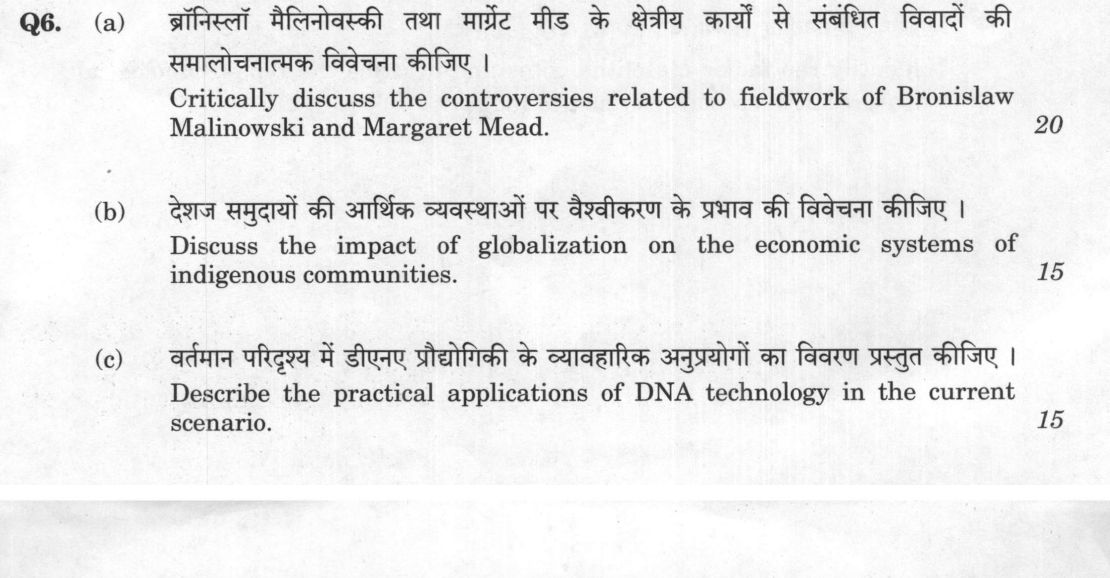
(a) Critically discuss the controversies related to fieldwork of Bronislaw Malinowski and Margaret Mead. 20 (b) Discuss the…
Critically discuss the controversies related to fieldwork of Bronislaw Malinowski and Margaret Mead. 20 marks
Discuss the impact of globalization on the economic systems of indigenous communities. 15 marks
Describe the practical applications of DNA technology in the current scenario. 15 marks
हिंदी में प्रश्न पढ़ें
ब्रॉनिस्लॉ मैलिनोव्स्की तथा मार्ग्रेट मीड के क्षेत्रीय कार्यों से संबंधित विवादों की समालोचनात्मक विवेचना कीजिए । 20
देशज समुदायों की आर्थिक व्यवस्थाओं पर वैश्वीकरण के प्रभाव की विवेचना कीजिए । 15
वर्तमान परिदृश्य में डीएनए प्रौद्योगिकी के व्यावहारिक अनुप्रयोगों का विवरण प्रस्तुत कीजिए । 15
Model answer
Written by UPSC Answer Check against this question's marking rubric, to the expected length. UPSC does not publish answers for Mains — this is one way to score well, not an official key.
Classical anthropological ethnography long claimed objective, value-neutral observation. However, the posthumous publication of Bronislaw Malinowski’s A Diary in the Strict Sense of the Term (1967) fractured this ideal, exposing a stark dissonance between the empathetic fieldworker portrayed in Argonauts of the Western Pacific and his private expressions of racial prejudice, sexual frustration, and cynical detachment from the Trobriand Islanders. Malinowski’s functionalism obscured these personal subjectivities behind an aura of scientific rigor. Similarly, Margaret Mead’s Coming of Age in Samoa (1928), which championed Franz Boas’s cultural determinism over biological determinism, faced severe challenge from Derek Freeman in 1983. Freeman revealed Mead’s methodological deficiencies, notably her brief stay, lack of linguistic mastery, and vulnerability to adolescent informant hoaxes regarding sexual permissiveness. These controversies precipitated anthropology’s "crisis of representation" and the reflexive turn led by Clifford and Marcus, establishing that ethnographies are situated, polyvocal texts rather than detached truths. Ultimately, while both scholars suffered from theoretical and personal vulnerabilities, their work catalyzed modern methodological transparency and reflexive self-scrutiny.
Impact of Globalization on Indigenous Economic Systems
Historically, indigenous economic systems in India—such as those of the Birhor, Kadar, and Onge—relied on subsistence production, reciprocity, redistribution, communal land tenure, and deep dependence on non-timber forest produce (NTFP). Globalization fundamentally altered these systems by incorporating isolated economies into global circuits of capital via commercial mining, rapid industrialization, infrastructure projects, and ecotourism. These processes frequently bypass statutory safeguards like the Panchayats (Extension to Scheduled Areas) Act (PESA, 1996) and forest rights regimes, resulting in involuntary displacement and land alienation. The structural outcomes include the proletarianization of self-sufficient tribal households into unorganized wage labor, loss of food sovereignty, and the feminization of poverty as environmental degradation forces women to travel farther for foraging. These disruptions have triggered persistent socio-environmental resistance, notably the Narmada Bachao Andolan and the Dongria Kondh’s mobilization against Vedanta’s mining operations at Niyamgiri, asserting traditional rights under the Forest Rights Act (FRA, 2006).
Practical Applications of DNA Technology
DNA technology has become foundational across forensic, clinical, and evolutionary anthropology. In forensic anthropology, short tandem repeat (STR) profiling and mitochondrial DNA analysis, operationalized through the Central Forensic Science Laboratories (CFSL) and indexed in national criminal databases, are critical for crime resolution, disputed paternity, and disaster victim identification in mass-casualty events.
In medical and anthropological genetics, next-generation sequencing facilitates prenatal genetic screening, pharmacogenomics, and early diagnosis of rare genetic disorders. Pioneering work by institutions like the Centre for Cellular and Molecular Biology (CCMB) uses genomic markers to trace human migration routes and population histories, including the deep ancestral lineages of Andamanese tribes and Austro-Asiatic dispersals across the subcontinent. Additionally, the integration of genomics with traditional knowledge (Ayurgenomics under AYUSH) aids personalized therapeutics.
In conservation biology, the Wildlife Institute of India employs DNA forensics to identify illegal wildlife contraband, evaluate genetic diversity, and conduct population viability analyses for endangered fauna. However, these applications require robust ethical oversight to prevent biopiracy, genetic essentialism, and breaches of informed consent among Particularly Vulnerable Tribal Groups (PVTGs).
From Malinowski and Mead's methodological reassessments to the ecological disruptions of globalization and the ethical frontiers of genomics, contemporary anthropology must integrate empirical rigor with ethical accountability across both its socio-cultural and biological domains.
What "Critically discuss" is asking you to do
Lay the issue out from more than one side — how it arose, what is claimed for it, what is held against it, and where it now stands. UPSC attaches discuss to broad topics with several live dimensions, so coverage of the dimensions earns more than the strength of your opinion. “Critically” is not a section added at the end: name the yardstick you are judging by — the evidence, the stated objective, a constitutional principle, a rival explanation — and let a verdict close each part of the body. Where the question quotes a claim, that verdict must land on the claim itself, accepted, qualified or rejected, and not on the theme in general.
Structure that answers it
Set the issue up → the case as it is made → the case against → the dimension both sides leave out → where the balance now lies
Where marks are lost
Merits in one paragraph, demerits in the next, and a conclusion calling for a balanced and holistic approach. That is a survey with the judgement left out and it holds the answer in the middle band. The opposite error is reading “critically” as permission to attack — and with the odd pairings, critically describe or critically explain, the exposition still carries most of the marks, the judgement being a layer on it rather than a substitute for it.
How this answer will be evaluated
Approach
(a) critique: the claim > its strengths > its weaknesses > your judgment | (b) discuss: intro > 3-4 dimensions > example > balanced close | (c) describe: define > structure or process in order > labelled diagram > significance Full marks: All parts show deep analytical engagement with named examples, balanced judgment, and anthropological framing.
Key points expected
- Malinowski's Trobriand Island fieldwork controversies
- Margaret Mead's Samoa fieldwork controversies
- Methodological critiques of both fieldworkers
- Balanced judgment on their contributions
- Definition of indigenous economic systems
- 3-4 dimensions of globalization impact
- Specific examples of affected communities
- Balanced assessment of positive/negative effects
Evaluation rubric
Each sub-part is marked on its own, against the marks and word limit printed on the paper.
- (a) Critical discussion of controversies in Malinowski and Mead's fieldwork. 20 marks
critique— the claim → its strengths → its weaknesses → your judgment
Must cover
- Malinowski's Trobriand Island fieldwork controversies
- Margaret Mead's Samoa fieldwork controversies
- Methodological critiques of both fieldworkers
- Balanced judgment on their contributions
Loses marks
- Biographical details without critical analysis
- One-sided defense or condemnation
- Confusing their respective fieldwork sites
Earns more
- Specific ethnographic details from Trobriand/Samoa
- Named critics (e.g., Freeman, Sahlins)
- Comparison of their methodological approaches
- Impact on anthropological fieldwork standards
Extra mark
- Reference to specific published critiques
- Mention of subsequent fieldwork verification
- (b) Impact of globalization on indigenous economic systems. 15 marks
discuss— intro → 3-4 dimensions → example → balanced close
Must cover
- Definition of indigenous economic systems
- 3-4 dimensions of globalization impact
- Specific examples of affected communities
- Balanced assessment of positive/negative effects
Loses marks
- Generic globalization discussion without indigenous focus
- Sociological framing without anthropological lens
- Ignoring economic system specifics
Earns more
- Indian tribal examples (e.g., Naga, Gond)
- Market integration and commodification
- Loss of traditional livelihoods
- Policy responses (FRA, PESA)
Extra mark
- Specific tribal policy reference
- Recent economic data on tribal communities
- (c) Practical applications of DNA technology in current scenario. 15 marks
describe— define → structure or process in order → labelled diagram → significance
Must cover
- Definition of DNA technology
- Applications in order (forensic, medical, etc.)
- Specific current examples
- Significance for anthropology
Loses marks
- Theoretical discussion without practical applications
- Ignoring anthropological relevance
- Outdated or irrelevant examples
Earns more
- Forensic identification applications
- Medical genetics and disease detection
- Population genetics and migration studies
- Agricultural biotechnology applications
Extra mark
- Specific case study reference
- Ethical considerations mention
Practice this exact question
Write your answer and it is marked point by point against the model answer above — what you covered, what you missed, what you got wrong.
Evaluate my answer →More from Anthropology 2023 Paper I
- Q3 (a) What is hominization process ? Discuss the major trends in human evolution with the h…
- Q4 (a) Discuss the role of marriage regulations in traditional societies in India for streng…
- Q5 Write notes on the following in about 150 words each : 10×5=50 (a) Polygenic Inheritance…
- Q6 (a) Critically discuss the controversies related to fieldwork of Bronislaw Malinowski and…
- Q7 (a) Describe various methods of qualitative data analysis. Highlight some popular compute…
- Q8 (a) Critically examine Arjun Appadurai's conceptualization of global cultural economy. 20…