Paper I — Q3
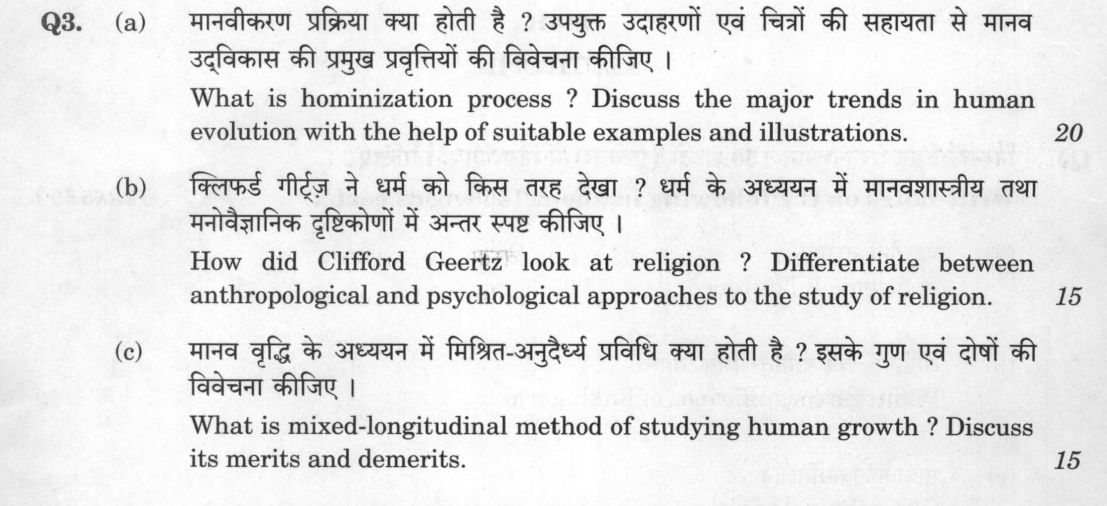
(a) What is hominization process ? Discuss the major trends in human evolution with the help of suitable examples and…
What is hominization process ? Discuss the major trends in human evolution with the help of suitable examples and illustrations. 20 marks
How did Clifford Geertz look at religion ? Differentiate between anthropological and psychological approaches to the study of religion. 15 marks
What is mixed-longitudinal method of studying human growth ? Discuss its merits and demerits. 15 marks
हिंदी में प्रश्न पढ़ें
मानवीकरण प्रक्रिया क्या होती है ? उपयुक्त उदाहरणों एवं चित्रों की सहायता से मानव उद्विकास की प्रमुख प्रवृत्तियों की विवेचना कीजिए । 20
क्लिफर्ड गीर्ट्ज ने धर्म को किस तरह देखा ? धर्म के अध्ययन में मानवशास्त्रीय तथा मनोवैज्ञानिक दृष्टिकोणों में अंतर स्पष्ट कीजिए । 15
मानव वृद्धि के अध्ययन में मिश्रित-अनुदैर्ध्य प्रविधि क्या होती है ? इसके गुण एवं दोषों की विवेचना कीजिए । 15
Model answer
Written by UPSC Answer Check against this question's marking rubric, to the expected length. UPSC does not publish answers for Mains — this is one way to score well, not an official key.
Hominization, Religion, and Growth: An Anthropological Perspective
Anthropology operates at the intersection of biological evolution, symbolic meaning, and rigorous methodology. To understand the human condition, one must trace the biological roots of hominization, interpret the cultural frameworks of religion, and apply precise methods to study human development.
Hominization and Evolutionary Trends Hominization is the biocultural process of human evolution, characterized by the interplay of biological changes and cultural adaptations. It is not a linear progression but a complex branching of traits, primarily involving bipedalism, encephalization, and tool-making. The major trends include orthognathism (reduction of facial protrusion), dental reduction, and a significant increase in cranial capacity.
The transition is best illustrated by specific fossils. Australopithecus afarensis, represented by the "Lucy" skeleton, marks the critical shift to habitual bipedalism, freeing the hands for tool use. This is followed by Homo habilis, where cranial capacity increases to roughly 600cc, indicating early cognitive expansion. Homo erectus, exemplified by the Narmada Man fossil from India, shows a cranial capacity of approximately 900–1100cc and robust skeletal structures adapted for long-distance migration. Finally, Homo sapiens exhibits full encephalization (approx. 1350cc) and orthognathic faces. While early symbolic behavior is often debated, the archaeological record from sites like Bhimbetka (Mesolithic) demonstrates the mature symbolic capacity of modern humans, distinct from the earlier biological hominization phase.
Geertz’s View and Approaches to Religion Clifford Geertz viewed religion not as a set of beliefs about the supernatural, but as a "system of symbols" that creates powerful, pervasive, and long-lasting moods and motivations in men by formulating conceptions of a general order of existence. He argued that religion functions as both a "model of" reality (a conceptualization of how things are) and a "model for" reality (a template for how they ought to be). This symbolic approach contrasts with functionalist views that see religion merely as a social glue.
The anthropological approach to religion is holistic, cross-cultural, and fieldwork-based. It seeks an emic-etic synthesis, understanding religion from the insider’s perspective while analyzing it structurally. For instance, Evans-Pritchard’s study of the Azande or Tambiah’s work on Thai Buddhism reveals how religious symbols maintain social order. In contrast, the psychological approach focuses on individual cognition and emotional needs. Freud’s Totem and Taboo interprets religion as a collective neurosis stemming from Oedipal conflicts, while Jung’s archetypes and the cognitive science of religion examine universal mental structures. Anthropology thus prioritizes cultural context over individual pathology.
Mixed-Longitudinal Method in Growth Studies The mixed-longitudinal method combines cross-sectional data (snapshots of different age groups at one time) with longitudinal data (tracking the same individuals over time) to study human growth. This method is crucial for constructing accurate growth charts, such as those developed by the ICMR and researchers like Reddy and Rao for Indian populations.
The merits of this method include cost-effectiveness compared to pure longitudinal studies, as it requires fewer subjects over a shorter period. It also allows researchers to control for secular trends (changes in growth patterns over generations) and provides a larger sample coverage. However, it has demerits. Cohort effects can distort data if different age groups experienced different historical conditions. Statistical complexity increases due to the need to synchronize data from different cohorts. Furthermore, attrition bias in the longitudinal component can skew results if participants drop out systematically.
Conclusion In conclusion, anthropological inquiry is inherently multidimensional. Understanding hominization provides the biological baseline of our species; Geertz’s symbolic analysis reveals how humans construct meaning and social order; and the mixed-longitudinal method offers the empirical rigor to track physical development. Together, these dimensions—evolutionary, symbolic, and methodological—constitute the holistic framework necessary to comprehend the full spectrum of human existence.
What "Discuss" is asking you to do
Lay the issue out from more than one side — how it arose, what is claimed for it, what is held against it, and where it now stands. UPSC attaches discuss to broad topics with several live dimensions, so coverage of the dimensions earns more than the strength of your opinion.
Structure that answers it
Set the issue up → the case as it is made → the case against → the dimension both sides leave out → where the balance now lies
Where marks are lost
Listing facts with no thread between them, or arguing one side throughout and calling it a discussion.
How this answer will be evaluated
Approach
Framework: UPSC Anthropology Paper 1 (Physical Anthropology & Research Methodology). (a) discuss: intro > 3-4 dimensions > example > balanced close | (b) compare: paired headings or table > key differences > significance > conclusion | (c) discuss: intro > 3-4 dimensions > example > balanced close Full marks: Comprehensive, well-structured, with specific examples and clear differentiation.
Key points expected
- Define hominization as the process of becoming human
- Identify major trends: bipedalism, encephalization, tool use
- Provide suitable examples of hominid species (e.g., Australopithecus, H. erectus)
- Include illustrations or descriptions of anatomical changes
- Define Clifford Geertz's concept of religion (symbols, world-view, mood)
- Differentiate anthropological approach (cultural, symbolic, social)
- Differentiate psychological approach (individual, cognitive, functional)
- Highlight the key difference: culture vs individual mind
Evaluation rubric
Each sub-part is marked on its own, against the marks and word limit printed on the paper.
- (a) Define hominization and trace major evolutionary trends with examples. 20 marks
discuss— intro → 3-4 dimensions → example → balanced close
Must cover
- Define hominization as the process of becoming human
- Identify major trends: bipedalism, encephalization, tool use
- Provide suitable examples of hominid species (e.g., Australopithecus, H. erectus)
- Include illustrations or descriptions of anatomical changes
Loses marks
- Confusing hominization with humanization
- Lack of specific species examples
- Ignoring the 'illustrations' requirement
Earns more
- Mention specific sites like Olduvai Gorge or Laetoli
- Discuss the role of diet in evolution
- Reference specific fossil evidence (e.g., Lucy, Turkana Boy)
Extra mark
- Labelled diagram of skull or foot structure
- Mention of specific Indian hominid sites (e.g., Narmada)
- (b) Explain Geertz's view on religion and differentiate anthropological vs psychological approaches. 15 marks
compare— paired headings or table → key differences → significance → conclusion
Must cover
- Define Clifford Geertz's concept of religion (symbols, world-view, mood)
- Differentiate anthropological approach (cultural, symbolic, social)
- Differentiate psychological approach (individual, cognitive, functional)
- Highlight the key difference: culture vs individual mind
Loses marks
- Treating religion as purely supernatural
- Failing to distinguish the two approaches clearly
- Ignoring Geertz's specific contribution
Earns more
- Reference Geertz's 'Religion as a Cultural System'
- Mention specific psychological theories (e.g., Freud, Jung)
- Use a specific ethnographic example of religious practice
Extra mark
- Mention specific Indian religious context
- Reference specific psychological studies
- (c) Define mixed-longitudinal method and discuss its merits and demerits. 15 marks
discuss— intro → 3-4 dimensions → example → balanced close
Must cover
- Define mixed-longitudinal method (combining cross-sectional and longitudinal)
- Explain how it works (tracking cohorts over time)
- List merits (e.g., controls for cohort effects, efficient)
- List demerits (e.g., complex design, attrition)
Loses marks
- Confusing it with pure longitudinal method
- Failing to list both merits and demerits
- Lack of clarity on how it combines the two methods
Earns more
- Mention specific studies using this method
- Explain the 'cohort effect' clearly
- Compare it briefly with pure longitudinal or cross-sectional
Extra mark
- Mention specific Indian growth studies
- Reference specific statistical techniques used
Practice this exact question
Write your answer and it is marked point by point against the model answer above — what you covered, what you missed, what you got wrong.
Evaluate my answer →More from Anthropology 2023 Paper I
- Q1 Write notes on the following in about 150 words each : 10×5=50 (a) Scope and relevance of…
- Q2 (a) Discuss major species of Australopithecus discovered from South and East Africa. Desc…
- Q3 (a) What is hominization process ? Discuss the major trends in human evolution with the h…
- Q4 (a) Discuss the role of marriage regulations in traditional societies in India for streng…
- Q5 Write notes on the following in about 150 words each : 10×5=50 (a) Polygenic Inheritance…
- Q6 (a) Critically discuss the controversies related to fieldwork of Bronislaw Malinowski and…