Paper I — Q4
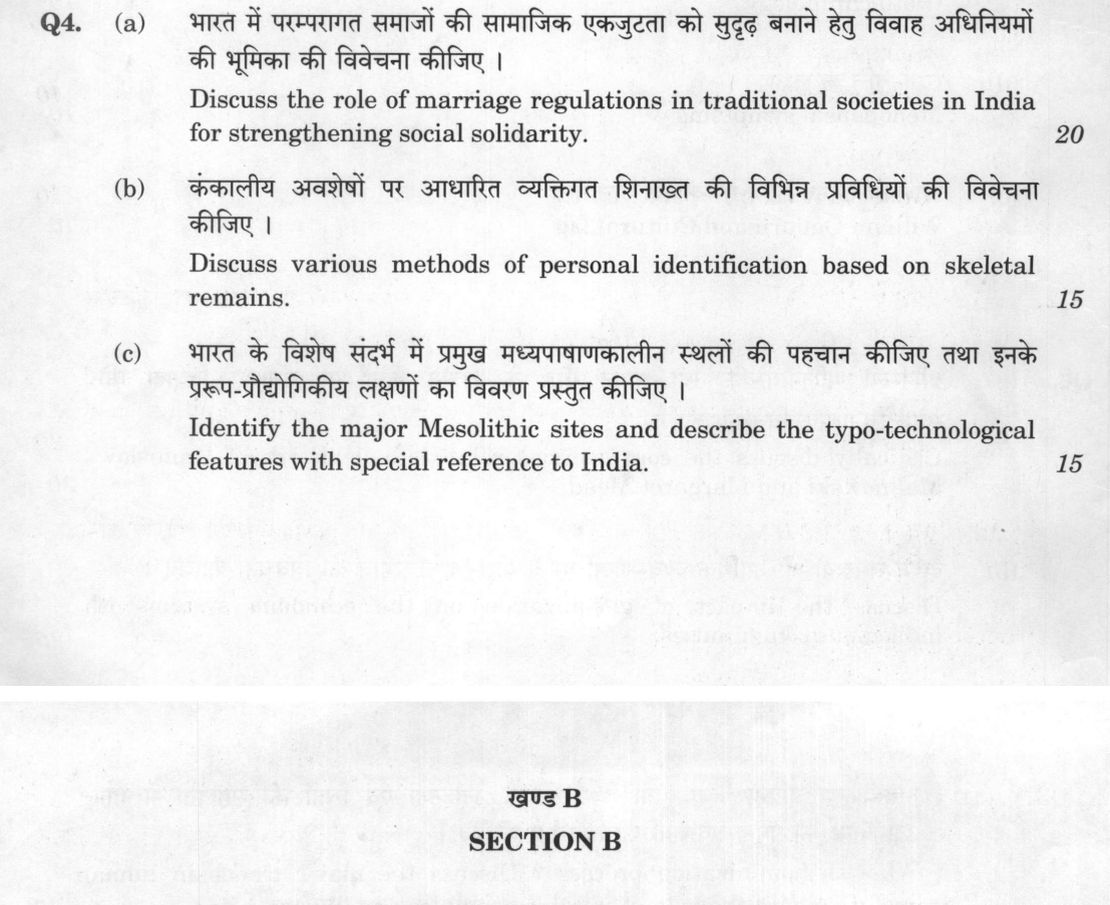
(a) Discuss the role of marriage regulations in traditional societies in India for strengthening social solidarity. 20 (b)…
Discuss the role of marriage regulations in traditional societies in India for strengthening social solidarity. 20 marks
Discuss various methods of personal identification based on skeletal remains. 15 marks
Identify the major Mesolithic sites and describe the typo-technological features with special reference to India. 15 marks
हिंदी में प्रश्न पढ़ें
भारत में परम्परागत समाजों की सामाजिक एकजुटता को सुदृढ़ बनाने हेतु विवाह अधिनियमों की भूमिका की विवेचना कीजिए । 20
कंकालीय अवशेषों पर आधारित व्यक्तिगत शिनाख्त की विभिन्न प्रविधियों की विवेचना कीजिए । 15
भारत के विशेष संदर्भ में प्रमुख मध्यपाषाणकालीन स्थलों की पहचान कीजिए तथा इनके प्ररूप-प्रौद्योगिकीय लक्षणों का विवरण प्रस्तुत कीजिए । 15
Model answer
Written by UPSC Answer Check against this question's marking rubric, to the expected length. UPSC does not publish answers for Mains — this is one way to score well, not an official key.
In Indian anthropology, human social organization, biological morphology, and prehistoric adaptations reflect interconnected dimensions of societal continuity and adaptation.
Marriage Regulations and Social Solidarity in Traditional India
In traditional Indian society, marriage regulations serve as foundational mechanisms for maintaining structural equilibrium and collective identity. Caste endogamy preserves group boundaries, ritual purity, and hereditary occupations, fostering what Émile Durkheim conceptualized as mechanical solidarity through shared norms and collective consciousness. Simultaneously, rules of exogamy—such as gotra, pravara, and sapinda prohibitions in North India—prevent intra-lineage conflict and compel groups to establish external socio-economic ties.
Radcliffe-Brown’s structural-functionalism highlights how these prescriptive and proscriptive rules reinforce lineage stability and social cohesion. In South India, preferential cross-cousin and uncle-niece marriages consolidate property within the kin group while reinforcing enduring reciprocal obligations. Claude Lévi-Strauss’s alliance theory elucidates this dynamic, demonstrating that the structural exchange of women creates symmetrical or asymmetrical alliance networks that bind otherwise distinct descent groups. Furthermore, Louis Dumont in Homo Hierarchicus illustrated that marriage regulations operationalize the structural dialectic between status and power, where hypergamy (anuloma) and endogamous purity preserve the overarching hierarchical solidarity of the caste system. Through these complementary mechanisms of internal cohesion and external alliance, marriage regulations integrate localized descent groups into stable, broader regional systems.
Personal Identification from Skeletal Remains
Biological anthropologists reconstruct the biological profile—comprising sex, age, stature, and ancestry—using metric and morphological analyses of skeletal remains. Osteometry applies precise cranial and post-cranial measurements, utilizing cranial, nasal, and orbital indices to assess biological variation. Morphoscopic and non-metric epigenetic traits (such as suture patterns and supraorbital structures) further refine individualization.
Sex estimation relies on sexually dimorphic features of the pelvis (greater sciatic notch, subpubic angle, phenice traits) and robusticity of the cranium (nuchal crest, mastoid process). Age at death is determined through dental eruption patterns, epiphyseal fusion in long bones, pubic symphyseal changes via the Suchey-Brooks method, and cranial suture obliteration. Stature is reconstructed using regression equations applied to maximum lengths of intact long bones like the femur and tibia.
In contemporary forensic contexts, these conventional methods are augmented by computational tools such as FORDISC for discriminant function analysis, 3D craniofacial approximation for facial reconstruction, and ancient DNA (aDNA) extraction. In India, these techniques are applied in forensic disaster victim identification, mass casualties, and bioarchaeological studies (such as investigations at Roopkund and Rakhigarhi) to establish biological affinity and individual identity.
Major Mesolithic Sites and Typo-Technological Features in India
The Indian Mesolithic period represents an adaptive transition to early Holocene climatic conditions, characterized by widespread distribution across diverse ecological zones. Key sites include Bagor in Rajasthan (the largest Mesolithic open-air settlement), Langhnaj in Gujarat, and the dense concentration of open-air and semi-permanent sites in the central Ganga valley, such as Sarai Nahar Rai, Mahadaha, and Damdama in Uttar Pradesh, alongside stratified rock shelter contexts like Bhimbetka and Adamgarh in Madhya Pradesh.
Typo-technologically, the era is defined by the microlithic blade-bladelet industry manufactured via the pressure flaking technique using silicious raw materials such as chert, chalcedony, agate, and jasper. The tool repertoire includes non-geometric forms (backed blades, points, scrapers) and geometric forms (lunates, triangles, trapezes). These microliths served predominantly as components of composite tools, hafted into wooden or bone handles with natural resins to create sickles, harpoons, and arrowheads. Sites like Mahadaha and Damdama have yielded worked bone and antler tools, including points and ornaments. Subsistence strategies exhibit regional variation, transitioning from broad-spectrum hunting-foraging in dense forest eco-zones to incipient animal domestication (evidenced at Bagor and Adamgarh) and intensive plant exploitation in alluvial savannas.
Synthesizing social structures, biological profiles, and prehistoric material cultures reveals the enduring processes through which Indian populations have organized social life, biologically adapted, and innovated technologically across evolutionary and historical time.
What "Discuss" is asking you to do
Lay the issue out from more than one side — how it arose, what is claimed for it, what is held against it, and where it now stands. UPSC attaches discuss to broad topics with several live dimensions, so coverage of the dimensions earns more than the strength of your opinion.
Structure that answers it
Set the issue up → the case as it is made → the case against → the dimension both sides leave out → where the balance now lies
Where marks are lost
Listing facts with no thread between them, or arguing one side throughout and calling it a discussion.
How this answer will be evaluated
Approach
Framework: UPSC Anthropology Paper 1 (Sociology & Physical Anthropology). (a) discuss: intro > 3-4 dimensions > example > balanced close | (b) discuss: intro > 3-4 dimensions > example > balanced close | (c) enumerate: list the items in order > one line each > no commentary Full marks: Comprehensive, analytical, and well-supported with specific Indian examples and technical terminology.
Key points expected
- Define social solidarity (Durkheim) and marriage regulations
- Explain endogamy (caste/tribe) as a mechanism for group cohesion
- Explain exogamy (clan/lineage) as a mechanism for alliance-building
- Provide specific Indian ethnographic examples (e.g., Jains, Nairs, or tribal groups)
- Mention of age estimation (epiphyseal union, dental eruption)
- Mention of sex determination (pelvic and cranial features)
- Mention of stature estimation (regression formulas on long bones)
- Mention of specific identification (DNA, dental records, unique marks)
Evaluation rubric
Each sub-part is marked on its own, against the marks and word limit printed on the paper.
- (a) Analytical discussion of how marriage rules (endogamy/exogamy) function as social glue in Indian traditional societies. 20 marks
discuss— intro → 3-4 dimensions → example → balanced close
Must cover
- Define social solidarity (Durkheim) and marriage regulations
- Explain endogamy (caste/tribe) as a mechanism for group cohesion
- Explain exogamy (clan/lineage) as a mechanism for alliance-building
- Provide specific Indian ethnographic examples (e.g., Jains, Nairs, or tribal groups)
Loses marks
- Descriptive account of marriage rituals without sociological analysis
- Ignoring the 'traditional' context of the question
- Confusing social solidarity with mere social order
Earns more
- Reference to specific kinship terminologies (e.g., Dravidian)
- Mention of specific rituals (e.g., Sati, Gotra rules)
- Discussion of the economic function of marriage (dowry/bride price)
Extra mark
- Reference to specific fieldwork (e.g., Radcliffe-Brown on Nairs)
- Mention of modern legal changes (Hindu Marriage Act)
- (b) Technical overview of forensic anthropological methods used to identify individuals from skeletal remains. 15 marks
discuss— intro → 3-4 dimensions → example → balanced close
Must cover
- Mention of age estimation (epiphyseal union, dental eruption)
- Mention of sex determination (pelvic and cranial features)
- Mention of stature estimation (regression formulas on long bones)
- Mention of specific identification (DNA, dental records, unique marks)
Loses marks
- General discussion of human anatomy without forensic application
- Ignoring the 'identification' aspect (focusing only on age/sex)
- Confusing biological age with chronological age
Earns more
- Reference to specific indices (e.g., cephalic index)
- Mention of specific bones used (e.g., femur for stature)
- Discussion of limitations of skeletal identification
Extra mark
- Reference to specific forensic case studies
- Mention of specific software used in forensic anthropology
- (c) Identification of key Indian Mesolithic sites and description of their specific stone tool technology. 15 marks
enumerate— list the items in order → one line each → no commentary
Must cover
- Name major sites (e.g., Bagor, Langhnaj, Sarai Nahar Rai)
- Describe microliths (geometric/non-geometric types)
- Explain the 'microlithic industry' (bladelets, burins)
- Mention the transition from hunting to pastoralism (if applicable to site)
Loses marks
- Confusing Mesolithic with Neolithic features
- Listing sites without describing their technological features
- Ignoring the 'special reference to India' constraint
Earns more
- Mention of specific tool types (e.g., lunates, trapezes, triangles)
- Reference to specific raw materials used (e.g., chert, quartzite)
- Discussion of the 'Mesolithic Revolution' in India
Extra mark
- Reference to specific excavators (e.g., S.R. Rao, V.S. Wadghule)
- Mention of specific faunal remains found at sites
Practice this exact question
Write your answer and it is marked point by point against the model answer above — what you covered, what you missed, what you got wrong.
Evaluate my answer →More from Anthropology 2023 Paper I
- Q1 Write notes on the following in about 150 words each : 10×5=50 (a) Scope and relevance of…
- Q2 (a) Discuss major species of Australopithecus discovered from South and East Africa. Desc…
- Q3 (a) What is hominization process ? Discuss the major trends in human evolution with the h…
- Q4 (a) Discuss the role of marriage regulations in traditional societies in India for streng…
- Q5 Write notes on the following in about 150 words each : 10×5=50 (a) Polygenic Inheritance…
- Q6 (a) Critically discuss the controversies related to fieldwork of Bronislaw Malinowski and…
- Q7 (a) Describe various methods of qualitative data analysis. Highlight some popular compute…