Paper I — Q8
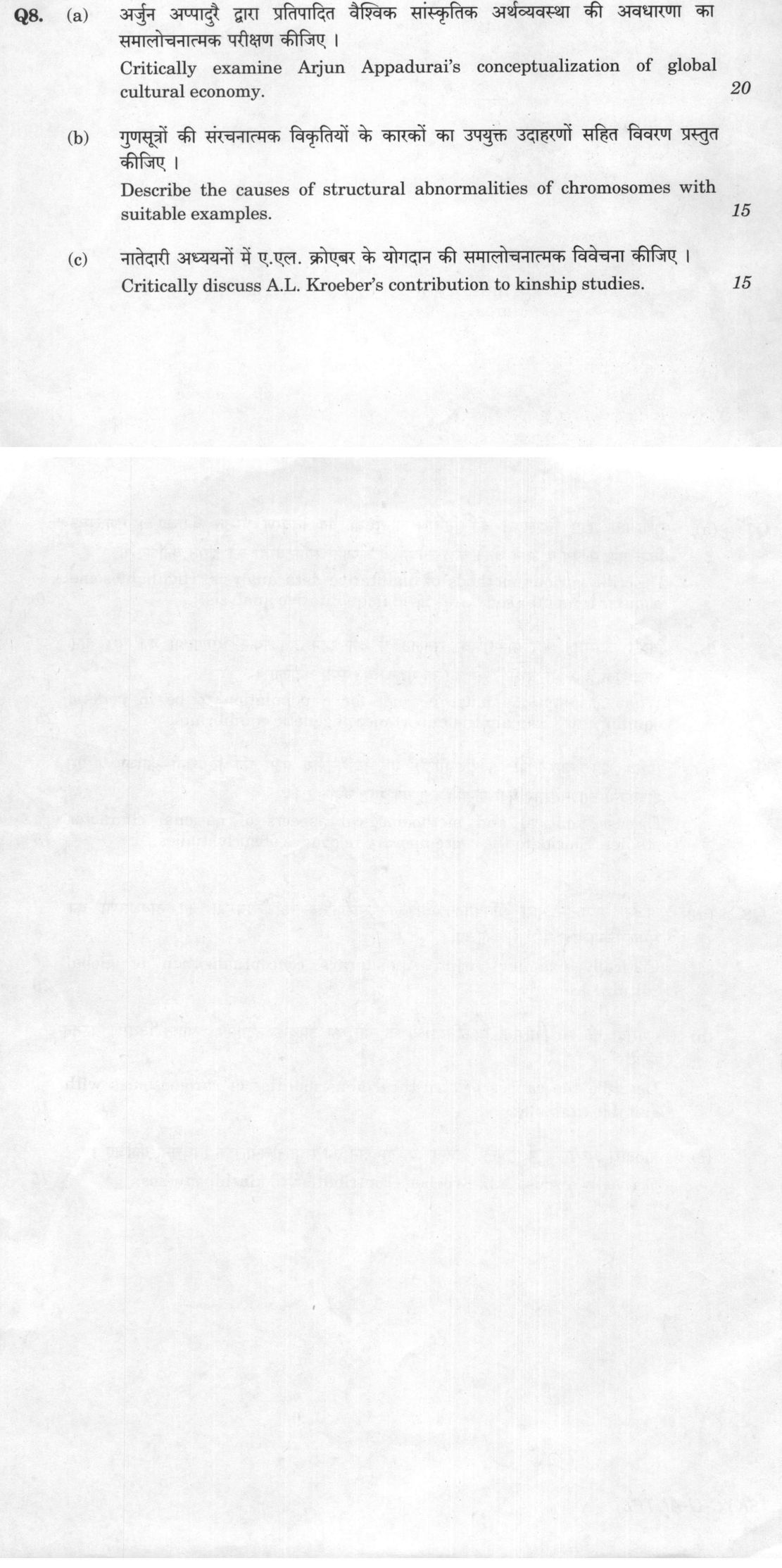
(a) Critically examine Arjun Appadurai's conceptualization of global cultural economy. 20 (b) Describe the causes of structural…
Critically examine Arjun Appadurai's conceptualization of global cultural economy. 20 marks
Describe the causes of structural abnormalities of chromosomes with suitable examples. 15 marks
Critically discuss A.L. Kroeber's contribution to kinship studies. 15 marks
हिंदी में प्रश्न पढ़ें
अर्जुन अप्पादुरै द्वारा प्रतिपादित वैश्विक सांस्कृतिक अर्थव्यवस्था की अवधारणा का समालोचनात्मक परीक्षण कीजिए । 20
गुणसूत्रों की संरचनात्मक विकृतियों के कारकों का उपयुक्त उदाहरणों सहित विवरण प्रस्तुत कीजिए । 15
नातेदारी अध्ययनों में ए.एल. क्रोबर के योगदान की समालोचनात्मक विवेचना कीजिए । 15
Model answer
Written by UPSC Answer Check against this question's marking rubric, to the expected length. UPSC does not publish answers for Mains — this is one way to score well, not an official key.
Appadurai’s Global Cultural Economy
In Disjuncture and Difference in the Global Cultural Economy (1990), Arjun Appadurai proposed an elementary framework to explore the fundamental disjunctures between economy, culture, and politics through five fluid dimensions of global cultural flows:
- Ethnoscapes: The landscape of persons who constitute the shifting world—migrants, refugees, tourists, and guest workers (e.g., the Indian diaspora influencing domestic politics and culture).
- Technoscapes: The global configuration of technology moving across boundaries at high speeds (e.g., India’s IT corridors driving global software services).
- Financescapes: The rapid, volatile movement of global capital through currency markets and stock exchanges.
- Mediascapes: The distribution of electronic capabilities to produce and disseminate information and images (e.g., the global consumption of Bollywood cinema).
- Ideoscapes: Ideological chains of images, often political, composed of elements like freedom, welfare, rights, and democracy.
Appadurai moved beyond the binary of homogenization (Americanization) versus heterogenization, arguing that cultural flows are indigenized upon arrival. However, critically examined, Appadurai’s post-Marxist cultural framework overemphasizes fluid agency, hyper-mobility, and consumption while under-theorizing enduring material hierarchies, state power, and neo-imperial capitalist exploitation. His conceptualization exhibits a metropolitan bias, glossing over geopolitical power asymmetries and the lived immobility of marginalized populations who remain excluded from these flows.
Structural Abnormalities of Chromosomes
Structural chromosomal abnormalities occur when chromosomes break and rejoin in aberrant configurations during gametogenesis or early embryonic development. These are classified into four primary types:
- Deletion: Loss of a chromosomal segment. For example, Cri-du-chat syndrome arises from a terminal deletion on the short arm of chromosome 5 (5p-).
- Duplication: Presence of an extra chromosomal segment, seen in Charcot-Marie-Tooth disease type 1A, caused by the duplication of the PMP22 gene on chromosome 17p.
- Inversion: A segment breaks, rotates 180 degrees, and rejoins. It is paracentric (excluding the centromere) or pericentric (including the centromere).
- Translocation: Exchange of segments between non-homologous chromosomes. The Philadelphia chromosome, a reciprocal translocation between chromosomes 9 and 22 [t(9;22)(q34;q11)], leads to Chronic Myeloid Leukemia (CML).
The primary causes (clastogens and etiologies) include ionizing radiation (X-rays, gamma rays), mutagenic chemicals (alkylating agents, benzene), oncogenic viral infections, and advanced parental age which impairs meiotic repair mechanisms. In India, cytogenetic monitoring across research centers like the National Institute of Biomedical Genomics (NIBMG) maps these mutations across diverse endogamous populations.
A.L. Kroeber’s Contribution to Kinship Studies
A.L. Kroeber revolutionized kinship anthropology with his seminal 1909 paper, Classificatory Systems of Relationship. Rooted in Boasian historical particularism, Kroeber decisively critiqued Lewis Henry Morgan’s unilinear evolutionary scheme, which treated classificatory systems as survivals of primitive promiscuity or group marriage.
Kroeber argued that kinship terminologies are primarily linguistic and psychological phenomena reflecting categories of thought ("kinds" of relatives) rather than direct reflections of existing or historical social institutions. He delineated eight basic categories of relationship:
- Difference of generation (e.g., father vs. son)
- Lineal vs. collateral relationship (e.g., father vs. uncle)
- Relative age within the same generation (e.g., elder vs. younger brother)
- Consanguinity vs. affinity (e.g., brother vs. brother-in-law)
- Sex of the relative (e.g., brother vs. sister)
- Sex of the speaker (common in Indigenous North American languages)
- Sex of the connecting relative (distinguishing maternal from paternal kin)
- Condition of life of the person through whom relationship exists (whether living or deceased).
Critically, Kroeber’s extreme linguistic reductionism overlooked the functional and sociological dimensions of kinship. Scholars like W.H.R. Rivers and A.R. Radcliffe-Brown demonstrated that kinship terminologies closely correlate with social rights, duties, and clan organization, correcting Kroeber's neglect of social practice.
Synthesis
Anthropological inquiry bridges cultural representations, social structures, and biological realities. Modern globalization dislodges traditional structures: Appadurai’s ethnoscapes restructure Kroeberian kinship systems through transnational marriages, while technoscapes diffuse advanced biotechnological and genetic screening tools to diagnose structural chromosomal anomalies. A comprehensive anthropology must evaluate both symbolic-linguistic structures and material-biological constraints.
What "Critically examine" is asking you to do
Test the proposition the question puts to you and return a finding on how far it holds. Examine stems carry a claim, or ask whether something has happened, and expect evidence weighed both ways before the extent is stated — often with remedial measures attached. “Critically” is not a section added at the end: name the yardstick you are judging by — the evidence, the stated objective, a constitutional principle, a rival explanation — and let a verdict close each part of the body. Where the question quotes a claim, that verdict must land on the claim itself, accepted, qualified or rejected, and not on the theme in general.
Structure that answers it
Restate the claim as the question frames it → evidence that supports it → evidence that undercuts it → the conditions under which it holds → verdict on how far it stands
Where marks are lost
Merits in one paragraph, demerits in the next, and a conclusion calling for a balanced and holistic approach. That is a survey with the judgement left out and it holds the answer in the middle band. The opposite error is reading “critically” as permission to attack — and with the odd pairings, critically describe or critically explain, the exposition still carries most of the marks, the judgement being a layer on it rather than a substitute for it.
How this answer will be evaluated
Approach
(a) examine: intro > how/why with reasoning > evidence > conclusion | (b) describe: define > structure or process in order > labelled diagram > significance | (c) discuss: intro > 3-4 dimensions > example > balanced close Full marks: Comprehensive, critical, and well-structured with specific examples and named theories.
Key points expected
- Define the five 'scapes' (ethno, media, techno, finance, tro)
- Explain the shift from 'culture' to 'cultural economy'
- Discuss the 'disjuncture' between state and society
- Critique the model's limitations or applicability
- Define structural abnormalities (deletion, duplication, inversion, translocation)
- Explain the mechanism of breakage and rejoining
- Provide a specific example (e.g., Philadelphia chromosome)
- Mention the role of radiation or mutagens
Evaluation rubric
Each sub-part is marked on its own, against the marks and word limit printed on the paper.
- (a) Critical analysis of Appadurai's 'scapes' and the global cultural economy. 20 marks
examine— intro → how/why with reasoning → evidence → conclusion
Must cover
- Define the five 'scapes' (ethno, media, techno, finance, tro)
- Explain the shift from 'culture' to 'cultural economy'
- Discuss the 'disjuncture' between state and society
- Critique the model's limitations or applicability
Loses marks
- Treating it as a purely economic theory
- Ignoring the 'critical' aspect of the command word
- Confusing 'scapes' with 'spheres'
Earns more
- Reference to 'Modernity at Large' (1996)
- Link to 'deterritorialization' of culture
- Mention of 'globalization' vs 'glocalization'
- Connection to diaspora studies
Extra mark
- Specific example of a 'scape' (e.g., Bollywood as mediascape)
- Comparison with other globalization theorists (e.g., Hannerz)
- (b) Causes of chromosomal structural abnormalities with examples. 15 marks
describe— define → structure or process in order → labelled diagram → significance
Must cover
- Define structural abnormalities (deletion, duplication, inversion, translocation)
- Explain the mechanism of breakage and rejoining
- Provide a specific example (e.g., Philadelphia chromosome)
- Mention the role of radiation or mutagens
Loses marks
- Confusing structural with numerical abnormalities
- Failing to provide a named example
- Vague description of 'breakage' without mechanism
Earns more
- Distinction between balanced and unbalanced translocations
- Reference to 'Robertsonian translocation'
- Mention of 'ring chromosomes'
- Link to specific syndromes (e.g., Cri-du-chat)
Extra mark
- Labelled diagram of a translocation
- Mention of specific mutagen (e.g., X-rays)
- (c) Critical discussion of A.L. Kroeber's contribution to kinship studies. 15 marks
discuss— intro → 3-4 dimensions → example → balanced close
Must cover
- Identify Kroeber's specific work (e.g., 'Kinship and Marriage' 1948)
- Explain his focus on 'kinship terminology' and 'descent'
- Discuss his 'cultural' approach to kinship (not just biological)
- Critique his limitations (e.g., lack of functionalism)
Loses marks
- Confusing Kroeber with other anthropologists
- Failing to address the 'critical' aspect
- Treating kinship as purely biological
Earns more
- Mention of 'cultural universals' in kinship
- Reference to his work on 'matrilineal' systems
- Comparison with Malinowski or Radcliffe-Brown
- Mention of 'cognatic' descent
Extra mark
- Specific example of a kinship term he analyzed
- Reference to his 'cultural drift' theory
Practice this exact question
Write your answer and it is marked point by point against the model answer above — what you covered, what you missed, what you got wrong.
Evaluate my answer →More from Anthropology 2023 Paper I
- Q5 Write notes on the following in about 150 words each : 10×5=50 (a) Polygenic Inheritance…
- Q6 (a) Critically discuss the controversies related to fieldwork of Bronislaw Malinowski and…
- Q7 (a) Describe various methods of qualitative data analysis. Highlight some popular compute…
- Q8 (a) Critically examine Arjun Appadurai's conceptualization of global cultural economy. 20…