Paper II — Q1
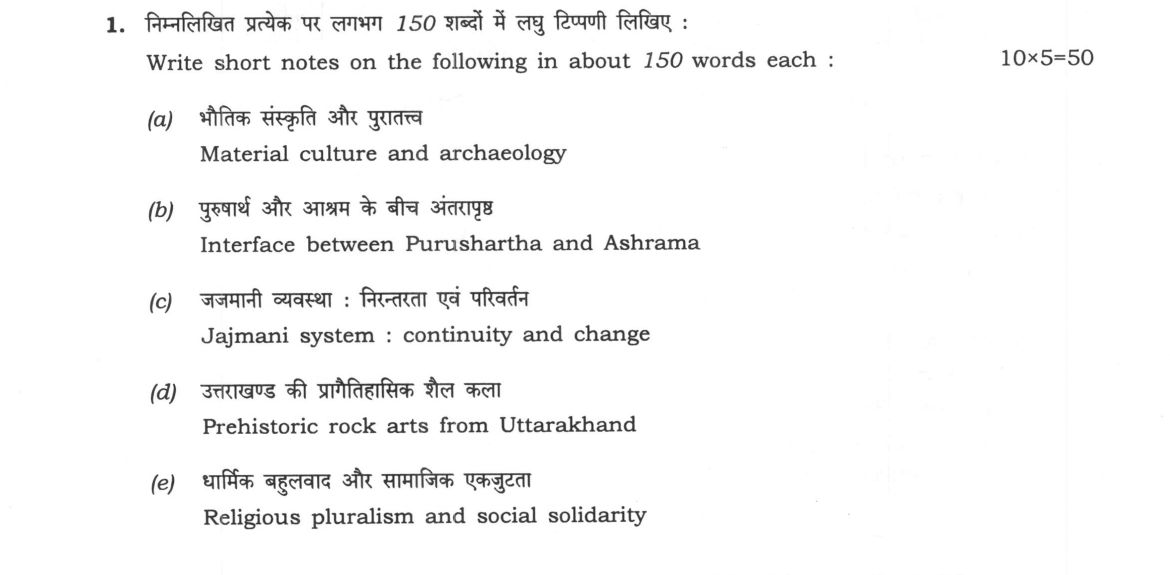
Write short notes on the following in about 150 words each: (a) Material culture and archaeology (10 marks) (b) Interface…
Write short notes on the following in about 150 words each:
Material culture and archaeology 10 marks
Interface between Purushartha and Ashrama 10 marks
Jajmani system : continuity and change 10 marks
Prehistoric rock arts from Uttarakhand 10 marks
Religious pluralism and social solidarity 10 marks
हिंदी में प्रश्न पढ़ें
निम्नलिखित प्रत्येक पर लगभग 150 शब्दों में लघु टिप्पणी लिखिए :
भौतिक संस्कृति और पुरातत्व (10 अंक)
पुरुषार्थ और आश्रम के बीच अंतरापृष्ठ (10 अंक)
जजमानी व्यवस्था : निरंतरता एवं परिवर्तन (10 अंक)
उत्तराखंड की प्रागैतिहासिक शैल कला (10 अंक)
धार्मिक बहुलवाद और सामाजिक एकजुटता (10 अंक)
Model answer
Written by UPSC Answer Check against this question's marking rubric, to the 150-word length. UPSC does not publish answers for Mains — this is one way to score well, not an official key.
Material Culture and Archaeology Material culture comprises the tangible objects, artifacts, and structures created and used by human societies, distinct from non-material culture like beliefs and norms. In archaeology, it serves as the primary evidence for reconstructing past lifeways. Gordon Childe’s "New Archaeology" and Lewis Binford’s processual approach emphasized using material remains to infer social organization and economic systems. Indian examples include the wheel-turned pottery of the Harappan civilization, indicating standardized production, and the bead industries of Lothal, reflecting trade networks. Unlike non-material culture, material culture is durable and recoverable, allowing archaeologists to trace technological evolution and cultural interactions across time and space, providing a concrete basis for historical reconstruction.
Interface between Purushartha and Ashrama Purusharthas (Dharma, Artha, Kama, Moksha) are the four goals of life, while Ashramas (Brahmacharya, Grihastha, Vanaprastha, Sannyasa) are the four stages of life. The interface lies in how each stage prioritizes specific goals. The Grihastha stage emphasizes Artha (wealth) and Kama (pleasure) within the framework of Dharma, as seen in household duties. The Sannyasa stage focuses exclusively on Moksha (liberation), renouncing worldly ties. Manusmriti outlines these transitions, while social anthropologist S. Kakar has analyzed this structure as a psycho-social mechanism for managing life’s conflicts. This system provides a structured pathway for individuals to balance material pursuits with spiritual aspirations, ensuring social stability through regulated life cycles.
Jajmani System: Continuity and Change The Jajmani system is a hereditary patron-client relationship where service castes (Kameens) provide specific services to landowners (Jajmans) in exchange for food and protection. William Wiser’s study of the Balaghat district highlighted its role in economic integration and social cohesion. Continuity is observed in the persistence of ritual interdependence, where caste-based service obligations remain central to village life. However, change has occurred through land reforms, monetization of labor, and migration, which have disrupted traditional bonds. Cash economies and state employment have reduced the economic necessity of the system, yet its social and ritual dimensions persist, illustrating the resilience of caste-based social structures amidst modernization.
Prehistoric Rock Arts from Uttarakhand Uttarakhand’s prehistoric rock art, primarily from the Mesolithic and Chalcolithic periods, offers insights into early Himalayan societies. Key sites include Lakhudiyar in Almora, featuring cupules, animal figures, and geometric patterns. Documentation by scholars like B.P. Mathpal and V.S. Wakankar has highlighted the Central Himalayan tradition. Depictions include stick figures, hunting scenes, and faunal representations, suggesting a subsistence strategy based on hunting and gathering. These artworks serve as a window into the cognitive and social world of prehistoric communities, reflecting their interaction with the environment and their symbolic understanding of life, death, and nature, distinct from the later Vedic cultural layers.
Religious Pluralism and Social Solidarity Religious pluralism refers to the coexistence of multiple faiths within a society, distinct from syncretism which involves blending beliefs. In India, this is evident in village-level practices where Hindus and Muslims share shrines or participate in each other’s festivals, such as the Baul-Fakir tradition in Bengal. This pluralism fosters social solidarity not through mechanical homogeneity, but through organic interdependence and shared cultural spaces. M.N. Srinivas’s concept of "dominant caste" and "spread" illustrates how religious practices permeate social boundaries, creating a cohesive social fabric. This pluralism enhances social stability by accommodating diversity and reducing conflict, demonstrating that religious diversity can be a source of unity rather than division in Indian society.
What "Write short notes" is asking you to do
Five or six self-contained answers, marked separately, typically 10 marks and about 150 words each. Each note must carry its own definition, its two or three defining features and a line on why it matters; a common introduction or conclusion across the notes earns nothing.
Structure that answers it
Per note: one-line definition or identification → two or three features, mechanisms or named examples → one line of significance or Indian application
Where marks are lost
Writing the first two notes at essay length and rationing the rest. Each note is marked on its own, so marks surrendered on a compressed or unattempted note cannot be won back by the long ones.
How this answer will be evaluated
Approach
Framework: Anthropology Paper II (Sociology & Social Anthropology). (a) write short notes: define > 3-4 key features > one example > one-line significance | (b) write short notes: define > 3-4 key features > one example > one-line significance | (c) write short notes: define > 3-4 key features > one example > one-line significance | (d) write short notes: define > 3-4 key features > one example > one-line significance | (e) write short notes: define > 3-4 key features > one example > one-line significance Full marks: Precise definitions, named sites/scholars, clear link to Indian context, balanced analysis.
Key points expected
- Define material culture (artifacts, ecofacts, structures)
- Explain its role in dating and cultural reconstruction
- Mention specific Indian archaeological site (e.g., Harappa, Lothal)
- Link material evidence to social/religious practices
- Define Purushartha (Dharma, Artha, Kama, Moksha)
- Define Ashrama (Brahmacharya, Grihastha, Vanaprastha, Sannyasa)
- Explain how Ashrama stages facilitate Purushartha goals
- Mention the transition from worldly to spiritual focus
Evaluation rubric
Each sub-part is marked on its own, against the marks and word limit printed on the paper.
- (a) Define material culture and its role in archaeological reconstruction. 10 marks · 150 words
write short notes— define → 3-4 key features → one example → one-line significance
Must cover
- Define material culture (artifacts, ecofacts, structures)
- Explain its role in dating and cultural reconstruction
- Mention specific Indian archaeological site (e.g., Harappa, Lothal)
- Link material evidence to social/religious practices
Loses marks
- Confusing material with non-material culture
- Generic description without site names
Earns more
- Mention specific artifact types (pottery, tools)
- Reference specific excavation (e.g., Rakhigarhi)
Extra mark
- Mention specific dating method (C-14, OSL)
- (b) Explain the relationship between Purushartha (goals) and Ashrama (stages). 10 marks · 150 words
write short notes— define → 3-4 key features → one example → one-line significance
Must cover
- Define Purushartha (Dharma, Artha, Kama, Moksha)
- Define Ashrama (Brahmacharya, Grihastha, Vanaprastha, Sannyasa)
- Explain how Ashrama stages facilitate Purushartha goals
- Mention the transition from worldly to spiritual focus
Loses marks
- Treating them as separate, unrelated concepts
- Ignoring the sequential nature of Ashrama
Earns more
- Reference specific texts (Dharmashastras, Gita)
- Mention the role of Grihastha in Artha/Kama
Extra mark
- Mention specific scholar (e.g., Dumont, Radhakrishnan)
- (c) Discuss the Jajmani system's persistence and modern changes. 10 marks · 150 words
write short notes— define → 3-4 key features → one example → one-line significance
Must cover
- Define Jajmani system (caste-based service exchange)
- Explain its traditional function (economic/social security)
- Identify factors causing change (urbanization, cash economy)
- Mention specific tribal/caste context (e.g., Jajman-Patwar)
Loses marks
- Ignoring the 'change' aspect of the question
- Confusing Jajmani with general caste system
Earns more
- Reference specific scholar (e.g., M.N. Srinivas)
- Mention specific region (e.g., Rajasthan, UP)
Extra mark
- Mention specific policy (e.g., SC/ST welfare schemes)
- (d) Describe prehistoric rock art sites and features in Uttarakhand. 10 marks · 150 words
write short notes— define → 3-4 key features → one example → one-line significance
Must cover
- Name specific sites (e.g., Kailar, Kalsi, Chikar)
- Describe motifs (animals, hunting, geometric)
- Mention dating/period (Mesolithic/Neolithic)
- Explain significance (subsistence, ritual)
Loses marks
- Confusing with other states' rock art (e.g., Bhimbetka)
- No specific site names
Earns more
- Mention specific excavation (e.g., Kalsi)
- Reference specific scholar (e.g., V.S. Wadghule)
Extra mark
- Mention specific conservation issue
- (e) Explain how religious pluralism fosters social solidarity in India. 10 marks · 150 words
write short notes— define → 3-4 key features → one example → one-line significance
Must cover
- Define religious pluralism (coexistence of faiths)
- Explain mechanisms of solidarity (shared festivals, syncretism)
- Mention specific example (e.g., Sufi-Bhakti, shared rituals)
- Link to social cohesion/peace
Loses marks
- Ignoring the 'solidarity' aspect
- Generic description without examples
Earns more
- Reference specific scholar (e.g., Dumont, Srinivas)
- Mention specific region (e.g., Kerala, Bengal)
Extra mark
- Mention specific policy (e.g., secularism)
Practice this exact question
Write your answer and it is marked point by point against the model answer above — what you covered, what you missed, what you got wrong.
Evaluate my answer →More from Anthropology 2023 Paper II
- Q1 Write short notes on the following in about 150 words each: (a) Material culture and arch…
- Q2 (a) "Tribes are backward Hindus." Critically comment with reference to the contributions…
- Q3 (a) "Sanskritization is a culture-bound concept." Critically comment to assess the streng…
- Q4 (a) Elucidate the problems faced by Particularly Vulnerable Tribal Groups and the major c…