Paper II — Q8
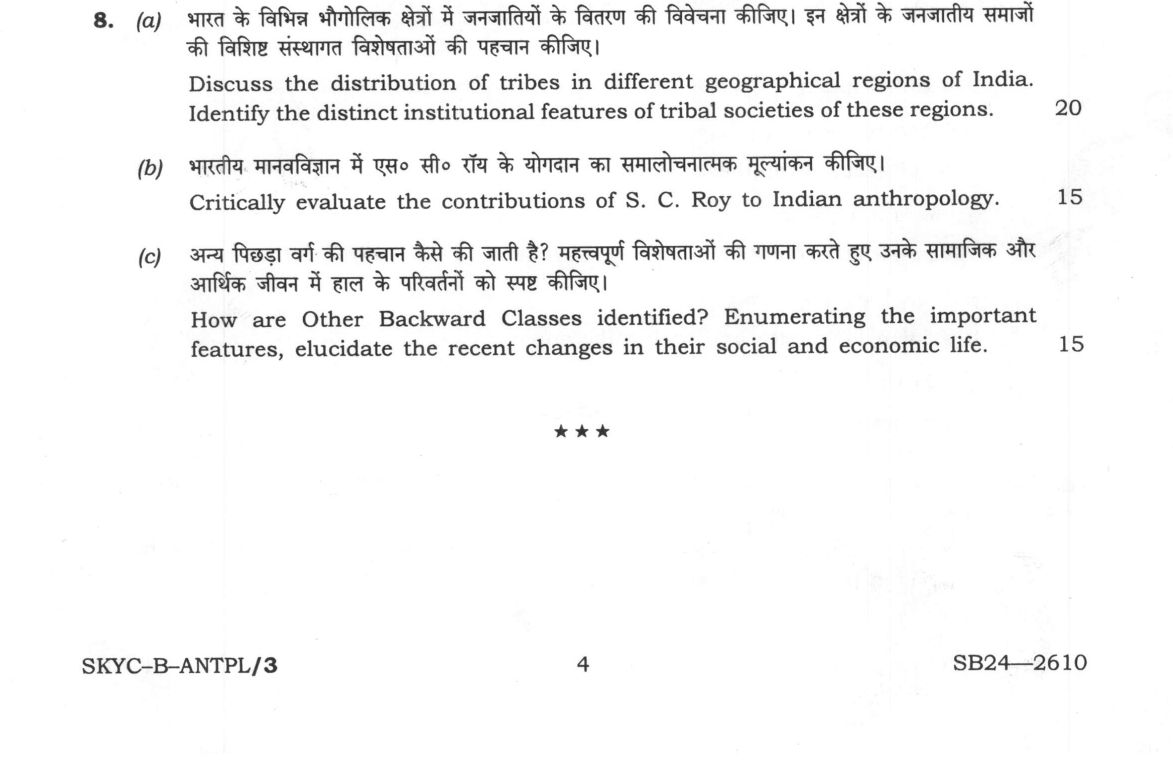
(a) Discuss the distribution of tribes in different geographical regions of India. Identify the distinct institutional features…
Discuss the distribution of tribes in different geographical regions of India. Identify the distinct institutional features of tribal societies of these regions. 20 marks
Critically evaluate the contributions of S. C. Roy to Indian anthropology. 15 marks
How are Other Backward Classes identified? Enumerating the important features, elucidate the recent changes in their social and economic life. 15 marks
हिंदी में प्रश्न पढ़ें
भारत के विभिन्न भौगोलिक क्षेत्रों में जनजातियों के वितरण की विवेचना कीजिए। इन क्षेत्रों के जनजातीय समाजों की विशिष्ट संस्थागत विशेषताओं की पहचान कीजिए। (20 अंक)
भारतीय मानवविज्ञान में एस० सी० रॉय के योगदान का समालोचनात्मक मूल्यांकन कीजिए। (15 अंक)
अन्य पिछड़ा वर्ग की पहचान कैसे की जाती है? महत्वपूर्ण विशेषताओं की गणना करते हुए उनके सामाजिक और आर्थिक जीवन में हाल के परिवर्तनों को स्पष्ट कीजिए। (15 अंक)
Model answer
Written by UPSC Answer Check against this question's marking rubric, to the expected length. UPSC does not publish answers for Mains — this is one way to score well, not an official key.
Distribution and Institutions of Tribal Societies
India’s tribal population is geographically stratified into distinct zones, each with unique institutional adaptations. In the Northeast, tribes like the Naga, Khasi, and Mizo inhabit hills and plains. Their institutions are characterized by segmentary lineage systems and, in many Naga groups like the Angami, autonomous village republics governed by councils of elders, distinct from hereditary chieftainships like the Konyak Angh. The Central region, home to the Gonds, Baigas, and Bhils, features strong clan organization and territorial panchayats that manage forest resources and dispute resolution. In the Southern region, tribes such as the Todas, Kotas, and Irulas exhibit traces of matrilineal inheritance and practice podu (shifting) cultivation, adapting to the Western Ghats’ ecology. The Western region, dominated by Bhils and Warlis, is marked by Bhil confederacies that historically resisted state authority through collective mobilization. Finally, the Himalayan region includes Gujjars and Bakarwals, whose institutions are defined by transhumance (seasonal migration) and a composite economy integrating pastoralism with trade.
Contributions of S. C. Roy
S. C. Roy is pivotal in Indian anthropology as the first Indian ethnographer to conduct systematic empirical fieldwork, particularly among the Mundas, Oraons, and Khonds of Jharkhand. He founded the journal Man in India, providing a platform for indigenous scholarship. Roy was a fierce advocate for tribal rights, emphasizing land protection and critiquing colonial ethnography for its extractive nature. However, a critical evaluation reveals limitations. His work lacked the structural-functional rigor of later anthropologists like Radcliffe-Brown or Malinowski. Furthermore, his writings occasionally romanticized tribal life, echoing the "noble savage" trope, and his theoretical framework remained unsystematic. Despite these flaws, his foundational role in establishing an Indian perspective on tribal studies remains undeniable.
Identification and Changes in OBCs
Other Backward Classes (OBCs) are identified based on social, educational, and economic backwardness, as outlined by the Mandal Commission (1979). The National Commission for Backward Classes (NCBC), constituted under Article 338B, plays a key role in this process. Since the 102nd Constitutional Amendment (2018), the central government can identify OBCs under Article 342A, though state-wise variations persist. The "creamy layer" exclusion ensures that economically advanced sections within OBCs do not avail benefits.
Recent socio-economic changes among OBCs are significant. Sanskritization has led to occupational diversification, with many OBCs moving from agriculture to white-collar jobs and urban professions. Political mobilization post-1990 has empowered OBCs to assert their identity, influencing electoral politics and policy formulation. The implementation of reservation policies has improved educational access, yet tensions remain between caste-based identity and class-based mobility. Urbanization has further complicated these dynamics, creating new social hierarchies within OBC communities.
Conclusion
The interface between tribal and OBC categories highlights the complexity of social stratification in India. While tribal institutions offer insights into indigenous governance and ecology, OBC dynamics reflect the ongoing struggle for social justice in a modernizing economy. Anthropology’s policy relevance lies in understanding these distinct yet intersecting realities to craft inclusive developmental strategies.
What "Discuss" is asking you to do
Lay the issue out from more than one side — how it arose, what is claimed for it, what is held against it, and where it now stands. UPSC attaches discuss to broad topics with several live dimensions, so coverage of the dimensions earns more than the strength of your opinion.
Structure that answers it
Set the issue up → the case as it is made → the case against → the dimension both sides leave out → where the balance now lies
Where marks are lost
Listing facts with no thread between them, or arguing one side throughout and calling it a discussion.
How this answer will be evaluated
Approach
(a) discuss: intro > 3-4 dimensions > example > balanced close | (b) critically evaluate: positives > negatives/limits > conditions/safeguards > conclusion | (c) explain: definition/context > points in order > small example > short close Full marks: Comprehensive, specific, and critical analysis with named examples and clear structure.
Key points expected
- Map distribution across North, East, Central, South, Northeast
- Identify distinct institutional features for each region
- Name specific tribes for each geographical region
- Link institutional features to specific tribal societies
- Identify S. C. Roy's key contributions to Indian anthropology
- Critically evaluate the strengths of his work
- Identify limitations or criticisms of his approach
- Assess the impact of his work on Indian anthropology
Evaluation rubric
Each sub-part is marked on its own, against the marks and word limit printed on the paper.
- (a) Regional distribution of tribes and their distinct institutional features. 20 marks
discuss— intro → 3-4 dimensions → example → balanced close
Must cover
- Map distribution across North, East, Central, South, Northeast
- Identify distinct institutional features for each region
- Name specific tribes for each geographical region
- Link institutional features to specific tribal societies
Loses marks
- Generalizing tribal features without regional specificity
- Failing to link institutions to specific tribes
- Ignoring geographical factors in distribution
Earns more
- Mention specific tribal institutions like village councils
- Reference specific tribal laws or customs
- Discuss geographical factors influencing tribal distribution
- Mention specific tribal languages or dialects
Extra mark
- Reference specific tribal policies or acts
- Mention specific tribal festivals or rituals
- (b) Critical assessment of S. C. Roy's contributions to Indian anthropology. 15 marks
critically evaluate— positives → negatives/limits → conditions/safeguards → conclusion
Must cover
- Identify S. C. Roy's key contributions to Indian anthropology
- Critically evaluate the strengths of his work
- Identify limitations or criticisms of his approach
- Assess the impact of his work on Indian anthropology
Loses marks
- Listing contributions without critical evaluation
- Ignoring limitations or criticisms of his work
- Failing to assess the impact of his work
Earns more
- Mention specific works or publications by S. C. Roy
- Discuss his methodological approach
- Compare his work with other anthropologists
- Mention specific tribal groups he studied
Extra mark
- Reference specific debates or controversies around his work
- Mention specific awards or recognitions he received
- (c) Identification of OBCs and recent changes in their social and economic life. 15 marks
explain— definition/context → points in order → small example → short close
Must cover
- Explain the criteria for identifying OBCs
- Enumerate important features of OBCs
- Describe recent changes in their social life
- Describe recent changes in their economic life
Loses marks
- Failing to explain the identification criteria
- Ignoring recent changes in social or economic life
- Generalizing OBC features without specific examples
Earns more
- Mention specific committees or reports on OBCs
- Reference specific government policies for OBCs
- Discuss specific social or economic indicators
- Mention specific OBC communities
Extra mark
- Reference specific data or statistics on OBCs
- Mention specific legal provisions for OBCs
Practice this exact question
Write your answer and it is marked point by point against the model answer above — what you covered, what you missed, what you got wrong.
Evaluate my answer →More from Anthropology 2023 Paper II
- Q5 Write short notes on the following in about 150 words each: (a) Scheduled areas (10 marks…
- Q6 (a) Is annihilation of caste possible? Discuss the future of caste system in the light of…
- Q7 (a) Elucidate the shifting terrains of India's tribal policies in colonial and post-colon…
- Q8 (a) Discuss the distribution of tribes in different geographical regions of India. Identi…