Paper II — Q6
(a) Is annihilation of caste possible? Discuss the future of caste system in the light of various proactive measures taken by the…
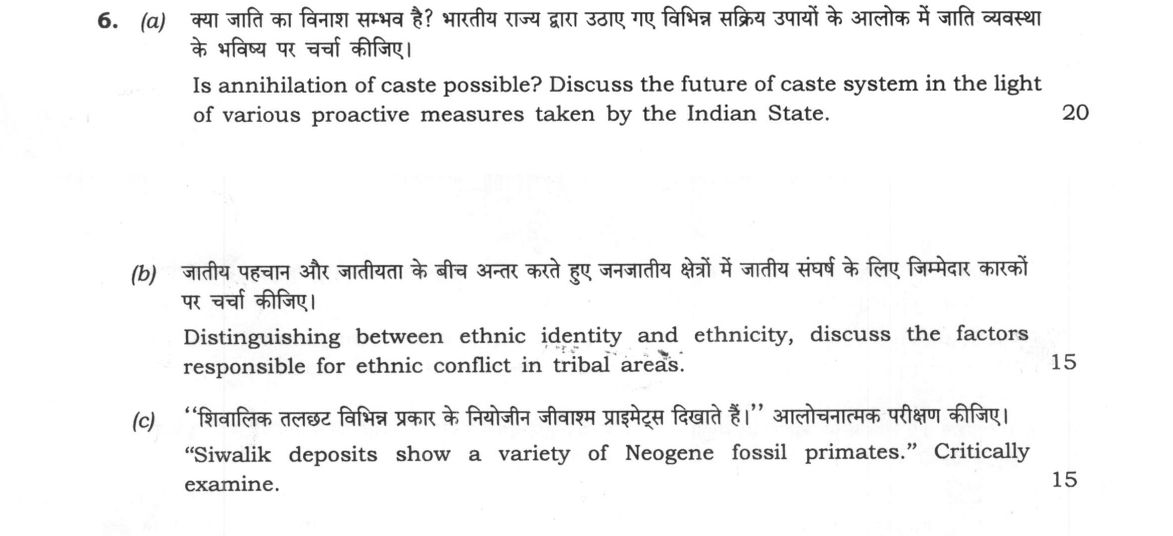
Is annihilation of caste possible? Discuss the future of caste system in the light of various proactive measures taken by the Indian State. 20 marks
Distinguishing between ethnic identity and ethnicity, discuss the factors responsible for ethnic conflict in tribal areas. 15 marks
"Siwalik deposits show a variety of Neogene fossil primates." Critically examine. 15 marks
हिंदी में प्रश्न पढ़ें
क्या जाति का विनाश संभव है? भारतीय राज्य द्वारा उठाए गए विभिन्न सक्रिय उपायों के आलोक में जाति व्यवस्था के भविष्य पर चर्चा कीजिए। (20 अंक)
जातीय पहचान और जातीयता के बीच अंतर करते हुए जनजातीय क्षेत्रों में जातीय संघर्ष के लिए जिम्मेदार कारकों पर चर्चा कीजिए। (15 अंक)
"शिवालिक तलछट विभिन्न प्रकार के नियोजीन जीवाश्म प्राइमेट्स दिखाते हैं।" आलोचनात्मक परीक्षण कीजिए। (15 अंक)
Model answer
Written by UPSC Answer Check against this question's marking rubric, to the expected length. UPSC does not publish answers for Mains — this is one way to score well, not an official key.
Annihilation of Caste and the Future of the System
The question of whether caste annihilation is possible requires a critical engagement with B.R. Ambedkar’s thesis in Annihilation of Caste. Ambedkar argued that caste is a "condition of the mind," not merely a social arrangement, and that its destruction requires a fundamental transformation of consciousness and social structure. This stands in contrast to Louis Dumont’s structuralist analysis in Homo Hierarchicus, which views caste as a self-sustaining, hierarchical system defined by ritual purity and pollution. Dumont’s structuralist perspective suggests that caste is an endogenous feature of the Indian social order, making its annihilation a matter of dismantling the entire symbolic universe rather than just legal reform.
The Indian State has undertaken proactive measures to address this structural inequality. Constitutionally, Article 17 abolished untouchability, while Articles 15 and 17 prohibit discrimination and enforce equal access to public places. Article 46 directs the State to protect the interests of SCs and STs. Legally, the SC/ST (Prevention of Atrocities) Act, 1989, criminalizes specific acts of violence and humiliation. Economically, schemes like MNREGA and Stand-Up India aim to provide financial independence and reduce the economic dependency that reinforces caste hierarchy. However, the future of the caste system remains uncertain. While legal abolition has curbed overt violence, caste consciousness persists in marriage, employment, and political mobilization. The "annihilation" of caste is likely impossible under current measures because they address the symptoms (discrimination) rather than the root cause (social stratification and economic disparity). Without a radical transformation of social consciousness and a complete leveling of economic status, caste will continue to evolve, perhaps becoming less rigid but remaining a potent force in social identity.
Ethnic Identity, Ethnicity, and Conflict in Tribal Areas
It is crucial to distinguish between ethnic identity and ethnicity. Ethnicity refers to the objective cultural markers that define a group, such as language, religion, and customs. Ethnic identity, however, is the subjective group consciousness—the internal sense of belonging and distinctiveness that individuals feel. In tribal areas, ethnic conflict often arises when these identities are mobilized against the state or other groups.
Several factors drive ethnic conflict in tribal regions. First, resource competition is a primary driver. Land alienation, often facilitated by mining and industrial projects, strips tribes of their primary livelihood, leading to resistance. Second, developmental displacement causes trauma and loss of cultural heritage, fueling grievances. Third, ethnic mobilization plays a key role. Movements in the Naga, Mizo, and Gond regions have historically used ethnic identity to demand political autonomy or protection of rights. Finally, state-tribe power asymmetries exacerbate tensions. When the state imposes policies without adequate consultation or when security forces are deployed aggressively, it reinforces the "us vs. them" dynamic. The interplay of economic deprivation, cultural assertion, and political marginalization creates a volatile environment where ethnic identity becomes a tool for resistance.
Siwalik Fossil Primates and Evolutionary Debates
The Siwalik deposits, comprising the Murree, Dharamsala, and Siwalik formations, provide a rich record of Neogene fossil primates. These deposits have been central to understanding hominoid evolution in South Asia. Key genera include Sivapithecus, Ramapithecus, and Gigantopithecus.
The taxonomic status of these fossils has been subject to significant debate. Sivapithecus was initially thought to be a direct ancestor of the orangutan, linking the Siwalik fauna to Southeast Asian apes. However, recent phylogenetic analyses suggest that Sivapithecus is more closely related to Dryopithecus and may represent a side branch of the great ape lineage rather than a direct ancestor. The most controversial case is Ramapithecus. Once widely accepted as an early hominid ancestor, it was reclassified as a basal member of the Ponginae (orangutan lineage) after the discovery of more complete cranial material. This reclassification was a pivotal moment in paleoanthropology, highlighting the dangers of interpreting fragmentary fossils. Gigantopithecus, a giant ape, is now understood to be a distinct lineage with no direct link to human evolution.
Critically examining the Siwalik record reveals that while it offers valuable insights into the diversity of Neogene primates, it does not support a linear model of human evolution from Indian apes. The fossils reflect a complex web of relationships, with many lineages ending in extinction. The Siwalik deposits thus serve as a testament to the evolutionary experimentation that occurred in the region, rather than a direct pathway to Homo sapiens.
Conclusion
In synthesis, the three domains of caste, ethnicity, and primate evolution highlight the persistence of structural and identity-based hierarchies. While the State has made significant legal and economic strides, the annihilation of caste remains an aspirational goal due to deep-rooted social consciousness. Similarly, ethnic conflicts in tribal areas are driven by the intersection of resource competition and identity mobilization. The Siwalik fossil record, meanwhile, underscores the complexity of evolutionary history, challenging simplistic narratives of linear progress. Together, these areas illustrate the ongoing struggle against structural determinism in both social and biological contexts.
What "Discuss" is asking you to do
Lay the issue out from more than one side — how it arose, what is claimed for it, what is held against it, and where it now stands. UPSC attaches discuss to broad topics with several live dimensions, so coverage of the dimensions earns more than the strength of your opinion.
Structure that answers it
Set the issue up → the case as it is made → the case against → the dimension both sides leave out → where the balance now lies
Where marks are lost
Listing facts with no thread between them, or arguing one side throughout and calling it a discussion.
How this answer will be evaluated
Approach
(a) discuss: intro > 3-4 dimensions > example > balanced close | (b) discuss: intro > 3-4 dimensions > example > balanced close | (c) examine: intro > how/why with reasoning > evidence > conclusion Full marks: Comprehensive, well-structured, with specific examples, theoretical grounding, and critical analysis.
Key points expected
- Define 'annihilation of caste' (Ambedkar) vs 'abolition of caste' (Gandhi)
- Analyze constitutional measures (Articles 15, 17, 46) and legal acts (SC/ST Act)
- Critique socio-economic persistence of caste (occupational, residential, endogamy)
- Assess impact of political mobilization and reservation policies
- Define 'ethnic identity' (subjective) vs 'ethnicity' (objective/social)
- Identify factors: resource competition, political marginalization, cultural erosion
- Provide specific Indian tribal examples (e.g., Naga, Gond, Santhal)
- Link conflict to state policies or development projects
Evaluation rubric
Each sub-part is marked on its own, against the marks and word limit printed on the paper.
- (a) Evaluate the feasibility of caste annihilation and the future of the caste system in India. 20 marks
discuss— intro → 3-4 dimensions → example → balanced close
Must cover
- Define 'annihilation of caste' (Ambedkar) vs 'abolition of caste' (Gandhi)
- Analyze constitutional measures (Articles 15, 17, 46) and legal acts (SC/ST Act)
- Critique socio-economic persistence of caste (occupational, residential, endogamy)
- Assess impact of political mobilization and reservation policies
Loses marks
- Treating caste as a static, unchanging institution
- Ignoring the role of political mobilization in perpetuating caste
- Sociological generalities without anthropological grounding
Earns more
- Reference to specific field studies (e.g., M.N. Srinivas, Louis Dumont)
- Discussion of 'Sanskritization' and 'Westernization' as modernizing forces
- Mention of recent data on caste-based violence or discrimination
- Balanced conclusion on structural vs. attitudinal change
Extra mark
- Citation of specific Supreme Court judgments on caste
- Reference to specific state-level proactive measures (e.g., Maharashtra)
- (b) Distinguish ethnic identity from ethnicity and analyze causes of conflict in tribal areas. 15 marks
discuss— intro → 3-4 dimensions → example → balanced close
Must cover
- Define 'ethnic identity' (subjective) vs 'ethnicity' (objective/social)
- Identify factors: resource competition, political marginalization, cultural erosion
- Provide specific Indian tribal examples (e.g., Naga, Gond, Santhal)
- Link conflict to state policies or development projects
Loses marks
- Confusing 'ethnicity' with 'race' or 'tribe' without distinction
- Ignoring the role of the state in tribal conflicts
- Generalizing about 'tribal areas' without specific examples
Earns more
- Reference to specific tribal movements (e.g., Naga Accord, Jharkhand movement)
- Discussion of 'cultural rights' vs 'political rights' in tribal areas
- Mention of specific anthropological concepts (e.g., 'primordialism' vs 'instrumentalism')
Extra mark
- Reference to specific FRA (Forest Rights Act) implementation issues
- Citation of specific tribal leader or organization
- (c) Critically examine the significance of Neogene fossil primates in Siwalik deposits. 15 marks
examine— intro → how/why with reasoning → evidence → conclusion
Must cover
- Identify key Siwalik fossil primates (e.g., Ramapithecus, Sivapithecus)
- Explain their significance in human evolution debates
- Discuss the geological context (Neogene period, Siwalik Hills)
- Critique the 'missing link' hypothesis or related theories
Loses marks
- Confusing Siwalik primates with modern primates
- Ignoring the critical debate on their evolutionary status
- Factual errors regarding the geological period or location
Earns more
- Reference to specific paleoanthropologists (e.g., Le Gros Clark, Pilbeam)
- Discussion of the 'Ramapithecus' controversy (ape vs. hominid)
- Mention of specific fossil sites (e.g., Siwalik Hills, Pakistan/India)
Extra mark
- Reference to specific fossil specimens or collections
- Discussion of recent genetic or isotopic studies on Siwalik fossils
Practice this exact question
Write your answer and it is marked point by point against the model answer above — what you covered, what you missed, what you got wrong.
Evaluate my answer →More from Anthropology 2023 Paper II
- Q3 (a) "Sanskritization is a culture-bound concept." Critically comment to assess the streng…
- Q4 (a) Elucidate the problems faced by Particularly Vulnerable Tribal Groups and the major c…
- Q5 Write short notes on the following in about 150 words each: (a) Scheduled areas (10 marks…
- Q6 (a) Is annihilation of caste possible? Discuss the future of caste system in the light of…
- Q7 (a) Elucidate the shifting terrains of India's tribal policies in colonial and post-colon…
- Q8 (a) Discuss the distribution of tribes in different geographical regions of India. Identi…