Paper II — Q7
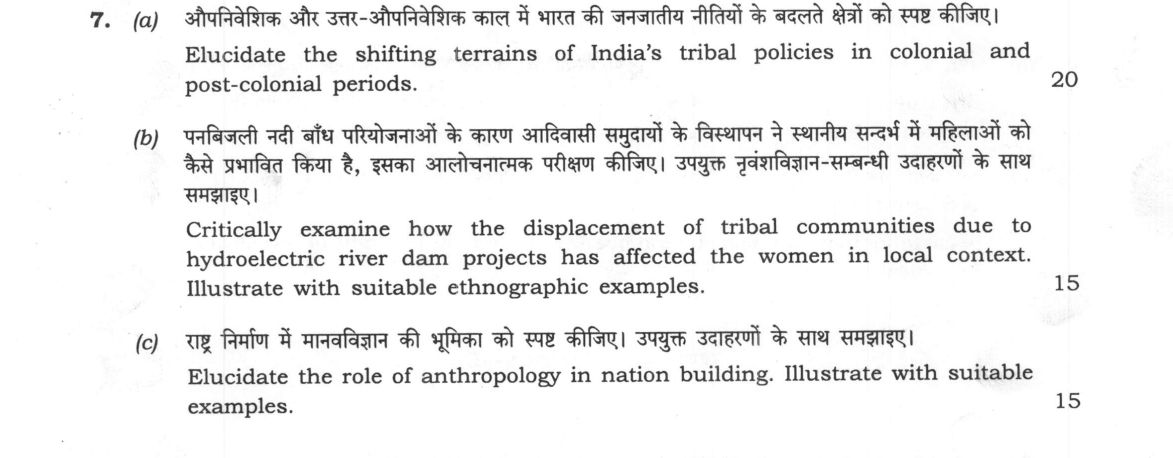
(a) Elucidate the shifting terrains of India's tribal policies in colonial and post-colonial periods. (20 marks) (b) Critically…
Elucidate the shifting terrains of India's tribal policies in colonial and post-colonial periods. 20 marks
Critically examine how the displacement of tribal communities due to hydroelectric river dam projects has affected the women in local context. Illustrate with suitable ethnographic examples. 15 marks
Elucidate the role of anthropology in nation building. Illustrate with suitable examples. 15 marks
हिंदी में प्रश्न पढ़ें
औपनिवेशिक और उत्तर-औपनिवेशिक काल में भारत की जनजातीय नीतियों के बदलते क्षेत्रों को स्पष्ट कीजिए। (20 अंक)
पनबिजली नदी बांध परियोजनाओं के कारण आदिवासी समुदायों के विस्थापन ने स्थानीय संदर्भ में महिलाओं को कैसे प्रभावित किया है, इसका आलोचनात्मक परीक्षण कीजिए। उपयुक्त नृवंशविज्ञान-संबंधी उदाहरणों के साथ समझाइए। (15 अंक)
राष्ट्र निर्माण में मानवविज्ञान की भूमिका को स्पष्ट कीजिए। उपयुक्त उदाहरणों के साथ समझाइए। (15 अंक)
Model answer
Written by UPSC Answer Check against this question's marking rubric, to the expected length. UPSC does not publish answers for Mains — this is one way to score well, not an official key.
Shifting Tribal Policies and Anthropological Roles
India’s tribal policies have traversed a complex trajectory from colonial control to post-colonial integration, fundamentally reshaping the socio-political landscape of Adivasi communities. Understanding this evolution is crucial to analyzing contemporary displacement issues and the evolving mandate of anthropology in nation-building.
Colonial Isolation to Post-Colonial Integration The colonial era was characterized by a dual approach of isolation and assimilation. The Criminal Tribes Act of 1871 stigmatized specific communities as "born criminals," while the Forest Acts of the 1860s and 1870s criminalized traditional forest rights, severing the ecological bond between tribes and their habitat. The Government of India Act 1919 introduced the concept of "backward tracts," but it was the Government of India Act 1935 that formally established Excluded and Partially Excluded Areas, creating a legal framework for administrative isolation. This colonial legacy of paternalistic control was rejected by the post-independence state, which adopted an integrationist model. Prime Minister Nehru’s Panchsheel (1950) outlined five principles for tribal development, emphasizing non-interference in internal affairs. Constitutionally, this was codified in the Fifth Schedule (Article 244(1)) for most tribal areas and the Sixth Schedule (Article 244(2) and Article 275) for the North-Eastern states, granting autonomous district councils. However, the state’s development-centric approach often ignored these protections. The Panchayats (Extension to Scheduled Areas) Act (PESA) of 1996 attempted to restore self-governance by recognizing Gram Sabhas, and the Forest Rights Act (FRA) of 2006 sought to rectify historical injustices by recognizing customary rights. Yet, neoliberal pressures and industrialization have often overridden these legal safeguards, leading to renewed conflicts.
Gendered Dimensions of Displacement The shift from protection to development-driven displacement has disproportionately impacted tribal women, a reality illuminated by feminist anthropology. Hydroelectric projects like the Sardar Sarovar Dam on the Narmada and the Koel-Karo projects in Jharkhand have displaced millions. Ethnographic studies reveal that displacement is not gender-neutral. Women, who are primary managers of common property resources (CPRs) such as forests and water sources, lose their livelihood base when these are submerged or fenced off. The disruption of kin networks and the loss of community cohesion exacerbate vulnerability. In the Narmada Valley, displaced women reported increased domestic violence due to economic stress and the breakdown of traditional social controls. Furthermore, the shift from subsistence agriculture to wage labor often forces women into precarious, low-paid work or, in extreme cases, prostitution, as seen in studies of the Tehri Dam region. The "development" narrative obscures these gendered costs, treating women as passive beneficiaries rather than active agents whose labor and ecological knowledge are essential for community survival.
Anthropology in Nation Building Anthropology’s role in India has evolved from colonial ethnography to a tool for national integration. Early works by H.H. Risley and Grierson provided the racial and linguistic classifications that underpinned colonial administration. Post-independence, anthropologists like Verrier Elwin and D.N. Majumdar shifted focus to understanding tribal societies for policy formulation, advocating for their protection within the national framework. Institutions like the Tribal Research Institute (Tribal Research Institute, Bhopal) and the National Institute of Rural Development (NIRD) have applied anthropological insights to design development programs. Today, anthropology plays a critical advocacy role. Scholars and practitioners use political ecology and post-colonial critiques to challenge state policies that violate tribal rights. For instance, anthropological evidence has been instrumental in Supreme Court judgments regarding evictions and the implementation of the Forest Rights Act. The discipline now serves as a bridge between the state and tribal communities, ensuring that development does not come at the cost of cultural integrity and human rights.
Conclusion In conclusion, the trajectory of India’s tribal policies reflects a tension between integration and autonomy. While the state has moved from colonial isolation to constitutional protection, the implementation of development projects continues to displace communities, with women bearing the heaviest burden. Anthropology, having evolved from a colonial instrument to a critical academic discipline, must continue to advocate for the rights of tribal communities. By grounding policy in ethnographic reality and upholding the principles of the Forest Rights Act and UNDRIP, anthropology can ensure that nation-building is inclusive and just, respecting the distinct identities and rights of India’s Adivasi populations.
What "Elucidate" is asking you to do
Make a stated proposition plain and then prove it with instances. Elucidate stems almost always carry a claim or a named concept, and very often the words “with examples” or “with suitable diagrams” — the illustration is part of the directive, not decoration.
Structure that answers it
Plain-language statement of what the proposition means → the part that is obscure, resolved → first illustration → second illustration → why the proposition holds
Where marks are lost
Adding terminology; elucidate rewards removing it. The commoner loss is a clean explanation with no example, when the stem asked for examples.
How this answer will be evaluated
Approach
(a) explain: definition/context > points in order > small example > short close | (b) critique: the claim > its strengths > its weaknesses > your judgment | (c) explain: definition/context > points in order > small example > short close Full marks: Precise legal/policy references, strong ethnographic examples, clear analytical structure.
Key points expected
- Colonial policy: FRA 1872, Criminal Tribes Act 1871, Excluded Areas
- Post-colonial: 5th/6th Schedules, PESA 1996, FRA 2006
- Shift from 'pacification' to 'rights-based' development
- Mention specific tribal groups (e.g., Santhal, Naga) in context
- Specific impact on women: loss of livelihood, social status
- Ethnographic example: Narmada (Bastar) or Sardar Sarovar
- Link to 'feminization of poverty' or 'gendered displacement'
- Mention of specific tribal group (e.g., Gond, Baiga)
Evaluation rubric
Each sub-part is marked on its own, against the marks and word limit printed on the paper.
- (a) Trace the evolution of tribal policy from colonial to post-colonial India. 20 marks
explain— definition/context → points in order → small example → short close
Must cover
- Colonial policy: FRA 1872, Criminal Tribes Act 1871, Excluded Areas
- Post-colonial: 5th/6th Schedules, PESA 1996, FRA 2006
- Shift from 'pacification' to 'rights-based' development
- Mention specific tribal groups (e.g., Santhal, Naga) in context
Loses marks
- Treating tribal policy as general rural development
- Ignoring the legal/statutory framework (Acts/Schedules)
- Failing to distinguish between colonial and post-colonial eras
Earns more
- Reference to Hunter Commission or Verghese Committee
- Discussion of 'Tribal Sub-Plan' or 'Tribal Development Plan'
- Mention of 'Tribal Areas' vs 'Tribal Regions' distinction
Extra mark
- Reference to specific Supreme Court judgments (e.g., Niyamgiri case)
- Mention of specific state-level tribal policies (e.g., Jharkhand)
- (b) Critically examine the impact of dam-induced displacement on tribal women. 15 marks
critique— the claim → its strengths → its weaknesses → your judgment
Must cover
- Specific impact on women: loss of livelihood, social status
- Ethnographic example: Narmada (Bastar) or Sardar Sarovar
- Link to 'feminization of poverty' or 'gendered displacement'
- Mention of specific tribal group (e.g., Gond, Baiga)
Loses marks
- Generalizing about 'tribal people' without gender focus
- Ignoring the 'local context' or specific ethnographic evidence
- Failing to link displacement to specific dam projects
Earns more
- Reference to specific NGO or researcher (e.g., Medha Patkar)
- Discussion of 'resettlement' vs 'rehabilitation' failure
- Mention of 'cultural loss' or 'identity crisis' for women
Extra mark
- Reference to specific court order or policy (e.g., Narmada Control Authority)
- Mention of specific village or site (e.g., Kaptanganj)
- (c) Elucidate the role of anthropology in nation building. 15 marks
explain— definition/context → points in order → small example → short close
Must cover
- Role in 'integration' of diverse tribal groups
- Role in 'policy formulation' (e.g., 5th/6th Schedules)
- Role in 'cultural preservation' and 'identity construction'
- Example: Role of anthropologists in 'Census' or 'Planning'
Loses marks
- Treating anthropology as 'social work' or 'development'
- Ignoring the 'political' or 'policy' dimension of nation building
- Failing to provide specific examples of anthropological contribution
Earns more
- Reference to specific anthropologist (e.g., Verrier Elwin, M.N. Srinivas)
- Discussion of 'nation' vs 'state' in tribal context
- Mention of 'cultural rights' or 'autonomy' debates
Extra mark
- Reference to specific committee (e.g., Mandal Commission)
- Mention of specific tribal movement (e.g., Naga, Mizo)
Practice this exact question
Write your answer and it is marked point by point against the model answer above — what you covered, what you missed, what you got wrong.
Evaluate my answer →More from Anthropology 2023 Paper II
- Q4 (a) Elucidate the problems faced by Particularly Vulnerable Tribal Groups and the major c…
- Q5 Write short notes on the following in about 150 words each: (a) Scheduled areas (10 marks…
- Q6 (a) Is annihilation of caste possible? Discuss the future of caste system in the light of…
- Q7 (a) Elucidate the shifting terrains of India's tribal policies in colonial and post-colon…
- Q8 (a) Discuss the distribution of tribes in different geographical regions of India. Identi…