Paper II — Q2
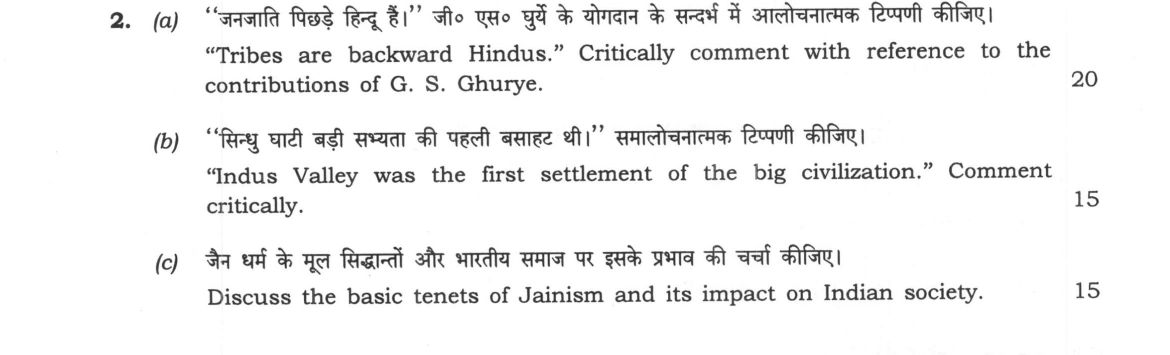
(a) "Tribes are backward Hindus." Critically comment with reference to the contributions of G. S. Ghurye. (20 marks) (b) "Indus…
"Tribes are backward Hindus." Critically comment with reference to the contributions of G. S. Ghurye. 20 marks
"Indus Valley was the first settlement of the big civilization." Comment critically. 15 marks
Discuss the basic tenets of Jainism and its impact on Indian society. 15 marks
हिंदी में प्रश्न पढ़ें
"जनजाति पिछड़े हिंदू हैं।" जी० एस० घुर्ये के योगदान के संदर्भ में आलोचनात्मक टिप्पणी कीजिए। (20 अंक)
"सिंधु घाटी बड़ी सभ्यता की पहली बसाहट थी।" समालोचनात्मक टिप्पणी कीजिए। (15 अंक)
जैन धर्म के मूल सिद्धांतों और भारतीय समाज पर इसके प्रभाव की चर्चा कीजिए। (15 अंक)
Model answer
Written by UPSC Answer Check against this question's marking rubric, to the expected length. UPSC does not publish answers for Mains — this is one way to score well, not an official key.
The relationship between tribal communities, ancient urbanization, and religious reform constitutes the bedrock of Indian social anthropology. To understand the contemporary Indian social fabric, one must critically evaluate the assimilationist narratives of tribal identity, the archaeological evidence for the Indus Valley Civilization (IVC), and the enduring societal imprint of Jainism.
Part (a): Tribes and the "Backward Hindu" Thesis
G.S. Ghurye, in his seminal work The Scheduled Tribes (1963), posited that tribes are essentially "backward Hindus." His assimilationist thesis argued that tribal societies are not distinct entities but rather a segment of Hindu society that has remained at an earlier stage of cultural development. Ghurye viewed the process of Sanskritization—where lower castes and tribes emulate higher castes in rituals and lifestyle—as the primary mechanism for social mobility. He believed that tribes are undergoing a gradual process of integration into the mainstream Hindu fold, and their "backwardness" is a result of geographical isolation and lack of contact with the Vedic culture.
However, this view has been subjected to rigorous critical scrutiny. First, the constitutional and legal distinction between Scheduled Tribes (STs) and Hindu castes is fundamental. Article 342 of the Constitution identifies STs based on tribal character, primitive traits, and backwardness, distinct from the caste hierarchy. Second, anthropologists like Verrier Elwin challenged Ghurye’s assimilationist bias. Elwin advocated for an isolationist approach, arguing that tribes possess distinct cultural identities and should be protected from the assimilative pressures of the dominant caste society to preserve their unique heritage. Third, M.N. Srinivas and later scholars like M.N. Dube refined the concept, with Dube proposing the "neither-nor" position, suggesting that tribes are neither purely tribal nor fully caste-based but exist in a liminal space. Furthermore, Xaxa and others have emphasized the assertion of tribal identity, where communities actively resist being labeled as "backward Hindus" to claim specific political rights and cultural autonomy. Thus, while Ghurye highlighted the fluidity of boundaries, his reduction of tribal identity to a "backward" phase of Hinduism ignores the distinctiveness and agency of tribal communities.
Part (b): The Indus Valley as the "First Settlement"
The statement that the Indus Valley was the "first settlement" of big civilization is analytically flawed. Archaeological evidence suggests that the Mature Harappan phase (c. 2600–1900 BCE) was not the beginning but the culmination of a long developmental process. The pre-Harappan phase, particularly the Mehrgarh culture in Baluchistan (c. 7000–2500 BCE), provides the foundational antecedents. Mehrgarh shows evidence of early agriculture, animal domestication, and pottery, which evolved into the Kirthar and Kot Diji phases, eventually leading to the urban complexity of Harappa and Mohenjo-daro.
The Mature Harappan cities exhibited sophisticated urban planning, including grid-pattern streets, standardized brick sizes, and advanced drainage systems, as seen in the Great Bath of Mohenjo-daro. However, labeling it the "first" settlement ignores the regional antecedents in Baluchistan and Gujarat. Moreover, the claim is limited by the undeciphered script and unclear political organization of the IVC, which prevents a definitive understanding of its social hierarchy compared to later Vedic or Mauryan states. Therefore, the IVC represents a peak of urbanization rather than an isolated origin, rooted in earlier Neolithic and Chalcolithic traditions.
Part (c): Jainism and Its Societal Impact
Jainism, an ancient Indian religion, is founded on the teachings of the Tirthankaras, with Mahavira (the 24th Tirthankara) being the most recent and influential reformer. It is crucial to note that Jainism existed before Mahavira, with Parshvanatha (the 23rd Tirthankara) being a key figure in its early history. Mahavira systematized and propagated its doctrines. The basic tenets include Anekantavada (the doctrine of non-absolutism or manifoldness of reality), Syadvada (the theory of conditional predication), Ahimsa (non-violence), Aparigraha (non-possession), and a strict Karma theory that views the soul as weighed down by karmic particles.
The impact of Jainism on Indian society is profound. It fostered the rise of mercantile communities, as Jain traders like the Baniyas became economically dominant, influencing trade networks across Asia. Architecturally, Jainism contributed to the construction of monumental temples and statues, such as the Gommateshwara statue at Shravanabelagola and the temples at Mount Abu. Philosophically, Jainism’s emphasis on Ahimsa and Anekantavada significantly influenced Gandhian thought, providing a philosophical basis for non-violent resistance. Additionally, Jainism promoted vegetarianism and ethical living, which permeated broader Indian society, encouraging a culture of compassion and tolerance.
Conclusion
In conclusion, while Ghurye’s assimilationist view offers a perspective on social integration, it is limited by its neglect of tribal distinctiveness. The Indus Valley Civilization was a culmination of earlier regional developments, not a singular origin. Jainism, with its philosophical depth and ethical rigor, has left an indelible mark on Indian society, shaping its economic, architectural, and moral landscape. A critical understanding of these elements is essential for appreciating the complexity of Indian civilization.
What "Critically comment" is asking you to do
Take a position on the statement and support it. Comment usually attaches to a quoted line in the short slots, so the reasoning must be compressed — an opening view, a few load-bearing reasons, and the limit of the claim. “Critically” is not a section added at the end: name the yardstick you are judging by — the evidence, the stated objective, a constitutional principle, a rival explanation — and let a verdict close each part of the body. Where the question quotes a claim, that verdict must land on the claim itself, accepted, qualified or rejected, and not on the theme in general.
Structure that answers it
Unpack what the statement asserts → your stance → two or three supporting reasons → the qualification that limits it
Where marks are lost
Merits in one paragraph, demerits in the next, and a conclusion calling for a balanced and holistic approach. That is a survey with the judgement left out and it holds the answer in the middle band. The opposite error is reading “critically” as permission to attack — and with the odd pairings, critically describe or critically explain, the exposition still carries most of the marks, the judgement being a layer on it rather than a substitute for it.
How this answer will be evaluated
Approach
(a) critique: the claim > its strengths > its weaknesses > your judgment | (b) critique: the claim > its strengths > its weaknesses > your judgment | (c) discuss: intro > 3-4 dimensions > example > balanced close Full marks: Comprehensive, well-structured, with specific examples and critical analysis
Key points expected
- State Ghurye's 'Hinduization' thesis on tribal integration
- Identify Ghurye's view of tribes as 'backward Hindus'
- Present counter-arguments (e.g., S.C. Dube, M.N. Srinivas)
- Provide judgment on the validity of the statement
- Define 'big civilization' in archaeological context
- Present evidence for Indus Valley as early urbanization
- Mention other early settlements (e.g., Mehrgarh, Lothal)
- Provide balanced judgment on the claim
Evaluation rubric
Each sub-part is marked on its own, against the marks and word limit printed on the paper.
- (a) Critically evaluate the statement 'Tribes are backward Hindus' using G.S. Ghurye's contributions. 20 marks
critique— the claim → its strengths → its weaknesses → your judgment
Must cover
- State Ghurye's 'Hinduization' thesis on tribal integration
- Identify Ghurye's view of tribes as 'backward Hindus'
- Present counter-arguments (e.g., S.C. Dube, M.N. Srinivas)
- Provide judgment on the validity of the statement
Loses marks
- Treating tribes as static or homogeneous
- Ignoring Ghurye's specific arguments
- Confusing Ghurye with other anthropologists
Earns more
- Mention Ghurye's 'Tribes of India' (1968)
- Reference specific tribes (e.g., Bhils, Gonds) as examples
- Discuss the concept of 'Hinduization' vs 'Sanskritization'
- Mention Ghurye's 'Hinduization' vs 'Westernization' debate
Extra mark
- Reference specific Ghurye fieldwork (e.g., Bhils of Vidarbha)
- Mention Ghurye's 'Hinduization' vs 'Westernization' debate
- (b) Critically comment on the claim that Indus Valley was the first settlement of big civilization. 15 marks
critique— the claim → its strengths → its weaknesses → your judgment
Must cover
- Define 'big civilization' in archaeological context
- Present evidence for Indus Valley as early urbanization
- Mention other early settlements (e.g., Mehrgarh, Lothal)
- Provide balanced judgment on the claim
Loses marks
- Overstating Indus Valley's uniqueness
- Ignoring other early settlements
- Confusing Indus Valley with later Vedic civilization
Earns more
- Reference specific sites (e.g., Harappa, Mohenjo-daro)
- Mention dating (e.g., 2500-1900 BCE)
- Discuss urban planning features (drainage, grid system)
- Reference comparative civilizations (Mesopotamia, Egypt)
Extra mark
- Mention specific archaeological findings (e.g., Great Bath)
- Reference recent excavations or discoveries
- (c) Discuss the basic tenets of Jainism and its impact on Indian society. 15 marks
discuss— intro → 3-4 dimensions → example → balanced close
Must cover
- List core tenets (Ahimsa, Anekantavada, Aparigraha)
- Explain each tenet briefly
- Describe impact on Indian society (ethics, politics, culture)
- Provide examples of Jain influence
Loses marks
- Confusing Jainism with Buddhism
- Ignoring social impact
- Overstating Jain influence without evidence
Earns more
- Mention Mahavira and Parshvanatha
- Reference Jain contributions to art and architecture
- Discuss Jain influence on Gandhi and non-violence
- Mention Jain contributions to Indian philosophy
Extra mark
- Reference specific Jain texts (e.g., Tattvartha Sutra)
- Mention Jain contributions to Indian democracy
Practice this exact question
Write your answer and it is marked point by point against the model answer above — what you covered, what you missed, what you got wrong.
Evaluate my answer →More from Anthropology 2023 Paper II
- Q1 Write short notes on the following in about 150 words each: (a) Material culture and arch…
- Q2 (a) "Tribes are backward Hindus." Critically comment with reference to the contributions…
- Q3 (a) "Sanskritization is a culture-bound concept." Critically comment to assess the streng…
- Q4 (a) Elucidate the problems faced by Particularly Vulnerable Tribal Groups and the major c…
- Q5 Write short notes on the following in about 150 words each: (a) Scheduled areas (10 marks…