Paper II — Q3
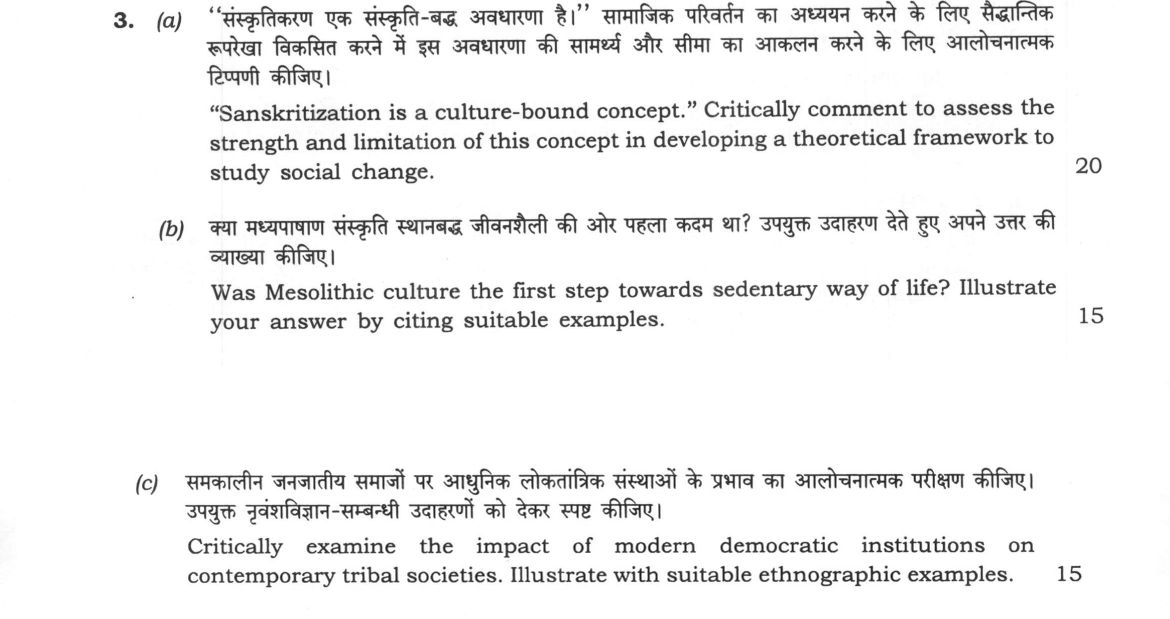
(a) "Sanskritization is a culture-bound concept." Critically comment to assess the strength and limitation of this concept in…
"Sanskritization is a culture-bound concept." Critically comment to assess the strength and limitation of this concept in developing a theoretical framework to study social change. 20 marks
Was Mesolithic culture the first step towards sedentary way of life? Illustrate your answer by citing suitable examples. 15 marks
Critically examine the impact of modern democratic institutions on contemporary tribal societies. Illustrate with suitable ethnographic examples. 15 marks
हिंदी में प्रश्न पढ़ें
"संस्कृतिकरण एक संस्कृति-बद्ध अवधारणा है।" सामाजिक परिवर्तन का अध्ययन करने के लिए सैद्धांतिक रूपरेखा विकसित करने में इस अवधारणा की सामर्थ्य और सीमा का आकलन करने के लिए आलोचनात्मक टिप्पणी कीजिए। (20 अंक)
क्या मध्यपाषाण संस्कृति स्थानबद्ध जीवनशैली की ओर पहला कदम था? उपयुक्त उदाहरण देते हुए अपने उत्तर की व्याख्या कीजिए। (15 अंक)
समकालीन जनजातीय समाजों पर आधुनिक लोकतांत्रिक संस्थाओं के प्रभाव का आलोचनात्मक परीक्षण कीजिए। उपयुक्त नृवंशविज्ञान-संबंधी उदाहरणों को देकर स्पष्ट कीजिए। (15 अंक)
Model answer
Written by UPSC Answer Check against this question's marking rubric, to the expected length. UPSC does not publish answers for Mains — this is one way to score well, not an official key.
Social transformation in India encompasses deep prehistoric shifts, endogenous caste mobility, and contemporary constitutional restructuring.
Sanskritization as a Culture-Bound Concept
M.N. Srinivas defined Sanskritization as the process by which a low Hindu caste, tribal, or other group changes its customs, ritual, ideology, and way of life in the direction of a high, frequently twice-born caste. The concept is inherently culture-bound because its explanatory framework operates strictly within the Hindu sacred-profane continuum, ritual purity-pollution dynamics, and Sanskritic reference models (Brahmanic, Kshatriya, or Vaisya).
Its primary strength lies in theorizing orthogenetic, intra-systemic mobility. It uncovers how marginalized castes and absorbed tribes historically claimed higher status through vegetarianism, teetotalism, and ritual emulation. However, as a generalized framework for social change, it possesses severe limitations. As Yogendra Singh noted, Sanskritization results only in "positional change without structural transformation"—the overarching caste hierarchy remains unchallenged. It overlooks economic, material, and political determinants of change, prompting Srinivas himself to formulate the concept of Westernization.
In contemporary India, Dipankar Gupta argues that Sanskritization has suffered declining salience. In a competitive electoral democracy, subaltern castes assert autonomous Dalit and backward-class identities rather than emulating upper-caste idioms. While Yogendra Singh's "modernization of tradition" illustrates that ritual traditions adapt alongside secular forces, Sanskritization remains inadequate for explaining modern, class-based, and post-industrial social transformations.
Mesolithic Roots of Sedentism
The Indian Mesolithic (c. 10,000–4,000 BCE) marked the first decisive transition from mobile Pleistocene foraging toward sedentism. Favourable Holocene climatic warming expanded ecological niches, encouraging broad-spectrum hunting, gathering, and fishing with microlithic composite tools.
Archaeological evidence shows clear signs of semi-permanent occupation. At Bagor (Rajasthan) and Langhnaj (Gujarat), microlith concentrations, habitation floors, and formalized human burials demonstrate prolonged settlement. In the Ganga Valley, sites such as Sarai Nahar Rai, Mahadaha, and Damdama have yielded circular hut floors, heavy querns, hearths, and multi-seasonal animal remains, reflecting substantial base camps. Similarly, the rock-shelters of Bhimbetka demonstrate sustained, intensive residential use.
However, this represented incipient or seasonal sedentism rather than permanent agricultural settlement. These communities remained reliant on wild resources. True sedentism required systematic food production and domestication, which emerged fully only in the Neolithic-Chalcolithic horizon, as evidenced at Mehrgarh. Thus, the Mesolithic was an indispensable stepping stone—establishing residential stability—without achieving full sedentary status.
Democratic Institutions and Contemporary Tribals
Modern democratic institutions have exerted dual and conflicting impacts on Indian tribal societies. Positively, constitutional provisions under the Fifth and Sixth Schedules, Articles 330 and 332 (electoral reservations), and the PESA Act, 1996, have institutionalized tribal political agency. These structures channelled historical movements, such as the Birsa Munda-led Ulgulan, into contemporary electoral mobilization, culminating in the Jharkhand Movement and assertive Gond and Bhil regional leadership.
Critically, however, modern representative democracy has disrupted indigenous social fabrics. Statutory Panchayats and party politics have eroded traditional authority structures, such as the Manki-Munda and Parha councils among Central Indian tribes. In Sixth Schedule areas, tensions persist between modern Autonomous District Councils and customary tribal chiefs among the Nagas and Mizos. Furthermore, as Madhav Gadgil and Ramachandra Guha observe, populist electoral democracy has frequently prioritized state-backed resource extraction and industrial projects over customary tribal rights, compounding ecological degradation and involuntary displacement.
Conclusion
Social change in India has evolved from early ecological adaptations in the Mesolithic and ritual repositioning under Sanskritization to modern constitutional contestation. Today, transformation is driven not by ritual emulation within a culture-bound hierarchy, but by democratic assertion, legal rights, and material struggles over autonomy and resources.
What "Critically comment" is asking you to do
Take a position on the statement and support it. Comment usually attaches to a quoted line in the short slots, so the reasoning must be compressed — an opening view, a few load-bearing reasons, and the limit of the claim. “Critically” is not a section added at the end: name the yardstick you are judging by — the evidence, the stated objective, a constitutional principle, a rival explanation — and let a verdict close each part of the body. Where the question quotes a claim, that verdict must land on the claim itself, accepted, qualified or rejected, and not on the theme in general.
Structure that answers it
Unpack what the statement asserts → your stance → two or three supporting reasons → the qualification that limits it
Where marks are lost
Merits in one paragraph, demerits in the next, and a conclusion calling for a balanced and holistic approach. That is a survey with the judgement left out and it holds the answer in the middle band. The opposite error is reading “critically” as permission to attack — and with the odd pairings, critically describe or critically explain, the exposition still carries most of the marks, the judgement being a layer on it rather than a substitute for it.
How this answer will be evaluated
Approach
(a) critique: the claim > its strengths > its weaknesses > your judgment | (b) justify: claim > 3-4 reasons > evidence > conclusion | (c) examine: intro > how/why with reasoning > evidence > conclusion Full marks: Comprehensive, well-structured, with specific examples and critical analysis.
Key points expected
- Define Sanskritization and its culture-bound nature
- Identify M.N. Srinivas as the originator
- Evaluate strengths in explaining caste mobility
- Critique limitations regarding class and gender
- Define Mesolithic culture and period
- Cite specific Indian sites (e.g., Bagor, Langhnaj)
- Explain transition from nomadic to semi-sedentary
- Mention evidence of animal domestication
Evaluation rubric
Each sub-part is marked on its own, against the marks and word limit printed on the paper.
- (a) Assess the utility of Sanskritization as a theoretical tool for social change. 20 marks
critique— the claim → its strengths → its weaknesses → your judgment
Must cover
- Define Sanskritization and its culture-bound nature
- Identify M.N. Srinivas as the originator
- Evaluate strengths in explaining caste mobility
- Critique limitations regarding class and gender
Loses marks
- Confusing Sanskritization with Westernization
- Ignoring the 'culture-bound' aspect
- Sociological answer without anthropological context
Earns more
- Mention M.S. Altekar's critique
- Reference 'Sahyadri' or 'Rural India' studies
- Discuss 'Sanskritization' vs 'Westernization'
- Mention 'Dominant Caste' concept
Extra mark
- Reference 'Sanskritization' in modern context
- Mention 'Caste Mobility' data
- (b) Argue whether Mesolithic culture initiated the sedentary way of life. 15 marks
justify— claim → 3-4 reasons → evidence → conclusion
Must cover
- Define Mesolithic culture and period
- Cite specific Indian sites (e.g., Bagor, Langhnaj)
- Explain transition from nomadic to semi-sedentary
- Mention evidence of animal domestication
Loses marks
- Confusing Mesolithic with Neolithic
- Ignoring the 'first step' argument
- No specific site examples
Earns more
- Reference 'Microliths' and tools
- Mention 'Painted Pottery' culture
- Discuss 'Hunting and Gathering' to 'Farming'
- Reference 'Neolithic Revolution' link
Extra mark
- Mention 'Dog' domestication evidence
- Reference 'Rock Art' at Bhimbetka
- (c) Analyze the impact of modern democratic institutions on tribal societies. 15 marks
examine— intro → how/why with reasoning → evidence → conclusion
Must cover
- Define modern democratic institutions
- Identify specific tribal societies (e.g., Gond, Santhal)
- Discuss impact on traditional governance
- Mention 'Panchayati Raj' or 'Fifth Schedule'
Loses marks
- Ignoring the 'critical' aspect
- No ethnographic examples
- Generalizing without specific tribal context
Earns more
- Reference 'Gram Sabha' in tribal areas
- Mention 'Tribal Sub-Plan' (TSP)
- Discuss 'Cultural Erosion' vs 'Empowerment'
- Reference 'Forest Rights Act' (FRA)
Extra mark
- Mention 'Tribal Autonomous District Councils' (TADCs)
- Reference 'Land Alienation' issues
Practice this exact question
Write your answer and it is marked point by point against the model answer above — what you covered, what you missed, what you got wrong.
Evaluate my answer →More from Anthropology 2023 Paper II
- Q1 Write short notes on the following in about 150 words each: (a) Material culture and arch…
- Q2 (a) "Tribes are backward Hindus." Critically comment with reference to the contributions…
- Q3 (a) "Sanskritization is a culture-bound concept." Critically comment to assess the streng…
- Q4 (a) Elucidate the problems faced by Particularly Vulnerable Tribal Groups and the major c…
- Q5 Write short notes on the following in about 150 words each: (a) Scheduled areas (10 marks…
- Q6 (a) Is annihilation of caste possible? Discuss the future of caste system in the light of…