Paper II — Q4
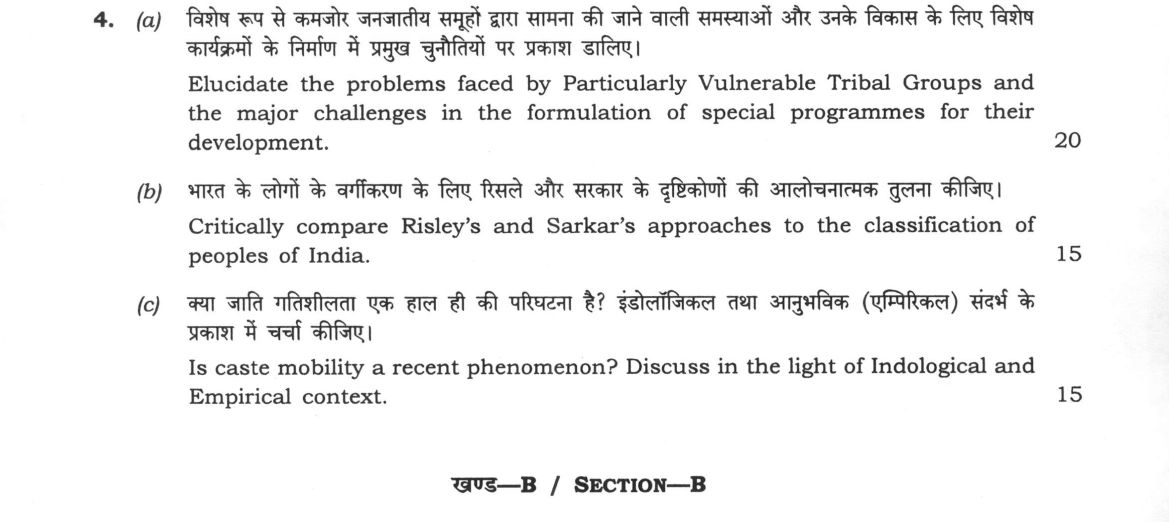
(a) Elucidate the problems faced by Particularly Vulnerable Tribal Groups and the major challenges in the formulation of special…
Elucidate the problems faced by Particularly Vulnerable Tribal Groups and the major challenges in the formulation of special programmes for their development. 20 marks
Critically compare Risley's and Sarkar's approaches to the classification of peoples of India. 15 marks
Is caste mobility a recent phenomenon? Discuss in the light of Indological and Empirical context. 15 marks
हिंदी में प्रश्न पढ़ें
विशेष रूप से कमजोर जनजातीय समूहों द्वारा सामना की जाने वाली समस्याओं और उनके विकास के लिए विशेष कार्यक्रमों के निर्माण में प्रमुख चुनौतियों पर प्रकाश डालिए। (20 अंक)
भारत के लोगों के वर्गीकरण के लिए रिस्ले और सरकार के दृष्टिकोणों की आलोचनात्मक तुलना कीजिए। (15 अंक)
क्या जाति गतिशीलता एक हाल ही की परिघटना है? इंडोलॉजिकल तथा अनुभविक (एम्पिरिकल) संदर्भ के प्रकाश में चर्चा कीजिए। (15 अंक)
Model answer
Written by UPSC Answer Check against this question's marking rubric, to the expected length. UPSC does not publish answers for Mains — this is one way to score well, not an official key.
The study of Indian society requires examining structural vulnerability, biocultural classification, and the dynamics of social stratification across tribal and caste groups.
Problems of PVTGs and Programme Formulation Challenges
Identified following the Dhebar Commission (1960–61) recommendations, Particularly Vulnerable Tribal Groups (PVTGs) face severe marginalization defined by pre-agricultural technology, stagnant or declining populations, extremely low literacy, and subsistence-level economies. Geographic isolation and rapid loss of traditional forest habitats have induced acute nutritional deprivation and endemic genetic vulnerabilities, such as sickle-cell anaemia among central Indian tribes.
Formulating development programmes for PVTGs faces critical institutional and operational challenges: First, the rigid application of national identification criteria overlooks micro-demographic realities due to an acute deficit of baseline ethnographic and health data. Second, bureaucratic delivery mechanisms frequently lack cultural sensitivity, resulting in misplaced interventions. A prominent example is the resettlement of the nomadic Birhor of Jharkhand into brick colonies, which alienated them from their traditional rope-making forest economy and led to livelihood collapse. Third, developmental policy remains caught between protectionism and integration. While Conservation-cum-Development (CCD) plans and the PM-PVTG Development Mission aim at holistic growth, they often suffer from centralized implementation, inadequate recognition of habitat rights under the Forest Rights Act (2006), and top-down assimilation that undermines indigenous socio-ecological knowledge.
Comparing Risley and Sarkar on Population Classification
Herbert Risley (1901 Census) classified India’s population into seven distinct racial types (including Indo-Aryan, Dravidian, and Mongolo-Dravidian) using anthropometric techniques, primarily the nasal and cephalic indices. Grounded in 19th-century colonial racial determinism, Risley argued that social status was inversely related to the nasal index. His methodology suffered from selective sampling, arbitrary typologies, and an imperial political agenda designed to portray Indian society as fragmented and naturally hierarchical.
In contrast, S.S. Sarkar (1954) challenged Risley’s racial determinism. While incorporating updated cephalic, somatoscopic, and blood group data, Sarkar emphasized socio-cultural criteria, including linguistic patterns, material culture, and social organization, to demarcate biological and cultural zones.
Methodologically, Sarkar replaced Risley’s static, hierarchical racial taxonomy with an ethno-historical framework accounting for gene flow, migration, and ecological adaptation. Politically, while Risley’s framework legitimized colonial governance through division, Sarkar’s holistic classification supported post-colonial nation-building by emphasizing historical intermixture and biocultural continuity.
Temporal Dimensions of Caste Mobility
Caste mobility is not merely an artifact of post-colonial modernity; it represents an ongoing historical process characterized by pre-modern positional shifts and modern structural realignments.
Indological and historical evidence disproves the notion of an entirely static caste system. Pre-modern mobility operated primarily within the varna framework through Sanskritization, Kshatriyization, and Rajputization. M.N. Srinivas demonstrated that lower jatis emulated the ritual, dietary, and social customs of dominant castes to claim elevated status. Historical records, such as medieval temple inscriptions and copper-plate grants, reveal how ruling lineages and pastoral-tribal groups—such as the Gonds and Bhumijs analysed by Surajit Sinha—were absorbed into the Kshatriya fold. Colonial censuses regularly recorded disputes where jatis organized caste sabhas to petition for higher varna rank.
Empirical studies in post-Independence India illustrate a distinct, accelerated form of mobility driven by democratic decentralization, constitutional reservations (Articles 15 and 16), and market access. André Béteille’s study of Sripuram demonstrated the progressive delinking of caste, class, and power, transforming a harmonic system of cumulative inequalities into a disharmonic one. Ghanshyam Shah highlighted how democratic politics and affirmative action transformed jatis into competitive political interest groups, fostering secular, horizontal mobility rather than traditional ritual emulation.
Pre-modern mobility was positional, slow, and accommodated within traditional hierarchies, whereas modern mobility is structural, legal-political, and actively deconstructs the ritual basis of social stratification.
A nuanced understanding of Indian society demonstrates that PVTG vulnerabilities, classification debates, and caste mobility reflect dynamic adaptations to political, ecological, and economic changes, requiring decentralised and culturally grounded policy responses.
What "Elucidate" is asking you to do
Make a stated proposition plain and then prove it with instances. Elucidate stems almost always carry a claim or a named concept, and very often the words “with examples” or “with suitable diagrams” — the illustration is part of the directive, not decoration.
Structure that answers it
Plain-language statement of what the proposition means → the part that is obscure, resolved → first illustration → second illustration → why the proposition holds
Where marks are lost
Adding terminology; elucidate rewards removing it. The commoner loss is a clean explanation with no example, when the stem asked for examples.
How this answer will be evaluated
Approach
Framework: UPSC Anthropology Paper II (Social Anthropology). (a) explain: definition/context > points in order > small example > short close | (b) compare: paired headings or table > key differences > significance > conclusion | (c) discuss: intro > 3-4 dimensions > example > balanced close Full marks: Comprehensive, well-structured, with specific examples and critical analysis.
Key points expected
- Define PVTGs and mention the 2007 Ministry of Tribal Affairs criteria
- List specific problems: isolation, low population, food insecurity, lack of immunity
- Identify challenges in program formulation: data scarcity, geographical inaccessibility
- Mention specific schemes like Van Dhan or PVTG-specific interventions
- Explain Risley's 'Ethnological' classification (Caucasoid, Mongoloid, Negroid)
- Explain Risley's 'Physical' classification (Dolichocephalic, Brachycephalic, etc.)
- Explain Sarkar's 'Cultural' classification (Aryans, Dravidians, etc.)
- Critically evaluate the limitations of Risley's racial approach vs Sarkar's cultural approach
Evaluation rubric
Each sub-part is marked on its own, against the marks and word limit printed on the paper.
- (a) Define PVTGs, list their specific problems, and analyze the challenges in formulating development programs. 20 marks
explain— definition/context → points in order → small example → short close
Must cover
- Define PVTGs and mention the 2007 Ministry of Tribal Affairs criteria
- List specific problems: isolation, low population, food insecurity, lack of immunity
- Identify challenges in program formulation: data scarcity, geographical inaccessibility
- Mention specific schemes like Van Dhan or PVTG-specific interventions
Loses marks
- Treating PVTGs as a generic category of 'Primitive Tribes' without specific criteria
- Focusing only on general tribal problems without addressing the 'vulnerable' aspect
- Ignoring the 'formulation' aspect and only listing problems
Earns more
- Reference to specific PVTG tribes (e.g., Baiga, Sentinelese, Jarawa)
- Discussion on the 'pre-agricultural' or 'pre-iron age' status of these groups
- Mention of the 75 PVTGs identified by the Ministry of Tribal Affairs
Extra mark
- Reference to the 2015 PVTG guidelines or specific state-level policies
- Mention of the 'Van Dhan Yojana' as a specific economic intervention
- (b) Critically compare Risley's and Sarkar's approaches to classifying the peoples of India. 15 marks
compare— paired headings or table → key differences → significance → conclusion
Must cover
- Explain Risley's 'Ethnological' classification (Caucasoid, Mongoloid, Negroid)
- Explain Risley's 'Physical' classification (Dolichocephalic, Brachycephalic, etc.)
- Explain Sarkar's 'Cultural' classification (Aryans, Dravidians, etc.)
- Critically evaluate the limitations of Risley's racial approach vs Sarkar's cultural approach
Loses marks
- Confusing Risley's physical types with his ethnological types
- Failing to mention the 'Cultural' aspect of Sarkar's classification
- Treating both as equally valid without critical evaluation
Earns more
- Mention Risley's 'The People of India' (1905) as the source
- Mention Sarkar's 'A History of the Indian Race' (1923) as the source
- Reference to the 'Aryan Invasion Theory' in the context of Sarkar's work
Extra mark
- Mention of the 'Cultural' vs 'Biological' debate in anthropology
- Reference to the 'Caste' system as a complicating factor in classification
- (c) Discuss whether caste mobility is a recent phenomenon, using Indological and Empirical contexts. 15 marks
discuss— intro → 3-4 dimensions → example → balanced close
Must cover
- Define 'Caste Mobility' (upward/downward, individual/group)
- Present Indological evidence: Manusmriti, Dharmashastras, Vedic texts
- Present Empirical evidence: Census data, sociological studies (e.g., M.N. Srinivas)
- Analyze the 'recent' nature: post-independence, reservation policies, economic changes
Loses marks
- Ignoring the 'Indological' context and focusing only on modern data
- Treating 'Caste Mobility' as a purely 'recent' phenomenon without historical context
- Failing to distinguish between 'individual' and 'group' mobility
Earns more
- Mention of 'Sanskritization' (M.N. Srinivas) as a mechanism of mobility
- Reference to 'Caste Mobility' in the context of 'Reservation' policies
- Mention of 'Dalit' movements as a driver of recent mobility
Extra mark
- Reference to specific studies on 'Caste Mobility' in urban vs rural India
- Mention of 'Caste Mobility' in the context of 'Globalization' and 'IT sector'
Practice this exact question
Write your answer and it is marked point by point against the model answer above — what you covered, what you missed, what you got wrong.
Evaluate my answer →More from Anthropology 2023 Paper II
- Q1 Write short notes on the following in about 150 words each: (a) Material culture and arch…
- Q2 (a) "Tribes are backward Hindus." Critically comment with reference to the contributions…
- Q3 (a) "Sanskritization is a culture-bound concept." Critically comment to assess the streng…
- Q4 (a) Elucidate the problems faced by Particularly Vulnerable Tribal Groups and the major c…
- Q5 Write short notes on the following in about 150 words each: (a) Scheduled areas (10 marks…
- Q6 (a) Is annihilation of caste possible? Discuss the future of caste system in the light of…
- Q7 (a) Elucidate the shifting terrains of India's tribal policies in colonial and post-colon…