Paper II — Q5
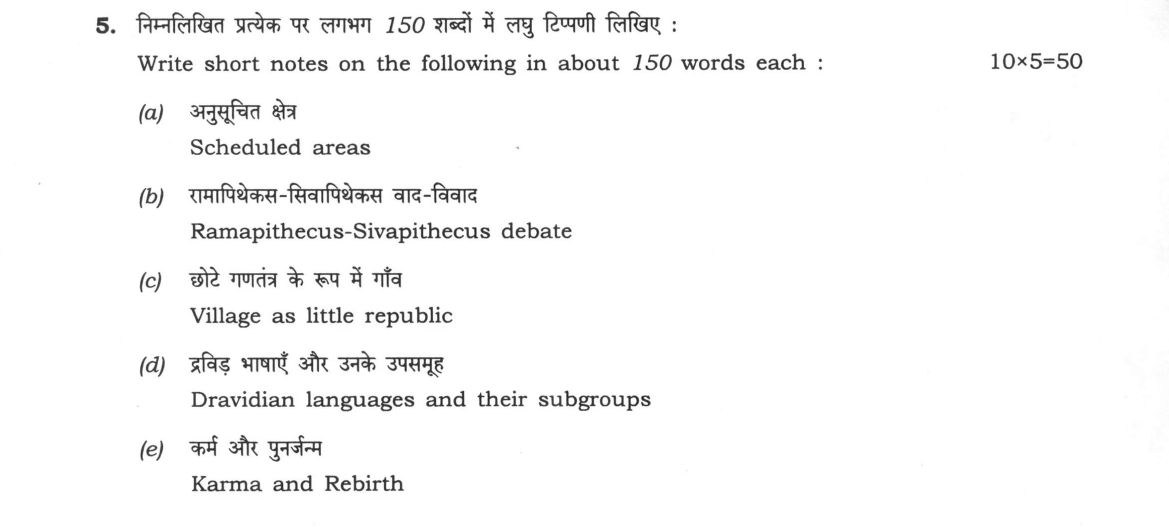
Write short notes on the following in about 150 words each: (a) Scheduled areas (10 marks) (b) Ramapithecus-Sivapithecus debate…
Write short notes on the following in about 150 words each:
Scheduled areas 10 marks
Ramapithecus-Sivapithecus debate 10 marks
Village as little republic 10 marks
Dravidian languages and their subgroups 10 marks
Karma and Rebirth 10 marks
हिंदी में प्रश्न पढ़ें
निम्नलिखित प्रत्येक पर लगभग 150 शब्दों में लघु टिप्पणी लिखिए :
अनुसूचित क्षेत्र (10 अंक)
रामापिथेकस-सिवापिथेकस वाद-विवाद (10 अंक)
छोटे गणतंत्र के रूप में गाँव (10 अंक)
द्रविड भाषाएँ और उनके उपसमूह (10 अंक)
कर्म और पुनर्जन्म (10 अंक)
Model answer
Written by UPSC Answer Check against this question's marking rubric, to the 150-word length. UPSC does not publish answers for Mains — this is one way to score well, not an official key.
Scheduled Areas Scheduled Areas are regions with significant tribal populations, notified under the Fifth and Sixth Schedules of the Constitution. The Fifth Schedule applies to states with tribal areas (e.g., Odisha, Jharkhand), while the Sixth Schedule grants autonomous district councils to tribal areas in Assam, Meghalaya, Tripura, and Mizoram. Under the Fifth Schedule, the Governor is the administrative head, responsible for the administration of these areas. The Governor establishes the Tribes Advisory Council (TAC) to advise on tribal welfare; however, the Constitution does not designate the Governor as the ex officio presiding officer of the TAC. Instead, the Governor makes rules for the appointment of the Chairman and other members. These areas are excluded from the direct application of certain central laws to protect tribal autonomy. The PESA Act, 1996, further empowers Gram Sabhas in these areas, though its implementation remains uneven. Contemporary discourse focuses on balancing development with the protection of tribal land rights and cultural integrity against encroachment by industrial projects.
Ramapithecus-Sivapithecus Debate The debate centers on the phylogenetic status of Siwalik fossils from the Miocene epoch. In 1934, G. E. Lewis erected the genus Ramapithecus based on dental material, while G. E. Pilgrim had earlier described Dryopithecus punjabicus. For decades, Ramapithecus was considered a direct ancestor of hominids, distinct from apes. This "lumping" view was challenged by the "splitting" hypothesis proposed by Simons and Chopra, who argued that Ramapithecus was a junior synonym of Sivapithecus, an ape genus. The turning point came in 1982 when Pilbeam and others analyzed facial material from the Potwar Plateau in Pakistan, which was orangutan-like, confirming Sivapithecus as an ape. Consequently, the current consensus rejects Ramapithecus as a hominid ancestor, reclassifying it as Sivapithecus. This shift corrected the misconception of a South Asian origin for human evolution, emphasizing that the Siwalik fossils represent a distinct lineage of Asian apes rather than a branch of the hominid clade.
Village as Little Republic The concept of the "village as a little republic" was popularized by R. H. Tawney, building on earlier ideas by Maine and others. It posits that the Indian village is a self-contained, autonomous unit with its own social, economic, and political structures, largely independent of the state. This view contrasts with the "patriarchal" model, which emphasizes vertical hierarchy. However, anthropologists like M. N. Srinivas and André Béteille critiqued this romanticized autonomy. Srinivas, in his study of Rampura, demonstrated that villages are not isolated but are deeply integrated into the caste hierarchy and the state apparatus. Béteille highlighted the role of factionalism and class conflict, showing that village politics are often extensions of broader regional and national power dynamics. Dumont’s critique further argued that the village is a microcosm of the hierarchical holism of Indian society, not a republican entity. Contemporary studies confirm that while villages retain local institutions like the Panchayat, they are increasingly penetrated by state bureaucracy, market forces, and political parties, challenging the notion of complete self-sufficiency.
Dravidian Languages and Subgroups Dravidian is a language family distinct from Indo-Aryan, comprising four major branches: Tamil-Kannada, Telugu, Malayalam, and Tulu. Tamil is the oldest, with a literary tradition dating back to the Sangam period. Kannada and Malayalam evolved from Old Tamil, while Telugu developed independently. Geographically, these languages are distributed across South India, with Tamil in the southeast, Kannada in the southwest, Malayalam in Kerala, and Telugu in the northeast of the Dravidian belt. Structurally, Dravidian languages are agglutinative, characterized by the use of retroflex consonants and a complex system of case suffixes. They lack gender distinction in nouns, unlike Indo-Aryan languages. A significant anthropological and linguistic feature is the substratum influence of Dravidian on Indo-Aryan languages like Hindi and Bengali, particularly in phonology and vocabulary. This contact reflects the deep historical interaction between the two language families in the Indian subcontinent, highlighting the linguistic diversity and cultural synthesis that define the region.
Karma and Rebirth Karma (action) and Rebirth (Samsara) are central concepts in Indian religions, linking ethical conduct to future existence. Anthropologically, these concepts are analyzed not just as theology but as social mechanisms. Marcel Mauss and later McKim Marriott viewed them as frameworks for understanding the "dividual" person, where the self is a bundle of social relationships and moral qualities. Louis Dumont interpreted karma within the framework of hierarchical holism, where social status is seen as a result of past actions, thereby legitimizing the caste system. Ethnographically, beliefs vary significantly. In mainstream Hinduism, karma dictates one’s station in life. In Buddhism, which denies a permanent soul (anatta), karma is a process of mental conditioning leading to rebirth. Jainism, in contrast, affirms an eternal individual soul (jiva) that accumulates karma as matter. Among tribal communities like the Bhils or Gonds, concepts of karma are often syncretic, blending indigenous animistic beliefs with Hindu notions of fate and ritual purity. These variations show how karma functions as a flexible moral code that adapts to local social structures, regulating behavior and explaining social inequality.
What "Write short notes" is asking you to do
Five or six self-contained answers, marked separately, typically 10 marks and about 150 words each. Each note must carry its own definition, its two or three defining features and a line on why it matters; a common introduction or conclusion across the notes earns nothing.
Structure that answers it
Per note: one-line definition or identification → two or three features, mechanisms or named examples → one line of significance or Indian application
Where marks are lost
Writing the first two notes at essay length and rationing the rest. Each note is marked on its own, so marks surrendered on a compressed or unattempted note cannot be won back by the long ones.
How this answer will be evaluated
Approach
Framework: Anthropological Short Note Structure (Definition > Key Features > Example > Significance). (a) write short notes: define > 3-4 key features > one example > one-line significance | (b) write short notes: define > 3-4 key features > one example > one-line significance | (c) write short notes: define > 3-4 key features > one example > one-line significance | (d) write short notes: define > 3-4 key features > one example > one-line significance | (e) write short notes: define > 3-4 key features > one example > one-line significance Full marks: Precise definitions, clear theoretical framework, specific examples, and strong anthropological analysis.
Key points expected
- Scheduled Areas: 5th/6th Schedule, Tribal Development Councils, land rights
- Ramapithecus-Sivapithecus: Siwaliks, Le Gros Clark vs Simpson, colobine consensus
- Village as little republic: M.N. Srinivas, autonomy, caste/kinship
- Dravidian languages: South/Central/North subgroups, tribal languages
- Karma and Rebirth: action/consequence, Samsara, social stratification, social control
Evaluation rubric
Each sub-part is marked on its own, against the marks and word limit printed on the paper.
- (a) Define Scheduled Areas and explain their constitutional/administrative status. 10 marks · 150 words
write short notes— define → 3-4 key features → one example → one-line significance
Must cover
- Definition under 5th/6th Schedule
- Distinction between 5th and 6th Schedule
- Role of Tribal Development Councils
- Protection of tribal land rights
Loses marks
- Confusing Scheduled Areas with Scheduled Tribes
- General discussion of tribal welfare without legal context
Earns more
- Mention of specific states (e.g., Jharkhand, Nagaland)
- Reference to PESA Act
- Mention of Autonomous District Councils
Extra mark
- Reference to specific Article (244)
- Mention of specific tribal group in a SA
- (b) Summarize the debate on the phylogenetic relationship between Ramapithecus and Sivapithecus. 10 marks · 150 words
write short notes— define → 3-4 key features → one example → one-line significance
Must cover
- Identification of fossil sites (Siwaliks)
- Le Gros Clark's hominid hypothesis
- Simpson's argument for Sivapithecus
- Current consensus (Sivapithecus as colobine)
Loses marks
- Treating them as the same species without debate
- Ignoring the Siwalik context
Earns more
- Mention of dental morphology differences
- Reference to Le Gros Clark vs Simpson
- Mention of Ramapithecus as a separate genus
Extra mark
- Mention of specific fossil specimen (e.g., Ramapithecus punjabensis)
- Reference to recent molecular evidence
- (c) Explain the concept of the village as a 'little republic' in Indian anthropology. 10 marks · 150 words
write short notes— define → 3-4 key features → one example → one-line significance
Must cover
- Attribution to M.N. Srinivas
- Concept of 'Village Republic'
- Autonomy in local governance
- Role of caste and kinship in village life
Loses marks
- General description of village life without theoretical framework
- Ignoring the 'republic' aspect of the concept
Earns more
- Mention of 'Sanskritization' in village context
- Reference to specific village study (e.g., Rampur)
- Discussion of village autonomy vs state control
Extra mark
- Mention of specific village institution (e.g., Panchayat)
- Reference to specific tribal village structure
- (d) List Dravidian languages and their major subgroups. 10 marks · 150 words
write short notes— define → 3-4 key features → one example → one-line significance
Must cover
- Definition of Dravidian language family
- Major subgroups (South, Central, North)
- Examples of languages in each subgroup
- Geographical distribution
Loses marks
- Listing languages without subgroups
- Ignoring the tribal Dravidian languages
Earns more
- Mention of specific languages (e.g., Tamil, Telugu, Kannada, Malayalam)
- Reference to linguistic features (e.g., agglutination)
- Mention of tribal Dravidian languages (e.g., Gondi, Bhili)
Extra mark
- Mention of specific tribal language (e.g., Kurukh)
- Reference to specific linguistic study
- (e) Explain the concepts of Karma and Rebirth in an anthropological context. 10 marks · 150 words
write short notes— define → 3-4 key features → one example → one-line significance
Must cover
- Definition of Karma (action/consequence)
- Definition of Rebirth (Samsara)
- Role in social stratification (caste)
- Anthropological interpretation (social control)
Loses marks
- Purely theological explanation without anthropological perspective
- Ignoring the social implications of the concepts
Earns more
- Mention of specific anthropological study (e.g., Dumont)
- Reference to specific tribal belief system
- Discussion of moral and social implications
Extra mark
- Mention of specific tribal ritual related to rebirth
- Reference to specific anthropological theory
Practice this exact question
Write your answer and it is marked point by point against the model answer above — what you covered, what you missed, what you got wrong.
Evaluate my answer →More from Anthropology 2023 Paper II
- Q2 (a) "Tribes are backward Hindus." Critically comment with reference to the contributions…
- Q3 (a) "Sanskritization is a culture-bound concept." Critically comment to assess the streng…
- Q4 (a) Elucidate the problems faced by Particularly Vulnerable Tribal Groups and the major c…
- Q5 Write short notes on the following in about 150 words each: (a) Scheduled areas (10 marks…
- Q6 (a) Is annihilation of caste possible? Discuss the future of caste system in the light of…
- Q7 (a) Elucidate the shifting terrains of India's tribal policies in colonial and post-colon…
- Q8 (a) Discuss the distribution of tribes in different geographical regions of India. Identi…