Paper I — Q1
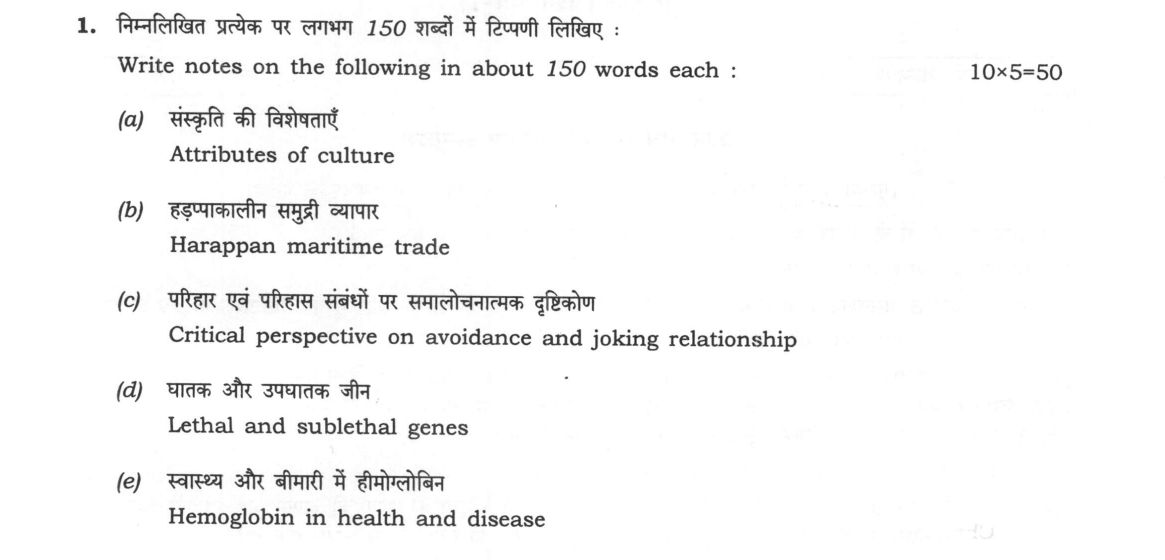
Write notes on the following in about 150 words each: 10×5=50 (a) Attributes of culture (b) Harappan maritime trade (c)…
Write notes on the following in about 150 words each: 10×5=50
Attributes of culture
Harappan maritime trade
Critical perspective on avoidance and joking relationship
Lethal and sublethal genes
Hemoglobin in health and disease
हिंदी में प्रश्न पढ़ें
निम्नलिखित प्रत्येक पर लगभग 150 शब्दों में टिप्पणी लिखिए : 10×5=50
संस्कृति की विशेषताएँ
हड़प्पाकालीन समुद्री व्यापार
परिहार एवं परिहास संबंधों पर समालोचनात्मक दृष्टिकोण
घातक और उपघातक जीन
स्वास्थ्य और बीमारी में हीमोग्लोबिन
Model answer
Written by UPSC Answer Check against this question's marking rubric, to the 150-word length. UPSC does not publish answers for Mains — this is one way to score well, not an official key.
Attributes of Culture Culture, defined by Tylor as "that complex whole which includes knowledge, belief, art, morals, law, custom," is the defining characteristic of humanity. Its core attributes include being learned, shared, and symbolic. It is not innate but acquired through socialization, distinguishing humans from other species. Culture is shared, creating a sense of group identity and solidarity, though it is not uniform. It is symbolic, relying on language and signs to convey meaning, such as the sacred cow in India representing non-violence and purity. Culture is integrated, where changes in one aspect (e.g., technology) ripple through others (e.g., family structure). It is adaptive, allowing groups to survive in specific environments, and dynamic, constantly evolving through diffusion and innovation. For instance, the caste system in India is a cultural institution that integrates social, economic, and religious roles, demonstrating how culture structures social life. Understanding these attributes helps anthropologists analyze how societies maintain order while adapting to change, highlighting culture as a flexible yet powerful force in human behavior.
Harappan Maritime Trade The Harappan civilization engaged in extensive maritime trade, evidenced by ports like Lothal, Balakot, and Sutkagendor. Lothal featured a sophisticated dockyard, facilitating the loading of goods. Dholavira, an inland fortified city in the Rann of Kutch, served as a crucial hub for overland and riverine trade, connecting to these coastal points. Key exports included carnelian beads, cotton textiles, timber, and ivory. Imports comprised gold, lapis lazuli, and tin. External contacts were primarily with Mesopotamia (Sumer), Oman (Magan), and Bahrain (Dilmun). Archaeological evidence includes Indus seals found in Mesopotamian cities like Ur and Susa, and Mesopotamian tablets mentioning "Meluhha" (Indus Valley). The trade was not merely commercial but also cultural, influencing artistic styles and religious practices. This network demonstrates the Harappans' advanced understanding of navigation, shipbuilding, and international diplomacy. The decline of this trade, possibly due to climate change or shifting river courses, contributed to the civilization's de-urbanization. Studying this trade reveals the interconnectedness of ancient civilizations and the economic sophistication of the Indus Valley.
Critical Perspective on Avoidance and Joking Relationships Radcliffe-Brown conceptualized avoidance and joking relationships as structural-functional mechanisms to manage social tension. Avoidance involves ritualized distance between certain kin (e.g., mother-in-law and son-in-law), while joking involves playful, often irreverent interaction between others (e.g., cross-cousins). Critically, these are not neutral but reflect power asymmetries. Avoidance can enforce patriarchal control, restricting women’s mobility and speech, as seen in South Indian joint families where son-in-law avoidance reinforces maternal authority. Joking relationships, while appearing egalitarian, can mask ritualized aggression and reinforce hierarchy. Among the Gonds and Bhils of Central India, clan-based joking allows for the release of tension but also solidifies endogamous boundaries. Modern anthropologists argue these practices are not static but negotiated, adapting to changing social dynamics. They serve to regulate intimacy and aggression, preventing conflict while maintaining social bonds. However, they can also perpetuate gender inequalities and ethnic exclusions. Understanding these relationships requires analyzing the specific social context, power structures, and historical changes. They are not merely "customs" but active strategies for social reproduction and conflict management, highlighting the complex interplay between structure and agency in kinship systems.
Lethal and Sublethal Genes Lethal genes are alleles that cause death when homozygous, such as the sickle cell gene (HbS) in homozygous form (HbSS), leading to sickle cell anemia. Sublethal genes reduce fitness but do not cause immediate death; for example, the heterozygous state (HbAS) of the sickle cell gene provides resistance to malaria, a phenomenon known as balanced polymorphism. This heterozygote advantage maintains the gene in populations despite its lethality in homozygotes. In India, sickle cell disease is prevalent in tribal populations of Central India, such as the Gond and Bhil, due to historical malaria exposure. Other examples include Tay-Sachs disease, a lethal genetic disorder more common in Ashkenazi Jews. Sublethal genes can also refer to conditions like thalassemia minor, where carriers have mild anemia but survive. These genetic variations illustrate the interaction between genotype and environment. Public health implications include the need for genetic counseling and screening in high-prevalence areas. Understanding lethal and sublethal genes is crucial for evolutionary biology and medical genetics, explaining how natural selection shapes human genetic diversity. It highlights the trade-offs in evolution, where a trait harmful in one context (homozygous) is beneficial in another (heterozygous), driving the persistence of genetic variation in human populations.
Hemoglobin in Health and Disease Hemoglobin (Hb) is the oxygen-carrying protein in red blood cells, with normal adult forms being HbA, HbA2, and HbF. Pathologies arise from mutations in globin genes. Sickle cell disease (HbS) results from a point mutation (β⁶ Glu→Val), causing Hb to polymerize under low oxygen, leading to vaso-occlusion. Thalassemia involves reduced synthesis of α or β chains; β-thalassemia is prevalent in coastal India and tribal populations. HbE, common in Northeast India, is a variant that can cause mild anemia or, when combined with β-thalassemia, severe disease. Diagnosis relies on hemoglobin electrophoresis and HPLC. Public health significance is high due to the high carrier frequency in India, necessitating screening programs in marriage registries and antenatal care. The National Programme for Prevention and Control of Non-Communicable Diseases includes genetic disorder screening. Understanding hemoglobin variants is crucial for managing anemia, which remains a major public health issue in India. Genetic counseling is essential for couples where both partners are carriers, to prevent severe disease in offspring. This knowledge aids in developing targeted interventions and improving maternal and child health outcomes, reducing the burden of hereditary blood disorders in vulnerable populations.
What "Write short notes" is asking you to do
Five or six self-contained answers, marked separately, typically 10 marks and about 150 words each. Each note must carry its own definition, its two or three defining features and a line on why it matters; a common introduction or conclusion across the notes earns nothing.
Structure that answers it
Per note: one-line definition or identification → two or three features, mechanisms or named examples → one line of significance or Indian application
Where marks are lost
Writing the first two notes at essay length and rationing the rest. Each note is marked on its own, so marks surrendered on a compressed or unattempted note cannot be won back by the long ones.
How this answer will be evaluated
Approach
Framework: UPSC Anthropology Paper 1 (Sociology & Social Anthropology / Physical Anthropology). (a) write short notes: define > 3-4 key features > one example > one-line significance | (b) write short notes: define > 3-4 key features > one example > one-line significance | (c) critique: the claim > its strengths > its weaknesses > your judgment | (d) write short notes: define > 3-4 key features > one example > one-line significance | (e) write short notes: define > 3-4 key features > one example > one-line significance Full marks: Precise definitions, named examples, critical analysis where asked, clear structure.
Key points expected
- Define culture (e.g., Malinowski or Kroeber)
- Mention culture is learned and shared
- Mention culture is symbolic and integrated
- Mention culture is dynamic and adaptive
- Mention Lothal as a port site
- Identify trade partners (Mesopotamia, Oman)
- List trade goods (carnelian, cotton, ivory)
- Mention evidence (cylinder seals, dockyard)
Evaluation rubric
Each sub-part is marked on its own, against the marks and word limit printed on the paper.
- (a) Define culture and list its key attributes with examples. · 150 words
write short notes— define → 3-4 key features → one example → one-line significance
Must cover
- Define culture (e.g., Malinowski or Kroeber)
- Mention culture is learned and shared
- Mention culture is symbolic and integrated
- Mention culture is dynamic and adaptive
Loses marks
- Confusing culture with personality
- Listing attributes without definition
- Ignoring the 'learned' aspect
Earns more
- Reference to Benedict or Boas
- Distinction between culture and civilization
- Mention of enculturation
Extra mark
- Reference to specific Indian tribal example
- (b) Describe the scope and evidence of Harappan maritime trade. · 150 words
write short notes— define → 3-4 key features → one example → one-line significance
Must cover
- Mention Lothal as a port site
- Identify trade partners (Mesopotamia, Oman)
- List trade goods (carnelian, cotton, ivory)
- Mention evidence (cylinder seals, dockyard)
Loses marks
- Confusing with Indus Valley river trade
- Ignoring the maritime aspect
- No specific site names
Earns more
- Reference to Dilmun or Magan
- Mention of bead-making workshops
- Reference to specific excavator (e.g., Rakhaldas Bandyopadhyay)
Extra mark
- Map sketch of trade routes
- (c) Critically evaluate the concepts of avoidance and joking relationships. · 150 words
critique— the claim → its strengths → its weaknesses → your judgment
Must cover
- Define avoidance (e.g., in-laws)
- Define joking (e.g., cross-cousins)
- Mention Radcliffe-Brown's functionalist view
- Provide a critical perspective (e.g., gender bias)
Loses marks
- Describing without critiquing
- Confusing avoidance with taboos
- Ignoring the kinship context
Earns more
- Reference to specific tribe (e.g., Nayar or Khasi)
- Mention of 'ritual avoidance'
- Critique of the 'universal' claim
Extra mark
- Reference to modern feminist critique
- (d) Explain the concepts of lethal and sublethal genes with examples. · 150 words
write short notes— define → 3-4 key features → one example → one-line significance
Must cover
- Define lethal genes (homozygous fatal)
- Define sublethal genes (reduced fitness)
- Give example of lethal (e.g., Cystic Fibrosis)
- Give example of sublethal (e.g., Sickle Cell)
Loses marks
- Confusing lethal with dominant
- No specific disease examples
- Ignoring the evolutionary context
Earns more
- Mention of heterozygote advantage
- Reference to Hardy-Weinberg equilibrium
- Mention of genetic drift
Extra mark
- Diagram of gene frequency change
- (e) Discuss the role of hemoglobin in health and disease. · 150 words
write short notes— define → 3-4 key features → one example → one-line significance
Must cover
- Define hemoglobin function (oxygen transport)
- Mention normal Hb types (HbA, HbF)
- Discuss HbS (Sickle Cell) disease
- Discuss HbC or Thalassemia
Loses marks
- Confusing hemoglobin with hemocyanin
- No mention of specific diseases
- Ignoring the genetic basis
Earns more
- Mention of electrophoresis
- Reference to high-altitude adaptation
- Mention of HbE (common in India)
Extra mark
- Diagram of Hb structure
Practice this exact question
Write your answer and it is marked point by point against the model answer above — what you covered, what you missed, what you got wrong.
Evaluate my answer →More from Anthropology 2024 Paper I
- Q1 Write notes on the following in about 150 words each: 10×5=50 (a) Attributes of culture (…
- Q2 (a) Discuss historical particularism as a critical development to the classical evolution…
- Q3 (a) What is meant by karyotype? How does its analysis help in diagnosis of the chromosoma…
- Q4 (a) Critically discuss the characteristics of the psychological types in the cultures of…