Paper I — Q2
(a) Discuss historical particularism as a critical development to the classical evolutionism. 20 marks (b) Describe the…
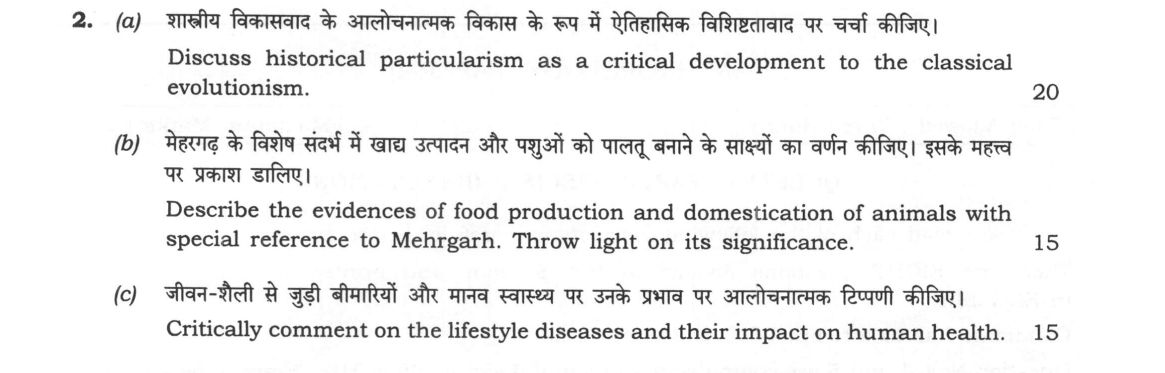
Discuss historical particularism as a critical development to the classical evolutionism. 20 marks
Describe the evidences of food production and domestication of animals with special reference to Mehrgarh. Throw light on its significance. 15 marks
Critically comment on the lifestyle diseases and their impact on human health. 15 marks
हिंदी में प्रश्न पढ़ें
शास्त्रीय विकासवाद के आलोचनात्मक विकास के रूप में ऐतिहासिक विशिष्टतावाद पर चर्चा कीजिए। 20 अंक
मेहरगढ़ के विशेष संदर्भ में खाद्य उत्पादन और पशुओं को पालतू बनाने के साक्ष्यों का वर्णन कीजिए। इसके महत्व पर प्रकाश डालिए। 15 अंक
जीवन-शैली से जुड़ी बीमारियों और मानव स्वास्थ्य पर उनके प्रभाव पर आलोचनात्मक टिप्पणी कीजिए। 15 अंक
Model answer
Written by UPSC Answer Check against this question's marking rubric, to the expected length. UPSC does not publish answers for Mains — this is one way to score well, not an official key.
Historical Particularism, Mehrgarh, and Lifestyle Diseases
The transition from classical evolutionism to historical particularism marked a paradigm shift in anthropology, moving from universal laws to specific historical contexts. This shift provides the methodological lens necessary to understand unique developmental trajectories, such as the early food production at Mehrgarh, and the culturally embedded nature of contemporary lifestyle diseases.
Historical Particularism as a Critique of Evolutionism Classical unilinear evolutionism, championed by Lewis Henry Morgan and Edward Tylor, posited that all societies progress through fixed stages: savagery, barbarism, and civilization. This model relied on the comparative method and the assumption of psychic unity, suggesting that human minds operate identically across cultures, leading to parallel inventions. Franz Boas emerged as the primary critic of this deterministic framework. He argued that cultures are not merely stages on a single ladder but unique entities shaped by specific historical accidents and environmental constraints.
Boas rejected the teleological notion of progress, advocating instead for cultural relativism—the idea that each culture must be understood on its own terms. His approach emphasized diffusion, the spread of traits through contact, rather than independent invention. This was a methodological revolution: where evolutionists used armchair speculation based on secondary sources, Boas insisted on inductive fieldwork and rigorous data collection. Alfred Kroeber further developed this by introducing the concept of the "superorganic," arguing that culture is a reality greater than the sum of its individual parts and cannot be reduced to biological or psychological laws. By prioritizing historical reconstruction over evolutionary laws, particularism dismantled the racist underpinnings of classical evolutionism, establishing that no society is inherently "primitive" or "advanced" but is simply different.
Evidences of Food Production at Mehrgarh Applying this particularist view, we can examine Mehrgarh in the Kachi Plain of Balochistan, a site dating back to 7000 BCE. It serves as a critical window into the Neolithic transition in the Indian subcontinent. Archaeobotanical evidence reveals the cultivation of wheat (emmer and einkorn) and barley (specifically naked six-row and hulled six-row varieties). These crops were likely introduced from West Asia, indicating early long-distance cultural contact rather than isolated invention.
Animal domestication is equally significant. Bones of sheep, goat, and cattle have been found in abundance. While sheep and goats were likely domesticated in the West, the presence of zebu cattle suggests local adaptation and possibly early domestication in the region. The site features mud-brick structures, granaries for storage, and evidence of craft specialization, including bead-making and pottery. The discovery of lapis lazuli from Badakhshan and turquoise from the Hindu Kush confirms extensive trade networks.
The significance of Mehrgarh lies in its role as a precursor to the Indus Valley Civilization. It demonstrates the indigenous development of agricultural practices in South Asia, showing how external influences (West Asian crops) were integrated into local contexts. It challenges diffusionist models that view South Asia as merely a passive recipient of Western innovations, highlighting instead a complex process of adaptation and local innovation.
Lifestyle Diseases: A Critical Anthropological View In contemporary India, the rise of non-communicable diseases (NCDs) such as diabetes, cardiovascular disease, and obesity represents a "lifestyle" crisis. These are linked to sedentism, high-calorie diets, and chronic stress. From an anthropological perspective, this is not merely a biomedical issue but a structural one.
Marshall Sahlins’s concept of the "original affluent society" provides a crucial contrast. He argued that hunter-gatherers, despite having limited material goods, had abundant leisure and satisfied their needs with less labor than modern workers. Their high physical activity levels and diverse diets naturally mitigated metabolic disorders. In contrast, the modern epidemiological transition has shifted the burden from infectious to chronic diseases. This shift is driven by the commodification of health and structural violence, where economic pressures force sedentary lifestyles and processed food consumption. The "disease" is thus a product of specific socio-economic conditions, not just individual choice.
Conclusion Historical particularism reminds us that both Mehrgarh’s agricultural revolution and modern India’s health crisis are products of specific historical and cultural contexts. Understanding Mehrgarh requires recognizing its unique blend of imported crops and local domestication, while addressing lifestyle diseases requires analyzing the structural forces that shape contemporary Indian lifestyles. A particularist approach allows us to move beyond universal generalizations, offering nuanced solutions rooted in local realities.
What "Discuss" is asking you to do
Lay the issue out from more than one side — how it arose, what is claimed for it, what is held against it, and where it now stands. UPSC attaches discuss to broad topics with several live dimensions, so coverage of the dimensions earns more than the strength of your opinion.
Structure that answers it
Set the issue up → the case as it is made → the case against → the dimension both sides leave out → where the balance now lies
Where marks are lost
Listing facts with no thread between them, or arguing one side throughout and calling it a discussion.
How this answer will be evaluated
Approach
Framework: UPSC Anthropology Paper 1 (Sociology & Social Anthropology). (a) discuss: intro > 3-4 dimensions > example > balanced close | (b) describe: define > structure or process in order > labelled diagram > significance | (c) comment: context > arguments both sides > judgment > close Full marks: Precise definitions, named scholars/sites, and clear logical flow.
Key points expected
- Define classical unilineal evolutionism (Tylor/Morgan)
- Explain Boas's critique of 'cultural stages'
- Define historical particularism and 'cultural relativism'
- Contrast 'diffusion' vs 'evolution' mechanisms
- Identify Mehrgarh's location (Balochistan, Indus Valley)
- List specific crops (wheat, barley, cotton)
- List domesticated animals (goat, sheep, cattle)
- Explain the transition from foraging to farming
Evaluation rubric
Each sub-part is marked on its own, against the marks and word limit printed on the paper.
- (a) Analyze the shift from unilineal evolution to historical particularism. 20 marks
discuss— intro → 3-4 dimensions → example → balanced close
Must cover
- Define classical unilineal evolutionism (Tylor/Morgan)
- Explain Boas's critique of 'cultural stages'
- Define historical particularism and 'cultural relativism'
- Contrast 'diffusion' vs 'evolution' mechanisms
Loses marks
- Confusing particularism with functionalism
- Ignoring the 'critique' aspect of the prompt
Earns more
- Mention 'cultural area' concept
- Reference Franz Boas's fieldwork (e.g., Kwakiutl)
- Mention 'cultural drift' or 'acculturation'
Extra mark
- Reference to 'cultural ecology' as a later development
- (b) Detail archaeological evidence of agriculture and animal husbandry at Mehrgarh. 15 marks
describe— define → structure or process in order → labelled diagram → significance
Must cover
- Identify Mehrgarh's location (Balochistan, Indus Valley)
- List specific crops (wheat, barley, cotton)
- List domesticated animals (goat, sheep, cattle)
- Explain the transition from foraging to farming
Loses marks
- Confusing Mehrgarh with Harappan urban sites
- Failing to mention specific species
Earns more
- Mention 'Neolithic' period dating
- Reference to 'pottery' or 'mud-brick' houses
- Mention 'grinding stones' or 'sickles' as tools
Extra mark
- Reference to 'Mehrgarh I' vs 'Mehrgarh II' phases
- (c) Critically analyze the rise of lifestyle diseases and their health impact. 15 marks
comment— context → arguments both sides → judgment → close
Must cover
- Define 'lifestyle diseases' (NCDs)
- Identify key causes (diet, sedentary behavior, stress)
- List specific diseases (diabetes, hypertension, CVD)
- Discuss impact on human health (morbidity/mortality)
Loses marks
- Focusing only on infectious diseases
- Ignoring the 'critical' aspect (causes/solutions)
Earns more
- Mention 'epidemiological transition'
- Reference to 'urbanization' as a driver
- Mention 'genetic predisposition' vs 'environment'
Extra mark
- Reference to 'National Health Policy' or 'NCD control'
Practice this exact question
Write your answer and it is marked point by point against the model answer above — what you covered, what you missed, what you got wrong.
Evaluate my answer →More from Anthropology 2024 Paper I
- Q1 Write notes on the following in about 150 words each: 10×5=50 (a) Attributes of culture (…
- Q2 (a) Discuss historical particularism as a critical development to the classical evolution…
- Q3 (a) What is meant by karyotype? How does its analysis help in diagnosis of the chromosoma…
- Q4 (a) Critically discuss the characteristics of the psychological types in the cultures of…
- Q5 Write notes on the following in about 150 words each: 10×5=50 (a) Chronometric dating (b)…