Paper I — Q3
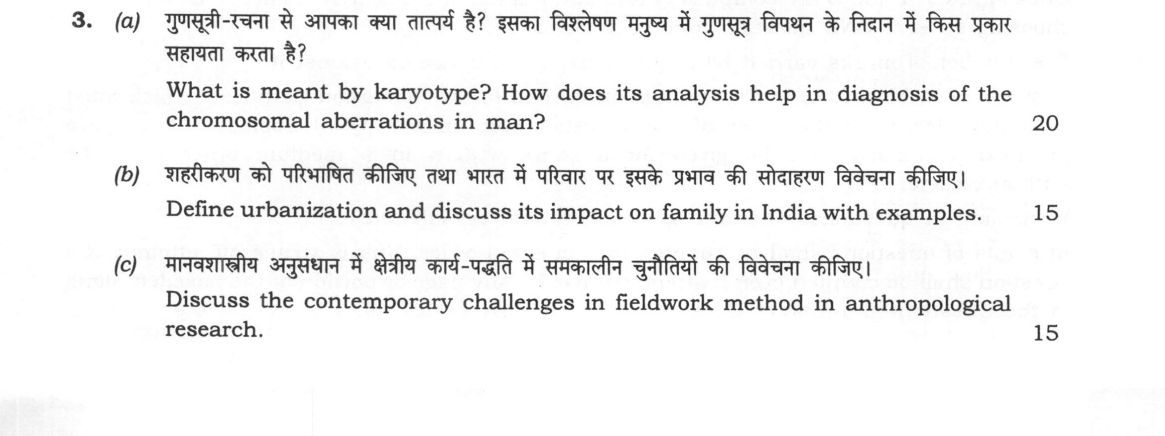
(a) What is meant by karyotype? How does its analysis help in diagnosis of the chromosomal aberrations in man? 20 marks (b)…
What is meant by karyotype? How does its analysis help in diagnosis of the chromosomal aberrations in man? 20 marks
Define urbanization and discuss its impact on family in India with examples. 15 marks
Discuss the contemporary challenges in fieldwork method in anthropological research. 15 marks
हिंदी में प्रश्न पढ़ें
गुणसूत्री-रचना से आपका क्या तात्पर्य है? इसका विश्लेषण मनुष्य में गुणसूत्र विपथन के निदान में किस प्रकार सहायता करता है? 20 अंक
शहरीकरण को परिभाषित कीजिए तथा भारत में परिवार पर इसके प्रभाव की संदर्भ विवेचना कीजिए। 15 अंक
मानवशास्त्रीय अनुसंधान में क्षेत्रीय कार्य-पद्धति में समकालीन चुनौतियों की विवेचना कीजिए। 15 अंक
Model answer
Written by UPSC Answer Check against this question's marking rubric, to the expected length. UPSC does not publish answers for Mains — this is one way to score well, not an official key.
Karyotype Analysis and Chromosomal Aberrations
A karyotype is the complete set of chromosomes in a cell, characterized by their number, size, centromere position, and banding patterns. It is not a phenotypic profile but a cytogenetic map. Standard human karyotypes consist of 46 chromosomes arranged in 23 homologous pairs. Analysis relies on staining techniques to visualize structural details. G-banding (Giemsa staining) produces specific light and dark transverse bands that serve as landmarks for identifying chromosomes. In contrast, Q-banding utilizes quinacrine fluorescence to produce bright and dull fluorescent bands, which are distinct from the optical bands seen in G-banding. These techniques allow for the precise diagnosis of chromosomal aberrations. Numerical abnormalities, or aneuploidy, are readily detected: Trisomy 21 (Down syndrome), Monosomy X (Turner syndrome), and XXY (Klinefelter syndrome) are identified by counting chromosomes. Structural aberrations, such as deletions, duplications, inversions, and translocations, are diagnosed by analyzing banding patterns. For instance, the Philadelphia chromosome, a reciprocal translocation between chromosomes 9 and 22, is a hallmark of Chronic Myeloid Leukemia (CML). Prenatal diagnosis via amniocentesis or Chorionic Villus Sampling (CVS) allows for early detection of these conditions, enabling informed reproductive decisions.
Urbanization and the Indian Family
Urbanization is the demographic shift from rural to urban areas, accompanied by economic transformation and spatial reorganization. It differs from mere urban growth, which is just an increase in population, by involving a change in the mode of life and social structure. In India, this process has profoundly impacted the family system. The traditional joint family, characterized by multiple generations and a patriarchal structure, has faced erosion due to the spatial mobility required for urban employment. Studies by M.S. Gore and others highlight the rise of the nuclear family in cities like Mumbai and Delhi, where housing constraints and industrial work schedules favor smaller household units. Census data reflects this shift; while average household size increased from 1961 to 1991 due to rural migration patterns, it has declined thereafter as urbanization deepened and nuclear units became dominant. Marriage patterns have also changed, with a rise in inter-caste and love marriages driven by individualistic urban values. Furthermore, women’s entry into the workforce has altered gender dynamics, though this often leads to a "double burden" of domestic and professional responsibilities. A critical consequence is the elderly care crisis; with the breakdown of the joint family, aged parents in urban centers like Delhi’s resettlement colonies often face isolation, lacking the traditional support network.
Challenges in Contemporary Anthropological Fieldwork
Contemporary fieldwork faces multifaceted challenges that demand methodological and ethical adaptation. Ethical considerations are paramount, governed by frameworks like the ICMR guidelines and the Nuremberg Code principles, which emphasize informed consent and the protection of vulnerable communities. Researchers must navigate the "insider-outsider" dilemma, balancing empathy with critical distance. The rise of digital ethnography and virtual fieldwork, accelerated by the post-COVID era, presents new complexities regarding data privacy and the authenticity of online interactions. Additionally, the critique of "studying up" has shifted focus from marginalized communities to power structures, requiring access to bureaucratic and corporate spaces that are often resistant to anthropological scrutiny. Decolonization critiques further challenge the discipline to move away from extractive research models toward collaborative, community-driven practices. Funding constraints and political access restrictions in certain regions also limit the scope of longitudinal studies.
Conclusion
Anthropology remains vital for understanding human variation and social change. The integration of precise cytogenetic tools like karyotyping with a nuanced analysis of urban social transformations and ethical fieldwork practices ensures the discipline’s relevance. By addressing these technical and methodological challenges, anthropology can provide robust insights into both biological and social dimensions of human experience.
What "Discuss" is asking you to do
Lay the issue out from more than one side — how it arose, what is claimed for it, what is held against it, and where it now stands. UPSC attaches discuss to broad topics with several live dimensions, so coverage of the dimensions earns more than the strength of your opinion.
Structure that answers it
Set the issue up → the case as it is made → the case against → the dimension both sides leave out → where the balance now lies
Where marks are lost
Listing facts with no thread between them, or arguing one side throughout and calling it a discussion.
How this answer will be evaluated
Approach
Framework: UPSC Anthropology Paper 1 (Physical Anthropology & Social Anthropology). (a) explain: definition/context > points in order > small example > short close | (b) discuss: intro > 3-4 dimensions > example > balanced close | (c) challenges: 3-4 challenges > solutions mapped to them > conclusion Full marks: Precise definitions, specific examples, clear structure, and strong analytical depth.
Key points expected
- Definition of karyotype (chromosome number, size, centromere position)
- Mechanism of karyotyping (metaphase arrest, banding techniques)
- Identification of numerical aberrations (e.g., Down syndrome, Turner syndrome)
- Identification of structural aberrations (e.g., translocation, deletion)
- Definition of urbanization (rural-urban migration, lifestyle change)
- Shift from joint to nuclear family structure
- Changes in marriage patterns (arranged to love, inter-caste)
- Impact on gender roles and women's workforce participation
Evaluation rubric
Each sub-part is marked on its own, against the marks and word limit printed on the paper.
- (a) Define karyotype and explain its diagnostic utility for chromosomal aberrations. 20 marks
explain— definition/context → points in order → small example → short close
Must cover
- Definition of karyotype (chromosome number, size, centromere position)
- Mechanism of karyotyping (metaphase arrest, banding techniques)
- Identification of numerical aberrations (e.g., Down syndrome, Turner syndrome)
- Identification of structural aberrations (e.g., translocation, deletion)
Loses marks
- Confusing karyotype with genotype
- Failing to link analysis to specific clinical diagnosis
Earns more
- Mention of G-banding or Q-banding techniques
- Reference to prenatal diagnosis (amniocentesis)
- Distinction between aneuploidy and polyploidy
Extra mark
- Labelled diagram of a normal human karyotype
- Specific mention of Philadelphia chromosome
- (b) Define urbanization and analyze its specific impact on the Indian family system. 15 marks
discuss— intro → 3-4 dimensions → example → balanced close
Must cover
- Definition of urbanization (rural-urban migration, lifestyle change)
- Shift from joint to nuclear family structure
- Changes in marriage patterns (arranged to love, inter-caste)
- Impact on gender roles and women's workforce participation
Loses marks
- Generic sociology answer without anthropological lens
- Ignoring the Indian context or using only Western examples
Earns more
- Reference to 'urbanization of the poor' or slums
- Mention of changing kinship networks (weakening of extended kin)
- Specific Indian examples (e.g., Mumbai, Delhi, Bangalore)
Extra mark
- Reference to specific sociological studies (e.g., M.N. Srinivas)
- Mention of 'urbanization without industrialization'
- (c) Identify and discuss contemporary challenges in anthropological fieldwork. 15 marks
challenges— 3-4 challenges → solutions mapped to them → conclusion
Must cover
- Ethical challenges (informed consent, IRB approval, do no harm)
- Access and security issues (conflict zones, restricted areas)
- Digital fieldwork challenges (cyber-ethics, data privacy)
- Positionality and reflexivity (researcher's bias, power dynamics)
Loses marks
- Listing only logistical challenges (weather, language)
- Ignoring the ethical dimension of fieldwork
Earns more
- Mention of 'armchair anthropology' vs. fieldwork
- Reference to specific ethical codes (e.g., AAA ethics)
- Discussion of 'parachute anthropology'
Extra mark
- Reference to specific recent fieldwork controversies
- Mention of 'digital ethnography' tools
Practice this exact question
Write your answer and it is marked point by point against the model answer above — what you covered, what you missed, what you got wrong.
Evaluate my answer →More from Anthropology 2024 Paper I
- Q1 Write notes on the following in about 150 words each: 10×5=50 (a) Attributes of culture (…
- Q2 (a) Discuss historical particularism as a critical development to the classical evolution…
- Q3 (a) What is meant by karyotype? How does its analysis help in diagnosis of the chromosoma…
- Q4 (a) Critically discuss the characteristics of the psychological types in the cultures of…
- Q5 Write notes on the following in about 150 words each: 10×5=50 (a) Chronometric dating (b)…
- Q6 (a) Discuss the geographical distribution of Homo erectus. Taking into account its physic…