Paper I — Q6
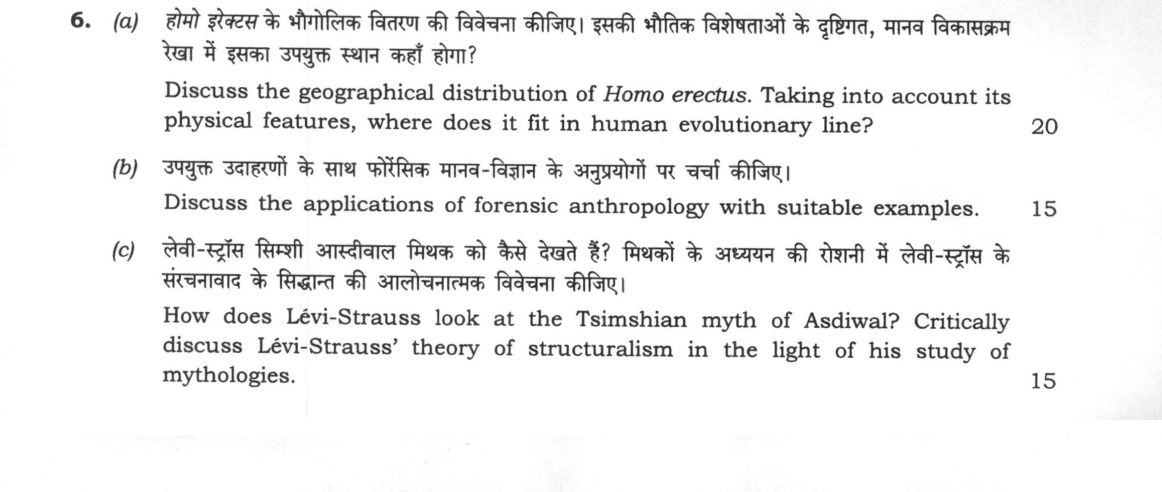
(a) Discuss the geographical distribution of Homo erectus. Taking into account its physical features, where does it fit in human…
Discuss the geographical distribution of Homo erectus. Taking into account its physical features, where does it fit in human evolutionary line? 20 marks
Discuss the applications of forensic anthropology with suitable examples. 15 marks
How does Lévi-Strauss look at the Tsimshian myth of Asdiwal? Critically discuss Lévi-Strauss' theory of structuralism in the light of his study of mythologies. 15 marks
हिंदी में प्रश्न पढ़ें
होमो इरेक्टस के भौगोलिक वितरण की विवेचना कीजिए। इसकी भौतिक विशेषताओं के दृष्टिगत, मानव विकासक्रम रेखा में इसका उपयुक्त स्थान कहाँ होगा? 20 अंक
उपयुक्त उदाहरणों के साथ फोरेंसिक मानव-विज्ञान के अनुप्रयोगों पर चर्चा कीजिए। 15 अंक
लेवी-स्ट्रॉस सिमशी आस्दीवाल मिथक को कैसे देखते हैं? मिथकों के अध्ययन की रोशनी में लेवी-स्ट्रॉस के संरचनावाद के सिद्धांत की आलोचनात्मक विवेचना कीजिए। 15 अंक
Model answer
Written by UPSC Answer Check against this question's marking rubric, to the expected length. UPSC does not publish answers for Mains — this is one way to score well, not an official key.
Homo erectus: Distribution, Evolution, and Anthropological Applications
Anthropology spans the biological, applied, and theoretical, as evidenced by the study of early hominins, forensic applications, and structuralist theory.
Geographical Distribution and Evolutionary Placement Homo erectus exhibits the widest geographical distribution of any hominin, spanning Africa, Asia, and potentially Europe. In Africa, key localities include Koobi Fora (Kenya) and Olduvai Gorge (Tanzania), where specimens like the Nariokotome Boy (WT 15000) reveal a modern human-like body plan with long legs and short arms, indicating efficient bipedalism. In Asia, the species is well-represented in Java (Indonesia), Zhoukoudian (China), and Dmanisi (Georgia), marking the first definitive evidence of hominins leaving Africa. While European presence is debated, sites like Atapuerca in Spain are primarily associated with Homo antecessor or Homo heidelbergensis, suggesting H. erectus may have been replaced by later archaic forms in Europe.
Physically, H. erectus is characterized by a cranial capacity ranging from 750 to 1250 cc, a prominent sagittal keel, and reduced prognathism. Sexual dimorphism is less pronounced than in earlier hominins. In the evolutionary line, H. erectus occupies an intermediate position between Homo habilis and Homo sapiens. A significant taxonomic debate exists regarding whether African specimens should be classified as Homo ergaster and Asian ones as H. erectus, or if they represent a single, globally dispersed species. The Nariokotome Boy is pivotal here, as its limb proportions suggest that the modern human body plan was established early in the genus Homo, facilitating long-distance migration.
Applications of Forensic Anthropology Forensic anthropology applies osteological knowledge to legal contexts, primarily through skeletal identification. Key applications include determining age, sex, ancestry, and stature from remains, which is crucial for identifying unknown victims. Trauma analysis distinguishes between ante-mortem, peri-mortem, and post-mortem injuries, helping to establish the cause and manner of death. Facial reconstruction aids in identification when skeletal markers are insufficient. In disaster victim identification (DVI), forensic anthropologists assist in mass casualty events.
In India, forensic anthropology has been instrumental in cases involving skeletal remains. For instance, during the 2004 Indian Ocean tsunami, forensic teams were deployed to identify victims through dental records and skeletal analysis. In criminal investigations, such as those involving the 2008 Delhi serial blasts, forensic experts analyzed bone fragments to identify victims and determine the nature of injuries, distinguishing between blast trauma and other causes. These applications highlight the discipline’s role in providing objective scientific evidence in the justice system.
Lévi-Strauss and Structuralism Lévi-Strauss analyzes the Tsimshian myth of Asdiwal to demonstrate that myths are not random narratives but structured systems of thought. He identifies binary oppositions within the myth, such as mountain/sea, upstream/downstream, and hunting/fishing. The myth’s narrative structure resolves these oppositions dialectically, reflecting the universal cognitive structures of the human mind. Asdiwal’s journey from the sea to the mountain and his transformation illustrate the reconciliation of conflicting elements, mirroring the social structures of the Tsimshian people.
Critically, Lévi-Strauss’s structuralism offers a powerful tool for uncovering deep, universal patterns in cultural phenomena. However, it has faced significant criticism. Critics argue that it neglects historical context, individual agency, and the functional or symbolic dimensions of culture. For example, Malinowski’s functionalism emphasizes the role of myths in maintaining social cohesion, a perspective structuralism overlooks. Additionally, Edmund Leach critiqued structuralism for its static nature, arguing that it fails to account for cultural change and historical processes. Despite these limitations, structuralism remains influential in anthropology for its ability to reveal the underlying logic of cultural systems.
Conclusion In summary, Homo erectus represents a crucial link in human evolution, characterized by its global spread and modern-like body plan. Forensic anthropology applies biological knowledge to legal and disaster contexts, while Lévi-Strauss’s structuralism offers a theoretical framework for understanding cultural universals. Together, these areas demonstrate anthropology’s interdisciplinary scope, bridging biological, applied, and theoretical domains.
What "Discuss" is asking you to do
Lay the issue out from more than one side — how it arose, what is claimed for it, what is held against it, and where it now stands. UPSC attaches discuss to broad topics with several live dimensions, so coverage of the dimensions earns more than the strength of your opinion.
Structure that answers it
Set the issue up → the case as it is made → the case against → the dimension both sides leave out → where the balance now lies
Where marks are lost
Listing facts with no thread between them, or arguing one side throughout and calling it a discussion.
How this answer will be evaluated
Approach
Framework: UPSC Anthropology Paper 1 (Physical & Social). (a) discuss: intro > 3-4 dimensions > example > balanced close | (b) discuss: intro > 3-4 dimensions > example > balanced close | (c) critique: the claim > its strengths > its weaknesses > your judgment Full marks: Comprehensive, well-structured, with specific examples and critical analysis.
Key points expected
- Map Old World sites (Africa, Asia, Europe)
- Detail key physical features (brow ridges, cranial capacity)
- Position in evolutionary line (H. habilis to H. sapiens)
- Mention Out of Africa or Multiregional context
- Define forensic anthropology
- Explain identification of skeletal remains
- Discuss age, sex, and stature estimation
- Provide a suitable example (e.g., mass disaster)
Evaluation rubric
Each sub-part is marked on its own, against the marks and word limit printed on the paper.
- (a) Map H. erectus distribution and place it in the evolutionary sequence based on morphology. 20 marks
discuss— intro → 3-4 dimensions → example → balanced close
Must cover
- Map Old World sites (Africa, Asia, Europe)
- Detail key physical features (brow ridges, cranial capacity)
- Position in evolutionary line (H. habilis to H. sapiens)
- Mention Out of Africa or Multiregional context
Loses marks
- Confusing H. erectus with H. sapiens
- Ignoring the geographical spread
- No mention of evolutionary position
Earns more
- Name specific sites (Dmanisi, Zhoukoudian, Trinil)
- Mention tool culture (Acheulean hand axes)
- Reference to fire usage
- Comparison with H. heidelbergensis
Extra mark
- Labelled map of H. erectus sites
- Skull profile sketch showing features
- (b) Explain forensic anthropology applications with specific case examples. 15 marks
discuss— intro → 3-4 dimensions → example → balanced close
Must cover
- Define forensic anthropology
- Explain identification of skeletal remains
- Discuss age, sex, and stature estimation
- Provide a suitable example (e.g., mass disaster)
Loses marks
- General sociology answer without biological focus
- No specific examples provided
- Confusing with general medical forensics
Earns more
- Mention DNA analysis from bones
- Reference to specific Indian cases (e.g., 26/11)
- Discussion of trauma analysis
- Mention of taphonomy
Extra mark
- Reference to specific forensic lab (e.g., FSL)
- Mention of specific software used
- (c) Analyze Lévi-Strauss's view of the Asdiwal myth and critique his structuralism. 15 marks
critique— the claim → its strengths → its weaknesses → your judgment
Must cover
- Explain Lévi-Strauss's view of Asdiwal myth
- Define structuralism in anthropology
- Critique the theory (positives/negatives)
- Link to study of mythologies
Loses marks
- Describing the myth without analysis
- No critique of the theory
- Confusing with other structuralists
Earns more
- Mention binary oppositions (raw/cooked)
- Reference to 'The Raw and the Cooked'
- Critique of ignoring historical context
- Mention of 'bricoleur' concept
Extra mark
- Reference to specific binary pairs in the myth
- Mention of specific critic (e.g., Clifford Geertz)
Practice this exact question
Write your answer and it is marked point by point against the model answer above — what you covered, what you missed, what you got wrong.
Evaluate my answer →More from Anthropology 2024 Paper I
- Q3 (a) What is meant by karyotype? How does its analysis help in diagnosis of the chromosoma…
- Q4 (a) Critically discuss the characteristics of the psychological types in the cultures of…
- Q5 Write notes on the following in about 150 words each: 10×5=50 (a) Chronometric dating (b)…
- Q6 (a) Discuss the geographical distribution of Homo erectus. Taking into account its physic…
- Q7 (a) Critically explain the notion of 'deconstruction' in the light of the postmodern work…
- Q8 (a) Examine critically the concept of social stratification as a basis for sustaining soc…