Paper I — Q5
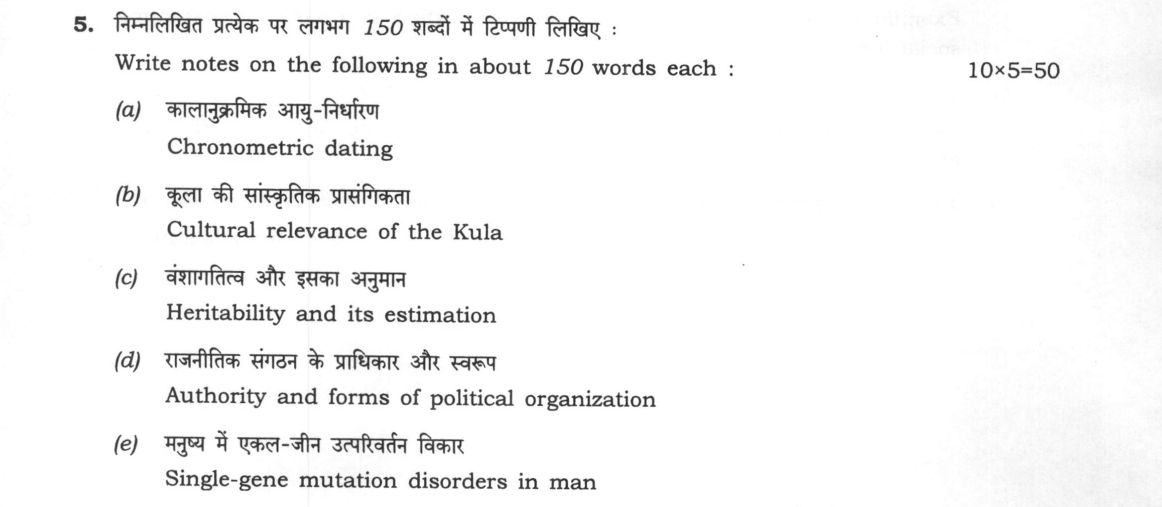
Write notes on the following in about 150 words each: 10×5=50 (a) Chronometric dating (b) Cultural relevance of the Kula (c)…
Write notes on the following in about 150 words each: 10×5=50
Chronometric dating
Cultural relevance of the Kula
Heritability and its estimation
Authority and forms of political organization
Single-gene mutation disorders in man
हिंदी में प्रश्न पढ़ें
निम्नलिखित प्रत्येक पर लगभग 150 शब्दों में टिप्पणी लिखिए : 10×5=50
कालानुक्रमिक आयु-निर्धारण
कुला की सांस्कृतिक प्रासंगिकता
वंशागतिक और इसका अनुमान
राजनीतिक संगठन के प्राधिकार और स्वरूप
मनुष्य में एकल-जीन उत्परिवर्तन विकार
Model answer
Written by UPSC Answer Check against this question's marking rubric, to the 150-word length. UPSC does not publish answers for Mains — this is one way to score well, not an official key.
Chronometric dating refers to absolute dating techniques that assign specific calendar ages to archaeological materials, distinct from relative methods that establish sequence. Radiocarbon (C-14) dating, based on the decay of carbon-14 in organic matter, is pivotal for dating Holocene sites. In India, it has established the chronology of Mehrgarh in Balochistan and the Neolithic transition at Adamgarh in Hoshangabad district, Madhya Pradesh. For older Pleistocene deposits, Potassium-Argon (K-Ar) and Argon-Argon (Ar-Ar) dating are used, such as at the Narmada Valley sites. Thermoluminescence (TL) dating measures trapped charges in ceramics or heated stones, resetting upon firing or sunlight exposure, applied to Bhimbetka rock shelters in Raisen district, Madhya Pradesh. Electron Spin Resonance (ESR) dating, however, measures accumulated radiation-induced trapped charges in tooth enamel or bone, often dating back to burial or formation rather than a specific heating event, providing crucial data for early human evolution studies in India.
Cultural relevance of the Kula is best understood through Bronislaw Malinowski’s ethnography of the Trobriand Islands. The Kula is a ceremonial exchange system involving two types of valuables: soulava (red necklaces) circulating clockwise and mwali (white armbands) circulating counter-clockwise. Unlike market exchange, Kula is not driven by economic profit but by the accumulation of social prestige, political alliance, and ritual status. Participants gain rank and influence through the successful circulation of these objects, creating a network of reciprocal obligations that binds disparate islands into a cohesive sociopolitical entity. The Kula demonstrates that economic activities are embedded in social relations, challenging Western utilitarian views of exchange. It serves as a mechanism for conflict resolution and status differentiation, where the path of valuables reinforces social bonds and hierarchical structures, illustrating the anthropological principle that culture integrates economic, political, and spiritual domains into a unified whole.
Heritability is a statistical measure in quantitative genetics representing the proportion of phenotypic variance (V_P) in a population attributable to genetic variance (V_G). It is crucial for understanding the transmission of traits. Broad-sense heritability (H²) is calculated as V_G / V_P, encompassing all genetic effects including dominance and epistasis. Narrow-sense heritability (h²) is calculated as V_A / V_P, where V_A is additive genetic variance, which is more relevant for predicting response to selection. Heritability is estimated using twin studies (comparing concordance rates of monozygotic vs. dizygotic twins), adoption studies, and family studies. It is critical to note that heritability is population-specific and environment-dependent; it does not indicate the degree to which an individual’s trait is genetically determined. For instance, high heritability of height in a stable environment does not imply that environmental changes cannot affect height in other populations.
Authority and forms of political organization are analyzed through the typology of Elman Service, who categorizes societies into bands, tribes, chiefdoms, and states based on political complexity. Bands are small, egalitarian groups with no formal authority, relying on consensus. Tribes feature segmentary lineage systems with limited leadership. Chiefdoms possess centralized authority, hereditary chiefs, and social stratification, often seen in pre-colonial Indian kingdoms. States involve institutionalized, coercive power and legal-rational authority. Max Weber’s classification of authority—traditional, charismatic, and legal-rational—complements this. In India, the Naga village republics exemplify traditional authority with elected heads, while caste panchayats operate through customary law. Modern Indian governance relies on legal-rational authority, codified in the Constitution. Understanding these forms helps explain the persistence of traditional power structures alongside modern state institutions, highlighting the complex interplay between indigenous political systems and colonial/post-colonial administrative frameworks in shaping contemporary Indian society.
Single-gene mutation disorders are genetic conditions caused by mutations in a single gene, following Mendelian inheritance patterns. Autosomal dominant disorders, such as Huntington’s disease, require only one mutant allele for expression. Autosomal recessive disorders, like sickle cell anemia and β-thalassemia, require two mutant alleles. X-linked disorders, such as hemophilia and Duchenne muscular dystrophy, affect males more frequently due to hemizygosity. India has a high prevalence of β-thalassemia, particularly in tribal belts and certain regions of West Bengal and Gujarat, due to high consanguinity rates. Sickle cell disease is prevalent in tribal populations of central India, such as the Gond and Bhil tribes. Genetic counseling and carrier screening are essential for prevention. The National Health Mission includes initiatives for thalassemia screening. Understanding these disorders is vital for public health strategies, as they impose significant economic and social burdens on families and the healthcare system, necessitating targeted interventions and awareness programs in high-prevalence areas.
What "Write short notes" is asking you to do
Five or six self-contained answers, marked separately, typically 10 marks and about 150 words each. Each note must carry its own definition, its two or three defining features and a line on why it matters; a common introduction or conclusion across the notes earns nothing.
Structure that answers it
Per note: one-line definition or identification → two or three features, mechanisms or named examples → one line of significance or Indian application
Where marks are lost
Writing the first two notes at essay length and rationing the rest. Each note is marked on its own, so marks surrendered on a compressed or unattempted note cannot be won back by the long ones.
How this answer will be evaluated
Approach
Framework: UPSC Anthropology Paper I (Physical & Social). (a) write short notes: define > 3-4 key features > one example > one-line significance | (b) write short notes: define > 3-4 key features > one example > one-line significance | (c) write short notes: define > 3-4 key features > one example > one-line significance | (d) write short notes: define > 3-4 key features > one example > one-line significance | (e) write short notes: define > 3-4 key features > one example > one-line significance Full marks: Precise definitions, named examples, and correct theoretical frameworks for all parts.
Key points expected
- Define chronometric dating (absolute dating)
- Mention at least two methods (e.g., C-14, K-Ar)
- Explain the principle of one method
- Provide one archaeological site example
- Define Kula exchange (soulava and mwali)
- Identify the Trobriand Islands context
- Explain the social function (kinship/alliance)
- Mention Malinowski's contribution
Evaluation rubric
Each sub-part is marked on its own, against the marks and word limit printed on the paper.
- (a) Define chronometric dating and list key methods with examples. · 150 words
write short notes— define → 3-4 key features → one example → one-line significance
Must cover
- Define chronometric dating (absolute dating)
- Mention at least two methods (e.g., C-14, K-Ar)
- Explain the principle of one method
- Provide one archaeological site example
Loses marks
- Confusing relative and absolute dating
- Listing methods without explaining principles
Earns more
- Mention specific half-life values
- Reference a specific Indian site (e.g., Bhimbetka)
Extra mark
- Sketch of decay curve
- Mention of specific researcher (e.g., Libby)
- (b) Explain the Kula ring and its cultural significance. · 150 words
write short notes— define → 3-4 key features → one example → one-line significance
Must cover
- Define Kula exchange (soulava and mwali)
- Identify the Trobriand Islands context
- Explain the social function (kinship/alliance)
- Mention Malinowski's contribution
Loses marks
- Treating Kula as simple trade
- Omitting the directionality of exchange
Earns more
- Contrast with market exchange
- Mention specific items (shell necklaces)
Extra mark
- Map of the Kula ring
- Reference to specific Trobriand clans
- (c) Define heritability and describe methods of estimation. · 150 words
write short notes— define → 3-4 key features → one example → one-line significance
Must cover
- Define heritability (H2) in population genetics
- Distinguish broad vs narrow sense
- Explain twin study method
- Explain regression method
Loses marks
- Confusing heritability with inheritance
- Ignoring environmental factors
Earns more
- Mention Falconer's formula
- Example of a heritable trait (e.g., height)
Extra mark
- Formula for heritability
- Reference to specific study (e.g., Minnesota Twins)
- (d) Define authority and outline forms of political organization. · 150 words
write short notes— define → 3-4 key features → one example → one-line significance
Must cover
- Define political authority
- List forms: Band, Tribe, Chiefdom, State
- Distinguish chiefdom from state
- Mention one Indian tribal example
Loses marks
- Confusing authority with power
- Omitting the State form
Earns more
- Reference to Elman Service's typology
- Mention specific Indian chiefdom (e.g., Gond)
Extra mark
- Table comparing the four forms
- Reference to specific Indian tribe (e.g., Naga)
- (e) Define single-gene disorders and list examples. · 150 words
write short notes— define → 3-4 key features → one example → one-line significance
Must cover
- Define single-gene (Mendelian) disorders
- Distinguish autosomal vs sex-linked
- Give one autosomal example (e.g., Sickle cell)
- Give one sex-linked example (e.g., Haemophilia)
Loses marks
- Confusing with polygenic disorders
- Listing diseases without inheritance pattern
Earns more
- Mention specific gene (e.g., HBB)
- Explain mode of inheritance briefly
Extra mark
- Punnett square sketch
- Mention of carrier frequency
Practice this exact question
Write your answer and it is marked point by point against the model answer above — what you covered, what you missed, what you got wrong.
Evaluate my answer →More from Anthropology 2024 Paper I
- Q2 (a) Discuss historical particularism as a critical development to the classical evolution…
- Q3 (a) What is meant by karyotype? How does its analysis help in diagnosis of the chromosoma…
- Q4 (a) Critically discuss the characteristics of the psychological types in the cultures of…
- Q5 Write notes on the following in about 150 words each: 10×5=50 (a) Chronometric dating (b)…
- Q6 (a) Discuss the geographical distribution of Homo erectus. Taking into account its physic…
- Q7 (a) Critically explain the notion of 'deconstruction' in the light of the postmodern work…
- Q8 (a) Examine critically the concept of social stratification as a basis for sustaining soc…