Paper I — Q7
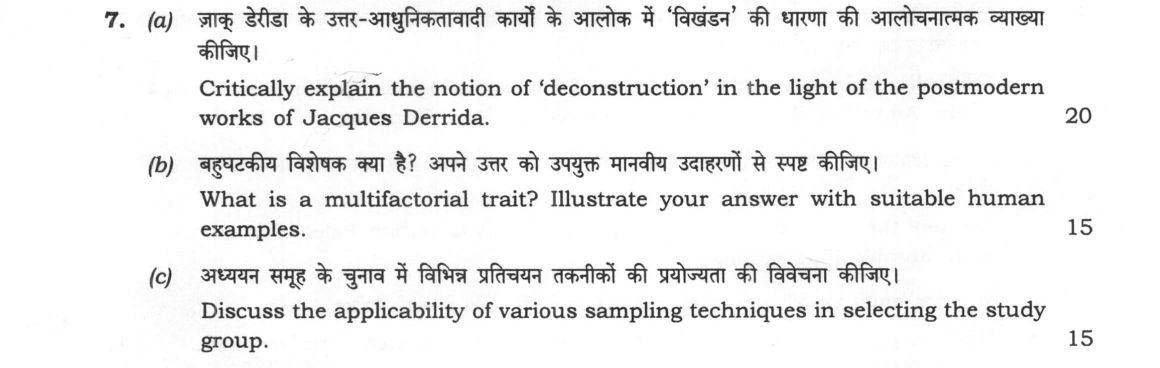
(a) Critically explain the notion of 'deconstruction' in the light of the postmodern works of Jacques Derrida. 20 marks (b) What…
Critically explain the notion of 'deconstruction' in the light of the postmodern works of Jacques Derrida. 20 marks
What is a multifactorial trait? Illustrate your answer with suitable human examples. 15 marks
Discuss the applicability of various sampling techniques in selecting the study group. 15 marks
हिंदी में प्रश्न पढ़ें
जाक् देरिदा के उत्तर-आधुनिकतावादी कार्यों के आलोक में 'विखंडन' की धारणा की आलोचनात्मक व्याख्या कीजिए। 20 अंक
बहुषटकीय विशेषक क्या है? अपने उत्तर को उपयुक्त मानवीय उदाहरणों से स्पष्ट कीजिए। 15 अंक
अध्ययन समूह के चुनाव में विभिन्न प्रतिचयन तकनीकों की प्रयोज्यता की विवेचना कीजिए। 15 अंक
Model answer
Written by UPSC Answer Check against this question's marking rubric, to the expected length. UPSC does not publish answers for Mains — this is one way to score well, not an official key.
Deconstruction and Anthropological Methodology
Jacques Derrida’s concept of deconstruction fundamentally challenges the Western metaphysical tradition of logocentrism, which privileges speech over writing and presence over absence. Derrida argues that meaning is never fixed or self-present but is perpetually deferred through *différance*—a play on "differing" and "deferring." In binary oppositions like nature/culture or self/other, one term is always privileged; deconstruction exposes this hierarchy as unstable, revealing that the "secondary" term (e.g., culture) is constitutive of the "primary" (nature). For anthropology, this implies that ethnographic knowledge is not a transparent mirror of reality but a textual construction. The "crisis of representation" highlighted by Clifford and Marcus stems from this: if truth is always deferred, the ethnographer’s authority to speak for the "Other" is compromised. However, a critical evaluation suggests that while deconstruction rightly critiques colonial epistemologies and essentialist categories, it risks leading to relativism where no empirical claim can be validated. Anthropology must balance this textual critique with the need for rigorous fieldwork, acknowledging that while representation is constructed, the material realities of the studied communities remain.
Multifactorial Traits
A multifactorial trait is a characteristic determined by the interaction of multiple genes (polygenic) and environmental factors. Unlike Mendelian traits, which follow simple dominant-recessive patterns and often show discrete categories, multifactorial traits typically exhibit continuous variation across a population, forming a bell-shaped curve. Crucially, not all multifactorial traits are continuous; some are threshold traits, where liability accumulates until a specific point is crossed, resulting in a discontinuous phenotype (presence or absence of disease).
Human examples illustrate this complexity. Stature is a classic polygenic trait influenced by dozens of genes and environmental factors like nutrition; in India, the significant increase in average height over the last century due to improved diet exemplifies the environmental component. Skin color involves multiple melanin-related genes and UV exposure. In contrast, Type 2 Diabetes is a multifactorial threshold trait. While genetic susceptibility (polygenic risk) exists, the disease manifests only when combined with environmental factors like sedentary lifestyle and diet. It is important to distinguish this from lactase persistence, which is primarily an oligogenic trait (involving specific regulatory variants like MCM6/LCT) and is better understood through gene-culture coevolution rather than as a standard polygenic-environmental interaction. Similarly, intelligence (IQ) is multifactorial, showing continuous variation, but is heavily influenced by socioeconomic and educational environments.
Sampling Techniques in Anthropology
Selecting a study group requires choosing between probability and non-probability sampling based on the research objective.
Probability sampling ensures every member of the population has a known, non-zero chance of selection, allowing for statistical generalization. Simple Random Sampling is ideal for homogeneous populations but is often impractical in anthropology due to lack of complete sampling frames. Stratified Sampling is highly applicable in heterogeneous Indian societies; for instance, studying caste-based health disparities requires stratifying by caste, religion, or region to ensure representation of marginalized groups. Cluster Sampling is useful for large-scale surveys (like the NFHS) where cost and logistics demand studying geographically contiguous units (villages/wards). Systematic Sampling can be used for household surveys but risks periodicity bias if the population has a hidden order.
Non-probability sampling is essential for intensive ethnographic work where generalization is not the goal, but deep understanding is. Purposive Sampling allows researchers to select specific cases that best answer the research question, such as selecting key informants in a tribal community. Snowball Sampling is critical for studying hidden or marginalized populations, such as sex workers, drug users, or undocumented migrants, where trust is built through referrals. Quota Sampling may be used to ensure demographic balance in qualitative interviews.
Conclusion
In conclusion, while Derrida’s deconstruction provides a vital critical lens to question the authority of anthropological representation, the discipline must retain empirical rigor. This is reflected in methodological choices: probability sampling ensures representative data for policy-relevant studies (e.g., health indicators), while non-probability techniques enable the deep, contextual understanding required for ethnographic insight. A robust anthropological approach integrates the critical awareness of postmodernism with the pragmatic precision of scientific sampling.
What "Critically explain" is asking you to do
Make the working of something clear — what sets it off, what follows from what, and what it produces. Explain is the Commission's mechanism word: it dominates the technical papers and the “explain why” stems, where the marks sit in the causal chain and not in the label. “Critically” is not a section added at the end: name the yardstick you are judging by — the evidence, the stated objective, a constitutional principle, a rival explanation — and let a verdict close each part of the body. Where the question quotes a claim, that verdict must land on the claim itself, accepted, qualified or rejected, and not on the theme in general.
Structure that answers it
State what it is → the initiating condition → the chain of cause, step by step → an instance where it plays out → what the chain produces
Where marks are lost
Merits in one paragraph, demerits in the next, and a conclusion calling for a balanced and holistic approach. That is a survey with the judgement left out and it holds the answer in the middle band. The opposite error is reading “critically” as permission to attack — and with the odd pairings, critically describe or critically explain, the exposition still carries most of the marks, the judgement being a layer on it rather than a substitute for it.
How this answer will be evaluated
Approach
Framework: UPSC Anthropology Paper 1 (Sociology/Methodology). (a) critique: the claim > its strengths > its weaknesses > your judgment | (b) define: precise definition > the distinguishing feature > one example | (c) discuss: intro > 3-4 dimensions > example > balanced close Full marks: Precise definitions, named examples, clear distinction between concepts, and critical analysis where required.
Key points expected
- Define 'deconstruction' and 'logocentrism'
- Explain 'différance' and 'trace'
- Critique binary oppositions (e.g., speech/writing)
- Link to postmodern rejection of grand narratives
- Define multifactorial (polygenic + environmental)
- Distinguish from single-gene (Mendelian) traits
- Explain 'threshold' or 'liability' concept
- Provide 2+ specific human examples (e.g., height, diabetes)
Evaluation rubric
Each sub-part is marked on its own, against the marks and word limit printed on the paper.
- (a) Critical analysis of Derrida's 'deconstruction' within postmodernism. 20 marks
critique— the claim → its strengths → its weaknesses → your judgment
Must cover
- Define 'deconstruction' and 'logocentrism'
- Explain 'différance' and 'trace'
- Critique binary oppositions (e.g., speech/writing)
- Link to postmodern rejection of grand narratives
Loses marks
- Confusing deconstruction with destruction
- Treating it as a method rather than a reading strategy
- Ignoring the 'postmodern' context
Earns more
- Mention 'metaphysics of presence'
- Reference 'Of Grammatology' or 'Dissemination'
- Contrast with structuralism (Saussure)
Extra mark
- Apply deconstruction to a specific anthropological text
- Mention 'supplement' or 'aporia'
- (b) Definition of multifactorial trait with human examples. 15 marks
define— precise definition → the distinguishing feature → one example
Must cover
- Define multifactorial (polygenic + environmental)
- Distinguish from single-gene (Mendelian) traits
- Explain 'threshold' or 'liability' concept
- Provide 2+ specific human examples (e.g., height, diabetes)
Loses marks
- Confusing with 'polygenic' (ignoring environment)
- Using only Mendelian examples (e.g., blood group)
- Failing to explain the interaction of factors
Earns more
- Mention 'heritability' (h2)
- Explain 'common disease-common allele' hypothesis
- Reference 'twin studies' or 'adoption studies'
Extra mark
- Mention specific genes (e.g., BRCA1 for cancer)
- Reference 'GWAS' (Genome-Wide Association Studies)
- (c) Applicability of sampling techniques in selecting study groups. 15 marks
discuss— intro → 3-4 dimensions → example → balanced close
Must cover
- Define 'sampling' and 'study group'
- Explain 'probability' vs 'non-probability' sampling
- Detail specific techniques (e.g., random, stratified, snowball)
- Link technique to specific research context (e.g., tribal vs urban)
Loses marks
- Listing techniques without explaining applicability
- Ignoring the 'study group' context
- Confusing 'population' with 'sample'
Earns more
- Mention 'sample size' and 'margin of error'
- Discuss 'bias' in sampling
- Reference 'census' vs 'sample'
Extra mark
- Mention 'cluster sampling' for large populations
- Reference 'purposive sampling' for qualitative work
Practice this exact question
Write your answer and it is marked point by point against the model answer above — what you covered, what you missed, what you got wrong.
Evaluate my answer →More from Anthropology 2024 Paper I
- Q4 (a) Critically discuss the characteristics of the psychological types in the cultures of…
- Q5 Write notes on the following in about 150 words each: 10×5=50 (a) Chronometric dating (b)…
- Q6 (a) Discuss the geographical distribution of Homo erectus. Taking into account its physic…
- Q7 (a) Critically explain the notion of 'deconstruction' in the light of the postmodern work…
- Q8 (a) Examine critically the concept of social stratification as a basis for sustaining soc…