Paper I — Q8
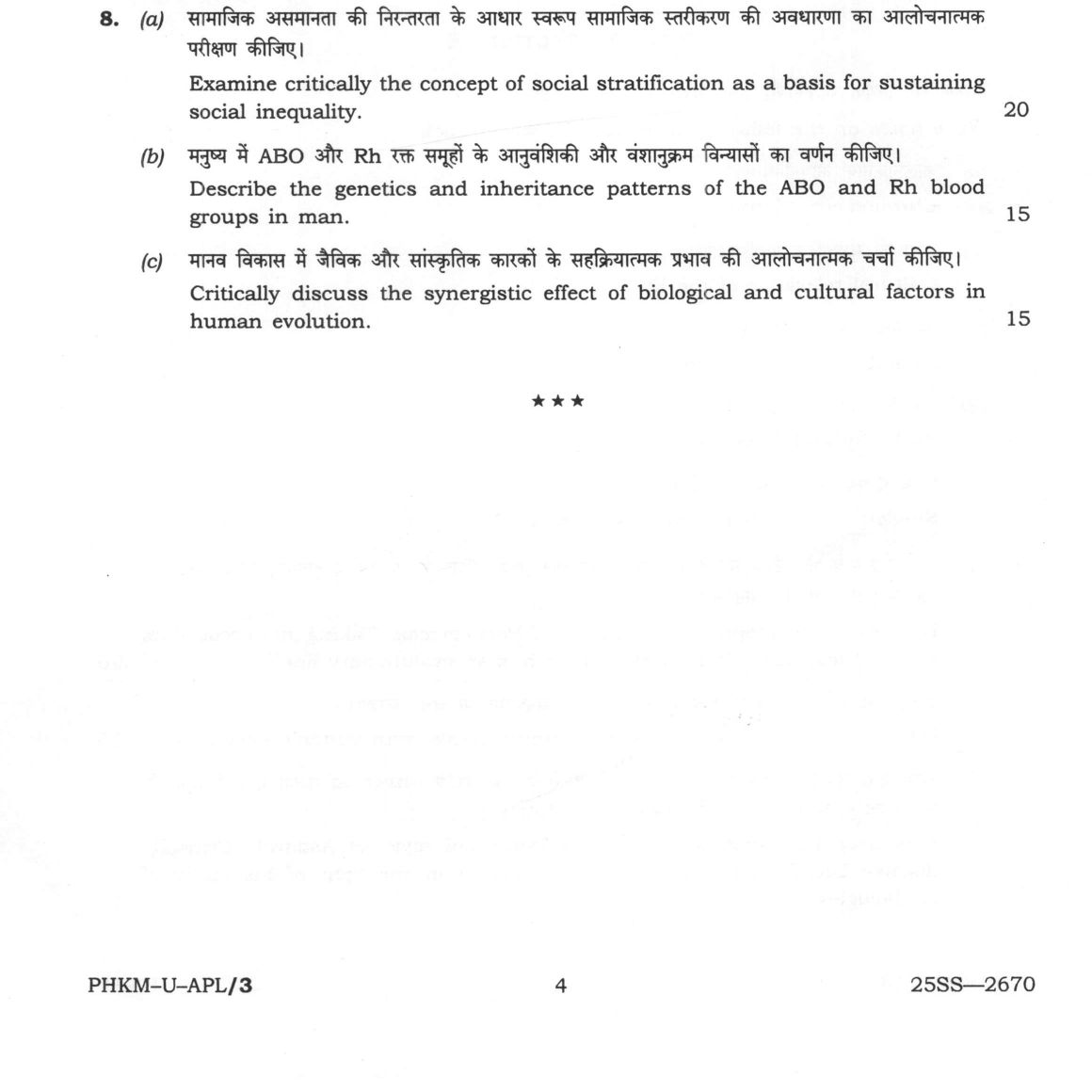
(a) Examine critically the concept of social stratification as a basis for sustaining social inequality. 20 marks (b) Describe…
Examine critically the concept of social stratification as a basis for sustaining social inequality. 20 marks
Describe the genetics and inheritance patterns of the ABO and Rh blood groups in man. 15 marks
Critically discuss the synergistic effect of biological and cultural factors in human evolution. 15 marks
हिंदी में प्रश्न पढ़ें
सामाजिक असमानता की निरंतरता के आधार स्वरूप सामाजिक स्तरीकरण की अवधारणा का आलोचनात्मक परीक्षण कीजिए। 20 अंक
मनुष्य में ABO और Rh रक्त समूहों के आनुवंशिकी और वंशानुक्रम विन्यासों का वर्णन कीजिए। 15 अंक
मानव विकास में जैविक और सांस्कृतिक कारकों के सहक्रियात्मक प्रभाव की आलोचनात्मक चर्चा कीजिए। 15 अंक
Model answer
Written by UPSC Answer Check against this question's marking rubric, to the expected length. UPSC does not publish answers for Mains — this is one way to score well, not an official key.
Social inequality refers to the uneven distribution of valued goods, power, and prestige across individuals, whereas social stratification is the institutionalized, structural hierarchy that groups populations into ranked strata. Stratification serves as the operational matrix that sustains inequality across generations.
Social Stratification and Inequality
Max Weber’s social closure theory demonstrates how dominant groups monopolize opportunities through exclusionary barriers such as endogamy, legal codes, and credentialism. In ascriptive systems, hierarchy is naturalized, locking individuals into predetermined socio-economic tiers.
The functionalist view (Davis-Moore thesis) argues that stratification is universally necessary to ensure that the most qualified individuals fill functionally vital roles via differential rewards. However, conflict theorists (Karl Marx, Max Weber) expose stratification as a socially constructed apparatus of exploitation. Marx highlighted that control over the means of production generates asymmetric power, while Weber demonstrated how the interplay of class, status, and party cements dominance.
In India, the caste (jati) system institutionalized hierarchy through ritual purity-pollution norms, occupational closure, and hereditary status. Despite constitutional interventions (Articles 15, 16, 17) and affirmative action policies like OBC reservations following the Mandal Commission case (Indra Sawhney, 1992), empirical reality shows a persistent class-caste overlap. Dalits and lower castes remain disproportionately concentrated in informal and low-wage labour. Thus, rather than being an inevitable functional meritocracy, stratification is an entrenched, constructed system that legitimizes and perpetuates systemic inequality.
Genetics of ABO and Rh Blood Groups
The ABO blood group system is governed by a polymorphic gene locus on chromosome 9 (9q34.2) exhibiting multiple allelism with three major alleles: I^A, I^B, and i. Alleles I^A and I^B encode specific glycosyltransferases that add N-acetylgalactosamine and D-galactose, respectively, to the precursor H-substance. The i allele is non-functional.
The alleles I^A and I^B exhibit codominance with each other, and both are completely dominant over the recessive i allele. Consequently, six possible genotypes yield four distinct phenotypes: genotypes I^A I^A and I^A i produce Type A; I^B I^B and I^B i produce Type B; I^A I^B produces Type AB; and the homozygous recessive genotype ii produces Type O. Under standard Mendelian segregation, a cross between heterozygous parents (I^A i × I^B i) yields a phenotypic ratio of 1 A : 1 B : 1 AB : 1 O.
The Rh system, located on chromosome 1, is primarily determined by the presence or absence of the D antigen. Inheritance follows simple dominant-recessive Mendelian patterns: genotypes DD and Dd are Rh-positive, while homozygous recessive dd is Rh-negative.
Clinically, maternal-fetal Rh incompatibility occurs when an Rh-negative mother carries an Rh-positive fetus. Sensitization during delivery leads to maternal anti-D IgG production, which can cross the placenta in subsequent Rh-positive pregnancies, causing hemolytic disease of the newborn (erythroblastosis fetalis). In population genetics, polymorphic frequencies of ABO and Rh alleles serve as classical anthropogenetic markers to assess microevolutionary trends, genetic drift, and population affinities.
Biocultural Evolution and Synergism
Human evolution is characterized by gene-culture coevolution (Durham; Boyd and Richerson), where biological and cultural processes act as mutually reinforcing selective forces. Early cultural developments, such as the manufacture of Oldowan stone tools and the control of fire for cooking (Richard Wrangham’s cooking hypothesis), softened diets and expanded metabolic intake, which relaxed selection for large masticatory structures and facilitated encephalization.
A classic genetic demonstration of this synergism is lactase persistence. The cultural innovation of cattle pastoralism and dairying created strong positive selection for regulatory mutations in the LCT gene, allowing adult lactose digestion in pastoralist populations.
Rather than culture decoupling humanity from natural selection, cultural environments actively steer biological adaptation. In the Indian context, the high-altitude Ladakhi population displays genetic adaptations in hypoxia pathways (EPAS1, EGLN1) alongside cultural practices such as specialized housing and yak pastoralism. Similarly, the indigenous Andamanese phenotype (pygmyism/short stature) represents an adaptive biocultural response optimized for thermoregulation in tropical insular habitats.
Human variation must therefore be evaluated as an integrated continuum: biological traits like blood group polymorphisms and biocultural adaptations emerge to optimize human survival, whereas social stratification remains a cultural construction designed to institutionalize power differentials.
What "Critically examine" is asking you to do
Test the proposition the question puts to you and return a finding on how far it holds. Examine stems carry a claim, or ask whether something has happened, and expect evidence weighed both ways before the extent is stated — often with remedial measures attached. “Critically” is not a section added at the end: name the yardstick you are judging by — the evidence, the stated objective, a constitutional principle, a rival explanation — and let a verdict close each part of the body. Where the question quotes a claim, that verdict must land on the claim itself, accepted, qualified or rejected, and not on the theme in general.
Structure that answers it
Restate the claim as the question frames it → evidence that supports it → evidence that undercuts it → the conditions under which it holds → verdict on how far it stands
Where marks are lost
Merits in one paragraph, demerits in the next, and a conclusion calling for a balanced and holistic approach. That is a survey with the judgement left out and it holds the answer in the middle band. The opposite error is reading “critically” as permission to attack — and with the odd pairings, critically describe or critically explain, the exposition still carries most of the marks, the judgement being a layer on it rather than a substitute for it.
How this answer will be evaluated
Approach
Framework: Anthropology Paper 1 (Physical & Social). (a) examine: intro > how/why with reasoning > evidence > conclusion | (b) describe: define > structure or process in order > labelled diagram > significance | (c) discuss: intro > 3-4 dimensions > example > balanced close Full marks: Precise definitions, named theorists, clear diagrams, Indian context.
Key points expected
- Define stratification and its link to inequality
- Explain functionalist view (Durkheim/Parsons) on necessity
- Critique Marxist view (Marx) on exploitation
- Apply to Indian caste system (M.N. Srinivas)
- Define ABO alleles (IA, IB, i) and dominance
- Explain Rh factor (D antigen) genetics
- Show Punnett square or inheritance chart
- Mention ABO/Rh polymorphism in human populations
Evaluation rubric
Each sub-part is marked on its own, against the marks and word limit printed on the paper.
- (a) Critical analysis of social stratification as a mechanism for sustaining inequality. 20 marks
examine— intro → how/why with reasoning → evidence → conclusion
Must cover
- Define stratification and its link to inequality
- Explain functionalist view (Durkheim/Parsons) on necessity
- Critique Marxist view (Marx) on exploitation
- Apply to Indian caste system (M.N. Srinivas)
Loses marks
- Sociological definitions without anthropological context
- Ignoring the 'critical' aspect of the prompt
Earns more
- Mention Weberian multidimensional stratification
- Reference specific Indian tribal hierarchy
- Discuss modern mobility vs. rigid structure
Extra mark
- Cite specific fieldwork (e.g., Dumont)
- Reference recent SC/ST policy impact
- (b) Genetic basis and inheritance patterns of ABO and Rh blood groups. 15 marks
describe— define → structure or process in order → labelled diagram → significance
Must cover
- Define ABO alleles (IA, IB, i) and dominance
- Explain Rh factor (D antigen) genetics
- Show Punnett square or inheritance chart
- Mention ABO/Rh polymorphism in human populations
Loses marks
- Confusing genotype with phenotype
- Missing the 'inheritance pattern' (Mendelian) aspect
Earns more
- Explain Bombay blood group (H antigen)
- Link to forensic or medical anthropology
- Mention specific population frequencies
Extra mark
- Labelled diagram of antigen-antibody reaction
- Reference specific tribal blood group study
- (c) Synergistic effect of biological and cultural factors in human evolution. 15 marks
discuss— intro → 3-4 dimensions → example → balanced close
Must cover
- Define biological evolution (genetic change)
- Define cultural evolution (technological/social change)
- Explain co-evolution (e.g., brain size and tool use)
- Mention specific hominid stage (e.g., H. erectus)
Loses marks
- Treating biology and culture as separate
- Ignoring the 'synergistic' (mutual) aspect
Earns more
- Reference 'dual inheritance theory' (Cavalli-Sforza)
- Discuss impact of language on brain
- Mention specific Indian site (e.g., Bhimbetka)
Extra mark
- Sketch of tool evolution alongside skull
- Reference specific recent fossil find
Practice this exact question
Write your answer and it is marked point by point against the model answer above — what you covered, what you missed, what you got wrong.
Evaluate my answer →More from Anthropology 2024 Paper I
- Q5 Write notes on the following in about 150 words each: 10×5=50 (a) Chronometric dating (b)…
- Q6 (a) Discuss the geographical distribution of Homo erectus. Taking into account its physic…
- Q7 (a) Critically explain the notion of 'deconstruction' in the light of the postmodern work…
- Q8 (a) Examine critically the concept of social stratification as a basis for sustaining soc…