Paper I — Q4
(a) Critically discuss the characteristics of the psychological types in the cultures of the American South-West as observed by…
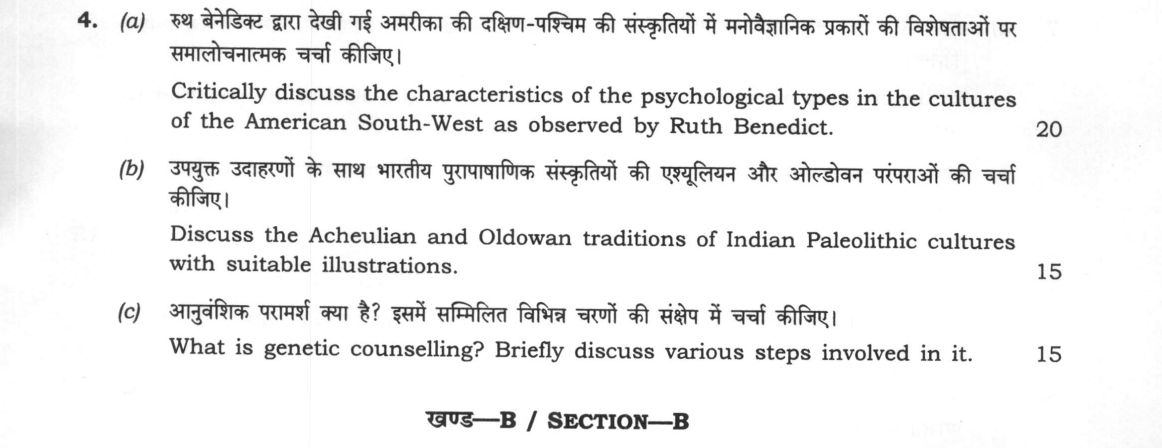
Critically discuss the characteristics of the psychological types in the cultures of the American South-West as observed by Ruth Benedict. 20 marks
Discuss the Acheulian and Oldowan traditions of Indian Paleolithic cultures with suitable illustrations. 15 marks
What is genetic counselling? Briefly discuss various steps involved in it. 15 marks
हिंदी में प्रश्न पढ़ें
रुथ बेनेडिक्ट द्वारा देखी गई अमरीका की दक्षिण-पश्चिम की संस्कृतियों में मनोवैज्ञानिक प्रकारों की विशेषताओं पर समालोचनात्मक चर्चा कीजिए। 20 अंक
उपयुक्त उदाहरणों के साथ भारतीय पुरापाषाणिक संस्कृतियों की एच्यूलियन और ओल्डोवन परंपराओं की चर्चा कीजिए। 15 अंक
आनुवंशिक परामर्श क्या है? इसमें सम्मिलित विभिन्न चरणों की संक्षेप में चर्चा कीजिए। 15 अंक
Model answer
Written by UPSC Answer Check against this question's marking rubric, to the expected length. UPSC does not publish answers for Mains — this is one way to score well, not an official key.
Ruth Benedict’s Psychological Types and Indian Paleolithic
Ruth Benedict’s Patterns of Culture (1934) posits that culture acts as a "selection of the individual's possibilities," shaping a dominant psychological type. In the American Southwest, she identified distinct configurations. The Zuni exemplify the Dionysian type, characterized by a fluid, improvisational approach to life, where art and ritual are spontaneous and individualistic. Conversely, the Pueblo (specifically the Hopi and Tewa) represent the Apollonian type, emphasizing rigid adherence to tradition, collective conformity, and the suppression of individual impulse for the sake of social order. While Benedict primarily associated the Paranoid type with the Kwakiutl of the Pacific Northwest, her framework suggests a culture of suspicion and ritualized aggression, which serves as a contrasting pole to the Southwest’s more communal or fluid types.
Critically, Benedict’s approach offers a powerful holistic view, rejecting the notion of a universal human nature in favor of cultural relativism. However, it faces significant limitations. The methodology suffers from circular reasoning: culture is defined by personality, and personality is defined by culture. Furthermore, the model is ahistorical and static, ignoring internal conflict, change, and the agency of individuals who deviate from the norm. It risks overgeneralization, treating complex societies as monolithic entities. While influential, modern anthropology views these types as idealized constructs rather than rigid realities, acknowledging that most cultures contain elements of all three types in varying degrees.
Oldowan and Acheulian Traditions in India
The Oldowan tradition in India, dated to the Early Pleistocene, is characterized by simple pebble tools such as choppers and chopping tools. These are found in the Siwalik foothills, particularly at sites like Uttarbaini in West Bengal and Hiran Valley in Gujarat (though Hiran Valley is often debated, Uttarbaini is a clearer Oldowan reference). These tools are associated with early Homo species, likely Homo habilis or early Homo erectus, indicating basic subsistence strategies.
The Acheulian tradition, spanning the Middle Pleistocene, represents a technological leap with bifacially worked handaxes and cleavers. Key Indian sites include Attirampakkam in Tamil Nadu, which shows a clear stratigraphic succession from Oldowan to Acheulian, and Didwana in Rajasthan, famous for its large handaxes. The Hunsgi and Baichbal valleys in Karnataka also yield significant Acheulian assemblages. Unlike the Oldowan’s uniface pebble tools, Acheulian tools exhibit symmetry and standardization, suggesting higher cognitive abilities and more complex social learning. The transition from Oldowan to Acheulian in India marks a critical phase in human evolution, reflecting improved resource exploitation and environmental adaptation.
Genetic Counselling
Genetic counselling is a communication process that helps individuals and families understand and adapt to the medical, psychological, and familial implications of genetic contributions to disease. It is non-directive, providing information and support for informed decision-making.
The process involves several systematic steps:
- Pedigree Construction: Mapping family history to identify inheritance patterns (autosomal dominant, recessive, X-linked).
- Risk Assessment: Calculating the probability of disease recurrence using statistical methods.
- Diagnostic Testing: Utilizing karyotyping for chromosomal abnormalities or molecular genetics (PCR, sequencing) for single-gene disorders.
- Communication of Results: Explaining findings in accessible language, addressing emotional reactions.
- Decision Support: Discussing options such as prenatal diagnosis, preimplantation genetic testing, or lifestyle modifications.
- Follow-up: Providing ongoing support and monitoring.
In the Indian context, genetic counselling is crucial for managing high-prevalence disorders like thalassemia and sickle cell anemia, as well as addressing issues related to consanguinity, which increases the risk of autosomal recessive disorders. Integrating psychological, archaeological, and biological perspectives reveals anthropology’s holistic approach to understanding human diversity and continuity.
What "Critically discuss" is asking you to do
Lay the issue out from more than one side — how it arose, what is claimed for it, what is held against it, and where it now stands. UPSC attaches discuss to broad topics with several live dimensions, so coverage of the dimensions earns more than the strength of your opinion. “Critically” is not a section added at the end: name the yardstick you are judging by — the evidence, the stated objective, a constitutional principle, a rival explanation — and let a verdict close each part of the body. Where the question quotes a claim, that verdict must land on the claim itself, accepted, qualified or rejected, and not on the theme in general.
Structure that answers it
Set the issue up → the case as it is made → the case against → the dimension both sides leave out → where the balance now lies
Where marks are lost
Merits in one paragraph, demerits in the next, and a conclusion calling for a balanced and holistic approach. That is a survey with the judgement left out and it holds the answer in the middle band. The opposite error is reading “critically” as permission to attack — and with the odd pairings, critically describe or critically explain, the exposition still carries most of the marks, the judgement being a layer on it rather than a substitute for it.
How this answer will be evaluated
Approach
(a) critique: the claim > its strengths > its weaknesses > your judgment | (b) discuss: intro > 3-4 dimensions > example > balanced close | (c) explain: definition/context > points in order > small example > short close Full marks: Comprehensive, critical, and well-structured answers with specific examples and illustrations.
Key points expected
- Define 'psychological types' in Benedict's framework
- Identify specific types (e.g., Apollonian, Dionysian)
- Link types to specific South-West cultures (e.g., Zuni, Kwakiutl)
- Critically evaluate the validity or limitations of the typology
- Define Oldowan and Acheulian traditions
- Identify key tool types (e.g., hand axes, choppers)
- Name specific Indian sites (e.g., Bori, Belan valley)
- Provide suitable illustrations or descriptions of tools
Evaluation rubric
Each sub-part is marked on its own, against the marks and word limit printed on the paper.
- (a) Critical discussion of psychological types in American South-West cultures. 20 marks
critique— the claim → its strengths → its weaknesses → your judgment
Must cover
- Define 'psychological types' in Benedict's framework
- Identify specific types (e.g., Apollonian, Dionysian)
- Link types to specific South-West cultures (e.g., Zuni, Kwakiutl)
- Critically evaluate the validity or limitations of the typology
Loses marks
- Confusing psychological types with personality traits
- Failing to mention specific cultures
- Descriptive answer without critical evaluation
Earns more
- Mention 'Patterns of Culture' (1934)
- Contrast with Boas or other anthropologists
- Discuss the concept of 'cultural integration'
Extra mark
- Reference to specific rituals or social structures
- Mention of later critiques (e.g., by Mead or others)
- (b) Discussion of Acheulian and Oldowan traditions in Indian Paleolithic. 15 marks
discuss— intro → 3-4 dimensions → example → balanced close
Must cover
- Define Oldowan and Acheulian traditions
- Identify key tool types (e.g., hand axes, choppers)
- Name specific Indian sites (e.g., Bori, Belan valley)
- Provide suitable illustrations or descriptions of tools
Loses marks
- Confusing Oldowan with Acheulian tools
- Failing to provide illustrations or descriptions
- Generalizing without specific Indian examples
Earns more
- Mention chronological sequence (Oldowan before Acheulian)
- Discuss raw materials used
- Reference to specific excavations or researchers
Extra mark
- Comparison with African or European sites
- Mention of specific stratigraphic layers
- (c) Explanation of genetic counselling and its steps. 15 marks
explain— definition/context → points in order → small example → short close
Must cover
- Define genetic counselling
- List the various steps involved
- Explain the purpose of each step
- Mention the role of the genetic counsellor
Loses marks
- Confusing genetic counselling with genetic testing
- Failing to list the steps in order
- Vague or general description without specific steps
Earns more
- Discuss ethical considerations
- Mention specific genetic disorders
- Reference to pre- and post-test counselling
Extra mark
- Mention of specific genetic tests (e.g., karyotyping, PCR)
- Reference to specific genetic conditions (e.g., Down syndrome, Cystic fibrosis)
Practice this exact question
Write your answer and it is marked point by point against the model answer above — what you covered, what you missed, what you got wrong.
Evaluate my answer →More from Anthropology 2024 Paper I
- Q1 Write notes on the following in about 150 words each: 10×5=50 (a) Attributes of culture (…
- Q2 (a) Discuss historical particularism as a critical development to the classical evolution…
- Q3 (a) What is meant by karyotype? How does its analysis help in diagnosis of the chromosoma…
- Q4 (a) Critically discuss the characteristics of the psychological types in the cultures of…
- Q5 Write notes on the following in about 150 words each: 10×5=50 (a) Chronometric dating (b)…
- Q6 (a) Discuss the geographical distribution of Homo erectus. Taking into account its physic…
- Q7 (a) Critically explain the notion of 'deconstruction' in the light of the postmodern work…