Paper II — Q1
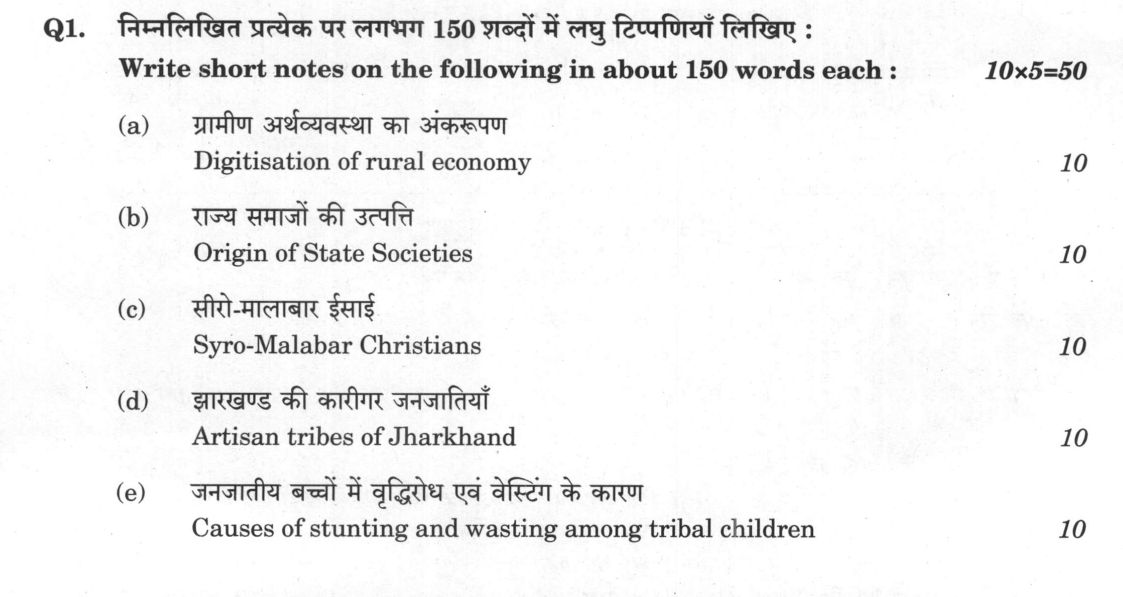
Write short notes on the following in about 150 words each : 10×5=50 (a) Digitisation of rural economy 10 (b) Origin of State…
Write short notes on the following in about 150 words each : 10×5=50
Digitisation of rural economy 10
Origin of State Societies 10
Syro-Malabar Christians 10
Artisan tribes of Jharkhand 10
Causes of stunting and wasting among tribal children 10
हिंदी में प्रश्न पढ़ें
निम्नलिखित प्रत्येक पर लगभग 150 शब्दों में लघु टिप्पणियाँ लिखिए : 10×5=50
ग्रामीण अर्थव्यवस्था का अंकरूपण 10
राज्य समाजों की उत्पत्ति 10
सीरो-मालाबार ईसाई 10
झारखंड की कारीगर जनजातियाँ 10
जनजातीय बच्चों में बुंदिरोध एवं बेस्टिंग के कारण 10
Model answer
Written by UPSC Answer Check against this question's marking rubric, to the 150-word length. UPSC does not publish answers for Mains — this is one way to score well, not an official key.
(a) Digitisation of rural economy
Digitisation of the rural economy involves integrating digital technologies across agricultural production, market linkages, and public service delivery. The Electronic National Agriculture Market (e-NAM) unifies physical mandis into an online trading network to reduce intermediary rent-seeking and ensure transparent price discovery. Financial inclusion has expanded via Direct Benefit Transfer (DBT) platforms like PM-KISAN, supported by the JAM trinity, Common Service Centres (CSCs), and the Aadhaar-enabled Payment System (AePS). Digital payment penetration through UPI and micro-ATMs has reached rural weekly markets (haats), integrating remote producers into mainstream banking. Anthropologically, digitisation reshapes rural social networks and patron-client ties by bypassing traditional middlemen. However, structural constraints persist: erratic broadband connectivity, low digital literacy, erratic power supply, and gender-based disparities in device ownership, creating digital divides that risk excluding marginal farmers and landless labourers from institutional benefits.
(b) Origin of State Societies
In political anthropology, the origin of state societies marks the transition from egalitarian, kinship-based bands and tribes to centralized, territorially organized, and socially stratified systems with a monopoly over legitimate coercive power. Elman Service proposed an evolutionary sequence from band to tribe, chiefdom, and state, emphasizing bureaucratic centralisation and redistribution. In contrast, Morton Fried highlighted economic stratification, defining the state as an institution created to defend differential access to strategic resources. Functionalist and ecological perspectives include Karl Wittfogel’s hydraulic hypothesis, which argues that large-scale irrigation management in arid river basins necessitated centralized administrative despotism. Robert Carneiro’s circumscription theory identifies warfare and population pressure within geographically or socially bounded territories as the prime drivers of conquest and state formation. Thus, states arose through a dialectic of managerial requirements, resource competition, and institutionalized socio-economic inequality.
(c) Syro-Malabar Christians
The Syro-Malabar Christians (St. Thomas Christians) of Kerala trace their origins to the apostolic arrival of St. Thomas in 52 AD and subsequent migrations, notably led by Thomas of Cana in the fourth century. Following the East Syrian liturgical rite, the community represents a distinct case of religious and caste acculturation. Within Kerala’s traditional social hierarchy, Syrian Christians were incorporated with high socio-ritual standing comparable to the Nairs, receiving royal copper-plate privileges (cheppeds), land tenures, and ceremonial duties at Hindu temples. The community reflects caste-like endogamous stratification, particularly the division between the Northists (Vadakkumbhagar) and Southists (Thekkumbhagar or Knanaya), based on claims of lineage purity and endogamy. Their domestic rituals, lifecycle ceremonies, and traditional norms of ritual purity illustrate how Christian faith adapted to indigenous South Indian caste structures.
(d) Artisan tribes of Jharkhand
Artisan tribes in Jharkhand are specialized occupational groups integrated into the regional tribal-peasant economic matrix. Prominent among them are the Lohra (or Lohar) and Asur, who practice traditional iron smelting and manufacture agricultural implements; the Mahli and Malhar, who specialize in bamboo craft, basketry, and Dhokra brass casting; and the Karmali and Chik Baraik, who work in smithy and cotton weaving respectively. Historically, these groups maintained reciprocal economic ties with settled agricultural tribes like the Santhal, Munda, and Oraon through localized barter arrangements akin to the jajmani system. Today, their traditional occupations face severe disruption due to mass-produced industrial substitutes, deforestation restricting access to bamboo and charcoal, and market intermediaries. Consequently, these groups face constrained occupational mobility, forcing many into distress migration and casual wage labour.
(e) Causes of stunting and wasting among tribal children
Stunting (chronic growth failure) and wasting (acute undernutrition) remain disproportionately elevated among India's Scheduled Tribe (ST) children, as highlighted in NFHS-5 data. Biological determinants include high rates of maternal anemia, adolescent pregnancies, low birth weight, and poor infant feeding practices. Recurrent enteric infections and malaria, driven by contaminated water sources and inadequate sanitation in remote habitations, exacerbate nutrient malabsorption. Socio-economically, land alienation, environmental degradation, and forest displacement have eroded traditional, biodiverse diets rich in uncultivated forest foods, millets, and wild tubers, creating micronutrient deficiencies. The transition to a cereal-heavy Public Distribution System (PDS) has reduced qualitative dietary diversity. Furthermore, structural bottlenecks such as geographical isolation of hamlets from Anganwadi Centres, under-resourced health sub-centres, and PDS leakages perpetuate the cycle of undernutrition among tribal children.
What "Write short notes" is asking you to do
Five or six self-contained answers, marked separately, typically 10 marks and about 150 words each. Each note must carry its own definition, its two or three defining features and a line on why it matters; a common introduction or conclusion across the notes earns nothing.
Structure that answers it
Per note: one-line definition or identification → two or three features, mechanisms or named examples → one line of significance or Indian application
Where marks are lost
Writing the first two notes at essay length and rationing the rest. Each note is marked on its own, so marks surrendered on a compressed or unattempted note cannot be won back by the long ones.
How this answer will be evaluated
Approach
Framework: UPSC Anthropology Paper II Rubric. (a) write short notes: define > 3-4 key features > one example > one-line significance | (b) write short notes: define > 3-4 key features > one example > one-line significance | (c) write short notes: define > 3-4 key features > one example > one-line significance | (d) write short notes: define > 3-4 key features > one example > one-line significance | (e) write short notes: define > 3-4 key features > one example > one-line significance Full marks: Precise definitions, named theories/tribes, specific Indian examples, clear structure.
Key points expected
- Define digitisation in economic context
- Mention Digital India or specific rural schemes
- Identify one specific rural application (e.g., e-NAM, UPI)
- State one-line significance for rural development
- Define 'State' in anthropological terms (e.g., Giddens)
- Mention one theory of origin (e.g., Hyden's surplus)
- Identify one key feature (e.g., centralization, bureaucracy)
- State one-line significance of state formation
Evaluation rubric
Each sub-part is marked on its own, against the marks and word limit printed on the paper.
- (a) Define digitisation and list 3-4 key features of its application in rural India. 10 marks · 150 words
write short notes— define → 3-4 key features → one example → one-line significance
Must cover
- Define digitisation in economic context
- Mention Digital India or specific rural schemes
- Identify one specific rural application (e.g., e-NAM, UPI)
- State one-line significance for rural development
Loses marks
- Generic IT definition without rural focus
- Ignoring the 'economy' aspect (focusing only on social)
- No mention of Indian context
Earns more
- Mention specific tribal or remote area challenges
- Reference to financial inclusion (Jan Dhan)
- Mention digital literacy initiatives
Extra mark
- Cite a specific recent government report or data point
- Mention a specific tribal state's digital initiative
- (b) Define state society and outline 3-4 key features of its origin. 10 marks · 150 words
write short notes— define → 3-4 key features → one example → one-line significance
Must cover
- Define 'State' in anthropological terms (e.g., Giddens)
- Mention one theory of origin (e.g., Hyden's surplus)
- Identify one key feature (e.g., centralization, bureaucracy)
- State one-line significance of state formation
Loses marks
- Confusing 'state' with 'nation-state'
- No mention of anthropological theories
- Ignoring the 'origin' aspect
Earns more
- Mention specific archaeological site (e.g., Harappa, Mohenjo-daro)
- Reference to specific anthropologist (e.g., Service, Fried)
- Mention transition from chiefdom to state
Extra mark
- Cite a specific Indian tribal example of state-like features
- Mention a specific recent archaeological finding
- (c) Define Syro-Malabar Christians and list 3-4 key features of their history. 10 marks · 150 words
write short notes— define → 3-4 key features → one example → one-line significance
Must cover
- Define Syro-Malabar Christians (St. Thomas Christians)
- Mention their origin (St. Thomas arrival)
- Identify one key feature (e.g., distinct liturgy, caste structure)
- State one-line significance in Indian history
Loses marks
- Confusing with other Christian groups
- No mention of their distinct identity
- Ignoring the 'Syro' (Syrian) connection
Earns more
- Mention specific historical event (e.g., Portuguese arrival)
- Reference to specific social structure (e.g., Nambudiri influence)
- Mention their current distribution (Kerala)
Extra mark
- Cite a specific historical document or treaty
- Mention a specific contemporary social issue
- (d) Define artisan tribes and list 3-4 key features of Jharkhand's artisan tribes. 10 marks · 150 words
write short notes— define → 3-4 key features → one example → one-line significance
Must cover
- Define 'artisan tribes' (craft-based STs)
- Name one specific Jharkhand artisan tribe (e.g., Kherwa, Kasa)
- Identify one key feature (e.g., specific craft, social status)
- State one-line significance of their role
Loses marks
- Confusing with general STs
- No mention of specific Jharkhand tribes
- Ignoring the 'artisan' (craft) aspect
Earns more
- Mention specific craft (e.g., blacksmithing, pottery)
- Reference to their social position (e.g., service providers)
- Mention their interaction with dominant tribes
Extra mark
- Cite a specific ethnographic study on Jharkhand artisans
- Mention a specific government scheme for artisans
- (e) Define stunting/wasting and list 3-4 key causes among tribal children. 10 marks · 150 words
write short notes— define → 3-4 key features → one example → one-line significance
Must cover
- Define stunting and wasting (nutritional terms)
- Identify one key cause (e.g., dietary deficiency)
- Identify one social cause (e.g., lack of healthcare)
- State one-line significance of addressing this
Loses marks
- Confusing stunting with wasting
- No mention of tribal context
- Ignoring the 'causes' aspect
Earns more
- Mention specific tribal dietary habits
- Reference to specific health indicators (e.g., NFHS data)
- Mention role of traditional practices
Extra mark
- Cite a specific recent health survey or report
- Mention a specific government health scheme
Practice this exact question
Write your answer and it is marked point by point against the model answer above — what you covered, what you missed, what you got wrong.
Evaluate my answer →More from Anthropology 2024 Paper II
- Q1 Write short notes on the following in about 150 words each : 10×5=50 (a) Digitisation of…
- Q2 (a) Critically discuss the recent welfare measures initiated by the Government for the Pa…
- Q3 (a) Critically describe evidences from Rakhi Garhi and its linkages to Harappan civilizat…
- Q4 (a) What are the ethical concerns in biological and socio-cultural anthropology because o…