Paper II — Q8
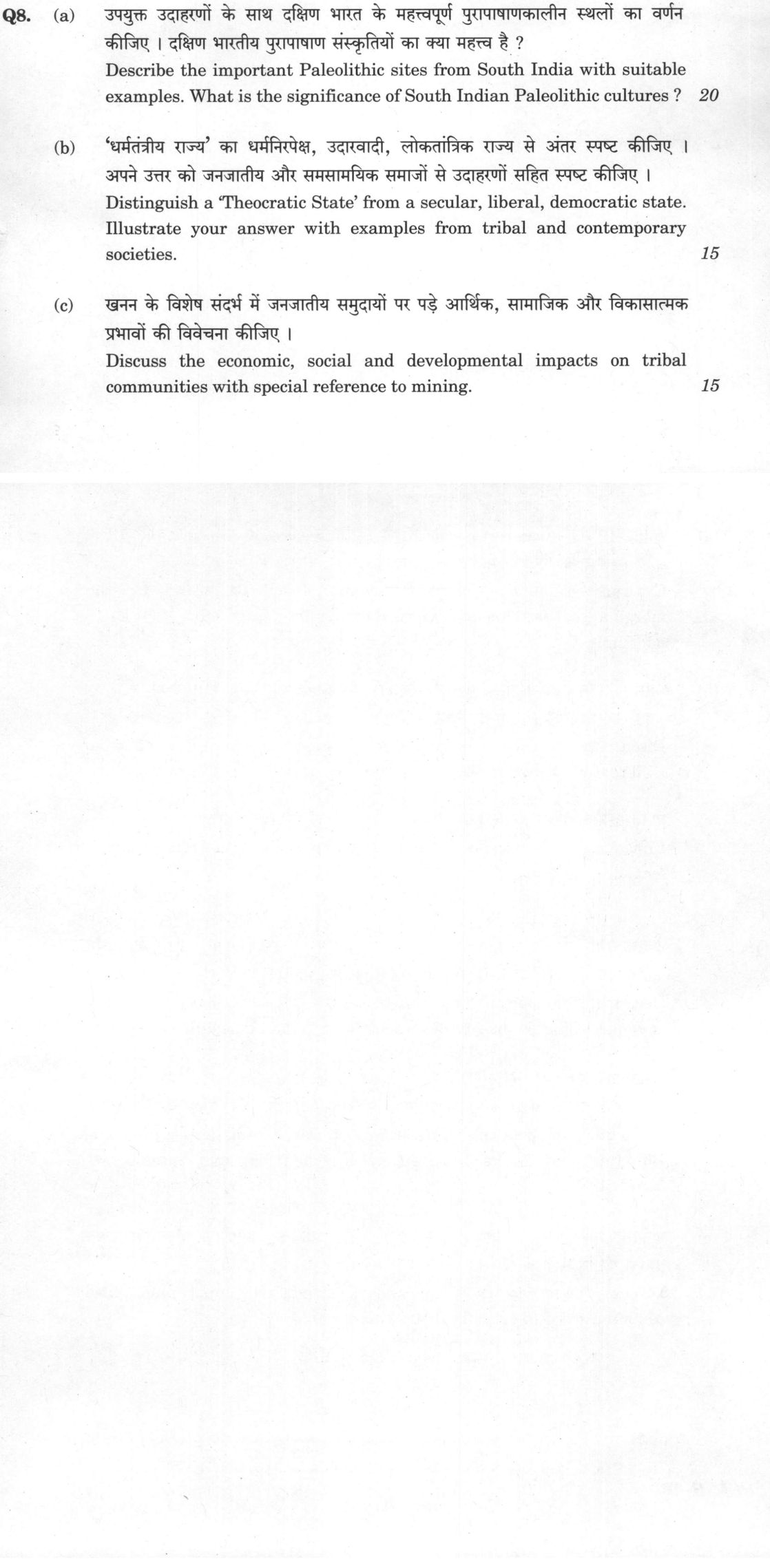
(a) Describe the important Paleolithic sites from South India with suitable examples. What is the significance of South Indian…
Describe the important Paleolithic sites from South India with suitable examples. What is the significance of South Indian Paleolithic cultures ? 20 marks
Distinguish a 'Theocratic State' from a secular, liberal, democratic state. Illustrate your answer with examples from tribal and contemporary societies. 15 marks
Discuss the economic, social and developmental impacts on tribal communities with special reference to mining. 15 marks
हिंदी में प्रश्न पढ़ें
उपयुक्त उदाहरणों के साथ दक्षिण भारत के महत्वपूर्ण पुरापाषाणकालीन स्थलों का वर्णन कीजिए । दक्षिण भारतीय पुरापाषाण संस्कृतियों का क्या महत्व है ? 20 marks
'धर्मतंत्रीय राज्य' का धर्मनिरपेक्ष, उदारवादी, लोकतांत्रिक राज्य से अंतर स्पष्ट कीजिए । अपने उत्तर को जनजातीय और समसामयिक समाजों से उदाहरणों सहित स्पष्ट कीजिए । 15
खनन के विशेष संदर्भ में जनजातीय समुदायों पर पड़े आर्थिक, सामाजिक और विकासात्मक प्रभावों की विवेचना कीजिए । 15
Model answer
Written by UPSC Answer Check against this question's marking rubric, to the expected length. UPSC does not publish answers for Mains — this is one way to score well, not an official key.
South Indian Paleolithic Cultures
The Paleolithic era in South India is characterized by a distinct lithic tradition that challenges earlier notions of the region as a peripheral zone. Key sites include Attirampakkam in Tamil Nadu, which yields the oldest Acheulian handaxes in the subcontinent, dating back to approximately 1.5 million years ago. In Karnataka, the Hunsgi-Baichbal valleys and the Malaprabha valley provide extensive evidence of Lower and Middle Paleolithic occupations, showcasing the evolution from simple flake tools to refined bifaces. The Kurnool caves in Andhra Pradesh further attest to the continuity of human habitation across geological epochs.
The significance of these cultures is profound. First, they establish South India as an independent center of Lower Paleolithic development, distinct from the Soanian tradition of the northwest. The "Madras handaxe tradition," characterized by specific morphological traits, indicates a unique technological lineage rather than mere diffusion. Second, the rich Quaternary stratigraphy at these sites provides critical data for dating early hominin dispersals into the Indian peninsula. This continuity of occupation suggests that South India was a stable refuge for early humans during climatic fluctuations, playing a pivotal role in the peopling of the subcontinent.
Theocratic vs. Secular States
A Theocratic State is one where political authority is legitimized by divine sanction, and religious hierarchy is fused with governance. In such systems, law is derived from sacred texts, and religious leaders often hold supreme political power. In contrast, a Secular, Liberal, Democratic State is defined by the separation of religion and state, constitutional supremacy, and the protection of individual rights. The state remains neutral in religious matters, ensuring equality before the law regardless of faith.
In tribal societies, the distinction is often blurred due to the integration of ritual and political roles. For instance, among the Santal people, the Manjhi serves as the secular village headman, handling administrative and judicial matters, while the Naeke is the village priest who performs principal rituals and ancestral rites. This separation of functions, though within a traditional framework, differs from a theocracy where the priest is the ruler. Similarly, Naga chiefs often held priestly functions, but their authority was checked by village councils. In contemporary contexts, the Indian constitutional state exemplifies secularism through Articles 25-28, ensuring religious freedom. Conversely, entities like the Taliban or ISIS represent theocratic models where religious law supersedes civil law, suppressing individual liberties and enforcing a single interpretation of faith.
Impacts of Mining on Tribal Communities
Mining operations in tribal areas have profound economic, social, and developmental consequences. Economically, mining leads to the displacement of communities from their ancestral lands, resulting in the loss of forest commons and traditional livelihoods. Displaced tribes often become wage laborers, leading to proletarianization and increased dependency on unstable cash economies. The loss of access to forest produce, which constitutes a significant portion of tribal subsistence, exacerbates poverty.
Socially, the influx of non-tribal workers and the disruption of traditional social structures lead to the breakdown of kinship ties. The availability of cash often correlates with increased alcoholism, domestic violence, and the erosion of traditional value systems. Women are disproportionately affected, facing both economic marginalization and heightened gender-based violence.
Developmentally, there is a paradox where infrastructure improves but community well-being declines. Environmental degradation, including deforestation and water pollution, undermines the ecological base of tribal life. Furthermore, mining projects often violate the Forest Rights Act (FRA), 2006, which mandates the consent of Gram Sabhas for land diversion. The Samatha judgment (1997) by the Supreme Court emphasized the need for rehabilitation and resettlement plans, yet implementation remains flawed. The lack of Free, Prior, and Informed Consent (FPIC) is evident in conflicts like Niyamgiri, where the Dongria Kondh resisted Vedanta’s bauxite mining, highlighting the clash between industrial development and tribal sovereignty.
Conclusion
In summary, South Indian Paleolithic sites reveal a robust, independent archaeological tradition crucial for understanding human evolution. The distinction between theocratic and secular states underscores the importance of constitutional neutrality in protecting diverse tribal identities. Finally, mining in tribal areas, while driving industrial growth, often inflicts severe socio-economic harm. Sustainable development requires strict adherence to the FRA, genuine FPIC, and equitable benefit-sharing mechanisms to ensure that tribal communities are not sacrificed for industrial progress.
What "Describe" is asking you to do
Give a full, ordered account of the thing named — its parts, stages or mechanism — in the sequence in which it actually exists or occurs. Most describe questions come from the science optionals, where the marks sit in correct technical detail and, where the stem says so, a labelled diagram.
Structure that answers it
One-line identification of the subject → the parts or stages in their real order, each with its defining detail → labelled diagram where the subject is structural → closing line on function or significance
Where marks are lost
Loose general prose where the examiner is ticking named parts, correct terminology and their sequence; and in the General Studies papers, turning to evaluation before the description is finished.
How this answer will be evaluated
Approach
(a) describe: define > structure or process in order > labelled diagram > significance | (b) compare: paired headings or table > key differences > significance > conclusion | (c) discuss: intro > 3-4 dimensions > example > balanced close Full marks: Comprehensive, specific examples, clear distinctions, and strong tribal context.
Key points expected
- Name at least 3 specific South Indian sites (e.g., Attirampakkam, Belan, Kurnool).
- Define 'Theocratic State' and 'Secular/Liberal/Democratic State' clearly.
- Address economic, social, and developmental impacts specifically.
Evaluation rubric
Each sub-part is marked on its own, against the marks and word limit printed on the paper.
- (a) Describe important South Indian Paleolithic sites and their cultural significance. 20 marks
describe— define → structure or process in order → labelled diagram → significance
Must cover
- Name at least 3 specific South Indian sites (e.g., Attirampakkam, Belan, Kurnool).
Loses marks
- Confusing South Indian sites with North Indian (e.g., Belan).
Earns more
- Distinguish between Lower, Middle, and Upper Paleolithic industries.
Extra mark
- Mention specific tool types (e.g., hand axes, cleavers).
- (b) Distinguish a Theocratic State from a secular, liberal, democratic state. 15 marks
compare— paired headings or table → key differences → significance → conclusion
Must cover
- Define 'Theocratic State' and 'Secular/Liberal/Democratic State' clearly.
Loses marks
- Failing to distinguish between theocratic and secular governance.
Earns more
- Provide examples from tribal societies (e.g., Naga, Gond).
Extra mark
- Reference specific tribal governance structures (e.g., Kuki, Naga).
- (c) Discuss economic, social, and developmental impacts of mining on tribal communities. 15 marks
discuss— intro → 3-4 dimensions → example → balanced close
Must cover
- Address economic, social, and developmental impacts specifically.
Loses marks
- Generalizing impacts without specific tribal context.
Earns more
- Reference specific mining areas (e.g., Jharkhand, Odisha).
Extra mark
- Mention specific policies (e.g., PESA Act, Forest Rights Act).
Practice this exact question
Write your answer and it is marked point by point against the model answer above — what you covered, what you missed, what you got wrong.
Evaluate my answer →More from Anthropology 2024 Paper II
- Q5 Write short notes on the following in about 150 words each : 10×5=50 (a) B.K. Roy Burman'…
- Q6 (a) Custodians of natural resources are the tribals, but they are the most deprived. Crit…
- Q7 (a) Critically examine existing paradigms of holistic health for the marginalised section…
- Q8 (a) Describe the important Paleolithic sites from South India with suitable examples. Wha…