Paper II — Q3
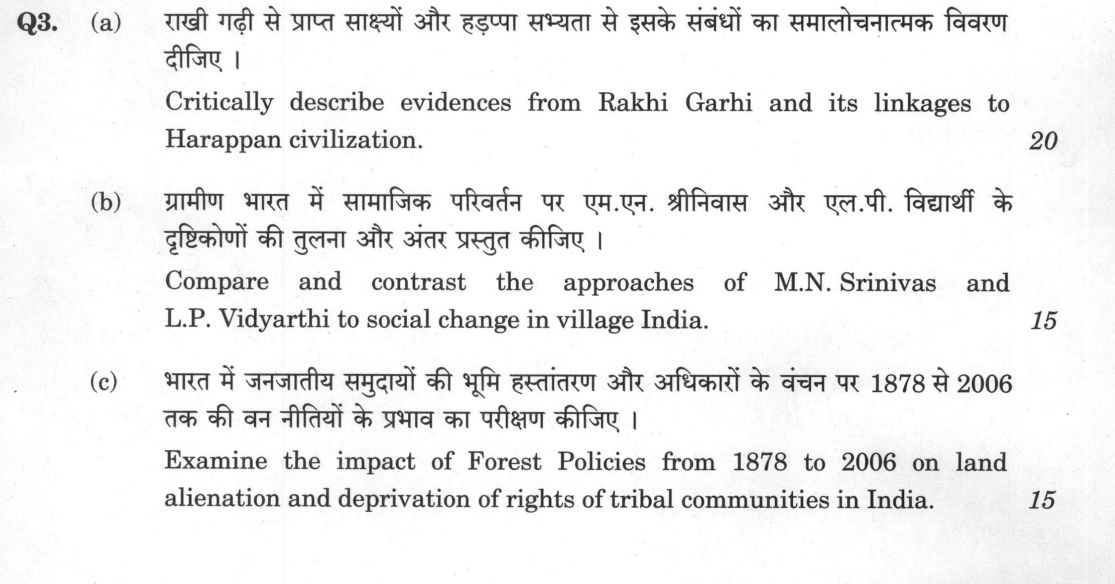
(a) Critically describe evidences from Rakhi Garhi and its linkages to Harappan civilization. 20 (b) Compare and contrast the…
Critically describe evidences from Rakhi Garhi and its linkages to Harappan civilization. 20 marks
Compare and contrast the approaches of M.N. Srinivas and L.P. Vidyarthi to social change in village India. 15 marks
Examine the impact of Forest Policies from 1878 to 2006 on land alienation and deprivation of rights of tribal communities in India. 15 marks
हिंदी में प्रश्न पढ़ें
राखी गढ़ी से प्राप्त साक्ष्यों और हड़प्पा सभ्यता से इसके संबंधों का समालोचनात्मक विवरण दीजिए । 20
ग्रामीण भारत में सामाजिक परिवर्तन पर एम.एन. श्रीनिवास और एल.पी. विद्यार्थी के दृष्टिकोणों की तुलना और अंतर प्रस्तुत कीजिए । 15
भारत में जनजातीय समुदायों की भूमि हस्तांतरण और अधिकारों के वंचन पर 1878 से 2006 तक की वन नीतियों के प्रभाव का परीक्षण कीजिए । 15
Model answer
Written by UPSC Answer Check against this question's marking rubric, to the expected length. UPSC does not publish answers for Mains — this is one way to score well, not an official key.
Rakhigarhi: Archaeological Evidence and Harappan Linkages
Located in the Saraswati basin of Haryana, Rakhigarhi is the largest Harappan site in India, offering critical evidence for the civilization’s urban planning and indigenous development. Excavations reveal a stratified sequence from Early Harappan (Sothi-Siswal) to Mature Harappan phases, characterized by pottery, terracotta figurines, and seals. The presence of bead manufacturing workshops and a sophisticated drainage system—consisting of covered street drains rather than subterranean networks—links it directly to the urban planning of Harappa and Mohenjo-daro. Critically, Rakhigarhi challenges the "Indus Valley" narrative by demonstrating a metropolitan center in the upper reaches, supporting the theory of indigenous development. However, while the site’s scale and continuity suggest local agency, it does not definitively disprove external stimuli or contacts. Recent genomic studies (Narasimhan et al., 2019) indicate a lack of Steppe ancestry in Rakhigarhi samples, which speaks to population ancestry but does not independently confirm that urbanization was entirely free of external influence. Thus, Rakhigarhi evidences a robust local trajectory of urbanization without proving it was an isolated cradle.
Srinivas vs. Vidyarthi: Approaches to Social Change
M.N. Srinivas and L.P. Vidyarthi offer distinct frameworks for understanding social change in village India. Srinivas, through his structural-functionalism, introduced concepts like Sanskritization and Westernization to explain caste mobility. His work, rooted in Mysore village studies, adopts an all-India perspective, integrating micro-level caste dynamics with macro-level national processes. He views change as a process of upward mobility driven by the emulation of higher castes and adoption of Western norms. In contrast, L.P. Vidyarthi, focusing on Middle India, employs a cultural ecology approach. He emphasizes the "Sacred Complex" and the continuum between tribe and caste, arguing that social change is driven by ecological adaptation and the interaction between the Great Tradition and Little Tradition. While Srinivas prioritizes social structure and status, Vidyarthi highlights the role of religion, power, and regional ecological contexts. Srinivas’s model is more universalist, whereas Vidyarthi’s is regionally specific, focusing on the unique tribal-caste interface in central India.
Forest Policies and Tribal Deprivation (1878–2006)
The trajectory of forest policies in India reflects a shift from colonial monopoly to post-colonial state control, often at the expense of tribal rights. The Indian Forest Act of 1878 established state monopoly, classifying forests as "reserved" or "protected" and criminalizing traditional livelihoods through the Indian Forest Act and later the Wildlife Protection Act. The 1894 Forest Policy reinforced this state control, while the Indian Forest Act of 1927 became the operative law for much of the period, further restricting access. Post-independence, the Forest Policy of 1952 continued nationalization, leading to land alienation through zamindari remnants and displacement for dams and mining, particularly in Jharkhand and Chhattisgarh. The 1988 National Forest Policy marked a shift by recommending people's participation, which led to the formal launch of Joint Forest Management (JFM) via the 1990 circular, though implementation often failed to restore genuine rights. The Forest Rights Act of 2006 finally attempted to restore community rights, acknowledging historical deprivation. However, the legacy of colonial and post-colonial policies, including the Forest Conservation Act of 1980 which restricted land diversion, has resulted in significant alienation and failure of rehabilitation for tribal communities in the Northeast and Central India.
Conclusion
Collectively, these dimensions reveal a complex interplay between indigenous development, social mobility, and state policy. Rakhigarhi underscores the indigenous roots of urbanization, Srinivas and Vidyarthi highlight the diverse mechanisms of social change, and forest policies illustrate the systemic deprivation of tribal rights. A critical synthesis suggests that while indigenous agency is evident in both archaeology and sociology, state interventions have often marginalized these communities, necessitating a re-evaluation of policies to ensure equitable recognition of rights and heritage.
What "Critically describe" is asking you to do
Give a full, ordered account of the thing named — its parts, stages or mechanism — in the sequence in which it actually exists or occurs. Most describe questions come from the science optionals, where the marks sit in correct technical detail and, where the stem says so, a labelled diagram. “Critically” is not a section added at the end: name the yardstick you are judging by — the evidence, the stated objective, a constitutional principle, a rival explanation — and let a verdict close each part of the body. Where the question quotes a claim, that verdict must land on the claim itself, accepted, qualified or rejected, and not on the theme in general.
Structure that answers it
One-line identification of the subject → the parts or stages in their real order, each with its defining detail → labelled diagram where the subject is structural → closing line on function or significance
Where marks are lost
Merits in one paragraph, demerits in the next, and a conclusion calling for a balanced and holistic approach. That is a survey with the judgement left out and it holds the answer in the middle band. The opposite error is reading “critically” as permission to attack — and with the odd pairings, critically describe or critically explain, the exposition still carries most of the marks, the judgement being a layer on it rather than a substitute for it.
How this answer will be evaluated
Approach
Framework: UPSC Anthropology Paper II (Sociology & Social Anthropology). (a) critique: the claim > its strengths > its weaknesses > your judgment | (b) compare: paired headings or table > key differences > significance > conclusion | (c) examine: intro > how/why with reasoning > evidence > conclusion Full marks: Precise, specific, and critical; uses named concepts and evidence effectively.
Key points expected
- Identify Rakhi Garhi as a Chalcolithic site
- Detail specific material culture evidence (pottery, tools)
- Explain the 'linkage' to Harappan civilization (trade/contact)
- Provide a critical evaluation of the evidence
- Identify Srinivas's key concepts (e.g., Sanskritization, Dominant Caste)
- Identify Vidyarthi's key concepts (e.g., Social Change, Modernization)
- Contrast their views on the nature of change (cultural vs structural)
- Discuss their views on the role of the state or modernity
Evaluation rubric
Each sub-part is marked on its own, against the marks and word limit printed on the paper.
- (a) Critical description of Rakhi Garhi evidence and its specific linkages to Harappan civilization. 20 marks
critique— the claim → its strengths → its weaknesses → your judgment
Must cover
- Identify Rakhi Garhi as a Chalcolithic site
- Detail specific material culture evidence (pottery, tools)
- Explain the 'linkage' to Harappan civilization (trade/contact)
- Provide a critical evaluation of the evidence
Loses marks
- Treating it as a Harappan site rather than a contact site
- Vague generalities about 'ancient trade' without specific evidence
- Ignoring the 'critical' aspect of the command word
Earns more
- Mention specific artifacts (e.g., Harappan beads, weights)
- Reference the geographical location (Haryana)
- Discuss the chronological overlap or gap
- Mention the 'Rakhi Garhi culture' specifically
Extra mark
- Labelled sketch of a specific Rakhi Garhi artifact
- Mention of specific excavators (e.g., B.B. Lal)
- (b) Comparison and contrast of M.N. Srinivas and L.P. Vidyarthi's approaches to social change in village India. 15 marks
compare— paired headings or table → key differences → significance → conclusion
Must cover
- Identify Srinivas's key concepts (e.g., Sanskritization, Dominant Caste)
- Identify Vidyarthi's key concepts (e.g., Social Change, Modernization)
- Contrast their views on the nature of change (cultural vs structural)
- Discuss their views on the role of the state or modernity
Loses marks
- Confusing the two scholars' core arguments
- Failing to contrast their approaches to 'change'
- General sociological talk without specific anthropological concepts
Earns more
- Mention Srinivas's 'Sanskritization' in detail
- Mention Vidyarthi's 'Social Change in Village India' work
- Discuss the 'Dominant Caste' concept
- Reference specific ethnographic examples used by either
Extra mark
- Mention of specific works (e.g., 'The Remembered Village')
- Reference to their specific fieldwork locations
- (c) Examination of the impact of Forest Policies (1878-2006) on tribal land alienation and rights deprivation. 15 marks
examine— intro → how/why with reasoning → evidence → conclusion
Must cover
- Identify the 1878 Forest Act as a starting point
- Explain the mechanism of 'land alienation' (displacement)
- Discuss the 'deprivation of rights' (customary rights ignored)
- Mention the 2006 Forest Rights Act (FRA) as a corrective
Loses marks
- Ignoring the specific date range (1878-2006)
- Failing to link policy directly to 'alienation' and 'deprivation'
- General environmental talk without focusing on tribal rights
Earns more
- Mention the 1927 Forest Act
- Discuss the concept of 'Reserved Forests'
- Reference specific tribal communities affected
- Discuss the shift from 'conservation' to 'rights' in policy
Extra mark
- Mention of specific tribal groups (e.g., Gond, Baiga)
- Reference to specific policy documents or reports
Practice this exact question
Write your answer and it is marked point by point against the model answer above — what you covered, what you missed, what you got wrong.
Evaluate my answer →More from Anthropology 2024 Paper II
- Q1 Write short notes on the following in about 150 words each : 10×5=50 (a) Digitisation of…
- Q2 (a) Critically discuss the recent welfare measures initiated by the Government for the Pa…
- Q3 (a) Critically describe evidences from Rakhi Garhi and its linkages to Harappan civilizat…
- Q4 (a) What are the ethical concerns in biological and socio-cultural anthropology because o…
- Q5 Write short notes on the following in about 150 words each : 10×5=50 (a) B.K. Roy Burman'…
- Q6 (a) Custodians of natural resources are the tribals, but they are the most deprived. Crit…