Paper II — Q2
(a) Critically discuss the recent welfare measures initiated by the Government for the Particularly Vulnerable Tribal Groups…
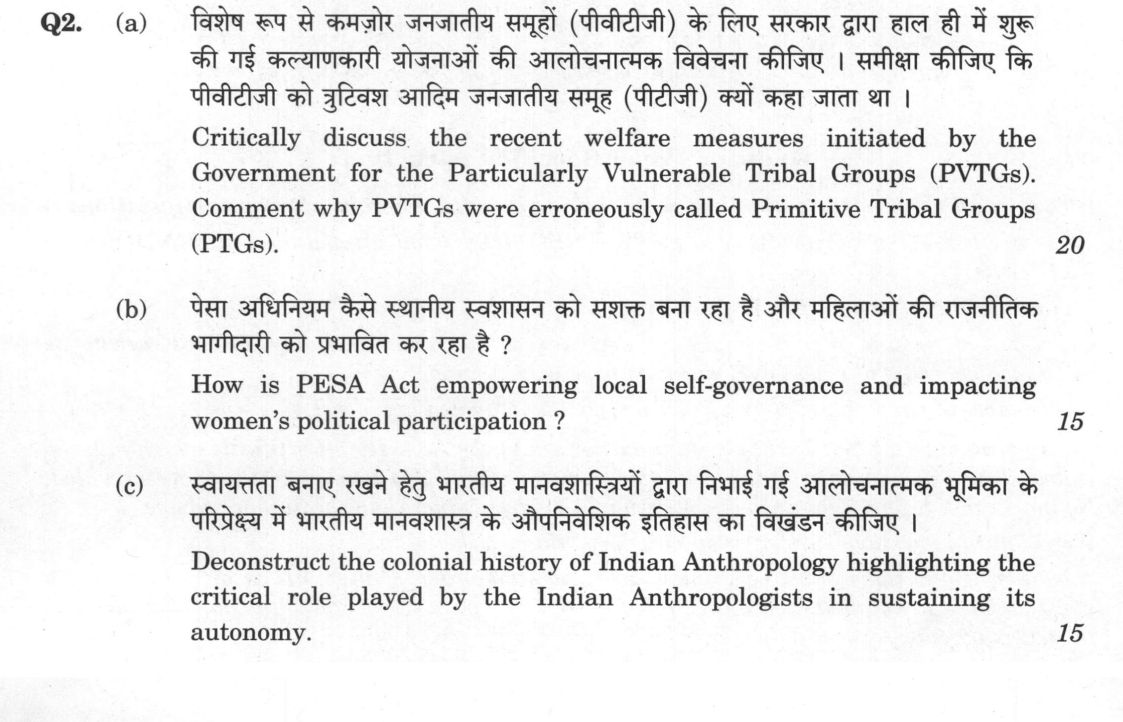
Critically discuss the recent welfare measures initiated by the Government for the Particularly Vulnerable Tribal Groups (PVTGs). Comment why PVTGs were erroneously called Primitive Tribal Groups (PTGs). 20 marks
How is PESA Act empowering local self-governance and impacting women's political participation ? 15 marks
Deconstruct the colonial history of Indian Anthropology highlighting the critical role played by the Indian Anthropologists in sustaining its autonomy. 15 marks
हिंदी में प्रश्न पढ़ें
विशेष रूप से कमजोर जनजातीय समूहों (पीवीटीजी) के लिए सरकार द्वारा हाल ही में शुरू की गई कल्याणकारी योजनाओं की आलोचनात्मक विवेचना कीजिए । समीक्षा कीजिए कि पीवीटीजी को त्रुटिवश आदिम जनजातीय समूह (पीटीजी) क्यों कहा जाता था । 20
पेसा अधिनियम कैसे स्थानीय स्वशासन को सशक्त बना रहा है और महिलाओं की राजनीतिक भागीदारी को प्रभावित कर रहा है ? 15 marks
स्वायत्तता बनाए रखने हेतु भारतीय मानवशास्त्रियों द्वारा निभाई गई आलोचनात्मक भूमिका के परिप्रेक्ष्य में भारतीय मानवशास्त्र के औपनिवेशिक इतिहास का विखंडन कीजिए । 15
Model answer
Written by UPSC Answer Check against this question's marking rubric, to the expected length. UPSC does not publish answers for Mains — this is one way to score well, not an official key.
The State, the Tribe, and the Discipline
The interface between the Indian state and tribal communities has undergone a paradigm shift from administrative control to welfare-oriented engagement, while the discipline of anthropology has moved from colonial taxonomy to indigenous critique. This trajectory is visible in the reclassification of PVTGs, the legislative empowerment under PESA, and the decolonization of anthropological inquiry.
Critical Assessment of PVTG Welfare and Terminology The term "Primitive Tribal Group" was erroneous due to its evolutionary baggage, implying a linear stage of "backwardness" that denied the coevalness of tribal societies with mainstream India. It stigmatized communities as relics of the past rather than acknowledging their structural vulnerability. The shift to "Particularly Vulnerable Tribal Groups" (PVTGs) in 2006 correctly identifies the issue as one of heightened sensitivity to external shocks—such as displacement, disease, and market integration—rather than inherent primitiveness.
Recent welfare measures, notably the PM-JANMAN mission, aim to address this vulnerability through habitat protection, food security, and health interventions. While the Van Dhan Vikas Yojana empowers tribal women by formalizing the collection of Minor Forest Produce (MFP), and residential schools attempt to bridge educational gaps, implementation remains uneven. A critical gap lies in the disconnect between policy intent and ground reality; for instance, while PM-JAY provides health insurance, it is a general scheme and does not specifically target genetic conditions like sickle-cell anemia, which requires the specific focus of the National Sickle Cell Anaemia Elimination Mission. Furthermore, habitat rights under the Forest Rights Act (FRA) are often undermined by bureaucratic delays in title issuance, leaving PVTGs exposed to displacement despite legal protections. Thus, while the terminological correction is a victory of dignity, the welfare architecture still struggles with the "last mile" delivery problem.
PESA and Gendered Self-Governance The PESA Act (1996) operationalizes the 5th and 6th Schedule provisions, empowering local self-governance by vesting significant authority in the Gram Sabha. Unlike the 73rd Amendment, which applies to general panchayats, PESA recognizes the Gram Sabha as the primary decision-making body. Crucially, it mandates consultation with the Gram Sabha before any land acquisition or transfer, rather than vesting absolute decision-making power in the village assembly, thereby balancing tribal autonomy with state sovereignty.
Regarding women’s political participation, PESA mandates reservation for women in Gram Sabhas and executive committees. However, the impact is mixed. While the law provides a platform, patriarchal norms often lead to proxy representation, where women are present physically but excluded from substantive decision-making. Cases like Mendha-Lekha demonstrate that when women are actively engaged in Gram Sabha deliberations, they become effective agents of environmental and resource governance. Yet, tokenism remains a barrier, indicating that legal reservation must be accompanied by socio-cultural transformation to ensure genuine agency.
Deconstructing Colonial Anthropology Colonial Indian anthropology was an instrument of administrative control, characterized by survey ethnography and racial typologies. Scholars like H.H. Risley and E.B. Thurston classified Indians based on physical features and caste hierarchies, creating a static, hierarchical view of society that served colonial governance.
Post-Independence, Indian anthropologists sustained the discipline’s autonomy by rejecting these colonial frameworks. N.K. Bose is credited with formulating the caste-tribe continuum, arguing that caste and tribe are not distinct categories but points on a spectrum of social organization, thereby challenging the colonial binary. D.N. Majumdar further explored the interplay of caste and tribe in Bengal, while L.P. Vidyarthi introduced an ecosystem approach, viewing tribal societies as adaptive systems rather than isolated primitives. S.C. Dube’s village studies and M.N. Srinivas’s indigenization of structural-functionalism helped ground the discipline in Indian realities.
Institutionally, the Anthropological Survey of India (ASI) and various Tribal Research Institutes were reoriented to focus on development and rights, moving away from mere data collection. This shift decolonized methodology, prioritizing indigenous knowledge systems and community participation.
Conclusion The transition from "Primitive" to "Particularly Vulnerable" reflects a broader decolonization of the state-tribe relationship. While PVTG welfare schemes and PESA provide legal and economic frameworks, their efficacy depends on overcoming implementation gaps and patriarchal barriers. Simultaneously, the autonomy of Indian anthropology, forged by scholars like Bose and Vidyarthi, ensures that tribal studies remain a tool for empowerment rather than a legacy of colonial classification.
What "Critically discuss" is asking you to do
Lay the issue out from more than one side — how it arose, what is claimed for it, what is held against it, and where it now stands. UPSC attaches discuss to broad topics with several live dimensions, so coverage of the dimensions earns more than the strength of your opinion. “Critically” is not a section added at the end: name the yardstick you are judging by — the evidence, the stated objective, a constitutional principle, a rival explanation — and let a verdict close each part of the body. Where the question quotes a claim, that verdict must land on the claim itself, accepted, qualified or rejected, and not on the theme in general.
Structure that answers it
Set the issue up → the case as it is made → the case against → the dimension both sides leave out → where the balance now lies
Where marks are lost
Merits in one paragraph, demerits in the next, and a conclusion calling for a balanced and holistic approach. That is a survey with the judgement left out and it holds the answer in the middle band. The opposite error is reading “critically” as permission to attack — and with the odd pairings, critically describe or critically explain, the exposition still carries most of the marks, the judgement being a layer on it rather than a substitute for it.
How this answer will be evaluated
Approach
(a) discuss: intro > 3-4 dimensions > example > balanced close | (b) explain: definition/context > points in order > small example > short close | (c) highlight: name the salient points > one line of substance each > close Full marks: Comprehensive, critical, and well-structured answers with specific examples and clear reasoning.
Key points expected
- Define PVTG and the criteria for identification (e.g., pre-agriculture, negative growth).
- List specific welfare measures (e.g., PVTG Development Programme, food security).
- Explain the shift from 'Primitive' to 'Particularly Vulnerable' (decolonizing language).
- Critically evaluate the implementation gaps or challenges of these measures.
- Define PESA (1996) and its objective (empowerment of Gram Sabhas).
- Explain the mechanism of local self-governance (Gram Sabha authority).
- Detail the 1/3rd reservation for women in Gram Sabhas and Panchayats.
- Discuss the impact on women's political agency and decision-making.
Evaluation rubric
Each sub-part is marked on its own, against the marks and word limit printed on the paper.
- (a) Critical analysis of PVTG welfare measures and the rationale for the nomenclature change from PTG. 20 marks
discuss— intro → 3-4 dimensions → example → balanced close
Must cover
- Define PVTG and the criteria for identification (e.g., pre-agriculture, negative growth).
- List specific welfare measures (e.g., PVTG Development Programme, food security).
- Explain the shift from 'Primitive' to 'Particularly Vulnerable' (decolonizing language).
- Critically evaluate the implementation gaps or challenges of these measures.
Loses marks
- Treating PVTGs as a static, unchanging 'primitive' category.
- Failing to distinguish PVTGs from general STs.
- Listing measures without critical analysis of their impact.
Earns more
- Mention specific PVTG examples (e.g., Sentinelese, Jarawa, Baiga).
- Reference the 2013/2014 Ministry of Tribal Affairs guidelines.
- Discuss the 'Vulnerable' aspect regarding external contact and disease.
Extra mark
- Cite specific budget allocations for PVTG development.
- Mention the role of the National Commission for Scheduled Tribes.
- (b) Explanation of PESA's role in local self-governance and its specific impact on women's political participation. 15 marks
explain— definition/context → points in order → small example → short close
Must cover
- Define PESA (1996) and its objective (empowerment of Gram Sabhas).
- Explain the mechanism of local self-governance (Gram Sabha authority).
- Detail the 1/3rd reservation for women in Gram Sabhas and Panchayats.
- Discuss the impact on women's political agency and decision-making.
Loses marks
- Confusing PESA with the 73rd Amendment (Panchayati Raj Act).
- Ignoring the specific 'women' aspect of the question.
- Failing to link PESA to the 5th and 6th Schedules.
Earns more
- Mention the 10th Schedule of the Constitution.
- Reference the 2004 amendment regarding women's reservation.
- Discuss the role of women in managing forest and land resources.
Extra mark
- Cite specific data on women's participation in tribal panchayats.
- Mention the role of the Ministry of Panchayati Raj in implementation.
- (c) Deconstruction of colonial history of Indian Anthropology and the role of Indian anthropologists in sustaining its autonomy. 15 marks
highlight— name the salient points → one line of substance each → close
Must cover
- Outline the colonial origins of Indian Anthropology (e.g., for administration).
- Identify key Indian anthropologists (e.g., S.C. Dube, M.N. Srinivas).
- Explain how they challenged colonial narratives (e.g., 'Hinduism' vs 'Hindu society').
- Discuss the establishment of autonomous Indian schools of thought.
Loses marks
- Treating Indian Anthropology as a direct import of Western theory.
- Failing to name specific Indian anthropologists.
- Ignoring the 'autonomy' aspect of the question.
Earns more
- Mention the 'Sahayak' or 'Research Assistant' role in early colonial studies.
- Reference the 'Sanskritization' concept by M.N. Srinivas.
- Discuss the shift from 'exotic' to 'indigenous' anthropology.
Extra mark
- Cite specific works by Indian anthropologists that challenged colonial views.
- Mention the role of the Anthropological Survey of India (ASI).
Practice this exact question
Write your answer and it is marked point by point against the model answer above — what you covered, what you missed, what you got wrong.
Evaluate my answer →More from Anthropology 2024 Paper II
- Q1 Write short notes on the following in about 150 words each : 10×5=50 (a) Digitisation of…
- Q2 (a) Critically discuss the recent welfare measures initiated by the Government for the Pa…
- Q3 (a) Critically describe evidences from Rakhi Garhi and its linkages to Harappan civilizat…
- Q4 (a) What are the ethical concerns in biological and socio-cultural anthropology because o…
- Q5 Write short notes on the following in about 150 words each : 10×5=50 (a) B.K. Roy Burman'…