Paper II — Q4
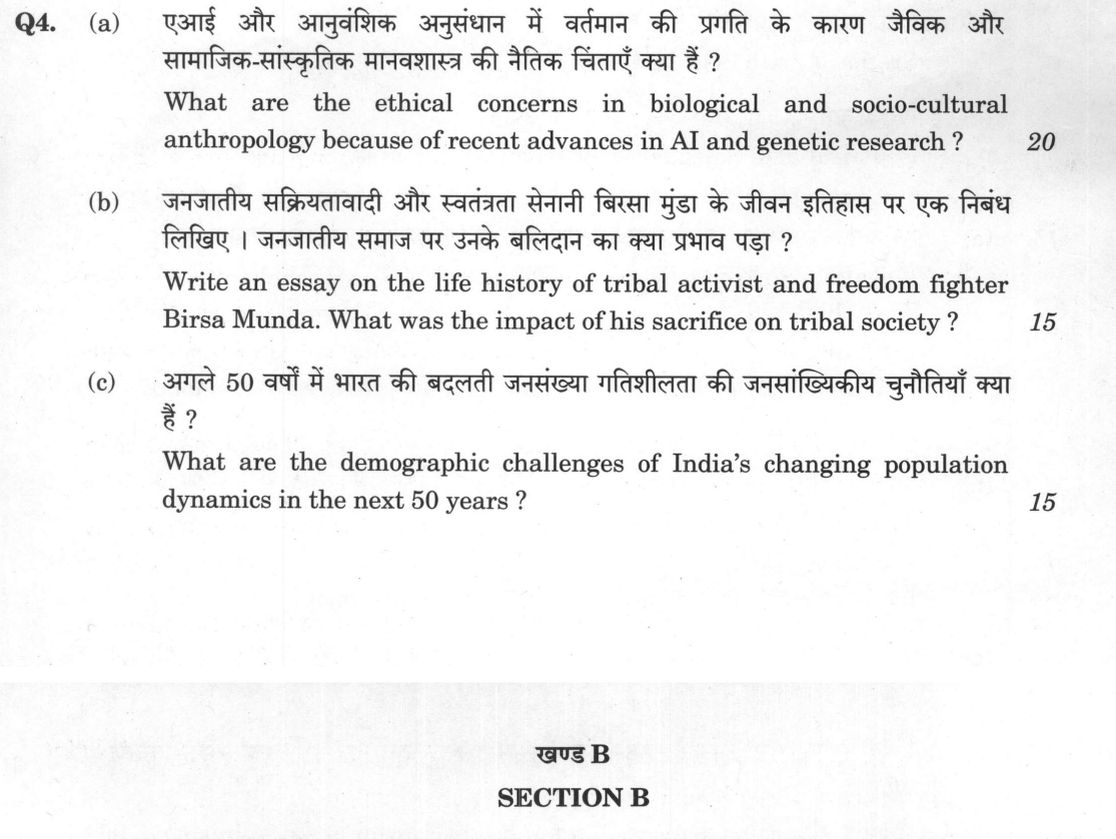
(a) What are the ethical concerns in biological and socio-cultural anthropology because of recent advances in AI and genetic…
What are the ethical concerns in biological and socio-cultural anthropology because of recent advances in AI and genetic research ? 20 marks
Write an essay on the life history of tribal activist and freedom fighter Birsa Munda. What was the impact of his sacrifice on tribal society ? 15 marks
What are the demographic challenges of India's changing population dynamics in the next 50 years ? 15 marks
हिंदी में प्रश्न पढ़ें
एआई और आनुवंशिक अनुसंधान में वर्तमान की प्रगति के कारण जैविक और सामाजिक-सांस्कृतिक मानवशास्त्र की नैतिक चिंताएं क्या हैं ? 20 marks
जनजातीय सक्रियतावादी और स्वतंत्रता सेनानी बिरसा मुंडा के जीवन इतिहास पर एक निबंध लिखिए । जनजातीय समाज पर उनके बलिदान का क्या प्रभाव पड़ा ? 15 marks
अगले 50 वर्षों में भारत की बदलती जनसंख्या गतिशीलता की जनसांख्यिकीय चुनौतियां क्या हैं ? 15 marks
Model answer
Written by UPSC Answer Check against this question's marking rubric, to the expected length. UPSC does not publish answers for Mains — this is one way to score well, not an official key.
Ethical Frontiers, Tribal Legacy, and Demographic Futures
The intersection of advanced technology, indigenous heritage, and population dynamics presents a complex triad of challenges for contemporary anthropology and policy. Addressing these requires a nuanced understanding of ethical boundaries in research, the enduring political significance of tribal resistance, and the structural implications of India’s shifting demographic profile.
Ethical Concerns in AI and Genetic Research Recent advances in Artificial Intelligence and genomics have introduced profound ethical dilemmas in both biological and socio-cultural anthropology. In socio-cultural anthropology, the use of AI for analyzing ethnographic data raises concerns regarding algorithmic bias. If training datasets lack diversity, AI models may reinforce stereotypes or misinterpret cultural nuances, leading to distorted representations of tribal communities. Furthermore, digital ethnography complicates informed consent; recording interactions via smart devices or social media scraping often bypasses traditional consent protocols, raising surveillance concerns where participants are unaware of data collection.
In biological anthropology, genetic research presents issues ranging from CRISPR applications to biobanking. The risk of indigenous DNA exploitation is significant, where samples collected for medical research are later used for commercial purposes without community benefit. This commodification is evident in genetic ancestry testing, which often reduces complex tribal identities to simplified genetic markers, promoting genetic determinism and ignoring cultural continuity. Additionally, AI-driven phenotyping risks reinforcing outdated race concepts by correlating physical traits with genetic data, a practice that has no scientific basis but strong social implications. In India, while the ICMR and DBT guidelines mandate ethical oversight, the rapid pace of technology often outstrips regulatory frameworks, creating dual-use research dilemmas where data could be misused for discriminatory purposes.
Birsa Munda: Life and Legacy Birsa Munda (1875–1900), born in the Chotanagpur plateau, emerged as a pivotal figure in the Munda tribe’s resistance against colonial exploitation. Influenced by the Sardar movement and local religious traditions, he founded the Ulgulan (Great Tremor) in 1899. This was not merely a political revolt but a religious reform movement, with Birsa establishing Birsait to assert spiritual and social autonomy. The movement targeted both the British administration and the zamindars, who imposed oppressive land tenure systems. Birsa led an armed resistance against forced labor (bethi/begari) and land alienation. Despite his arrest and subsequent death in June 1900 at age 24, his impact was transformative.
The impact of his sacrifice on tribal society was multifaceted. Immediately, it forced the British to review some exploitative labor practices. In the long term, Birsa became a symbolic resource for tribal identity politics, providing a template for mobilization that influenced the later Jharkhand movement. His legacy inspired subsequent generations of Adivasi assertion, including Jaipal Singh Munda, who advocated for tribal rights in the Constituent Assembly. While the Fifth and Sixth Schedules were shaped by multiple factors, including Jaipal Singh’s advocacy, Birsa’s martyrdom provided the foundational narrative of resistance that underpinned the demand for autonomous tribal governance.
Demographic Challenges in the Next 50 Years India’s population dynamics are undergoing a critical transition. The declining fertility rate is evident, with TFR below replacement level in southern states (e.g., Kerala, Tamil Nadu) and approaching it in western states like Maharashtra. However, regional demographic divergence persists, with a youth bulge in northern states like Uttar Pradesh and Bihar. This creates a dual challenge: southern states face an aging population, requiring robust elderly care infrastructure and pension systems, while northern states must manage the demographic dividend through skill development to prevent unemployment.
Over the next 50 years, inter-state migration will intensify as younger populations move from high-fertility to low-fertility regions, straining urban infrastructure and social services. Policy challenges include ensuring sustainable development amidst these shifts. India’s population is projected to peak around 2062 (UN WPP 2022), after which it will begin to decline. Preparing for this requires a shift from population control to population management, focusing on health, education, and economic opportunities for the elderly and the youth alike.
Conclusion In conclusion, the ethical stewardship of genetic and AI data, the political mobilization inspired by figures like Birsa Munda, and the strategic management of demographic transitions are interconnected. Anthropology must navigate the ethical complexities of technology while preserving cultural integrity, and policy must address the uneven nature of India’s demographic transition to ensure inclusive growth.
What "Discuss" is asking you to do
Lay the issue out from more than one side — how it arose, what is claimed for it, what is held against it, and where it now stands. UPSC attaches discuss to broad topics with several live dimensions, so coverage of the dimensions earns more than the strength of your opinion.
Structure that answers it
Set the issue up → the case as it is made → the case against → the dimension both sides leave out → where the balance now lies
Where marks are lost
Listing facts with no thread between them, or arguing one side throughout and calling it a discussion.
How this answer will be evaluated
Approach
Framework: UPSC Anthropology Paper II (Socio-Cultural & Biological). (a) discuss: intro > 3-4 dimensions > example > balanced close | (b) write short notes: define > 3-4 key features > one example > one-line significance | (c) challenges: 3-4 challenges > solutions mapped to them > conclusion Full marks: Comprehensive, well-structured, with specific examples and critical analysis.
Key points expected
- Genetic privacy and consent in tribal populations
- AI bias in anthropological data analysis
- Bio-piracy and bioprospecting of tribal knowledge
- Informed consent in digital ethnography
- Life history: birth, education, and rise as a leader
- The Munda Uprising (1899-1900) against British rule
- Impact: Revival of tribal identity and self-respect
- Impact: Long-term inspiration for tribal rights movements
Evaluation rubric
Each sub-part is marked on its own, against the marks and word limit printed on the paper.
- (a) Critical analysis of ethical dilemmas in biological and socio-cultural anthropology arising from AI and genetics. 20 marks
discuss— intro → 3-4 dimensions → example → balanced close
Must cover
- Genetic privacy and consent in tribal populations
- AI bias in anthropological data analysis
- Bio-piracy and bioprospecting of tribal knowledge
- Informed consent in digital ethnography
Loses marks
- General discussion of AI ethics without anthropological context
- Ignoring the specific vulnerability of tribal populations
- Confusing biological and socio-cultural ethical issues
Earns more
- Reference to the Human Genome Project
- Mention of the Nagoya Protocol
- Discussion of the 'Black Box' problem in AI
- Reference to the 2016 UNESCO Recommendation on Bioethics
Extra mark
- Mention of the Human Genome Diversity Project (HGDP)
- Reference to the 2001 UNESCO Declaration on Human Cloning
- (b) Essay on Birsa Munda's life and the specific impact of his sacrifice on tribal society. 15 marks
write short notes— define → 3-4 key features → one example → one-line significance
Must cover
- Life history: birth, education, and rise as a leader
- The Munda Uprising (1899-1900) against British rule
- Impact: Revival of tribal identity and self-respect
- Impact: Long-term inspiration for tribal rights movements
Loses marks
- Treating Birsa Munda as a generic freedom fighter
- Failing to connect his sacrifice to specific tribal outcomes
- Ignoring the socio-cultural context of the Munda tribe
Earns more
- Mention of the 'Dharam Thana' (religious headquarters)
- Reference to the 'Bhagat' (devotee) movement
- Mention of the 'Munda' tribe specifically
- Reference to the 'Munda' language and culture
Extra mark
- Mention of the 'Munda' tribe's specific grievances (land, labor)
- Reference to the 'Munda' tribe's specific cultural practices
- (c) Analysis of demographic challenges facing India's population dynamics over the next 50 years. 15 marks
challenges— 3-4 challenges → solutions mapped to them → conclusion
Must cover
- Aging population and the 'silver tsunami'
- Urbanization and the 'urban-rural divide'
- Gender imbalance and its social consequences
- Migration and the 'brain drain' or 'brain gain'
Loses marks
- Focusing only on population growth, ignoring structure
- Ignoring the regional variations in demographic trends
- Failing to link demographic changes to socio-economic challenges
Earns more
- Reference to the 'demographic dividend' window
- Mention of the 'Total Fertility Rate' (TFR) trends
- Reference to the 'Sex Ratio' (SR) data
- Mention of the 'Urbanization Rate' (UR) projections
Extra mark
- Reference to the 'National Population Policy' (NPP) 2000
- Mention of the 'National Health Mission' (NHM)
Practice this exact question
Write your answer and it is marked point by point against the model answer above — what you covered, what you missed, what you got wrong.
Evaluate my answer →More from Anthropology 2024 Paper II
- Q1 Write short notes on the following in about 150 words each : 10×5=50 (a) Digitisation of…
- Q2 (a) Critically discuss the recent welfare measures initiated by the Government for the Pa…
- Q3 (a) Critically describe evidences from Rakhi Garhi and its linkages to Harappan civilizat…
- Q4 (a) What are the ethical concerns in biological and socio-cultural anthropology because o…
- Q5 Write short notes on the following in about 150 words each : 10×5=50 (a) B.K. Roy Burman'…
- Q6 (a) Custodians of natural resources are the tribals, but they are the most deprived. Crit…
- Q7 (a) Critically examine existing paradigms of holistic health for the marginalised section…