Paper II — Q5
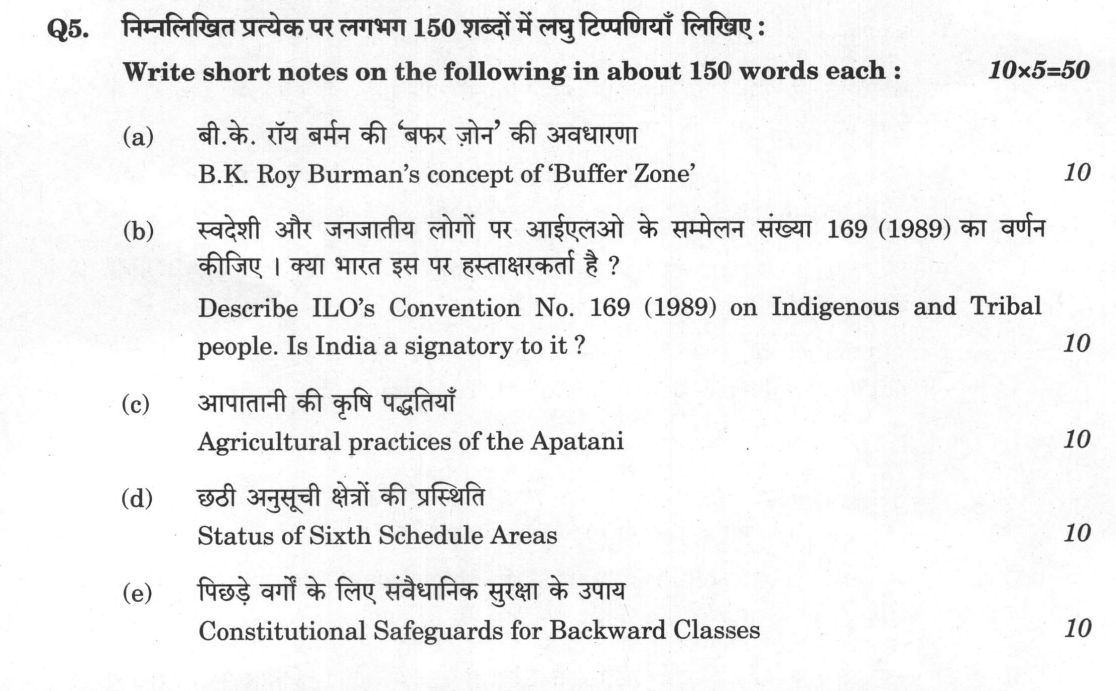
Write short notes on the following in about 150 words each : 10×5=50 (a) B.K. Roy Burman's concept of 'Buffer Zone' 10 (b)…
Write short notes on the following in about 150 words each : 10×5=50
B.K. Roy Burman's concept of 'Buffer Zone' 10
Describe ILO's Convention No. 169 (1989) on Indigenous and Tribal people. Is India a signatory to it ? 10 marks
Agricultural practices of the Apatani 10
Status of Sixth Schedule Areas 10
Constitutional Safeguards for Backward Classes 10
हिंदी में प्रश्न पढ़ें
निम्नलिखित प्रत्येक पर लगभग 150 शब्दों में लघु टिप्पणियाँ लिखिए : 10×5=50
बी.के. रॉय बर्मन की 'बफर जोन' की अवधारणा 10
स्वदेशी और जनजातीय लोगों पर आईएलओ के सम्मेलन संख्या 169 (1989) का वर्णन कीजिए । क्या भारत इस पर हस्ताक्षरकर्ता है ? 10 marks
आपातानी की कृषि पद्धतियाँ 10
छठी अनुसूची क्षेत्रों की प्रस्थिति 10
पिछड़े वर्गों के लिए संवैधानिक सुरक्षा के उपाय 10
Model answer
Written by UPSC Answer Check against this question's marking rubric, to the 150-word length. UPSC does not publish answers for Mains — this is one way to score well, not an official key.
1. B.K. Roy Burman’s Concept of ‘Buffer Zone’
B.K. Roy Burman’s concept of the ‘Buffer Zone’ posits an intermediate geographical and socio-cultural space between the core tribal areas and the non-tribal plains. This zone serves as a transitional area where tribal communities interact with mainstream society, acting as a shield against rapid cultural erosion while facilitating economic integration. The concept is crucial for tribal development policy, suggesting that development strategies must account for this liminal space to prevent forced assimilation. It highlights the need for policies that respect tribal autonomy in these peripheral areas, ensuring that integration is gradual and consensual rather than coercive. By recognizing the buffer zone, planners can design targeted interventions that preserve cultural identity while providing access to modern amenities, thereby balancing preservation with progress in tribal administration.
2. ILO Convention No. 169 (1989) and India’s Status
ILO Convention No. 169 (1989) is the first international treaty specifically addressing the rights of indigenous and tribal peoples. Key provisions include the right to self-identification, protection of land and natural resources, and the right to free, prior, and informed consultation on matters affecting them. It emphasizes participation in decision-making processes and prohibits forced relocation. India is not a signatory to this convention. The government’s refusal is based on the argument that the Indian Constitution already provides robust safeguards for Scheduled Tribes and Other Backward Classes, rendering the convention redundant. Additionally, India cites sovereignty concerns, arguing that international treaties cannot override domestic constitutional provisions regarding land rights and administrative control. Critics, however, argue that the convention’s emphasis on consent and self-determination offers stronger protections than existing Indian laws, which often prioritize state development projects over tribal rights.
3. Agricultural Practices of the Apatani
The Apatani people of the Ziro Valley in Arunachal Pradesh practice unique, sustainable agricultural methods distinct from the shifting cultivation (jhum) common in the region. Their primary system is wet rice cultivation integrated with fish farming, known as paddy-cum-fish cultivation. This polyculture system maximizes land use and provides both food security and protein sources. A distinctive feature is their bamboo drip irrigation system, which channels water from higher elevations to terraced fields, ensuring efficient water management in a hilly terrain. Unlike jhum, Apatani agriculture is permanent and settled, reflecting a sedentary lifestyle. This ecosystem management approach has been recognized for its sustainability, as it maintains soil fertility and biodiversity. The Apatani model serves as a case study for sustainable agriculture in tribal regions, demonstrating how traditional knowledge can support long-term ecological balance and food security without depleting natural resources.
4. Status of Sixth Schedule Areas
The Sixth Schedule of the Indian Constitution provides special administrative and legislative autonomy to tribal areas in Assam, Meghalaya, Tripura, and Mizoram. It establishes Autonomous District Councils (ADCs) and Autonomous State Councils, which possess legislative, judicial, and developmental powers over land, forest, and local governance. These councils manage local resources and enact laws for the welfare of the tribal population. The 125th Constitutional Amendment Bill (2019) proposed extending the Panchayati Raj system to these areas by establishing elected Village Councils and Municipal Councils, aiming to integrate them into the broader local governance framework. However, the bill faced opposition from tribal groups who feared the dilution of their autonomous rights. Currently, the implementation of the Sixth Schedule remains a contentious issue, with debates over the balance between tribal autonomy and national integration. The status of these areas is thus characterized by a complex interplay of constitutional safeguards, political negotiations, and ongoing legal challenges regarding the extent of their self-governance.
5. Constitutional Safeguards for Backward Classes
Constitutional safeguards for Backward Classes, primarily Other Backward Classes (OBCs), are distinct from those for Scheduled Castes and Scheduled Tribes. The 102nd Constitutional Amendment Act, 2018, established the National Commission for Backward Classes (NCBC) as a constitutional body under Article 338A, enhancing its status from a statutory to a constitutional commission. Article 342A empowers the President to specify which castes or sections of castes are deemed OBCs, allowing for the inclusion or exclusion of groups based on social and educational backwardness. A key feature of OBC safeguards is the exclusion of the 'creamy layer,' ensuring that benefits reach only the genuinely disadvantaged. Unlike SC/ST reservations, which are based on historical caste-based discrimination, OBC reservations focus on social and economic backwardness. The dynamics between state and central lists of OBCs remain a point of contention, with states often maintaining their own lists that differ from the central list. This dual structure allows for regional variations in identification and benefits, reflecting the diverse social landscapes across Indian states.
What "Write short notes" is asking you to do
Five or six self-contained answers, marked separately, typically 10 marks and about 150 words each. Each note must carry its own definition, its two or three defining features and a line on why it matters; a common introduction or conclusion across the notes earns nothing.
Structure that answers it
Per note: one-line definition or identification → two or three features, mechanisms or named examples → one line of significance or Indian application
Where marks are lost
Writing the first two notes at essay length and rationing the rest. Each note is marked on its own, so marks surrendered on a compressed or unattempted note cannot be won back by the long ones.
How this answer will be evaluated
Approach
Framework: UPSC Anthropology Paper II (Sociology & Social Anthropology). (a) write short notes: define > 3-4 key features > one example > one-line significance | (b) describe: define > structure or process in order > labelled diagram > significance | (c) write short notes: define > 3-4 key features > one example > one-line significance | (d) write short notes: define > 3-4 key features > one example > one-line significance | (e) write short notes: define > 3-4 key features > one example > one-line significance Full marks: Precise, specific, and directly addresses the command word with relevant examples.
Key points expected
- Define 'Buffer Zone' as a transitional area
- Link to B.K. Roy Burman's tribal studies
- Explain the interface between tribal and non-tribal
- Mention the impact on tribal identity
- Identify ILO Convention No. 169 (1989)
- Mention key rights (land, self-determination)
- State clearly that India is NOT a signatory
- Provide one reason for non-ratification
Evaluation rubric
Each sub-part is marked on its own, against the marks and word limit printed on the paper.
- (a) Define the concept and its application to tribal geography. 10 marks · 150 words
write short notes— define → 3-4 key features → one example → one-line significance
Must cover
- Define 'Buffer Zone' as a transitional area
- Link to B.K. Roy Burman's tribal studies
- Explain the interface between tribal and non-tribal
- Mention the impact on tribal identity
Loses marks
- Treating it as a purely military term
- Ignoring the socio-cultural dimension
Earns more
- Reference to specific tribal regions (e.g., Northeast)
- Discussion of cultural erosion vs. adaptation
Extra mark
- Reference to specific geographical examples
- (b) Outline the convention's key provisions and India's status. 10 marks · 150 words
describe— define → structure or process in order → labelled diagram → significance
Must cover
- Identify ILO Convention No. 169 (1989)
- Mention key rights (land, self-determination)
- State clearly that India is NOT a signatory
- Provide one reason for non-ratification
Loses marks
- Incorrectly stating India has signed it
- Failing to mention the year 1989
Earns more
- Comparison with ILO Convention No. 107
- Mention of the 'free, prior and informed consent' principle
Extra mark
- Reference to specific Indian legal alternatives (e.g., PESA Act)
- (c) Detail the specific farming methods of the Apatani people. 10 marks · 150 words
write short notes— define → 3-4 key features → one example → one-line significance
Must cover
- Identify Apatani as a tribe of Arunachal Pradesh
- Describe the 'Apatani system' of terraced agriculture
- Mention the integration of agriculture and forestry
- Note the role of the 'Apatani Council' in resource management
Loses marks
- Confusing with other Arunachal tribes (e.g., Monpa)
- Failing to mention the communal aspect
Earns more
- Mention of specific crops (e.g., rice, vegetables)
- Reference to the 'Apatani' as a model of sustainable development
Extra mark
- Mention of the 'Apatani' as a 'living fossil' of Neolithic culture
- (d) Explain the constitutional status and administration of these areas. 10 marks · 150 words
write short notes— define → 3-4 key features → one example → one-line significance
Must cover
- Identify the states (Assam, Meghalaya, Tripura, Mizoram)
- Mention the Autonomous District Councils (ADCs)
- Explain the legislative and executive powers of ADCs
- Note the role of the Governor in these areas
Loses marks
- Confusing with the Fifth Schedule
- Failing to mention the specific states
Earns more
- Mention of the 'Sixth Schedule' in the Constitution
- Reference to the 'Tribal Areas' vs 'Scheduled Areas' distinction
Extra mark
- Mention of specific ADCs (e.g., Dima Hasao, Garo Hills)
- (e) List the constitutional provisions for the protection of BCs. 10 marks · 150 words
write short notes— define → 3-4 key features → one example → one-line significance
Must cover
- Mention Article 16(4) for reservation in employment
- Mention Article 335 for maintaining efficiency of administration
- Mention the role of the National Commission for BCs (Article 338A)
- Note the 'creamy layer' exclusion
Loses marks
- Confusing with SC/ST safeguards
- Failing to mention the 'creamy layer'
Earns more
- Mention of the Mandal Commission (1993)
- Reference to the 'social and educational backwardness' criteria
Extra mark
- Mention of the 'EWS' (Economically Weaker Sections) category
Practice this exact question
Write your answer and it is marked point by point against the model answer above — what you covered, what you missed, what you got wrong.
Evaluate my answer →More from Anthropology 2024 Paper II
- Q2 (a) Critically discuss the recent welfare measures initiated by the Government for the Pa…
- Q3 (a) Critically describe evidences from Rakhi Garhi and its linkages to Harappan civilizat…
- Q4 (a) What are the ethical concerns in biological and socio-cultural anthropology because o…
- Q5 Write short notes on the following in about 150 words each : 10×5=50 (a) B.K. Roy Burman'…
- Q6 (a) Custodians of natural resources are the tribals, but they are the most deprived. Crit…
- Q7 (a) Critically examine existing paradigms of holistic health for the marginalised section…
- Q8 (a) Describe the important Paleolithic sites from South India with suitable examples. Wha…