Paper II — Q7
(a) Critically examine existing paradigms of holistic health for the marginalised sections of society drawing inferences from…
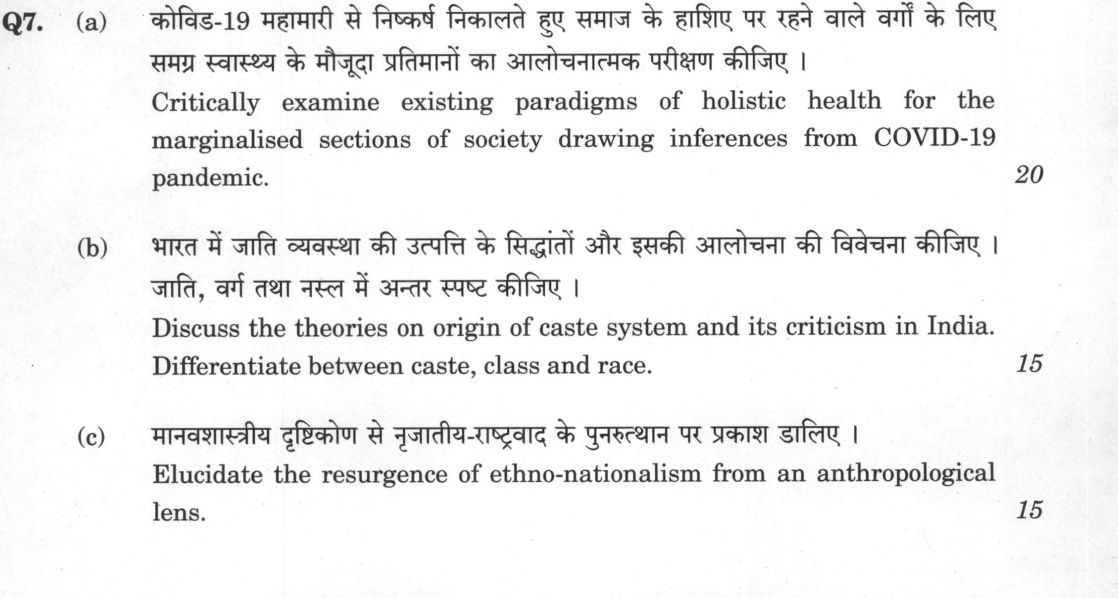
Critically examine existing paradigms of holistic health for the marginalised sections of society drawing inferences from COVID-19 pandemic. 20 marks
Discuss the theories on origin of caste system and its criticism in India. Differentiate between caste, class and race. 15 marks
Elucidate the resurgence of ethno-nationalism from an anthropological lens. 15 marks
हिंदी में प्रश्न पढ़ें
कोविड-19 महामारी से निष्कर्ष निकालते हुए समाज के हाशिए पर रहने वाले वर्गों के लिए समग्र स्वास्थ्य के मौजूदा प्रतिमानों का आलोचनात्मक परीक्षण कीजिए । 20
भारत में जाति व्यवस्था की उत्पत्ति के सिद्धांतों और इसकी आलोचना की विवेचना कीजिए । जाति, वर्ग तथा नस्ल में अंतर स्पष्ट कीजिए । 15
मानवशास्त्रीय दृष्टिकोण से नृजातीय-राष्ट्रवाद के पुनरुत्थान पर प्रकाश डालिए । 15
Model answer
Written by UPSC Answer Check against this question's marking rubric, to the expected length. UPSC does not publish answers for Mains — this is one way to score well, not an official key.
Holistic Health, Caste Origins, and Ethno-Nationalism
Health, social stratification, and identity politics are inextricably linked in the Indian context, where biological vulnerability is often compounded by structural exclusion.
(a) Critically Examining Holistic Health Paradigms
The prevailing biomedical paradigm, which treats the body as a mechanical system, has long failed marginalised sections by ignoring the social determinants of health. A critical examination reveals that for Adivasis, Dalits, and the urban poor, health is not merely a biological state but a product of structural inequality. The "One Health" approach, which integrates human, animal, and environmental health, offers a more holistic framework, yet its implementation often remains top-down, neglecting indigenous knowledge systems.
The COVID-19 pandemic starkly exposed these paradigmatic failures. The reverse migration of over 10 million workers highlighted how the lack of social security rendered the "healthy" body a luxury for the marginalised. While the government deployed the CoWIN portal for vaccination registration, the digital divide meant that many in informal sectors were excluded from this digital health infrastructure, forcing reliance on physical camps that often lacked basic amenities. This exposed the gap between digital health policy and ground reality. Conversely, the role of ASHA workers demonstrated the efficacy of community-led, holistic responses. Their integration of traditional practices with modern medicine helped bridge trust deficits, particularly in areas with vaccine hesitancy. However, the pandemic also revealed the fragility of the public health system for the marginalised, who lacked access to isolation facilities and nutrition support. Thus, while the crisis forced a re-evaluation of health equity, the response remained largely reactive rather than transformative, failing to address the root causes of health disparities such as caste-based discrimination in healthcare delivery.
(b) Theories on Caste Origin and Differentiation
The origin of the caste system in India is debated among anthropologists. H.H. Risley’s racial theory posited that caste originated from racial intermarriage, a view largely discredited by modern genetics. R.D. Nesfield’s occupational theory suggested that caste evolved from guilds, ignoring the ritual dimension. D.N. Majumdar, a functionalist, defined caste as a "closed class," emphasizing endogamy and social closure rather than racial or occupational roots.
The most influential critique comes from Louis Dumont, who argued that caste is a hierarchical system based on ritual purity and impurity, where secular power is subordinated to ritual status. This contrasts with Marxist scholars like Gail Omvedt, who view caste as a mode of production and exploitation, emphasizing economic control over land and labor. B.R. Ambedkar’s perspective further critiques caste as a system of graded inequality and untouchability, rather than mere social segregation.
Differentiating caste, class, and race is crucial. Caste is ascriptive, determined by birth, and governed by ritual hierarchy and endogamy. Class is achieved, based on economic position and mobility, though in India, caste often intersects with class. Race is a phenotypical and colonial construction, historically used to justify hierarchy based on physical features, whereas caste is a socio-religious construct. While race was a tool of colonial administration, caste is an indigenous, albeit colonial-amplified, social structure.
(c) Resurgence of Ethno-Nationalism
Ethno-nationalism, the assertion of a distinct ethnic identity as the basis for political mobilization, has resurged globally. Anthropologically, this can be analyzed through three lenses: Primordialism (Geertz), which views ethnic ties as innate and ancient; Instrumentalism (Gellner), which sees ethnicity as a tool for political mobilization; and Constructivism (Anderson), which emphasizes the "imagined community" created through media and print.
In India, the resurgence is evident in the Northeast, where groups like the Naga and Mizo have mobilized for territorial autonomy, often citing the Sixth Schedule. However, the Meitei mobilization in Manipur is distinct; it is not a Sixth Schedule issue but a demand for Scheduled Tribe status and protection of territorial integrity against perceived encroachment by non-tribals. Similarly, in Kashmir, ethno-nationalism intersects with religious and political identity, challenging the state’s secular framework. Globally, while Brexit is often cited, it is better understood as national populism rather than ethno-nationalism, as it lacked a strong ethnic component. In contrast, movements in Europe based on linguistic or ethnic distinctiveness align more closely with the Indian context.
The role of the census, language politics, and territorial claims is pivotal. The demand for separate lists of Scheduled Tribes and the politicization of language (e.g., in Assam and Manipur) fuel ethno-nationalist sentiments. This resurgence reflects a crisis of identity in a globalized world, where local communities seek to assert distinctiveness against homogenizing forces.
Conclusion
The interplay between health marginalization, caste stratification, and ethno-nationalism reveals a society where identity is both a source of vulnerability and a tool for political agency. A holistic approach to health must address caste and class inequalities, while understanding caste requires moving beyond racial theories to recognize its ritual and economic dimensions. Finally, the resurgence of ethno-nationalism demands a nuanced understanding of identity construction, balancing the need for cultural recognition with the imperative of social cohesion.
What "Critically examine" is asking you to do
Test the proposition the question puts to you and return a finding on how far it holds. Examine stems carry a claim, or ask whether something has happened, and expect evidence weighed both ways before the extent is stated — often with remedial measures attached. “Critically” is not a section added at the end: name the yardstick you are judging by — the evidence, the stated objective, a constitutional principle, a rival explanation — and let a verdict close each part of the body. Where the question quotes a claim, that verdict must land on the claim itself, accepted, qualified or rejected, and not on the theme in general.
Structure that answers it
Restate the claim as the question frames it → evidence that supports it → evidence that undercuts it → the conditions under which it holds → verdict on how far it stands
Where marks are lost
Merits in one paragraph, demerits in the next, and a conclusion calling for a balanced and holistic approach. That is a survey with the judgement left out and it holds the answer in the middle band. The opposite error is reading “critically” as permission to attack — and with the odd pairings, critically describe or critically explain, the exposition still carries most of the marks, the judgement being a layer on it rather than a substitute for it.
How this answer will be evaluated
Approach
(a) examine: intro > how/why with reasoning > evidence > conclusion | (b) discuss: intro > 3-4 dimensions > example > balanced close | (c) explain: definition/context > points in order > small example > short close Full marks: Comprehensive, critical, and well-supported with specific anthropological theories, ethnographic evidence, and Indian context.
Key points expected
- Define holistic health paradigms (biomedical vs. social)
- Identify specific marginalized sections (tribal, urban poor)
- Analyze pandemic impact on these specific groups
- Critique existing paradigms' failure to address social determinants
- Present 2-3 origin theories (e.g., Aryan, Occupational)
- Provide anthropological criticism of these theories
- Differentiate caste from class (endogamy vs. mobility)
- Differentiate caste from race (social vs. biological)
Evaluation rubric
Each sub-part is marked on its own, against the marks and word limit printed on the paper.
- (a) Critical analysis of holistic health paradigms for marginalized groups using COVID-19 as a case study. 20 marks
examine— intro → how/why with reasoning → evidence → conclusion
Must cover
- Define holistic health paradigms (biomedical vs. social)
- Identify specific marginalized sections (tribal, urban poor)
- Analyze pandemic impact on these specific groups
- Critique existing paradigms' failure to address social determinants
Loses marks
- Generic discussion of health without marginalization focus
- Ignoring the 'critical' aspect of the command word
- Sociological answers without anthropological lens
Earns more
- Reference to specific tribal health data during pandemic
- Mention of specific health policy failures
- Linkage to social determinants of health
- Use of specific anthropological concepts (e.g., structural violence)
Extra mark
- Citation of specific tribal health statistics
- Reference to specific government health schemes
- (b) Discussion of caste origin theories, their criticism, and differentiation from class and race. 15 marks
discuss— intro → 3-4 dimensions → example → balanced close
Must cover
- Present 2-3 origin theories (e.g., Aryan, Occupational)
- Provide anthropological criticism of these theories
- Differentiate caste from class (endogamy vs. mobility)
- Differentiate caste from race (social vs. biological)
Loses marks
- Confusing caste with class or race
- Presenting only one origin theory without criticism
- Ignoring the 'criticism' part of the question
Earns more
- Mention of specific scholars (e.g., Dumont, Srinivas)
- Reference to specific ethnographic examples
- Discussion of 'Sanskritization' or 'Dominant Caste'
- Clear distinction between biological and social markers
Extra mark
- Reference to specific tribal caste dynamics
- Mention of specific legal provisions (e.g., SC/ST Act)
- (c) Explanation of ethno-nationalism resurgence through an anthropological perspective. 15 marks
explain— definition/context → points in order → small example → short close
Must cover
- Define ethno-nationalism in anthropological terms
- Explain the 'resurgence' (why now, how it manifests)
- Apply anthropological lens (e.g., identity, boundary-making)
- Provide specific examples of ethno-nationalist movements
Loses marks
- Political commentary without anthropological analysis
- Ignoring the 'resurgence' aspect (focusing only on definition)
- Lack of specific examples or case studies
Earns more
- Reference to specific theorists (e.g., Anderson, Gellner)
- Discussion of 'imagined communities' or 'primordialism'
- Analysis of specific regional or tribal movements
- Linkage to globalization or modernization
Extra mark
- Citation of specific recent ethno-nationalist events
- Reference to specific anthropological fieldwork
Practice this exact question
Write your answer and it is marked point by point against the model answer above — what you covered, what you missed, what you got wrong.
Evaluate my answer →More from Anthropology 2024 Paper II
- Q4 (a) What are the ethical concerns in biological and socio-cultural anthropology because o…
- Q5 Write short notes on the following in about 150 words each : 10×5=50 (a) B.K. Roy Burman'…
- Q6 (a) Custodians of natural resources are the tribals, but they are the most deprived. Crit…
- Q7 (a) Critically examine existing paradigms of holistic health for the marginalised section…
- Q8 (a) Describe the important Paleolithic sites from South India with suitable examples. Wha…