Paper II — Q6
(a) Custodians of natural resources are the tribals, but they are the most deprived. Critically examine how climate change will…
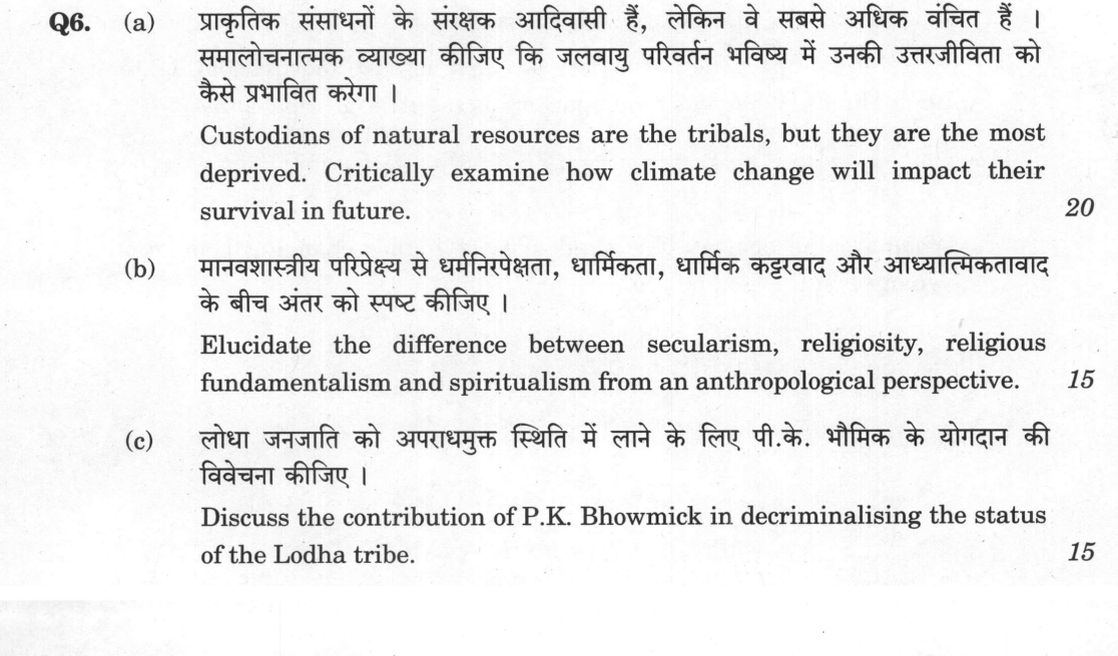
Custodians of natural resources are the tribals, but they are the most deprived. Critically examine how climate change will impact their survival in future. 20 marks
Elucidate the difference between secularism, religiosity, religious fundamentalism and spiritualism from an anthropological perspective. 15 marks
Discuss the contribution of P.K. Bhowmick in decriminalising the status of the Lodha tribe. 15 marks
हिंदी में प्रश्न पढ़ें
प्राकृतिक संसाधनों के संरक्षक आदिवासी हैं, लेकिन वे सबसे अधिक वंचित हैं । समालोचनात्मक व्याख्या कीजिए कि जलवायु परिवर्तन भविष्य में उनकी उत्तरजीविता को कैसे प्रभावित करेगा । 20
मानवशास्त्रीय परिप्रेक्ष्य से धर्मनिरपेक्षता, धार्मिकता, धार्मिक कट्टरवाद और आध्यात्मिकतावाद के बीच अंतर को स्पष्ट कीजिए । 15
लोधा जनजाति को अपराधमुक्त स्थिति में लाने के लिए पी.के. भौमिक के योगदान की विवेचना कीजिए । 15
Model answer
Written by UPSC Answer Check against this question's marking rubric, to the expected length. UPSC does not publish answers for Mains — this is one way to score well, not an official key.
Anthropology examines ecological adaptation, belief systems, and socio-legal marginalization through an integrated lens of empirical field research and applied advocacy.
Climate Change and Tribal Vulnerability
Indian scheduled tribes have historically functioned as ecological custodians, managing natural habitats through customary conservation norms, sacred groves, and sustainable rotational practices. However, accelerating climate change threatens to transform them into ecological refugees. Unpredictable precipitation, forest degradation, and temperature extremes directly disrupt shifting cultivation (jhum) and rainfed agriculture, while depleting non-timber forest products (NTFP) vital for groups like the Baiga, Chenchu, and Birhor. These disruptions induce acute water scarcity, localized crop failures, loss of herbal pharmacopeia, and involuntary distress migration.
Critical Evaluation: The prevailing discourse that romanticizes tribals as innate "ecological custodians" often obscures the structural deprivation that renders them vulnerable in the first place. Tribals have contributed least to anthropogenic carbon emissions, yet they bear the highest vulnerability due to historical land alienation, tenuous forest rights under the Forest Rights Act (FRA) 2006, and restricted access to capital. While indigenous knowledge systems facilitate localized adaptation (such as Apatani agro-water management), self-adaptation is severely constrained by socio-economic marginalization. Without institutionalized land tenure, climate finance, and state-backed livelihood diversification, tribal communities face systemic socio-ecological collapse rather than autonomous adaptation.
Anthropological Distinctions: Secularism, Religiosity, Fundamentalism, and Spiritualism
Anthropology analyzes religion not through theological validity, but as culturally constructed, historically situated phenomena investigated through emic (insider meaning) and etic (cross-cultural analytical) perspectives.
Religiosity refers to the lived intensity of religious belief and ritual practice within a cultural matrix, fostering group cohesion and shared symbolic universes, as highlighted by Clifford Geertz and Émile Durkheim.
Religious Fundamentalism is a distinctively modern, reactionary socio-political phenomenon. It relies on selective textual literalism, rigid boundary-maintenance, and the politicization of sacred doctrine to resist modernity, pluralism, and secularization.
Spiritualism (or contemporary spirituality) denotes individualized, experiential quests for meaning, transcendence, and cosmic connection, largely emancipated from organized ecclesiastical authority, dogmatic orthodoxy, or institutional rituals.
Secularism, traditionally viewed etically as the political neutrality or separation of religion from the state, is critically reconsidered in anthropology. As Talal Asad argues, secularism is not merely the natural absence of religion, but a modernist, state-enforced ideological construct that actively categorizes, regulates, and redefines what constitutes "legitimate" private belief versus prohibited public intervention.
P.K. Bhowmick and the Decriminalisation of the Lodhas
The Lodhas of Midnapore (West Bengal) were historically stigmatized and notified as a "hereditary criminal tribe" under the colonial Criminal Tribes Act (CTA) of 1871. Following its repeal in 1952, they were categorized as Denotified Tribes (DNTs), yet severe societal ostracism, police surveillance, and lynching persisted.
Anthropologist P.K. Bhowmick dismantled this colonial construct through extensive empirical ethnography. He demonstrated that Lodha criminality was not a cultural or biological predisposition, but a direct socio-economic consequence of territorial dispossession. British forest acts had stripped them of their traditional forest-dwelling economy without providing alternative subsistence, forcing them into opportunistic crime for survival.
Bhowmick translated this insight into "Action Anthropology," establishing the Bidisa project in Midnapore. His model combined rigorous ethnographic research with applied rehabilitation, offering formal education, vocational training, grain banks, and land reclamation. Bhowmick’s empirical evidence disproved the criminal stereotype, informed state rehabilitation policies, facilitated their recognition as a Particularly Vulnerable Tribal Group (PVTG), and established a benchmark for activist anthropology in emancipating India's denotified communities.
Anthropology demonstrates that whether confronting ecological vulnerability, ideological classification, or socio-legal stigmatization, the discipline must move beyond passive documentation toward structurally securing the rights, identities, and survival of marginalized populations.
What "Critically examine" is asking you to do
Test the proposition the question puts to you and return a finding on how far it holds. Examine stems carry a claim, or ask whether something has happened, and expect evidence weighed both ways before the extent is stated — often with remedial measures attached. “Critically” is not a section added at the end: name the yardstick you are judging by — the evidence, the stated objective, a constitutional principle, a rival explanation — and let a verdict close each part of the body. Where the question quotes a claim, that verdict must land on the claim itself, accepted, qualified or rejected, and not on the theme in general.
Structure that answers it
Restate the claim as the question frames it → evidence that supports it → evidence that undercuts it → the conditions under which it holds → verdict on how far it stands
Where marks are lost
Merits in one paragraph, demerits in the next, and a conclusion calling for a balanced and holistic approach. That is a survey with the judgement left out and it holds the answer in the middle band. The opposite error is reading “critically” as permission to attack — and with the odd pairings, critically describe or critically explain, the exposition still carries most of the marks, the judgement being a layer on it rather than a substitute for it.
How this answer will be evaluated
Approach
Framework: UPSC Anthropology Paper II (Sociology & Anthropology of India). (a) examine: intro > how/why with reasoning > evidence > conclusion | (b) compare: paired headings or table > key differences > significance > conclusion | (c) discuss: intro > 3-4 dimensions > example > balanced close Full marks: Comprehensive, well-structured, with specific examples and critical analysis.
Key points expected
- Link tribal resource dependence to climate vulnerability
- Identify specific impacts on food, water, and health
- Discuss socio-economic consequences of climate stress
- Provide specific Indian tribal examples
- Define each of the four terms clearly
- Highlight key differences between the concepts
- Use anthropological theories or examples
- Maintain an anthropological perspective throughout
Evaluation rubric
Each sub-part is marked on its own, against the marks and word limit printed on the paper.
- (a) Critical analysis of climate change impacts on tribal survival. 20 marks
examine— intro → how/why with reasoning → evidence → conclusion
Must cover
- Link tribal resource dependence to climate vulnerability
- Identify specific impacts on food, water, and health
- Discuss socio-economic consequences of climate stress
- Provide specific Indian tribal examples
Loses marks
- Generic climate change discussion without tribal focus
- Ignoring the 'custodian' aspect of tribal relationship with nature
- Lack of critical analysis, only descriptive
Earns more
- Reference to specific climate data or reports
- Mention of specific tribal adaptation strategies
- Discussion of policy gaps in climate action
- Comparison of different tribal groups' vulnerabilities
Extra mark
- Reference to specific government climate policy
- Mention of specific tribal leader or organization
- (b) Differentiate four concepts from an anthropological perspective. 15 marks
compare— paired headings or table → key differences → significance → conclusion
Must cover
- Define each of the four terms clearly
- Highlight key differences between the concepts
- Use anthropological theories or examples
- Maintain an anthropological perspective throughout
Loses marks
- Confusing the definitions of the terms
- Lack of anthropological perspective, only sociological
- Failing to clearly differentiate the concepts
Earns more
- Use of specific anthropological scholars or works
- Examples from Indian tribal or religious contexts
- Discussion of how these concepts interact or overlap
- Reference to specific anthropological studies
Extra mark
- Reference to specific anthropological fieldwork
- Mention of specific tribal or religious group
- (c) Analyze P.K. Bhowmick's role in decriminalizing the Lodha tribe. 15 marks
discuss— intro → 3-4 dimensions → example → balanced close
Must cover
- Identify P.K. Bhowmick and his work
- Explain the 'criminalized' status of the Lodha tribe
- Detail Bhowmick's specific contributions to decriminalization
- Assess the impact of his work
Loses marks
- Vague or general discussion of tribal issues
- Failing to specifically address P.K. Bhowmick's contributions
- Lack of understanding of the 'decriminalization' process
Earns more
- Reference to specific ethnographic studies by Bhowmick
- Discussion of the social and economic factors leading to criminalization
- Mention of specific policies or legal changes influenced by his work
- Comparison with other tribal decriminalization efforts
Extra mark
- Reference to specific government policy or report
- Mention of specific tribal leader or organization
Practice this exact question
Write your answer and it is marked point by point against the model answer above — what you covered, what you missed, what you got wrong.
Evaluate my answer →More from Anthropology 2024 Paper II
- Q3 (a) Critically describe evidences from Rakhi Garhi and its linkages to Harappan civilizat…
- Q4 (a) What are the ethical concerns in biological and socio-cultural anthropology because o…
- Q5 Write short notes on the following in about 150 words each : 10×5=50 (a) B.K. Roy Burman'…
- Q6 (a) Custodians of natural resources are the tribals, but they are the most deprived. Crit…
- Q7 (a) Critically examine existing paradigms of holistic health for the marginalised section…
- Q8 (a) Describe the important Paleolithic sites from South India with suitable examples. Wha…